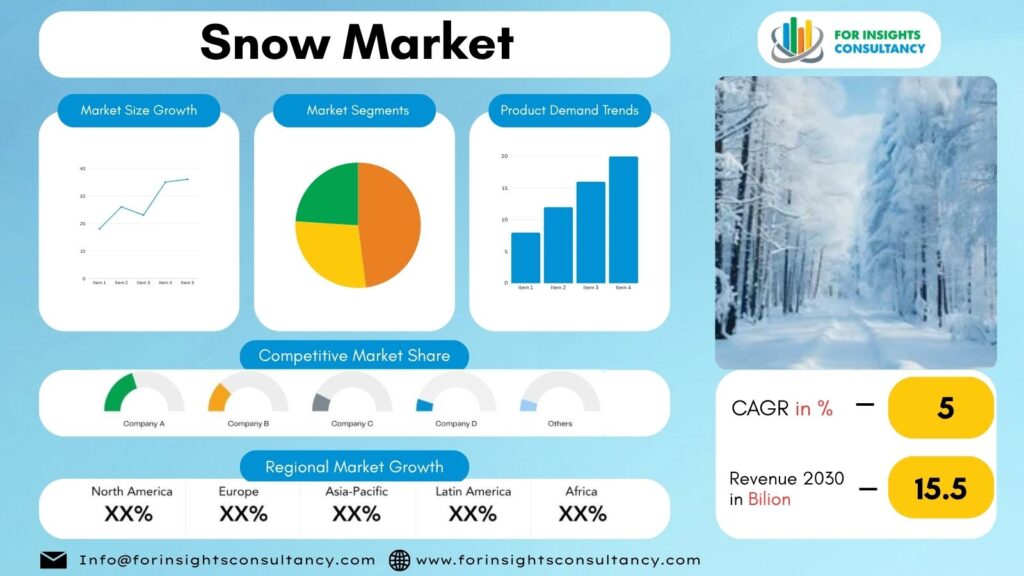
Snow Market Size, Share & Forecast
Market Size (2026): USD 10.5 billion
Forecast (2034): USD 15.5 billion
CAGR (2026–2034): 5.0%
Base Year: 2025 (about USD 10.0 billion)
Leading Region (2026): Europe
Core Trends: Shift to smart, GPS-enabled, electric and autonomous snow clearing equipment, driven by emission rules and municipal fleet modernization.
Snow Market Definition
The global Snow Market encompasses the production, distribution, and commercialization of snow-related products, equipment, technologies, services, and solutions used across winter tourism, recreational activities, transportation infrastructure, municipal operations, and commercial applications.
Snow Market Overview 2026
The global Snow Market is evolving through increasing investments in winter tourism, snow-based recreational activities, artificial snow production, and advanced snow management infrastructure. Snow-related equipment and technologies play an important role in maintaining ski resorts, winter sports facilities, transportation networks, and urban infrastructure.
The growing impact of climate change and unpredictable snowfall patterns has increased the importance of artificial snowmaking technologies. Ski resorts and winter tourism operators are investing in advanced snow guns, snow cannons, automated snowmaking systems, and water-efficient technologies to maintain consistent snow coverage and extend operating seasons.
At the same time, regions experiencing heavy snowfall are increasing investments in snow removal equipment, including snow plows, snow blowers, and specialized snow-clearing machinery. Municipal authorities, airport operators, highway maintenance agencies, and commercial property managers are adopting advanced equipment to improve winter maintenance efficiency.
Technological advancements, including electric-powered equipment, GPS-enabled fleet management, IoT-based monitoring, and autonomous snow-clearing solutions, are transforming the Snow Market.
Furthermore, increasing investments in winter sports infrastructure across Europe, North America, and Asia Pacific are creating opportunities for manufacturers of snowmaking equipment, snow removal machinery, and integrated snow management solutions.
Technology Trends 2026
Automated Snowmaking Technologies
Increasing adoption of automated snow guns, weather monitoring systems, and centralized snowmaking controls is improving artificial snow production efficiency.
Electric and Battery-Powered Snow Removal Equipment
Manufacturers are introducing electric snow blowers, battery-powered snow-clearing equipment, and low-emission machinery to reduce operating costs and environmental impact.
GPS and Telematics-Based Snow Management
GPS-enabled equipment tracking, fleet management platforms, and real-time monitoring technologies are helping municipalities and service providers optimize snow removal operations.
Autonomous and Robotic Snow-Clearing Solutions
Autonomous snow removal equipment and robotic clearing systems are gaining attention as operators seek to address labor shortages and improve operational efficiency.
Top Companies Covered in the Snow Market are
- Douglas Dynamics
- Oshkosh Corporation
- Aebi Schmidt Group
- Alamo Group
- Boschung Group
- TechnoAlpin
- DemacLenko
- Sufag (MND Group)
- HKD Snowmakers
- Snow Machines Inc.
Snow Market Company news 2026
Douglas Dynamics
- It reported record third-quarter results, led by strong preseason demand for snow and ice control equipment, unusually strong parts and accessories sales, and continued municipal strength. Per one analyst summary, total sales rose 35% to $218 million, with Attachments (mainly snowplows) up 78%. Management also does not view 2026 as necessarily a high-water mark, though snowfall remains a key variable.
Aebi Schmidt
- It reported third-quarter net sales of $493.1 million, up 4.6% year over year but below analyst estimates. It narrowed its 2026 revenue view to $1.95–2 billion from $1.95–2.15 billion. Management cited supply chain disruptions and rising material costs as reasons for the revision, and weaker China and Middle East demand as another factor.
Market Segmentation by Product Type
By Product Type
- Snowmaking Equipment
- Fan Snow Guns
- Snow Lances
- Air-Water Snow Guns
- Snow Cannons and Other Snowmaking Machines
- Snow Removal Equipment
- Snow Plows
- Snow Blowers
- Snow Throwers
- Snow Removal Attachments
- Snow Management Systems
- Automated Snow Management Systems
- Snow Monitoring and Weather Systems
- Snow Management Software and Control Solutions
By Installation Type
- Fixed Snowmaking Systems
- Mobile Snowmaking Systems
- Truck-Mounted Snow Removal Equipment
- Walk-Behind and Portable Equipment
- Ride-On and Heavy-Duty Equipment
By Operation Mode
- Manual Systems
- Semi-Automated Systems
- Fully Automated Systems
By Power Source
- Diesel-Powered Equipment
- Gasoline-Powered Equipment
- Electric and Battery-Powered Equipment
- Hybrid Equipment
By Application
- Ski Resorts and Winter Sports Facilities
- Municipal and Government Infrastructure
- Roads and Highways
- Airports and Transportation Infrastructure
- Commercial and Residential Properties
- Recreational and Entertainment Facilities
- Industrial and Institutional Facilities
Regional Market Analysis
North America
North America represents an important market for snow-related equipment and technologies, supported by established winter sports infrastructure, seasonal snowfall, and significant investments in winter road maintenance.
The United States and Canada are major markets for snowmaking equipment, snow removal machinery, and advanced snow management solutions. Ski resorts invest in artificial snow production technologies, while municipal authorities and transportation agencies use snow plows, snow blowers, and specialized clearing equipment to maintain roads and public infrastructure.
Europe
Europe represents a significant market driven by established ski resorts, winter tourism destinations, and advanced snow management infrastructure.
Countries including Germany, France, Switzerland, Austria, Italy, and the United Kingdom contribute to demand through winter sports facilities, municipal snow removal operations, and investments in advanced snowmaking technologies.
Asia Pacific
Asia Pacific is witnessing growing demand for snow-related products and technologies, supported by winter tourism development, investments in ski infrastructure, and increasing interest in winter sports.
China, Japan, and South Korea are important markets for artificial snowmaking technologies and winter recreational infrastructure. Other countries are also developing opportunities in specialized snow management and winter maintenance applications.
Latin America
The Latin American Snow Market remains relatively specialized, with demand concentrated in countries and locations with established winter sports destinations and seasonal snowfall.
Chile and Argentina represent relevant markets for ski resort infrastructure, snowmaking equipment, and winter tourism-related technologies.
Middle East and Africa
The Middle East and Africa represent an emerging and specialized market, particularly through indoor snow attractions, artificial snow production, and controlled-environment recreational facilities.
Investments in indoor winter entertainment destinations and artificial snow technologies are creating opportunities for specialized equipment manufacturers and service providers.
Frequently Asked Questions
What is the global Snow Market size in 2026?
The global snow removal equipment market is estimated at about USD 10.5 billion in 2026.
What will the Snow Market be worth by 2034?
The global snow removal equipment market is projected to reach about USD 15.5 billion by 2034, growing at a 5.0% CAGR from 2026.
Which snowmaking product segment dominates the market?
Snow guns, led by fan snow guns, dominate the snowmaking market, holding about 54% of product segment value in 2026.
Which application segment generates the highest demand?
Ski resorts generate the highest demand in the snowmaking market, holding around 59% of application share in 2026.
Which technology is growing fastest?
Automated, IoT-enabled snowmaking systems are growing fastest, as resorts adopt centralized, automated infrastructure that optimizes snow production across multiple slopes.
Who are the leading snowmaking equipment manufacturers?
The leading snowmaking equipment manufacturers are TechnoAlpin, Sufag (MND Group), DemacLenko, HKD Snowmakers and Snow Machines Inc.
Why Buy This Research Report?
- Independent, Cross-Checked Estimates: Market values are derived by For Insights Consultancy and validated against multiple published benchmarks, not copied from one source.
- Clear Growth Picture: Shows where demand is heading through 2034, including the fastest-growing technologies, regions and countries.
- Segment-Level Clarity: Breaks the market down by product, installation type, operation mode and application, so you can target the right opportunity.
- Regional and Country Insights: Identifies strong markets such as North America and high-growth countries such as China, Japan, South Korea and India.
- Competitive Intelligence: Profiles leading manufacturers and recent developments, helping you benchmark rivals and spot partnership or investment options.
- Decision-Ready Format: Short, focused insights that support market entry, investment, product planning and sales strategy.
Heavy Construction Equipment Market Size
Excavators Market Size, Share
Table of Contents
Chapter 1: Executive Summary
1.1 Global Snow Market Overview
1.2 Global Snow Market Size and Forecast, 2026–2034
1.3 Key Market Highlights
1.4 Leading Product Segments and Regional Markets
1.5 Key Market Trends and Growth Drivers
1.6 Competitive Landscape Overview
Chapter 2: Snow Market Introduction and Scope
2.1 Snow Market Definition
2.2 Market Scope and Coverage
2.3 Overview of Snow-Related Equipment and Technologies
2.4 Snowmaking Equipment and Artificial Snow Production
2.5 Snow Removal Equipment and Snow-Clearing Solutions
2.6 Snow Management Systems and Technologies
2.7 Research Methodology and Market Estimation Approach
Chapter 3: Global Snow Market Dynamics
3.1 Market Growth Drivers
3.2 Increasing Investments in Winter Tourism and Recreational Infrastructure
3.3 Rising Demand for Artificial Snowmaking Technologies
3.4 Growing Adoption of Advanced Snow Removal Equipment
3.5 Impact of Climate Change and Unpredictable Snowfall Patterns
3.6 Market Restraints and Challenges
3.7 Market Opportunities and Emerging Investment Areas
Chapter 4: Snow Market Technology Trends
4.1 Automated Snowmaking Technologies
4.2 Electric and Battery-Powered Snow Removal Equipment
4.3 GPS and Telematics-Based Snow Management
4.4 Autonomous and Robotic Snow-Clearing Solutions
4.5 Energy and Water-Efficient Snowmaking Systems
4.6 Smart Snow Monitoring and Predictive Maintenance
Chapter 5: Global Snow Market Analysis by Product Type
5.1 Introduction
5.2 Snowmaking Equipment
5.2.1 Fan Snow Guns
5.2.2 Snow Lances
5.2.3 Air-Water Snow Guns
5.2.4 Snow Cannons and Other Snowmaking Machines
5.3 Snow Removal Equipment
5.3.1 Snow Plows
5.3.2 Snow Blowers
5.3.3 Snow Throwers
5.3.4 Snow Removal Attachments
5.4 Snow Management Systems
5.4.1 Automated Snow Management Systems
5.4.2 Snow Monitoring and Weather Systems
5.4.3 Snow Management Software and Control Solutions
Chapter 6: Global Snow Market Analysis by Installation Type
6.1 Introduction
6.2 Fixed Snowmaking Systems
6.3 Mobile Snowmaking Systems
6.4 Truck-Mounted Snow Removal Equipment
6.5 Walk-Behind and Portable Equipment
6.6 Ride-On and Heavy-Duty Equipment
Chapter 7: Global Snow Market Analysis by Operation Mode
7.1 Introduction
7.2 Manual Systems
7.3 Semi-Automated Systems
7.4 Fully Automated Systems
Chapter 8: Global Snow Market Analysis by Power Source
8.1 Introduction
8.2 Diesel-Powered Equipment
8.3 Gasoline-Powered Equipment
8.4 Electric and Battery-Powered Equipment
8.5 Hybrid Equipment
Chapter 9: Global Snow Market Analysis by Application
9.1 Introduction
9.2 Ski Resorts and Winter Sports Facilities
9.3 Municipal and Government Infrastructure
9.4 Roads and Highways
9.5 Airports and Transportation Infrastructure
9.6 Commercial and Residential Properties
9.7 Recreational and Entertainment Facilities
9.8 Industrial and Institutional Facilities
Chapter 10: Global Snow Market Regional Analysis
10.1 Introduction
10.2 North America
10.2.1 United States
10.2.2 Canada
10.2.3 Mexico
10.3 Europe
10.3.1 Germany
10.3.2 France
10.3.3 United Kingdom
10.3.4 Italy
10.3.5 Switzerland
10.3.6 Austria
10.3.7 Rest of Europe
10.4 Asia Pacific
10.4.1 China
10.4.2 Japan
10.4.3 South Korea
10.4.4 India
10.4.5 Rest of Asia Pacific
10.5 Latin America
10.5.1 Brazil
10.5.2 Argentina
10.5.3 Chile
10.5.4 Rest of Latin America
10.6 Middle East and Africa
10.6.1 Saudi Arabia
10.6.2 United Arab Emirates
10.6.3 South Africa
10.6.4 Rest of Middle East and Africa
Chapter 11: Global Snow Market Competitive Landscape
11.1 Competitive Landscape Overview
11.2 Market Share Analysis of Key Companies
11.3 Competitive Positioning and Benchmarking
11.4 Product Portfolio Analysis
11.5 Strategic Developments, Partnerships and Acquisitions
Chapter 12: Company Profiles and Recent Developments
12.1 Douglas Dynamics
12.2 Oshkosh Corporation
12.3 Aebi Schmidt Group
12.4 Alamo Group
12.5 Boschung Group
12.6 TechnoAlpin
12.7 DemacLenko
12.8 Sufag (MND Group)
12.9 HKD Snowmakers
12.10 Snow Machines Inc.
12.11 Recent Company News and Developments (2026)
12.11.1 Douglas Dynamics – Third-Quarter Financial Performance and Snow Equipment Demand
12.11.2 Aebi Schmidt – Third-Quarter Financial Performance and 2026 Revenue Outlook
Chapter 13: Snow Market Future Outlook and Strategic Opportunities
13.1 Global Snow Market Outlook, 2027–2034
13.2 Emerging Technology Opportunities
13.3 High-Growth Regional and Country Markets
13.4 Investment Opportunities in Snowmaking and Snow Removal Equipment
13.5 Strategic Recommendations for Market Participants