
Pages: 133| September-2026 Formats | PDF | Category: Consumer Goods | Delivery: 24 to 72 Hours
Baby Products Market Size and Revenue
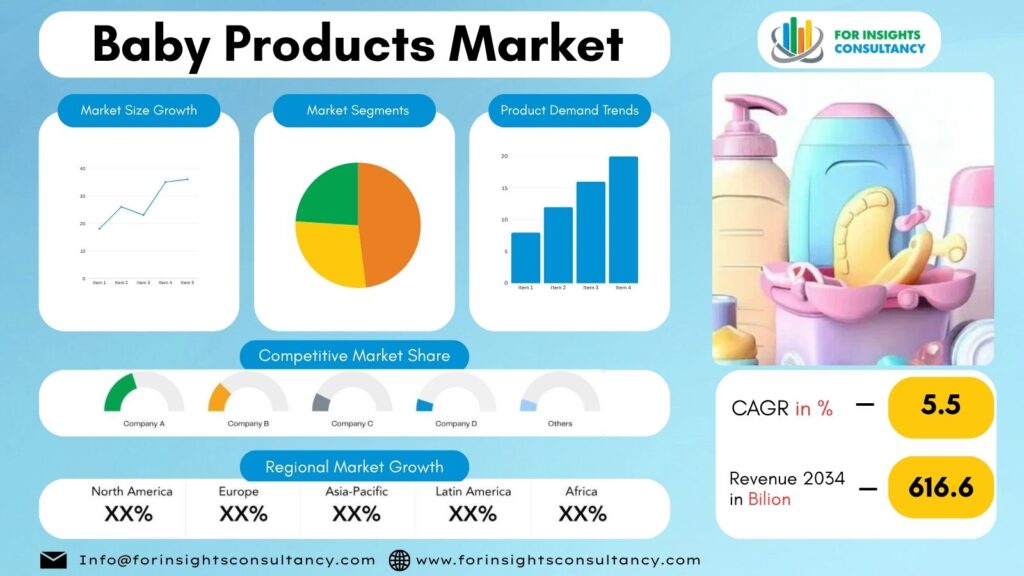
- Market Size (2026): 379.8 Billion
- Forecast (2034): 616.6 Billion
- CAGR (2026–2034): 5.5%
- Base Year: 2025
- Largest Segment: Baby cosmetics & toiletries (~27.5%); Mass segment (~73.6%); Hypermarkets & Supermarkets (~33.8%)
- Leading Region: Asia Pacific (~41.8% share)
Baby Products Market Executive Summary
The overall value of the global Baby Products Market raised at USD 379.8 billion in 2026, reaching USD 616.6 billion by 2034, at a CAGR of 5.5%, taking 2025 as the base year. The products in the baby cosmetics & toiletries category make up for about 27.5% of the market share in the Baby Products Market. Meanwhile, the mass segment is the most preferred type in the market, accounting for around 73.6% of the total market share due to their affordability. Hypermarkets & Supermarkets account for nearly 33.8% of the total share. The Asia Pacific region stands first in the market in terms of regional share, holding nearly 41.8% of the total market share globally.
Request Free Sample Copy: https://www.forinsightsconsultancy.com/reports/request-sample-baby-products-market
Baby Products Market Overview (2026)
In April 2026, Beyond Inc. revived Buy Baby through an online-only channel after acquiring its licensing rights for just $5 million – a relatively modest move reflecting a larger trend within the baby products market: even traditional retailers are making the move towards online first for the future of baby products. The move reflects the changing times on behalf of the consumers too. Consumers within the baby products market are doing research about the ingredients list before they buy anything – nearly two-thirds of these consumers claim that ingredients make or break a decision over price or loyalty to brands.
This move towards rational buying for safe choices has been transforming a market that used to operate based on necessities alone. The worldwide market for baby products is worth USD 379.8 billion in 2026. But the growth doesn’t come through increasing numbers of births because birth rates haven’t risen anywhere in the world, but rather through parents’ increased spend per baby and upgrading to safer, premium products.
Why this market is driving forward
However, growth here is not being fueled by increased numbers of births; birth rates are stable or falling in most large economies. Instead, it is being fueled by increased spending per child. Increased double-income families, better understanding of health, and the desire for organic and sustainable baby products have encouraged consumers to upgrade rather than downgrade.
Baby Products Market Dynamics 2026
Trends
Demand for Sustainable and Eco-Friendly Baby Products Continues to Rise
Consumers are are calling for more products to be produced using organic cotton, bamboo, biodegradable ingredients and recyclable packaging. Green messages are now the overriding concern contributing to purchasing decisions, prompting firms to develop eco-friendly products.
Premium Baby Care Products Gain Strong Consumer Preference
According to the 2026 Survey, the main categories where perental consumers are investing more are premium baby skin caring, baby food, feeding accessories and diapers with better quality, safety and clinically tested ingredients.
Smart Baby Products Are Becoming Mainstream
Technology-enabled baby monitors, wearable health devices, connected breastfeeding equipment, and linked nursery products are becoming more popular among parents. They benefit parents seeking to make life easier, provide enhanced safety monitoring, and promote children’s health and well-being.
E-Commerce Becomes the Preferred Purchasing Channel
Increase in the share of online platforms and DTC brands continues driven by the broader product range, better prices and subscription services as well as a more tailored shopping experience.
Growth Drivers
Rising Consumer Focus on Baby Health and Safety
The 2026 Survey found that straight-to-consumer brands will need to focus on offering products that adhere to the most rigid safety standards, are made from non-toxic ingredients, and from formulators tested or recommended by dermatologists or pediatricians. This will continue to drive demand for luxury baby care products within key categories.
Key Impact
- Increased consumer demand for baby products with certified safety features
- More investment into QA and compliancethese capabilities.
- Greater consumer trust in recognized brands
Growing Demand for Organic and Sustainable Baby Products
Environmental consciousness is shaping buying trends. Parents are consciously opting for biodegradable nappies, cotton garments and natural facial products and supporting environmentally friendly fold packaging, motivating producers to increase the range of green product lines.
Growth Opportunities
Organic baby food.
Baby skincare made from plants
Competitive Landscape of the Baby Products Market
In general, the baby product market is extremely competitive, and players are competing to gain market share by introducing new ideas differentiation, differentiation, and efficient strategy for positioning their brands.
- The Honest Company Inc.
- Gerber Products Company
- Philips Avent
- BabyBjorn AB
- Pigeon Corporation
- Chicco
- Munchkin Inc.
- Artsana S.p.A.
- Graco Children’s Products Inc.
- Summer Infant Inc.
- Procter & Gamble Co.
- Johnson & Johnson
- Kimberly-Clark Corporation
- Nestle S.A.
- Abbott Laboratories
- Danone S.A.
Baby Products Market Top Companies News 2026
Munchkin Inc.
Launched the “Flow Nipple Shield” in Japan (March 2026), expanding its breastfeeding-support product line internationally after strong U.S. reception — company data shows 87% of mothers using Flow continued breastfeeding at 12 months, versus a ~36% general average (CDC benchmark).
Danone S.A
Reported a 17% sales surge in its Specialized Nutrition segment in China (2026) despite China’s 2025 birth rate dropping roughly 17% — validating a “premiumization” thesis where parents trade up to clinically-proven, high-margin formulas even as birth volume shrinks.
Baby Products Market Segmentation
By Product
- Baby Cosmetics & Toiletries
- Baby Food
- Baby Safety & Convenience
Distribution Channel
- Supermarkets/Hypermarkets
- Convenience Stores
- Pharmacies/Drug Stores
- Online Retail
- Others
Baby Products Market: Segment and Sub segments
Baby Food & Nutrition
Baby food and nutrition products are essential for infant growth and development, providing necessary vitamins, minerals, and proteins.
Subsegments:
- Infant Formula (Dairy-based, Soy-based, Hydrolyzed)
- Prepared Baby Food (Purees, Snacks, Cereals)
- Baby Cereals & Porridge
- Organic & Natural Baby Food
- Toddler Milk & Nutritional Supplements
- Baby Personal Care Products
This segment includes products for skin, hair, and oral care, designed to be gentle, hypoallergenic, and free from harsh chemicals.
Subsegments:
- Baby Skin Care (Lotion, Creams, Oils, Powders)
- Baby Hair Care (Shampoos, Conditioners, Detanglers)
- Baby Bath Products (Soaps, Bubble Baths, Body Wash)
- Baby Wipes & Tissues
- Diaper Rash Creams & Ointments
- Baby Diapers & Hygiene
Diapers are one of the largest revenue-generating products in the baby market, available in various types and materials.
Largest segment share
Segment Category | Largest Share | Detail |
By Product Type | Baby cosmetics & toiletries | ~27.5-29.5% share (depending on report) |
By Type | Mass segment | ~73.6-74.6% share, driven by affordability and wide accessibility |
By Distribution Channel | Hypermarkets & Supermarkets | ~33.8-36.7% share, driven by wide product selection and one-stop convenience |
By Age Group/End Use | Infants (0-12 months) | Highest-spend category, driven by feeding, diapering, and safety essentials |
By Region | Asia Pacific | ~41.8-43.7% share (depending on report) |
By Country | China | Largest single-country market within Asia Pacific |
Baby Products Market Regional Outlook
This is approximately figure real report shows most accurate.
North America (~25% Share)
The growth driver for North America is premium spending rather than births, with more than 84% of parents in the United States buying specialist baby care products within the first six months of their child’s birth. Consumer confidence in safety regulations maintains the demand in dermatologically tested and health-oriented product lines.
Europe- (~18% Share)
The pharmacy-driven logistics and sustainability-driven development of the products drive the demands of Europe, especially Germany, France, and the UK. The presence of rigorous regulations, such as the EU General Product Safety Regulation and REACH, drives manufacturers to formulate safer products.
Asia-Pacific— (~41.8% Share)
Large population numbers in China and India, along with growing spending power among the middle classes, are behind the dominance of consumption in this region despite falling fertility rates in some cities. The fast growth of e-commerce has opened up new opportunities for premium imported baby products.
Middle East & Africa- (~6% Share) latin america -(~9%)
Growth is supported by the rising incomes of urban consumers along with growing awareness about the health and hygiene of babies, although from a far lower base compared to the other three regions. The low penetration levels of premium and organic products today indicate that growth potential lies in urbanization.
Frequently Asked Questions
What is the market for baby products?
The global baby products market is valued at $379.8 Billion in 2026, projected to reach $616.6 Billion by 2034 at a 5.5% CAGR.
Which companies dominate the Baby Products Market?
Procter & Gamble, Kimberly-Clark, Johnson & Johnson, Unilever, Nestlé, Pigeon, and Kao Corporation dominate the global baby products market.
What are the current baby product trends?
Key trends include organic/clean-label formulations, eco-friendly packaging, smart baby tech, personalized nutrition, and rising e-commerce/D2C purchasing.
What is the market size of the baby products market in India?
Estimates vary by scope, but India’s baby care products market is valued at approximately $8–10 Billlion in 2026, growing at a strong 20–24% CAGR.
Which region leads the Baby Products Market?
Asia-Pacific leads with roughly 41–43% market share, driven by China and India’s large birth rates and rising disposable income.
What baby products sell the most?
Diapers and baby food/formula are the top-selling baby product categories, together accounting for the largest global market share.
Customization: We can provide following things
1) On request more company profiles (competitors)
2) Data about particular country or region
3) We will incorporate the same with no additional cost (Post conducting feasibility).
Any Requirement Contact us: https://forinsightsconsultancy.com/contact-us/
Related Reports
Select PDF License
Single User: $3499
Multiple Users: $4499
Corporate Users: $5499