
Pages: 123 | September-2026 Formats | PDF | Category: Food & Beverages | Delivery: 24 to 72 Hours
Spice and Herb Extracts Market Size
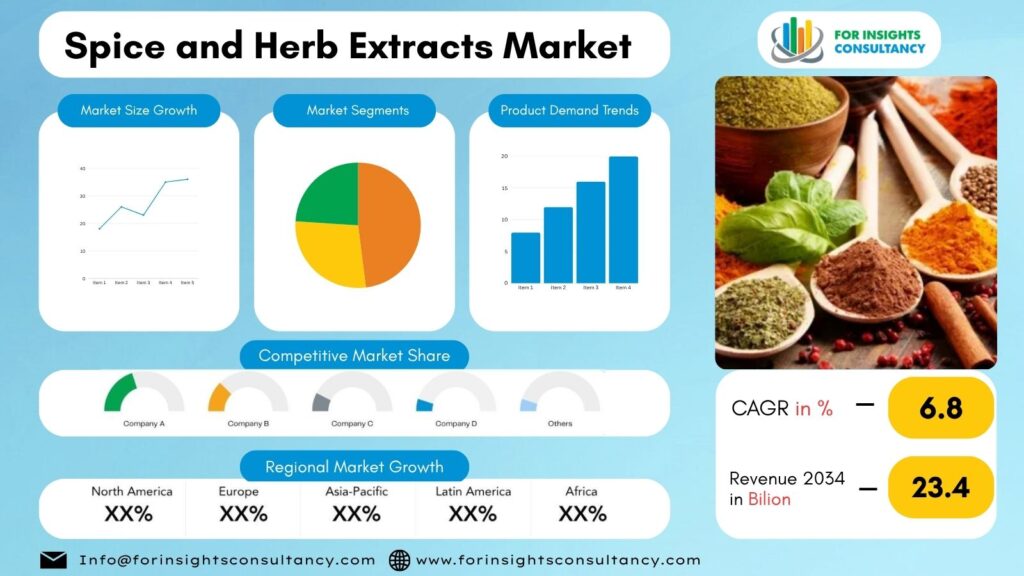
- Market Size (2026): USD 14.17 Billion
- Forecast (2034): USD 23.4 Billion
- CAGR (2026–2034): 6.8%
- Base Year: 2025
- Largest Segment: Essential Oils (~58% share).
- Leading Region: Asia Pacific (~39% Share)
Spice and Herb Extracts Market Executive Summary
The world market for Spice and Herb Extracts had a value of USD 14.17 Billion in 2026 and is forecast to reach USD 23.4 Billion by 2034, exhibiting a CAGR of 6.8% during the forecast period of 2026 to 2034, with 2025 as the base year. The growth is being witnessed due to increasing demand for natural and clean label ingredients in the food, beverage, pharmaceutical, and cosmetic industries, along with the innovations in extraction techniques. Among the product types, the Essential Oils and Oleoresins are dominating the market, while the largest application category is Food & Beverages. Regionally, Asia Pacific is the leading player with a market share of around 39%.
Spice and Herb Extracts Market Overview (2026)
By 2026, the FDA in the U.S. ban on petroleum-derived synthetic food dyes such as Red 40, Yellow 5, and Yellow 6, has driven leading food manufacturers such as Kraft Heinz, Nestlé USA, and General Mills to adopt natural colors derived from the Spice and Herb Extracts Market such as turmeric for yellows, paprika extract for orange, and beet for red. The ban on FD&C Red No. 3 being officially in place and other synthetic food dyes set to comply by 2027, the demand for the Spice and Herb Extracts Market is moving from marketing convenience to an unavoidable regulatory need almost instantaneously.
This is not just any random occurrence in regulation but fits into the greater picture of the evolving consumer preferences in food and beverage formulation. As consumers become more health conscious and look up the ingredient label on product packages before buying, the Spice and Herb Extracts Market is gaining from their unique dual advantage of being natural coloring and flavoring agents while also having a recognized ingredient appeal.
This report examines the Spice and Herb Extracts Market across key product types (Essential Oils, Oleoresins, Natural Extracts), applications (Food & Beverages, Pharmaceuticals, Cosmetics & Personal Care, Nutraceuticals), and regions (Asia Pacific, North America, Europe), profiling the leading suppliers driving this reformulation wave.
The sections below break down the market’s size, growth trajectory, and the forces accelerating it through 2034.
Spice and Herb Extracts Market Dynamics 2026
Growth Driver
Clean-Label Reformulation Driven by Regulatory Pressure
As the FDA works on its phased ban on petroleum-based artificial colors and dyes, the demand in the Spice and Herb Extracts market is bound to grow rapidly due to brand manufacturers making a transition from artificial flavorings and colorings to natural extract concentrates in order to comply with retailer guidelines regarding ingredient labeling. Essential oils lead in terms of their popularity, having approximately 60% of the total extracts available in the market due to their flexibility.
Functional Foods and Nutraceuticals Expansion
The use of spices and herbs for their health benefits, such as antioxidant, anti-inflammatory, antimicrobial, and immune-boosting properties, has gained importance, thereby making them applicable beyond just flavor. The ingredients such as turmeric curcumin, ginger, and oregano extracts have started gaining importance in dietary supplements and functional products among others as people look for preventative and natural health solutions, thus widening the market base for the Spice and Herb Extracts Market.
Rising Demand for Ethnic and Global Cuisines
The increasing desire among consumers for different types of cuisine from around the world has led to the increased demand for natural spice extracts such as cumin, coriander, and cardamom in the ethnic and fusion food preparations.
Trends
Natural Colorants Replacing Synthetic Dyes
The FDA dye phasing out is driving the utilization of colorants from spice, like turmeric for yellow color, paprika extract for orange color, and beet for red color, from an advantage of marketing into a regulation necessity. The major players such as Kraft Heinz, Nestlé USA, and General Mills have promised to get rid of all synthetic dyes, and most promises are aiming to accomplish it before the year 2027.
Advanced Extraction and Encapsulation Technology
SC-CO₂ extraction, MAE, and microencapsulation are becoming standard techniques in the pursuit of increasing purity, yield, shelf-life, and flavor retention. The emergence of such technology is crucial in order to be able to scale natural ingredients to deliver the same consistent quality as the artificial ones.
Premiumization Through Ethnic and Global Flavor Innovation
The increasing consumer interest in exotic cuisines is leading to the growing need for authentic spices such as cumin, coriander, and cardamom. Hence, companies are now more inclined towards using extract versions of spices that are more valuable rather than blends.
Spice and Herb Extracts Market Top Companies Covered In this Report are
- Dohler
- Sensient
- Archer Daniels Midland
- Ajinomoto
- Symrise
- Firmenich
- Naturex
- Kalsec
- Olam
Spice and Herb Extracts Market company news 2026
Döhler
Döhler opened a $64M ingredients plant in Mexico (State of Mexico) with a second-phase natural colours line, alongside launching Döhler Canada as part of a broader North/Latin America expansion. It also significantly expanded flavor and botanical extraction capabilities at its Cartersville, Georgia facility — upgrading hydroethanolic extraction for botanicals — and partnered with VitaWorks to accelerate nutraceutical innovation across North America.
Sensient Technologies
Sensient broke ground on “Project Prism,” a major expansion of its St. Louis natural color plant, part of a planned $250 million investment to scale natural color manufacturing capacity as it targets $1 billion in natural color sales. CEO Paul Manning called the U.S. synthetic-to-natural dye conversion “the single largest opportunity in the company’s history.” Sensient also named “Reverie Pink” its 2026 Color of the Year and continues promoting its Certasure™ natural color safety program amid the FDA-driven transition.
Archer Daniels Midland (ADM)
ADM continues building out its natural flavors and botanical extracts portfolio (flavors and colors derived from nature, botanical extracts, plant-based proteins) following its earlier WILD Flavors and Revela Foods/FDL acquisitions, with ongoing R&D focused on GLP-1-influenced eating behavior trends and functional, nature-derived ingredient systems.
Symrise
Symrise reported solid H1 2026 results (organic sales growth accelerating to 4.5% in Q2) and announced the planned acquisition of Floral Concept, a French premium natural botanical extracts specialist, to strengthen its Naturals platform in Grasse. The company also commissioned a new GEA-built flavor mixing plant in Holzminden, Germany, expanding capacity for vanilla extracts, botanical extracts, and natural flavors for clean-label F&B applications.
Spice and Herb Extracts Market Segments
Segment by Product Type
- Essential Oils — largest segment (~58% share), valued for versatility across food, pharmaceutical, and personal care applications
- Oleoresins — strong functional and flavor-intensity value, widely used in sauces, snacks, and ready meals
- Natural Extracts / Liquid Extracts, Tinctures & Powders — growing on clean-label reformulation demand
Segment by Extraction Method
- Supercritical CO₂ Extraction — gaining share for purity and yield advantages
- Solvent-Based Extraction — traditional method, still widely used for cost efficiency
- Microwave-Assisted & Ultrasonic Extraction — emerging technologies improving volatile compound retention
Segment by Application
- Food & Beverages — largest application segment (~70% share), spanning sauces, snacks, condiments, and functional foods
- Nutraceuticals & Dietary Supplements — fast-growing, driven by preventive health and wellness trends
- Pharmaceuticals — leveraging antioxidant, antimicrobial, and anti-inflammatory bioactive properties
- Cosmetics & Personal Care — botanical extracts used for natural fragrance and skin/hair care formulations
Segment by Source
- Herbs — largest source segment (basil, oregano, thyme, rosemary, and indigenous botanical varieties)
- Spices — fastest-growing source segment (turmeric, ginger, cardamom, cinnamon, cumin, coriander)
Segment by Distribution Channel
- Indirect Sales / B2B (to food & beverage manufacturers) — dominant channel (~64% share)
- Online Stores
- Supermarkets/Hypermarkets
- Specialty Stores
largest segment share
Why Essential Oils Lead the Spice and Herb Extracts Market
Essential oils command roughly 58% of the Spice and Herb Extracts Market. Established regulatory and safety track record: Essential oils have decades of documented use in food, pharma, and cosmetics, giving them established GRAS status and safety precedent across major markets. This lowers compliance burden and speeds time-to-market for manufacturers reformulating under 2026’s clean-label and dye-phase-out pressure.
Spice and Herb Extracts Market Regional Insights
North America
The North American demand for spices and herbs extracts will not be driven by trends among consumers of organic products, but rather by an unprecedentedly fragmented and fast-paced legal environment that food lawyers call a real compliance issue for national producers.
The first state-wide legislation for regulating the use of food dyes was enacted in West Virginia in 2025. The school-meals portion of this statute has been operative since August 1, 2025, but the state-wide ban has been preliminarily enjoined by a federal court in December 2025 for being vague (IACM v. Singh, S.D. W.Va.) with an appeal pending at the Fourth Circuit.
There are two different statutes operative in California; AB 418 (prohibiting the use of Red No. 3 and three other additives as of January 2027) and AB 2316 (prohibiting the use of six dyes in schools as of December 2027).
Arizona (HB 2164) prohibits the use of “ultraprocessed” foods containing dyes and additives in schools from the 2026-2027 school year.
Europe
EU Deforestation Regulation (EUDR), that mandates deforestation-free sourcing for products such as cocoa, coffee, palm oil, and rubber, is at present non-existent in relation to spices, a shortcoming that has been highlighted by peer-reviewed scientific studies in the field of environmental science (Environmental Science & Technology, 2026). In particular, the study points out that spice farming is just like that of the EUDR-covered products in terms of land-use change and loss of biodiversity. Moreover, the research identifies pepper, ginger, cumin, and capsicum as key components in the Spice and Herb Extracts Market whose cultivation has an adverse effect on land use and biodiversity; therefore, it must be regulated in the future.
With regard to the fact that the enforcement of EUDR has been put off until December 30, 2026 for large businesses, spice and herbs extracts manufacturers sourcing from high-risk countries have to expect this kind of regulation to occur sooner rather than later.
In 2026, Symrise, headquartered in Holzminden, Germany, ordered a flavor mixing plant built by GEA that increased the liquid compounding production capacity by 50%. It was intended to produce vanilla extracts, citrus oils, and botanical extracts for European and international F&B clients.
Asia-Pacific
Asia Pacific Spice and Herb Extracts Market is dominated by India, which, according to the Indian Spices Board (statutory organization under the Ministry of Commerce & Industry), produces nearly 70% of the world’s total spices and holds a volume market share of about 46% of global spice exports and generated a record export value of USD 4.72 billion in FY 2024-25, to reach over USD 4.5 billion in 2026 across 180+ countries. This does not mean a dispersed competitive advantage, but a geographically specific one, as the state of Kerala, whose Kochi houses the Spices Board of India, produces Malabar and Tellicherry black pepper (world standard), Idukki cardamom, ginger, turmeric, nutmeg, and India itself produces around 75% of the world’s total turmeric, the primary raw material for yellow colorant extraction.
Rest of World
In the case of the Gulf Cooperation Council (GCC) consisting of Saudi Arabia, UAE, Bahrain, Oman, Qatar, and Kuwait, food additive regulations are controlled by the Gulf Standardization Organization (GSO), where its standards are adopted as mandatory national regulations in all seven member countries after issuance. Specifically, in the case of Saudi Arabia, the country implements GSO 2500/2015 standards that, notably, distinguish between natural colors (Annex Table 1A that is approved for use in all food products) and synthetic colors (Annex Table 1B with stricter restrictions depending on the category). A study conducted by SFDA scientists and peer-reviewed in Frontiers in Nutrition (2026) proves that synthetic dye requirements in GSO are stricter than EU standards in similar food products, and SFDA banned titanium dioxide from food products and tartrazine (E102) from the list of approved colorants in Saudi Arabia — a product that leads to rejection of U.S. food products in Saudi ports.
Frequently asked questions with answers
How big is the global Spice and Herb Extracts market?
Spice and Herb Extracts Market is expected to grow from USD 14.17 Billion in 2026 to USD 23.4 Billion by 2034, at a CAGR of 6.8%.
Who are the key players in the Spice and Herb Extracts industry?
Dohler, Sensient, Archer Daniels Midland, Ajinomoto, Symrise, Firmenich, Naturex, Kalsec, Olam, Others.
Which region dominates Spice and Herb Extracts?
Asia Pacific dominates the Spice and Herb Extracts Market with approximately ~39% share.
What are the primary drivers for market growth?
Rising demand for clean-label, natural ingredients — accelerated by the U.S. synthetic dye phase-out and growing nutraceutical/functional food applications — is the primary driver of Spice and Herb Extracts Market growth.
Why should buy this Spice and Herb Extracts Market Report?
- Make confident investment and market-entry decisions
- Understand exactly where the growth is happening
- Benchmark against the competitive landscape
- Navigate regulatory complexity with clarity
- Identify the best regional entry point for your strategy
- Save months of independent research
- Support internal business cases and stakeholder buy-in
If you’re conducting a deeper analysis, let me know:
Are you focusing on a specific sector?
Do you need data on specific regional markets or key players?
Any Requirement Contact Us: https://www.forinsightsconsultancy.com/contact-us
Related Market Reports
Natural Food Colors Market —Size, Growth & Future Outlook 2034
Food Ingredient and Additive Market — Size, Share, Trends & Growth Forecast 2026-2034
Aroma Ingredients Market — By Type, Product, Source & Application, Forecast to 2034
Flavor Systems Market — By Type, Form & Application, Forecast to 2034
Food Flavors Market — By Type/Labeling (incl. Natural Flavors) & Flavor Category, Forecast to 2034
Table of Contents
- Introduction of Herb Spice Extracts Market
- Market Definition
- Market Segmentation
- Research Timelines
- Assumptions
- Limitations
*This section outlines the product definition, assumptions and limitations considered while forecasting the market.
- Research Methodology
- Data Mining
- Secondary Research
- Primary Research
- Subject Matter Expert Advice
- Quality Check
- Final Review
- Data Triangulation
- Bottom-Up Approach
- Top-Down Approach
- Research Flow
*This section highlights the detailed research methodology adopted while estimating the overall market helping clients understand the overall approach for market sizing.
- Executive Summary
- Market Overview
- Ecology Mapping
- Primary Research
- Absolute Market Opportunity
- Market Attractiveness
- Herb Spice Extracts Market Geographical Analysis (CAGR %)
- Herb Spice Extracts Market by Type USD Million
- Herb Spice Extracts Market by Application USD Million
- Future Market Opportunities
- Product Lifeline
- Key Insights from Industry Experts
- Data Sources
*This section covers comprehensive summary of the global market giving some quick pointers for corporate presentations.
- Herb Spice Extracts Market Outlook
- Herb Spice Extracts Market Evolution
- Market Drivers
- Driver 1
- Driver 2
- Market Restraints
- Restraint 1
- Restraint 2
- Market Opportunities
- Opportunity 1
- Opportunity 2
- Market Trends
- Trend 1
- Trend 2
- Porter’s Five Forces Analysis
- Value Chain Analysis
- Pricing Analysis
- Macroeconomic Analysis
- Regulatory Framework
*This section highlights the growth factors market opportunities, white spaces, market dynamics Value Chain Analysis, Porter’s Five Forces Analysis, Pricing Analysis and Macroeconomic Analysis
- by Type
- Overview
- Herb Extracts
- Spice Extracts
- by Application
- Overview
- Food
- Beverages
- Personal Care
- Nutraceutical
- Pharmaceutical
- Others
- Herb Spice Extracts Market by Geography
- Overview
- North America Market Estimates & Forecast 2021 – 2031 (USD Million)
- U.S.
- Canada
- Mexico
- Europe Market Estimates & Forecast 2021 – 2031 (USD Million)
- Germany
- United Kingdom
- France
- Italy
- Spain
- Rest of Europe
- Asia Pacific Market Estimates & Forecast 2021 – 2031 (USD Million)
- China
- India
- Japan
- Rest of Asia Pacific
- Latin America Market Estimates & Forecast 2021 – 2031 (USD Million)
- Brazil
- Argentina
- Rest of Latin America
- Middle East and Africa Market Estimates & Forecast 2021 – 2031 (USD Million)
- Saudi Arabia
- UAE
- South Africa
- Rest of MEA
This section covers global market analysis by key regions considered further broken down into its key contributing countries.
- Competitive Landscape
- Overview
- Company Market Ranking
- Key Developments
- Company Regional Footprint
- Company Industry Footprint
- ACE Matrix
This section covers market analysis of competitors based on revenue tiers, single point view of portfolio across industry segments and their relative market position.
- Company Profiles
- Introduction
- Dohler
- Company Overview
- Company Key Facts
- Business Breakdown
- Product Benchmarking
- Key Development
- Winning Imperatives*
- Current Focus & Strategies*
- Threat from Competitors*
- SWOT Analysis*
- Sensient
- Archer Daniels Midland
- Ajinomoto
- Symrise
- Firmenich
- Naturex
- Kalsec
- Olam
Select PDF License
Single User: $3499
Multiple Users: $4499
Corporate Users: $5499