

Pages: 143 | September-2026 Formats | PDF | Category: Food and Beverages | Delivery: 24 to 72 Hours
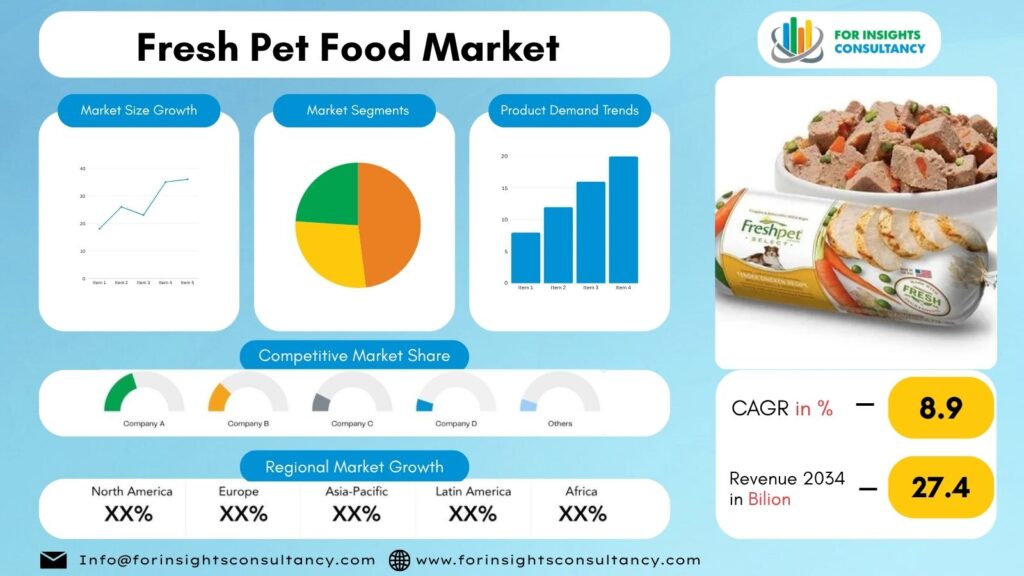
Fresh Pet Food Market Size 2026 to 2034
- Market Size (2026): USD 15.8 Billion
- Forecast (2034): USD 27.4 Billion
- CAGR (2026–2034): 8.9%
- Base Year: 2025
- Largest Segment: Dog food (by product); Refrigerated/Chilled (by storage type) — premium fresh category leads by revenue
- Leading Region: North America (~43.8% Share)
Fresh Pet Food Market Exclusive Summary
According to reports, the global Fresh Pet Food Market held a market value of USD 15.8 billion in 2026 and is expected to attain USD 27.4 billion in 2034, growing at a CAGR of 8.9% from 2025. Dog food dominates as the dominant product segment, and refrigerated/chilled is the dominating segment for storage type owing to the popularity of minimally processed and human grade nutrition among consumers. The market in North America accounts for approximately 43.8% of global market revenue and is expected to maintain its dominance throughout the forecast period, supported by high per-capita pet expenditure, stringent ingredient transparency laws, and a higher concentration of fresh pet food startups.
Fresh Pet Food Market Overview (2026)
The Fresh Pet Food Market is projected to reach USD 15.8 billion in 2026, growing at CAGR 8.9%, which will propel the market to cross USD 27.4 billion by 2034. The reason behind such an accelerated pace in growth is the trend of trade-up of pet owners from dry and canned to refrigerated, chilled, and human grade pet food. The difference in the percentage in the growth rate is quite evident; however, it speaks much about the reality in the industry. Consumers not only buy more pet food but consciously move from one type of product to another and manufacturers try to catch that movement before it becomes an advantage for several players in the market.
There are three driving forces for such growth simultaneously. Firstly, pet humanization is still increasing. The owners of the pets, especially Generation Z and millennials, pay attention to the ingredients in the same way as they would do with their personal food. Secondly, premiumization influences the economics of the categories since despite stagnation in pet owners’ growth in developed countries, spend per pet increases due to the owners upgrading to higher price products with fresh and functional nutrition.
Fresh Pet Food Market Dynamics 2026
Growth Driver
Rising Pet Humanization
The biggest factor cited in all sources is the trend among pet owners of looking at pets more like family members and thus expecting the same levels of quality, visibility, and nutrition from the food they are fed as they would from their own food.
Shift Toward Premium, Health-Conscious Nutrition
Pet owners are increasingly choosing to upgrade to refrigerated/frozen products from shelf-stable kibble and canned products due to increasing consumer awareness about pet health and wellness issues. This premiumization phenomenon is leading to value growth, even in situations where volume growth is stagnant in mature markets.
Regulatory & Certification-Driven Trust
The subscription model used by delivery services (The Farmer’s Dog, NomNomNow, Ollie, JustFoodForDogs) has answered the main problem associated with delivering fresh food products — how to deliver fresh and refrigerated goods to consumers without using grocery cold chain shelves. E-commerce currently accounts for over 50% of sales in the category.
Trends
Rise of Subscription-Based Delivery Models
New brands of pet food have started to rely more on a subscription delivery model than one-time retail sales (The Farmer’s Dog, NomNomNow, Ollie, PetPlate) – which is a different structure than the traditional method of distribution through groceries and retail outlets.
Personalized Nutrition Powered by AI
The development of personalized food plans through AI-powered analysis of a pet’s breed, size, age, health status, and level of physical activity is becoming a critical differentiating factor in the space of premium fresh foods, bringing it to the next level of customized nutrition.
Ingredient Transparency as a Core Purchase Driver
More than 68% of consumers who buy fresh pet food products seek clarity about their ingredients and hypoallergenic composition.
E-Commerce as the Dominant Channel
Over 50% of fresh pet food is purchased via Online/D2C channels, owing to the popularity of the subscription-based delivery system and consumer comfort buying perishable pet food without physical verification.
Fresh Pet Food Market Top Companies Covered In this Report are
- NomNomNow
- The Farmer’s Dog
- Ollie
- PetPlate
- JustFoodForDogs
- Wild Earth
- Stella & Chewy’s
- Darwin’s Natural Pet Products
- Open Farm
- Bella & Duke
- Tender & True Pet Nutrition
Fresh Pet Food Market company news 2026
The Farmer’s Dog
Now valued at approximately $4.2 billion (2026), having raised a total of $268 million across 6 funding rounds, with its latest round a Series E — a sharp climb from earlier-stage valuations, reflecting strong investor confidence in the fresh dog food category.
Chewy, Inc
Completed its $400 million acquisition of Modern Animal, a technology-forward veterinary platform, on May 21, 2026, strengthening Chewy’s integrated pet healthcare ecosystem — a signal of the broader trend toward fresh-food-plus-veterinary-care bundling across the industry.
Fresh Pet Food Market Segments
Segment by Product Type (Pet Type)
- Dogs – biggest segment in terms of revenue due to the dominance of the subscription brands such as The Farmer’s Dog, Ollie, and NomNomNow which are centered on canine nutrition
- Cats – fastest growing segment owing to the larger “cat economy” growing at an annual rate of 10.7% to $144.5 billion worldwide and the cat brands are coming up with new formulations for cats.
- Others (small mammals and exotic animals) – niche market segment.
Segment by Format/Processing Type
- Fresh/Refrigerated — main format that constitutes the category, minimal processing, high-quality, food-grade products that need refrigeration to retain their nutrients
- Frozen — considerable proportion, provides better shelf stability than refrigerated fresh but preserves the nutrients
- Freeze-Dried — most innovative format in terms of growth, increases shelf life, and makes logistics easier without preservatives
- Gently Cooked — unique format within the category (produced by brands like NomNomNow), lies between raw and fully cooked products.
Segment by Ingredient/Protein Type
- Meat (chicken, beef, turkey, lamb, pork) – most common and popular type of food for dogs
- Fish – less common, but still available type of dog food
- Vegetable based foods – added to meat as one of the ingredients, not created as a separate segment, but also increasingly popular due to the health benefits
- Novel Proteins – least common but increasingly popular type of dog food.
Segment by Distribution Channel
- Online/D2C (Direct-to-Consumer) – the most prominent route, making up over 50% of total sales, based on the subscription/ship-model which is common among the biggest players
- Offline (Supermarkets, Pet Specialty Stores, Vet Clinics) – the second largest channel, although much smaller in terms of revenue; the offline channel was worth about $1.71 billion in the US alone in 2024
- Vet Clinics – becoming a new, separate sub-channel due to co-branding efforts, presenting fresh food as a “clinically recommended” purchase.
Segment by Business Model
- Subscription Based – the model which defines the category itself (The Farmer’s Dog, Ollie, NomNomNow, PetPlate) that relies on personalization and subscription-based meals.
- One-Time/Retail Purchase Model – the conventional one for shelf-stable adjacent fresh players.
largest segment share
Segment leaders include dogs (type of pet), refrigerated/fresh (format), and online/D2C subscriptions (channel). The most important region is North America due to the high per-pet spend and the concentration of venture-funded fresh pet food brands.
Fresh Pet Food Market Regional Insights
North America Market Leader (43.8% Global Share)
The leading region in the global fresh pet food market is North America, holding a market share of 43.8% and accounting for a total of approximately $6.1 billion revenue in 2025. The region is the leading force in the market owing to a combination of three structural strengths, including the highest per capita pet expenditure on earth ($1,380 spent by each U.S household on pet food), presence of sound regulation systems that ensure mandatory disclosure of ingredients’ quality (regulated by AAFCO), and a highly venture-backed startup market ecosystem confined to the United States alone.
What is driving demand in the United States today? The established players in the pet food market are no longer looking at fresh pet food as just another niche market but are taking steps towards direct participation in the market. General Mills launched a new Blue Buffalo fresh, minimally-processed product line in 2025 to cater to “people who treat their pets like family” and Nestlé Purina PetCare announced the construction of a 1.3 million square feet advanced manufacturing plant in North Carolina in 2024 to expand its production capacity of fresh pet food.
Europe Second-Largest Market (28.5% Global Share)
Europe represents 28.5% of the global fresh pet food market share, driven primarily by Germany, UK, and France — countries where over 45% of households own pets. The regulations in Europe are different from that of the U.S.; FEDIAF (Fédération Européenne de l’Industrie des Aliments pour Animaux Familiers) oversees the standards related to nutritional requirements and labeling within the EU region, setting up a stricter regulatory environment as compared to different states of America.
What’s happening in Europe in 2026 in particular: Europe is rapidly consolidating. Nutriment Company acquired 10 companies in 2025, and Trouw Nutrition recently opened its second pet-dedicated premix facility in Europe; located in Spain in March 2026, the facility is further increasing Europe’s production capabilities in terms of functional and fresh adjacent products.
Asia-Pacific- Fastest-Growing Region (19.2% Share, Explosive Growth Trajectory)
The Asia-Pacific region generates 18.2% of global revenues today and definitely deserves its place on top, since pet adoption in China, Japan, and South Korea increased by 40-50% in the last five years, while the pet cat population in China alone surpassed 70 million at the beginning of 2024. This is not growth anymore but an instant shift of demographics.
What can be considered a remarkable event for 2026 and mentioned in our article: in April 2026, Drools (India) has launched Asia’s first fresh pet food product, packaged in Tetra Pak’s Tetra Recart retort packages. The company invested $21 million (₹180 crore) in new manufacturing capacity with Tetra Pak. This is not just about launching one particular product – it means that the cold chain is no longer a critical challenge for fresh pet food products, since it has been fresh pet food’s single biggest obstacle to entering a market without a developed refrigerated retail infrastructure.
Rest of World- Latin America & Middle East/Africa (10.5% Combined Share)
Latin America (share: 6.8%): While Brazil and Mexico are experiencing higher urban penetration of fresh pet food concepts, the lack of appropriate distribution systems (cold chain logistics in rural areas in particular) is hindering further expansion. Brazil’s larger pet food market is ranked as the sixth largest market for pet food globally due to its 140 million pets, strong local manufacturing base, and matured category. Hence, there is ample space available for fresh food in a relatively established market versus having to develop pet food demand first.
Middle East and Africa (share: 3.7%): While Africa’s market growth rate was the highest among regions for the broader pet food category at 8.1% (2026-2031), this comes from a much smaller starting base when compared with North America and Europe. This is because there is limited penetration of any kind of commercial pet food products at present. Therefore, long-term growth is contingent upon higher urban incomes and companion animal ownership converting a currently underpenetrated population.
Frequently asked questions with answers
How big is the global Fresh Pet Food market?
Fresh Pet Food Market is projected to grow from USD 15.8 Billion in 2026 to USD 27.4 Billion by 2034, at a CAGR of 8.9%.
What are the current trends in the pet food market?
Pet humanization, premiumization, functional/fresh nutrition, and subscription-based D2C delivery are the current defining trends in the pet food market.
Which region dominates the Fresh Pet Food market?
North America dominates the Fresh Pet Food market with roughly 43.8% of global revenue share.
Who are the major fresh pet food brands?
The Farmer’s Dog, NomNomNow, Ollie, JustFoodForDogs, and Stella & Chewy’s are among the major fresh pet food brands.
Which segment is expected to hold the largest share in the Fresh Pet Food market?
Dogs are expected to hold the largest segment share in the Fresh Pet Food market, driven by the concentration of major subscription brands built around dog nutrition.
Why should buy this Fresh Pet Food Market Report?
- Make confident investment and market-entry decisions
- Understand exactly where the growth is happening
- Benchmark against the competitive landscape
- Navigate regulatory complexity with clarity
- Identify the best regional entry point for your strategy
- Save months of independent research
- Support internal business cases and stakeholder buy-in
If you’re conducting a deeper analysis, let me know:
Are you focusing on a specific sector?
Do you need data on specific regional markets or key players?
Any Requirement Contact Us: https://www.forinsightsconsultancy.com/contact-us
Related Market Reports
Human Grade Pet Food Market — Size, Growth & Future Outlook 2034
Fresh Pet Food Market Report — Size 2026, Share, Trends Forecast to 2034
Luxury Pet Food Market — Size, Trends 2026, Growth Forecast to 2034
Dog Food Market — Size, Trends, Price & Forecast to 2034
Select PDF License
Single User: $3499
Multiple Users: $4499
Corporate Users: $5499