

Pages: 300 | Jul-2024 Formats | PDF | Category: Information Technology | Delivery: 24 to 72 Hours
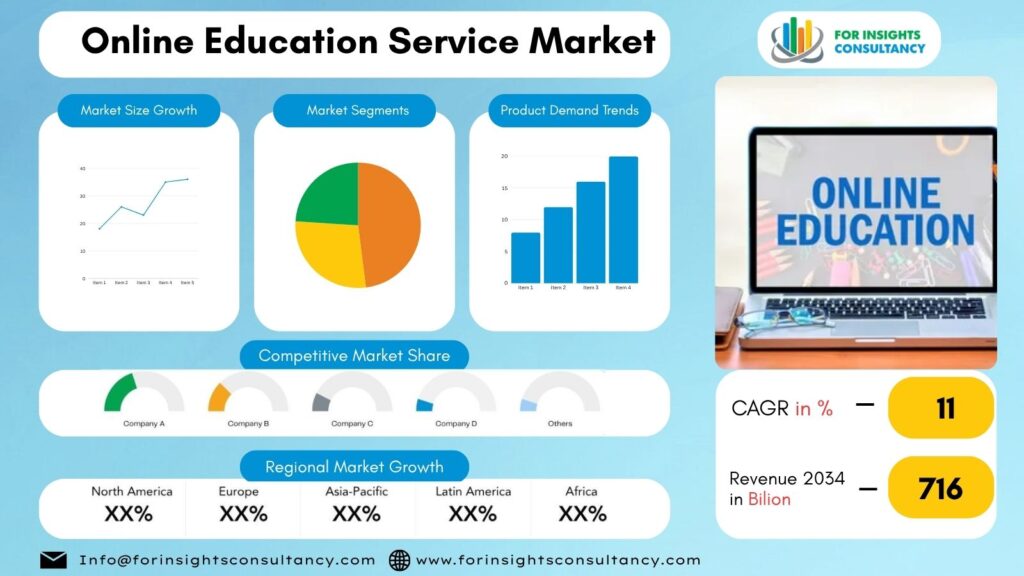
Online Education Service Market Size Statistics
Market Size (2026): USD 311 Billion
Forecast (2034): USD 716 Billion
CAGR (2026–2034): 11.0%
Base Year: 2025 (USD 280 Billion)
Leading Segment (2026): Higher education (academic) online programs, delivered mainly through self-paced courses
Leading Region (2026): North America (~35–37% share)
Core Trends: AI-powered personalized learning and tutoring is being built into self-paced courses and platforms.
Online Education Service Market Definition
The Online Education Service Market includes education and training provided via the Internet, comprising courses, degree programs, tutoring, test preparation, skills training, and other such offerings, as well as the software infrastructure needed to deliver these products. Learners can access the product via online websites, applications, and virtual classrooms, self-paced or instructor-led. Providers include universities, course-specific marketplaces, tutoring firms, and business training providers.
Online Education Service Market Overview 2026
Online Education Services Market 2026 is witnessing an increase in the market due to an increase in the use of digital platforms by learners, professionals, educational organizations, and business enterprises for learning and skills development purposes. Online education services comprise virtual classes, learning management systems, online tutoring, online courses, certifications, language learning, and corporate training. The increase in the availability of internet and smartphones, as well as flexible timings and career-oriented skills demand, is driving learners to opt for online education along with conventional learning.
The key drivers of the Online Education Services Market are an increase in the demand for digital skills, flexible and low-cost education, remote learning, and usage of artificial intelligence in educational platforms. Artificial intelligence-driven tutoring, personalized learning paths, automated assessment of learners, interactive course material, and analysis of learner performance are the ways through which service providers have been improving the overall learning process. Online training for developing workforces is being taken up by employers.
The service type segment consists of online academic education, professional certification, language learning, tutoring, test preparation, and corporate learning services. Self-paced courses suit learners that require flexible study schedule, while instructor-led courses and live virtual classes provide learners with the opportunity of interacting in real time. Subscription-based platforms, course-by-course payment and institution-based licensing are various ways to purchase the services for individual learners, schools, universities, and enterprises. The demand for various courses will be affected by factors such as course quality, accreditation of the course, instructors’ expertise, price, learning outcomes, and qualification relevance to job prospects.
The North America region will continue playing an important role owing to its advanced digital infrastructure, use of educational technology and demand for professional training. The Asia-Pacific region is expected to present good market growth opportunities as more people in the region gain internet connectivity, mobile learning becomes popular and there is an increasing need for additional education for academic and employment purposes. Europe will contribute to market growth with digital education, professional training, and lifelong learning.
Request a Free Sample Copy: https://forinsightsconsultancy.com/reports/request-sample-online-education-service-market (Sample Include key points such as 2026 market size, 2034 forecast, CAGR, leading product segment, fastest-growing segment, dominant region, major companies, trends, growth drivers, challenges, and opportunities.)
Trends 2026
AI-powered personalized learning and tutoring (the defining trend)
AI is being used to customize the learning content, provide instant feedback, and become on-demand tutors. A research firm projects personalized content through AI to be around 25% of worldwide e-learning content by 2025. An external source citing Grand View Research forecasts the AI in education market to reach USD 8.3 billion by 2025 with a CAGR of 31.2% up to 2030. I would want to confirm this figure before citing it.
Blended and hybrid learning
Self-paced course types continue to prevail with an estimated share of almost 40% within digital learning according to one report and nearly 63% within e-learning as per another report. However, blended formats offering both elements are gaining popularity and have a CAGR of 29.1% till 2031 within the digital learning report by Mordor Intelligence.
Mobile-first learning
The use of mobile apps is witnessing the fastest growth, growing at a rate of 18.1% CAGR, according to one study. However, portals remain more popular, accounting for nearly 45% of the market. This is because of the growth of smartphones in emerging economies as well as concise lessons.
Corporate upskilling and reskilling
As businesses are increasing their investments into employee training programs, corporates make up one of the quickest growing end-users (12.4% CAGR according to one estimate), although universities make up the biggest market segment. Corporate e-learning is estimated by one source at USD 104 billion, growing at a rate of 21.7% CAGR.
Online Education Service Market Growth Drivers 2026
Rising internet and smartphone access
Internet access and smartphone availability make online learning possible for many more people, particularly in emerging countries. The main factors behind the historic growth according to Research and Markets (through The Business Research Company) include internet penetration as well as the adoption of smartphones and laptops, while Dataintelo mentions mobile internet adoption in emerging countries.
Demand for flexible, self-paced learning
The learners and professionals need to learn at their own pace. The self-paced mode accounts for the highest share of course delivery, about 63% of all e-learning according to one survey and about 40% of digital learning according to another.
Growth in higher education enrollment and online degrees
Universities have introduced online degrees, certificates and hybrid education programs in order to target those students who cannot join universities on-campus. The academic institution is the biggest end user, having 47.8% share of e-learning according to one report, while the growth of enrollment at universities is mentioned by Research and Markets.
Corporate upskilling and reskilling budgets
Employees are getting trained on their skills, and this is driving the growth of corporate programs as one of the fastest-growing end users (12.4% CAGR in one report), and according to Dataintelo, increasing budgets of corporate training is one of the important drivers.
Top Companies Covered in the Online Education Service Market are
- Coursera
- Udemy
- Pearson
- Duolingo
- Khan Academy
Online Education Service Market Company news 2026
Coursera and Udemy
The two signed an all-stock merger agreement on December 17, 2025, stockholders approved it on April 9, 2026, and Coursera announced on its blog that the two were one company on May 11, 2026. Reports put the implied combined value at about USD 2.5 billion.
Duolingo
A 36Kr report on its Q2 results says CEO Luis von Ahn paused monetization changes early in the year to protect daily-user growth. Growth picked up in Q2, and the company is increasing monetization again, including extending the Super free trial from 7 days to 1 month.
Online Education Service Market Segments
By Type
- Academic: Online courses and degree programs from schools and universities. It is the largest type, driven by growing higher education enrollment.
- Corporate: Employee training, upskilling, and compliance programs. It is growing quickly as employers invest in workforce skills.
By Delivery Mode
- Self-Paced: Pre-recorded courses learners complete on their own schedule. It holds the largest share because of its flexibility and lower cost.
- Instructor-Led (Live): Real-time classes and tutoring through virtual classrooms. It is growing as learners seek interaction and support.
By Technology
- Mobile Learning: Courses and lessons accessed through smartphone apps. It is the fastest-growing access channel, especially in emerging markets.
- Learning Management Systems: Platforms used to host, deliver, and track courses. They are widely adopted by schools, universities, and employers.
By Offering
- Content: Courses, lessons, and learning materials. It holds the largest revenue share.
- Services: Tutoring, coaching, integration, and learner support. It is growing faster as institutions and companies seek help running programs.
Online Education Service Market Regional Insights 2026
North America:
North America: It is characterized by advanced adoption in enterprises, colleges and universities, and professional learners, with high corporate upskilling and credentialing demand. According to Coursera, 94% of employers would provide higher starting salaries to graduates with micro-credentials.
Companies mentioned in the report: Coursera (Udemy included), Duolingo, Chegg, Khan Academy, LinkedIn Learning, Pluralsight, Skillshare, edX, Skillsoft, Instructure (Canvas), and Stride.
Trends in consumer behavior: Self-learning, AI tutors, credentialing linked to employment, and gamified language learning applications.
Europe:
Growth is gradual and not rapid. Some of the deals made in 2026 include the acquisition by Sanoma of the Polish AI-powered language tutor Fluentbe and the buying by Alefredo of the UK tutoring company Tutor House.
Companies that were mentioned in the reports: Pearson, FutureLearn, Twinkl (UK), OpenClassrooms (France), Alison (Ireland), and Sanoma (Finland).
Consumers trends: Hybrid human + AI tutoring, university and professional programs, and language learning.
Asia-Pacific:
Inexpensive mobile phones along with digital education initiatives from governments are driving strong demand in countries like China and India. One study indicates that mobile applications are the fastest growing access point around the world.
Companies mentioned in reports: TAL Education Group, New Oriental, iTutorGroup, NetEase, and Yuanfudao (China); Simplilearn, upGrad, and Eruditus (India). Although BYJU’S is mentioned in some reports, please verify the company’s latest status before profiling it.
Consumer trends: Mobile learning, K-12 tuition, examination preparation, and budget-priced courses for developing skills.
Latin America & Middle East & Africa
Demand is influenced by increased internet penetration and curriculum-based digital learning. The Alefredo EdTech company will be expanding from its successful experience in Middle Eastern markets, where EDT&Partners acquired the UAE-based eFlow company in January 2026.
Brand names cited: Alefredo EdTech and eFlow, as well as some global platforms serving the region.
Consumer trends: Curriculum-based digital learning and conversational, AI-driven learning. These are weak data sources, so consider them in a general sense.
Frequently Asked Questions
What is the size of the online education service market in 2026?
The worldwide market is expected to be valued at USD 311 billion by 2026, from around USD 280 billion in 2025 (base year). The estimates vary greatly since the definition of the market scope differs among research firms (online learning, e-learning, or digital learning); this is an aggregate of all figures.
How fast is the online education market growing?
It is projected to grow at an 11.0% CAGR from 2026 to 2034, reaching about USD 716 billion by 2034. Competitor forecasts for similar scopes range from about 2.7% to 17.5%, and this estimate sits near the middle of that range.
What is driving online education market growth?
Increasing access to the internet and mobile phones, requirement for self-paced learning, online university degrees, company training budgets, and artificial intelligence are some of the major factors driving the market’s growth. Government initiatives for digital learning contribute to growth, particularly in Asia Pacific.
Why do online education market size reports show different numbers?
Some studies take into account only online learning programs and courses, whereas others may also include content, platform, and corporate e-learning. In the case of 2025, estimated values have been stated to be around USD 76 billion and USD 370 billion.
Which delivery mode is the largest?
Self-paced learning dominates the landscape, accounting for about 63% of e-learning, according to one report, while another shows that it represents around 40% of digital education. The fastest-growing categories are blended and hybrid learning, which have a CAGR of 29.1% until 2031.
What’s Included in This Report — Online Education Service Market
This report provides a comprehensive analysis of the Online Education Service Market, covering the following:
- Market size and forecast: Global online education service market value for 2025 (USD 280 billion), 2026 (USD 311 billion), and 2034 (USD 716 billion), with an 11.0% CAGR for 2026 to 2034.
- Segmentation analysis: Breakdown by type (academic, corporate, and others), delivery mode, technology, offering, and end user.
- Regional analysis: Market share, value, and growth outlook for North America, Asia Pacific, Europe, Latin America, and Middle East & Africa.
- Core trends and growth drivers: The main forces shaping 2026 demand, including AI-powered personalized learning, blended formats, and corporate upskilling.
- Restraints and opportunities: Learner retention, AI disruption, and access gaps, alongside emerging uses in workforce training and mobile-first learning.
- Competitive landscape: Profiles of leading companies such as Coursera, Pearson, Duolingo, Chegg, and Khan Academy, with recent developments such as the Coursera and Udemy merger.
- Technology and delivery comparison: How self-paced, instructor-led, and blended models compare on cost, reach, and learner outcomes.
- Buyer insights: Guidance for institutions and employers on provider selection, pilots, and contract terms.
Why Buy This Research Report?
- Reliable market numbers: Get a single, independently derived estimate (USD 311 billion in 2026, USD 716 billion by 2034) in place of conflicting figures from different sources.
- Clear growth outlook: Understand the 11.0% CAGR and the factors behind it, so you can plan investments with confidence.
- Segment-level clarity: See which types, delivery modes, and end users lead, so you can focus on the areas with the most demand.
- Regional guidance: Identify where to enter or expand, with North America leading today and Asia Pacific growing fastest.
- Competitive intelligence: Track leading players, their recent moves, and deals such as the Coursera and Udemy merger to benchmark your strategy.
- Early view of trends: Spot shifts such as AI-powered tutoring and blended learning before they become mainstream.
- Risk awareness: Understand retention, AI disruption, and access challenges, and how they affect different business models.
- Practical buyer support: Use provider-selection and contract guidance to make better sourcing decisions.
Buy This Report Now — https://forinsightsconsultancy.com/buy-now-online-education-service-market (Access In-Depth Analysis, Forecasts & Company Profiles)
Related Market Reports of Information Technology Industry
Education Technology (EdTech) Market Size
English Language Training (ELT) Market Size, Share
Game-Based Learning Market Research Report
Table of Contents
- Market Overview and Segmentation
- Global Online Education Service Market Size and Forecast (2024-2030)
- Market by Type (2024-2030)
- K-12
- Higher Education
- Professional and Vocational Training
- Market by Delivery Mode (2024-2030)
- E-Learning
- Mobile Learning
- Blended Learning
- Market by End-User (2024-2030)
- Students
- Educators
- Corporates
- Market by Region (2024-2030)
- North America Market Size and Forecast (2024-2030)
- Europe Market Size and Forecast (2024-2030)
- Asia-Pacific Market Size and Forecast (2024-2030)
- Latin America Market Size and Forecast (2024-2030)
- Middle East & Africa Market Size and Forecast (2024-2030)
- Competitive Landscape of Market (2024-2030)
- Key Players in the Market and Their Market Share (2024-2030)
- Recent Developments and Innovations in Market
- Market Drivers and Restraints for Market (2024-2030)
- Opportunities and Challenges in Market (2024-2030)
- Technological Advancements in Market (2024-2030)
- Regulatory and Compliance Considerations in Market
- Investment Analysis and Funding Opportunities in Market
- SWOT Analysis of Key Players in Market
- Future Outlook and Projections for Market (2024-2030)
Select PDF License
Single User: $3499
Multiple Users: $4499
Corporate Users: $5499