

19 September-2026 Formats | PDF | Category: Food and Beverages | Delivery: 24 to 72 Hours
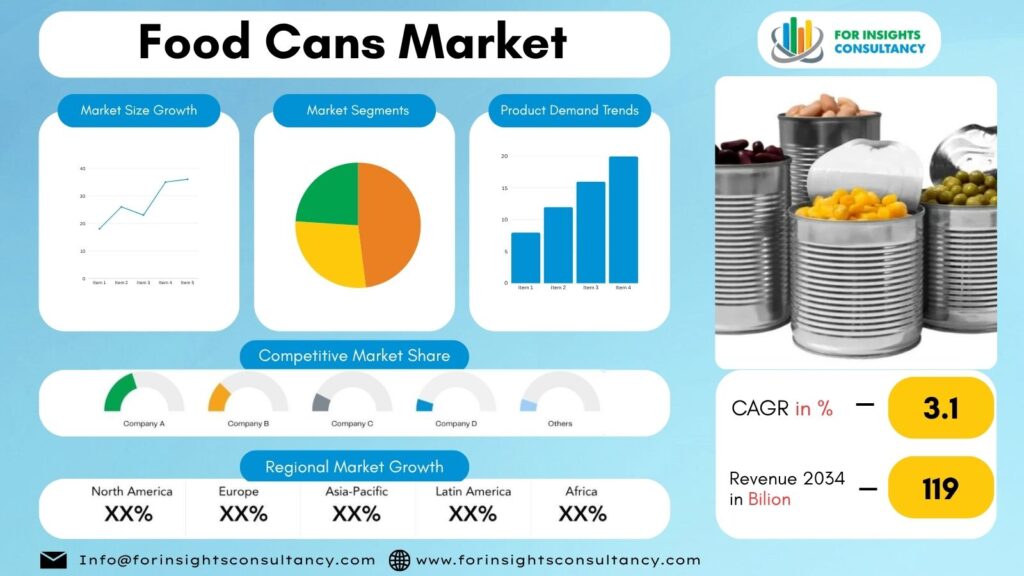
Food Cans Market Size & Forecast
Metric | For Insights Consultancy Estimate |
Market Size (2026) | 93.4 Billion |
Forecast (2034) | 119 Billion |
CAGR (2026–2034) | 3.1% |
Market Size (2025, base) | 90.5 Billion |
Largest Segment (2026) | 2-Piece Food Cans — ~80% share, favored for lighter weight and material efficiency. |
Leading Region (2026) | Asia-Pacific — largest and fastest-growing, driven by China/India packaged food demand and urbanization |
Food Cans Market Overview (2026)
Food cans represent an industry of metal containers that are designed for preserving and delivering processed foodstuffs such as fruits, vegetables, meat, seafood, and pre-prepared food items. It is estimated to be worth $93.4 billion in 2026 and grow to about $119 billion in 2034 with a ~3.1% CAGR based on 2025 as the base year. The growth in demand is expected owing to the high consumption of shelf-stable food packing solutions due to the influence of urbanization and a fast-paced lifestyle among consumers along with increasing organizational structures of retailing in developing countries. Two-piece cans account for almost 80% of the product type market share due to their efficient materials and lighter weight compared to traditional three-piece can design.
Leading among all other regions is the Asia-Pacific region, which is not only the biggest but also the fastest-growing region due to the increasing need for packed foods among its fast-growing population and higher disposable income levels in China and India, while North America and Europe lead in recycling and sustainable manufacturing of cans despite their slower growth compared to APAC region. Leading companies such as Conagra brands (market leader with approximately 12% market share), Campbell Soup Company, Kraft Heinz, Hormel Foods, and Nestlé form an important part of the competition, where strategies involve capacity expansion and sustainable packaging. For the future of the market, innovation in smart and easy-open cans, competition from pouches and cartons, and raw material price fluctuations (aluminum and tin/steel) will be the main factors influencing the margin up to 2034.
Request a Free Sample Copy: https://www.forinsightsconsultancy.com/reports/request-sample-food-cans-market
Food Cans Market Dynamics
Growth Driver 2026
Higher Demand for Convenient and Long-lasting Food Products
The growing trend of urbanization and hectic lifestyles is making consumers increasingly prefer ready-to-eat foods and long shelf-life foods in packaging, which leads to higher demand for airtight metal can packaging.
Organized Retail Growth
One of the key drivers of growth is the growing penetration of organized retail, including supermarkets, hypermarkets, and modern retail formats, driven by higher disposable income and evolving consumer preferences towards packaged food.
Growth in Ready-to-Eat Food Market
Consumer preference towards easy-to-use food products is further increasing the share of the ready-to-eat food segment, which is directly contributing to the growth in the demand for food cans market.
Innovations in Can Fabrication
The innovations in fabricating metal cans are providing the manufacturers with opportunities to add value to their products and explore innovative uses of metal cans ranging from easy to open cans to embossed designs.
Higher Preference for Sustainable Packaging Solutions
Consumers and regulators have become more interested in packaging solutions, which are recyclable in nature, making the manufacturers favor aluminum and steel cans compared to plastic packaging.
Trends 2026
Innovation in Light and BPA Free Packaging
Firms are focusing on lightweight packaging and elimination of hazardous substances such as BPA in response to health and environmental regulation changes in packaging sector.
Persistence of Two Piece Cans
Two piece cans have retained the largest market share (approximately 80%).
Sustainability and Recycling as Competitive Advantage
North America and Europe are at the forefront of recycling facilities and sustainability efforts, thereby using “recycling packaging” as a marketing edge even in slow-growing markets.
Price Volatility in Raw Material Prices
Fluctuating aluminum and steel/tin prices will be a consistent source of margin pressures.
Urbanization and population growth along with increasing disposable income in China and India will propel demand growth in packaged food – thereby food cans, making APAC the growth driver region.
Food Cans Market Top Companies Covered In this Report are
- Crown Holdings, Inc. — global leader, operating 147+ manufacturing plants across 37+ countries; segments include North American Food, European Food, Asia Pacific
- Ball Corporation
- Silgan Holdings Inc.
- Ardagh Group S.A. / Trivium Packaging (Ardagh’s food/specialty packaging arm)
- CAN-PACK S.A.
- CPMC Holdings Limited
- Kingcan Holdings Limited
- Toyo Seikan Group Holdings Ltd.
- Kian Joo Group
- Sonoco Products Company
- HUBER Packaging Group GmbH
- Daiwa Can Company
Branded Food Companies (End-Users/Fillers)
- Conagra Brands — reported category leader with ~12% market share
- Campbell Soup Company
- Kraft Heinz Company
- Hormel Foods Corporation
- Nestlé S.A.
Food Cans Market Company news 2026
Crown Holdings
Q1 2026 earnings (April 28, 2026): Global beverage can shipments rose 5%, with March marking the company’s highest shipments month ever. CEO Tim Donahue reported food can volumes up 3% for the quarter, with full-year growth guidance held at 2–3% amid a tightening can supply environment heading into summer.
Silgan Holdings
Continuing its acquisition-heavy growth strategy — 40 acquisitions completed to date, with its July 2024 purchase of Weener Plastics Holdings (dispensing solutions, ~$923M enterprise value) still shaping its expanded personal care/food packaging footprint into 2026.
Food Cans Market Segments
By Product Type
- 2-Piece Cans — dominant segment (~80% share), manufactured with fewer joints, reducing leakage risk and improving manufacturing efficiency
- 3-Piece Cans — traditional welded design offering strong sealing and reliable food protection, though losing share to 2-piece construction
By Manufacturing Process
- D&I (Drawn & Ironed) — provides uniform wall thickness and high production efficiency
- DRD (Drawn & Redrawn) — offers enhanced strength and structural integrity
- Drawn Wall-Ironed — advanced lightweight design with strong body structure
- Single Drawn — simpler design suited to select food applications
- Open Top Sanitary — designed for hygienic storage with secure sealing and easy opening
By Material
- Steel/Tin Cans — traditional material choice, valued for strength and cost-efficiency
- Aluminum Cans — growing share, favored for lighter weight and recyclability
- Others (composite/plastic-metal hybrid cans) — smaller, niche segment
By Can Size
- Medium-Sized Cans — significant share, widely used for vegetables, fruits, and seafood packaging
- Small-Sized Cans — gaining popularity, driven by single-serve meals and on-the-go consumption trends
- Large-Sized Cans — essential for bulk storage and institutional/industrial food processing applications
By End Use/Application
- Fruits & Vegetables — major application segment, core to the category’s preservation use case
- Meat, Poultry & Seafood — significant segment, driven by protein preservation and shelf-stability needs
- Ready-to-Eat Meals — growing segment, aligned with rising convenience food demand
- Pet Food — steady, established application
- Bakery & Confectionery — smaller, specialized segment
- Sauces, Jams & Pickles — established niche application
- Beverages — overlapping category with dedicated beverage can market, but relevant where food-grade cans serve dual purposes
- Others (soups, infant nutrition) — smaller specialized applications.
Food Cans Market Regional Insights
North America
Market Share (2026): ~32-34%
Key Brands: Crown Holdings, Ball Corporation, Silgan Holdings, Sonoco Products Company
Consumer Trend: Traditionally, the largest consumption market; due to high levels of per capita canned food consumption (soups, beans, veggies), mature distribution networks; increasing focus on BPA-free linings and recycling of aluminum containers due to increased awareness regarding sustainability; increasing pet ownership among Gen Z & Millennials has been mentioned as a demand driver.
Asia Pacific
Market Share (2026): ~18-20% – Derived directly from: Asia-Pacific region constituted 18% of the global food cans market according to Cantech Online, with forecast value expansion of 1.4 times in the period
Leading Brands: Local brands in China as well as growing operations of CAN-PACK and Crown Holdings
Consumer Trends: The fastest growing region in the world, with an incremental opportunity of ~$2.4 billion at ~5% CAGR; China dominates regional production and consumption due to hectic lifestyles of millennials which avoid fancy cooking at home; Vietnam and Malaysia (ASEAN) are fast emerging as key growth markets with increasing populations spending more on processed/packaged foods.
Europe
Market Share (2026): 26-28%
Estimate (in context: Europe & USA comprise ~60% of global market)
Major Brands: Ardagh Group, CAN-PACK S.A., Crown Holdings (operating regionally)
Market Forces: Very strong pressure on regulatory and consumer fronts to have packaging be recycled/reusable and sustainable, metal packaging is seen as better than plastic packaging. Mature market with low growth potential. Preference for canned fish, sauces, and vegetables.
Middle East & Africa
Market Share (2026): ~6–7%.
Leading Brands: Lack of major multinational manufacturing operations; predominantly import-dependent countries
Consumer Trends: Initial growth stages focused on urban areas; increasing need for shelf stable, easy to transport foods points to strong potential.
Latin America
Market Share (2026): ~8–9%
Dominant Brands: Regional packers along with increasing international packers (Ball Corporation, Crown Holdings)
Consumption Trends: Driven by increased urbanization and growing penetration of organized retail trade; canned fruits, vegetables, and meats continue to be essential elements of the diet.
Frequently Asked Questions
What is the size of the Food Cans market?
The global market for Food Cans has a valuation of about $ 93.4 Billion in 2026 and will reach $119 Billion in 2034, growing at a 3.1%.
Who are the biggest companies in the Food Cans industry?
The biggest companies in the Food Cans industry include Crown Holdings, Ball Corporation, Ardagh Group, Silgan Holdings, Sonoco Products Company, and CAN-PACK S.A.
What is the status of the EU BPA ban on food cans, and how does it affect global supply chains?
The EU’s BPA ban on food contact materials reached its main compliance deadline on July 20, 2026 (adopted via Regulation (EU) 2024/3190, with a further exception until January 2028 for cans preserving fruits, vegetables, and fishery products), forcing global can suppliers to accelerate the shift to BPA-free linings across their EU-bound supply chains.
Are canned foods as nutritious as fresh foods?
Canned foods are generally comparable in nutritional value to fresh foods (and sometimes higher in certain nutrients due to processing at peak ripeness), though they can have added sodium or syrup and slightly reduced levels of heat-sensitive vitamins.
What is the shelf life of canned food products?
Canned food products typically have a shelf life of 2 to 5 years, though many remain safe to eat well beyond that if the can stays undamaged and properly sealed.
Is Asia-Pacific worth exploring as a sourcing region, not just a growth market?
Certainly – the sheer presence of China as the largest manufacturing base and the growth rate of around 5% CAGR in the region make it probable that in the coming years, better sourcing opportunities may emerge there.
What material dominates the food cans market?
Aluminum is expected to dominate the market by material type, projected to generate approximately $20 billion by 2034 due to its lightweight, durable, and recyclable properties.
What is driving growth in the food cans market?
Key drivers include rising demand for convenient, shelf-stable food, increasing focus on sustainable and recyclable packaging, growth in pet food consumption, and expansion of food processing and preservation industries globally.
What’s Included in This Report?
- Market Size & Forecast — Historical data (2025 base year), current market valuation, and forecasts through 2034, including year-by-year revenue projections and CAGR analysis
- Market Segmentation Analysis — Detailed breakdown by material (steel, aluminum, tinplate, plastic, glass), can type (2-piece, 3-piece, composite), capacity, closure type, and end-use application
- Regional & Country-Level Analysis — Market sizing and growth trends across North America, Europe, Asia-Pacific, Latin America, and Middle East & Africa, including key country-level insights (US, China, India, Germany, Vietnam, Malaysia)
- Competitive Landscape — Company profiles, market positioning, and strategic analysis of major players including Crown Holdings, Ball Corporation, Ardagh Group, Silgan Holdings, Sonoco Products Company, and CAN-PACK S.A.
- Market Dynamics — In-depth analysis of growth drivers, restraints, opportunities, and challenges shaping the industry
- Regulatory Impact Analysis — Coverage of the EU BPA ban transition timeline (2026–2028) and its implications for global supply chains and packaging reformulation
- Emerging Trends & Innovation — Insights into sustainable/recyclable packaging shifts, BPA-free lining innovation, easy-open and embossed can technology, and lightweighting initiatives
- End-Use Industry Analysis — Demand patterns across meat/poultry/seafood, pet food, bakery & confectionery, sauces & pickles, fruits & vegetables, and tea & coffee segments
- SWOT & Porter’s Five Forces Analysis — Strategic frameworks assessing competitive intensity, supplier/buyer power, and market entry barriers
- Recent Developments & M&A Activity — Coverage of mergers, acquisitions, capacity expansions, and strategic partnerships among key industry players
- Custom Research Options — Availability of tailored analysis for specific countries, segments, or competitive benchmarking needs (available on request).
Buy This Report Now — https://www.forinsightsconsultancy.com/buy-now-food-cans-market (Access In-Depth Analysis, Forecasts & Company Profiles)
Related Market Reports of Food Category
Food Processing Equipment Market Research Report to 2034
Food Processing Automation Market Size, Share & Forecast 2034
Commercial Food Refrigeration Equipment Market Research Report to 2034
Frozen Meat Dumpling Market Size, Share & Growth Forecast 2034
Request TOC : https://www.forinsightsconsultancy.com/contact-us/
Select PDF License
Single User: $3499
Multiple Users: $4499
Corporate Users: $5499