

21 September-2026 Formats | PDF | Category: Food and Beverages | Delivery: 24 to 72 Hours
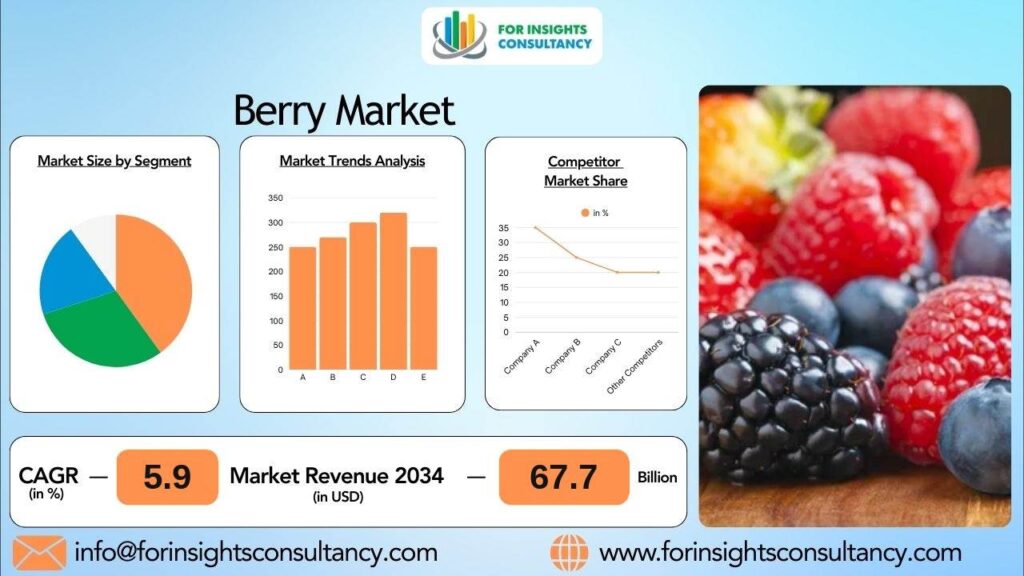
Berry Market Revenue Size & Growth Outlook
- Market Size (2026): USD 42.8 Billion
- Forecast (2034): USD 67.7 Billion
- CAGR (2026–2034): 5.9%
- Base Year: 2025
- Leading Segment (2026): Strawberries — the largest fruit-type segment, ahead of blueberries and raspberries.
- Top Region (2026): North America (~32% share); Europe is the strongest secondary market and shows the fastest regional growth momentum.
- Market Trends: The growing trend towards health conscious consumerism is the main factor, since the demand for antioxidants and clear label fruits is pushing berries towards becoming functional food ingredients and dietary supplements.
Berry Market Quick Market Briefing & Key Insights
Health positioning is still going to be the major force behind berry market expansion in 2026 and not just an advertising gimmick. Blueberries have the highest antioxidant content among common fruits with anthocyanin helping in blood sugar control and improved heart health, and the strongest consumer affinity towards such positioning belongs to Millennials and Generation Z. It is a trend that developed over two decades already: according to USDA-ERS statistics, the blueberry per capita consumption in the United States rose about ten times since the early 2000s.
In terms of production, the U.S. is the largest cranberry producer in the world, with more than 2/3 of global production. It is one of the main blueberry producers, with Oregon and Washington together producing nearly 55% of national blueberry production. However, there is a structural imbalance worth mentioning – the U.S. is the leading consumer of raspberries and blackberries with 38% of the consumption, while it is significantly lower than its production volume, resulting in increased imports from Mexico, Spain, and Morocco.
Mexico is the most important supply side story for 2026. According to USDA’s Foreign Agricultural Service, Mexico’s total berry production (blueberries, raspberries, blackberries, and strawberries) will increase by 4%, totaling 1.2 million metric tons, due to the increased investments in better varieties and shifted harvest time to benefit from higher prices. Strawberries are still the biggest category with 54% of production share, while only Michoacán provides 60% of national strawberry production.
In terms of berry types, strawberries hold the highest share in the fresh berries market segment, between 32%-35% for the period 2025-2026, owing to the wide applicability of strawberries in terms of fresh use, baking, dairy, beverages, confectionaries, and food service. Blueberries, meanwhile, represent the fastest growing berry variety, recording a CAGR of 6.9% -7.2%, depending on the dataset, owing to their position as “superfoods” and availability throughout the year through counter-seasonal sourcing.
Request a Free Sample Copy: https://www.forinsightsconsultancy.com/reports/requests-sample-berry-market
Berry Market Trends 2026
Health positioning keeps deepening, led by blueberries
Blueberries have the greatest antioxidant content of any popular fruit, while anthocyanins are related to blood sugar regulation and heart health, but this is not just a trend that stays still. The average consumption of blueberries per person in the USA has increased about ten times in the last twenty years (USDA-ERS), while Millennials and Generation Z are the biggest fans of such positioning.
Volume is up, but value is diverging — especially in blueberries
This is the trend that most general reports overlook. In 2025, Mexico had increased its exports of berries to 700,500 tons, although export value dropped to $3.4 billion due to blueberry price war resulting from increased supply from Peru. Increasing world production is beginning to exceed the demand that premium prices can support.
Counter-seasonal Southern Hemisphere supply is now structural, not supplementary.
Chile and Peru provide the source of blueberry supply during the time when the Northern Hemisphere’s production cycle for blueberries is over, thus making it possible to have these products available all year round. This is directly responsible for the rise of trend #2, as Peru’s growth led to the 2025 price war.
Controlled-environment and protected agriculture is scaling from niche to standard
The growing practice of substrate cultivation and macrotunnel systems is now standard practice for raspberries in particular, while the development of greenhouses in Baja California and Jalisco is now permitting continual harvest cycles for export purposes.
Growth Drivers 2026
Rising demand from import-dependent developed markets
America utilizes approximately 38% of total raspberries and blackberries available around the globe, which is more than its production capability – this shortage in demand stimulates exportation from Mexico, Spain, and Morocco, among others, which contribute to nearly 59% of total global exports of raspberries and blackberries.
Breadth of end-use application, led by strawberries
Strawberries enjoy the biggest market share among the category players (around 32-35%) simply because there is no channel-based concentration of demand – strawberries cater to fresh consumption, baking, dairy, beverages, confectionary, and food services markets at the same time.
Emerging-market retail sophistication, especially in Asia-Pacific
Japan’s blueberry demand (growing ~4.8% through 2036) is driven by consumer association with eye health and cognitive benefits, but growth is gated by strict retail quality standards for size, color, and freshness — meaning cold-chain and quality-control investment is itself becoming a growth enabler as suppliers scale up to meet those specifications.
Domestic consumption growth in producing countries, not just export markets
But another factor tends to be forgotten: Mexico’s own berry consumption is expected to total 499,450 metric tons in 2026, spurred by industry promotions in the country and the growing interest in healthy foods – strawberries account for more than 5 lbs of the domestic consumption. Producer countries are turning into consumers too.
Top Companies Covered in the Berry Market are
- Driscoll’s
- Naturipe Farms LLC
- Fresh Del Monte Produce
- Surexport Compañía Agraria SL
- North Bay Produce Inc.
- Agrovision Corp
- Agroberries SpA
- Wish Farms
- Hall Hunter Partnership
- Ocean Spray
Berry Market Company news 2026
Fresh Del Monte Produce completes historic Del Monte brand reunification — March 19, 2026 — Fresh Del Monte Produce closed its acquisition of select Del Monte Foods assets for approximately $285 million, following a court-supervised sale under Section 363 of the U.S. Bankruptcy Code. The deal brought canned vegetable, tomato, and refrigerated fruit businesses (Del Monte, S&W, Contadina, Take Root Organics trademarks, plus the Joyba bubble tea brand) under Fresh Del Monte’s ownership, along with four U.S. facilities, two in Mexico, and one in Venezuela — reuniting the Del Monte brand under a single owner for the first time in nearly four decades. The acquisition was first announced January 27, 2026, with a sale hearing on January 28, and an amendment to the original asset purchase agreement was filed shortly before close.
Driscoll’s presents at Fruit Attraction 2026 — mid-2026 — Driscoll’s used the major European produce trade show to showcase its EMEA berry operations and breeding program, emphasizing its proprietary variety development and long-term grower partnerships across Europe, the Middle East, and Africa.
Berry Market Segments
By Berry Type
Strawberries — largest category in terms of share of total (approximately 32-35%, based on source) due to wide utilization scope: consumption, bakery, dairy, beverages, confectionary, foodservice all contribute to volume. California is the largest producer in U.S.; Michoacán, Mexico contributes to over 60% of domestic strawberry volume.
Blueberries — fast growing category (approximately 6.9-7.2% CAGR, by tracker), benefitting from positioning as a superfood/antioxidants fruit. Oregon and Washington together are responsible for nearly 55% of U.S. blueberry volume; Peru and Chile are the largest producers in Southern Hemisphere, supplying during opposite season.
Raspberries — lower volume but fastest growing category in Mexico (+7% to 194,000 tons in 2026), driven by substrate cultivation and macro-tunnel technology; 80% of raspberries volume in Mexico is being exported, mostly to the United States.
Blackberries — steady growth (+3% in Mexico to 274,000 tons in 2026), accompanied by ongoing variety shift from traditional Tupi cultivar to Erandy, Sultana, Victoria for better taste and yield.
Cranberries — distinct subcategory, dominated by U.S. production (approximately two thirds of world volume), and characterized by higher processing/juicing share compared to other berry categories.
By Form
Fresh – This is the predominant and most monitored classification, which requires refrigerated facilities and forms the major part of the discussions in regard to tariffs and phytosanitary issues in this particular classification.
Frozen/processed – Pertains to baking, dairy, and beverages; not as prone to the logistics risk as fresh products, and also represents where poor quality or surplus fresh production is processed.
By Application
Direct consumption – the biggest application, particularly in relation to strawberries and blueberries in the retail setting.
Bakery – a major application area, particularly for strawberries and blackberries; directly connects this application area with the bakery processing equipment market discussed above.
Dairy products (yogurt, ice cream) – a constant, established application area for all berries.
Beverages – a developing application area, highlighted in Fresh Del Monte’s 2026 product portfolio expansion through the addition of bubble tea (Joyba) through the acquisition of Del Monte Foods.
Confectionery and foodservice – minor but constant application areas, explicitly cited as part of the reasons that strawberries dominate application areas.
Berry Market Regional Insights
Europe
Consumption and re-distribution center – the Netherlands is the primary gate to the European Union market regarding fresh berries imports. The European Union imposes the REACH phytosanitary procedures concerning the non-European suppliers’ entrance into the market, a hard trend as opposed to a soft trend. Major players: Driscoll’s (Europe Middle East Africa active, exhibited in Fruit Attraction 2026 in June), Surexport Compañía Agraria SL (Spain, developing blueberry cultivation on a larger scale), Hall Hunter Partnership (UK grower/supplier).
North America
Most dominant market share in 2025 (~31% to 32%), driven by berries (strawberries – California, blueberries – Oregon/Washington; together comprise ~55% of total U.S. production). Top brands: Driscoll’s (corporate headquarters located in Watsonville, CA – largest worldwide berry producer), Naturipe Farms (world’s largest blueberry marketing cooperative of North America), Fresh Del Monte Produce.
Biggest story for consumers and trade in 2026 – gap between the volume consumed in the U.S. and domestic production – the U.S. accounts for ~38% of worldwide consumption of raspberries/blackberries whereas the domestic production is relatively small. Major corporate event in 2026 – acquisition of Del Monte Foods’ assets by Fresh Del Monte for ~$285 million (closed on March 19) bringing Del Monte brand back under one roof for almost four decades and adding prepared foods/beverages to Fresh Del Monte business portfolio.
Asia-Pacific
Fastest growing region (CAGR of 5.47%, 2026-2031). Japan is the one to watch when it comes to consumer uptake of blueberries (growth of ~4.8% until 2036) because of the link that consumers see between the fruit and eye health, as well as cognitive health, but growth is constrained by the stringent requirements of Japanese retailers regarding the size, colour, and freshness of berries.
Middle East & Africa — Smallest, Early-Stage Region
South Africa: the regional supply and re-export center.
The trade in strawberries in South Africa reflects the dual nature of the region, being both the consumer and transit country, since the major part of its imports come from Egypt (78% of import value), and the country exports mainly to the Gulf states, with the UAE, Saudi Arabia, and Qatar taking up to 72% of South African strawberry exports. The country is also considered to be the largest market of blueberry components in Africa, representing approximately 40-45% of regional consumption.
Frequently Asked Questions
What is the size of the berry market?
Berry market is estimated at USD 42.8 Billion in 2026 and is projected to rise to USD 67.7 Billion by 2034, register a CAGR of 5.9% during the 2026–2034 forecast period.
Which region leads the berry market?
North America possesses the largest share at around 32%, owing to higher berry consumption and more efficient cultivation methods; however, Europe is the region that has the fastest growing momentum.
What is driving growth in the berry market?
The increase in the trend of health-focused consumption plays a vital role, as there is an increased demand for fruit containing antioxidants and free from artificial labels, making berries shift away from being merely fresh fruits.
Who are the key players in the berry market?
Some of the key players in this industry include Driscoll’s, Dole Food Company, Naturipe Farms LLC, Hortifrut S.A., SunOpta Inc., Fresh Del Monte Produce, Grimmway Farms, and Ocean Spray Cranberries.
Which company is the largest player in the berry market?
Driscoll’s is well known to be the biggest producer of berries under its brand name worldwide and leads in the market in terms of strawberries, blueberries, raspberries, and blackberries.
What factors should buyers consider when sourcing berries?
Important factors would be the harvesting seasons by regions, cold chain logistic capability, supplier certification (organic, food safety, fair trade), price fluctuation during peak versus off seasons, and whether the fresh or frozen variety is more suitable for the purchaser.
What’s Included in This Report — Berry Market
Market Size & Forecast
: Historical data (2020–2025) and forecast values (2026–2034), with market revenue estimated at USD 42.8 billion in 2026 growing to USD 67.7 billion by 2034 at a CAGR of 5.9%.
Segmentation Analysis
Detailed breakdowns by Berry Type (strawberries, blueberries, raspberries, blackberries, cranberries, others), Form (fresh, frozen, processed), Application (food & beverages, personal care, dietary supplements & pharmaceuticals), and Distribution Channel (offline retail, online/e-commerce).
Regional & Country-Level Insights
Market share and growth analysis across North America, Europe, Asia-Pacific, Latin America, and Middle East & Africa, with country-level detail for key markets including the U.S., Germany, China, Chile, and Peru.
Consumer & Buyer Trends
Coverage of health-and-wellness demand, clean-label preferences, seasonal sourcing patterns, and value-added product innovation (snacking formats, functional beverages).
Customization Options
Ability to request additional country-level breakdowns, company profiles, or a narrower/broader market scope (e.g., single-berry-type deep dives) tailored to specific research needs.
Who Should Buy This Report?
Berry Growers & Producers
Benchmark regional production trends, determine high-growth applications (functional foods and beverages), and justify expansion/diversification against the latest market information.
Food & Beverage Manufacturers
Brands from bakeries, dairy products, beverages, and snacks which are using berries as an ingredient can benefit by using this information to anticipate price fluctuation due to seasonality, discover new applications, and schedule their purchase plans accordingly.
New Market Players & Start-Ups
Analyze competition strength, underpenetrated geographies (Middle East and Africa, and some parts of Asia-Pacific), and enter the market from there on.
Market Analysts & Consultants
Use this report as a base to provide market analysis to their clients.
Buy This Report Now — https://www.forinsightsconsultancy.com/buy-now-berry-market/ (Access In-Depth Analysis, Forecasts & Company Profiles)
Related Market Reports of Food Industry
Frozen Fruits Market Size, Share & Growth Forecast 2034
Kiwi Market Size & Forecast to 2034
NFC Juice Market Size, Trends 2026
Frozen Snacks Market Report 2026–2034
Select PDF License
Single User: $3499
Multiple Users: $4499
Corporate Users: $5499