
28 September-2026 Formats | PDF | Category: Food and Beverages | Delivery: 24 to 72 Hours
Baby Food Market Size Statistics
- Market Size (2026): USD 84.0 Billion
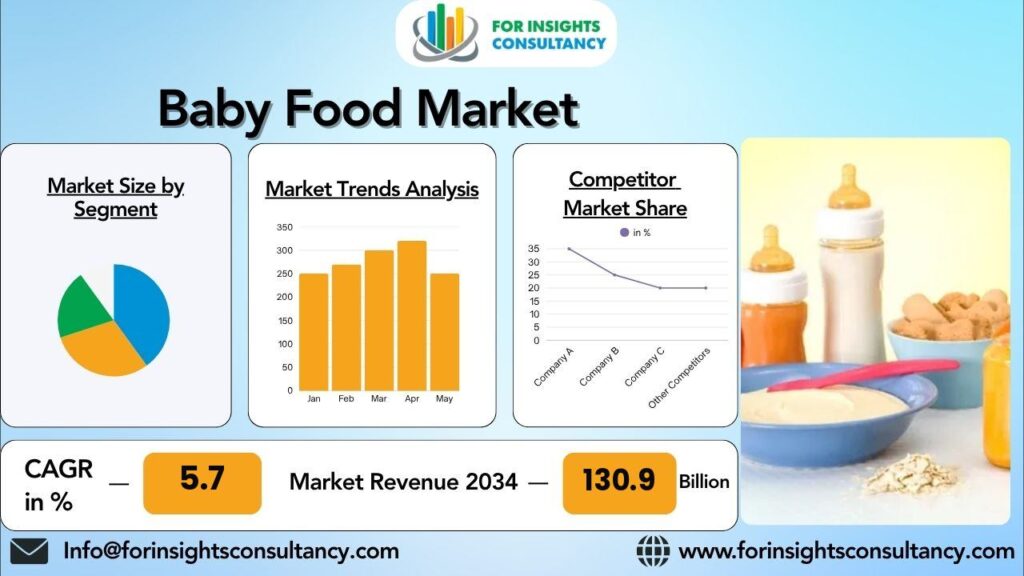
- Forecast (2034): USD 130.9 Billion
- CAGR (2026–2034): 5.7%
- Base Year: 2025
- Leading Segment (2026): Infant milk formula, about 60% of value
- Leading Region (2026): Asia Pacific, about 50% share
- Core Trends: Ingredient safety and traceability now drive purchase decisions, pushing parents toward verified, clean-label, HMO-enriched premium nutrition.
Baby Food Market Overview 2026
The global market for baby foods is growing as more and more parents look for convenient, healthy, safe, and premium food items for their babies and toddlers. Market growth is fueled by the growing consumption of infant formulas, baby cereals, purees, ready-to-eat products, organic baby foods, and special nutritional preparations. Lifestyle changes, urbanization, awareness of infant nutrition, online shopping, and product innovation are some factors affecting consumer behavior.
Infant formula and milk-based nutrition products retain their relevance within the Baby Food Market in 2026, whereas complementary foods, like cereals, purees, snacks, and ready-to-eat meals, help in broadening the product scope in terms of diversification. There is a growing trend of premium and specialized baby food products that meet consumers’ needs for functional nutrients, clean-label baby foods, organic baby foods, and baby food products designed specifically for particular ages.
The Asia Pacific region is a crucial growth market for the baby food market owing to the presence of huge consumer base, high urbanization, rise in number of middle class families, and increased awareness about nutrition in infants. Countries such as China, India, Japan, and South Korea are important markets to watch out for, besides the countries in Southeast Asia that are presenting growth opportunities for international as well as regional manufacturers. North America and Europe continue to be mature markets, which are characterized by intense brand competition, premium products, organic products, regulations, and consumer interest in ingredients.
India baby food market is being looked into owing to the huge young consumer base, increasing urban consumers, growth in the organized retailing industry, and increasing use of e-commerce. The demand is for infant formula, cereals, prepared food, snacks, and complementary food products. For manufacturers operating in India, there is the need to understand local nutritional requirements, consumer preferences, affordability, distribution, and brand competition.
Request a Free Sample Copy: https://www.forinsightsconsultancy.com/reports/request-sample-baby-food-market (Sample Include key points such as 2026 market size, 2034 forecast, CAGR, leading product segment, fastest-growing segment, dominant region, major companies, trends, growth drivers, challenges, and opportunities.)
Trends 2026
Safety and traceability become the buying criterion
The 2026 cereulide recall which originated from contaminated ARA oil became a problem for Nestlé, Danone, and Lactalis. The European Commission is currently working on an act to ensure tests for this toxin on infant formula. Brands that show accountability for ingredient source and testing get more credibility and those that remain unaffected like HiPP and Holle increase production.
Organic and clean-label premiumisation
The parents are turning towards minimally processed foods which are not genetically modified. The growth rate of organic baby foods is forecast to grow at 10.3%. This will be a high growth rate compared to the general market. The product launch by Beech-Nut in June 2026 is a reflection of this trend.
Finger foods and self-feeding formats over traditional purees
Baby food revenues from Hain Celestial in its fiscal 2026 demonstrate the dichotomy. Sales in the baby category decreased by 12%, but mainly due to purees. The finger foods and cereals are experiencing growth in the North American market.
Functional, HMO-enriched nutrition
Manufacturers are aiming to reproduce breast milk. Modern formulas contain elements like DHA, ARA, pre- and probiotics, and immunomodulators. In China, formulas containing HMO and functional formulas are anticipated to grow.
Baby Food Market Growth Drivers 2026
Government pro-birth support in China
The national childcare allowance in China is a monthly 300-yuan payment for each baby up to age 3. The central government contribution in 2026 will be 99.9 billion yuan, and total expenditure, including that from local governments, is expected to be close to 110 billion yuan. According to Xinhua, it covered more than 25 million babies. Creating “a baby-friendly society” is one of the priorities for the 15th Five-Year Plan (2026-2030). The allowance aims to reduce costs associated with bringing up an infant, which, in turn, helps to increase expenditures on formula and complementary products. According to some demographers, the sum may not be high enough to incentivize people to have more babies.
Strong demand in Asia-Pacific and China
In the Q1 of 2026, Danone reported that Asia Pacific was number one at 6.0% like-for-like growth and that China, North Asia, and Oceania were up by 10.3%. For Q2, Asia-Pacific grew by 5.2% due to competitive growth in China infant milk formula (IMF). Danone reports competitive growth in IMF China in a normalizing category, hence share growth is aiding more than category growth.
Regulatory modernization and safety upgrades
Operation Stork Speed is the first-ever thorough evaluation of nutrients for infant formula in the US since 1998 done by the FDA. The suggestions made by the experts from this organization include the intake of DHA and arachidonic acids and the maximum amount of linoleic acid. The tests of FDA conducted in April 2026 on more than 300 samples have revealed that there are low amounts of heavy metals and pesticides in them.
Sustained formula reliance and feeding gaps
According to the FDA, while in the US 84% of the infants have consumed breast milk at least once in their life, yet only 27% receive exclusive breastfeeding up to six months of age.
Top Companies Covered in the Baby Food Market are
- Nestlé (NAN, SMA, BEBA, Gerber, Wyeth Nutrition)
- Danone (Aptamil, Cow & Gate, Nutricia, Neocate)
- Abbott Laboratories (Similac, PediaSure)
- Reckitt / Mead Johnson (Enfamil, Nutramigen)
- Lactalis (Nutrition Santé)
- Hero Group
- HiPP
- Kewpie
- Morinaga Milk Industry
- Hain Celestial (Earth’s Best)
- Arla Foods
- Ausnutria
Baby Food Market Company news 2026
Cereulide recall (Nestlé, Danone, Lactalis)
Early 2026 saw a global infant formula recall over cereulide contamination. Nestlé recalled NAN, SMA, BEBA and Alfamino in more than 60 countries, which was the largest recall in its history, and booked a CHF 185 million hit. Danone withdrew batches of Aptamil and Cow & Gate in January and February.
Nestlé H1 2026
Nutrition organic growth was -1.2% for the half but recovered to 1.7% in Q2. Adult and medical nutrition (Nature’s Bounty, Vital Proteins, Pure Encapsulations) offset infant weakness. Nestlé’s report says Gerber’s performance is still challenged. It expects to regain share by year-end.
Baby Food Market Segments
By Product Type
- Infant formula (milk formula)
- Starter or Stage 1 (0-6 months), follow-on (6-12 months) and growing-up or toddler milk (1-3 years).
- Specialized formula: hypoallergenic and allergy (e.g., Neocate, Nutramigen, Alfamino), anti-reflux, lactose-free, soy or plant-based, and preterm formula and fortifiers (the NICU segment).
- Prepared baby food: ready-to-eat purees in jars, pouches and tubs.
- Dried baby food: infant cereals, and instant meals and powders.
- Snacks and finger foods: melts, puffs, biscuits and teething items.
- Other: frozen baby food, fresh subscription meals (e.g., Little Spoon) and supplements.
By ingredient or positioning
- Conventional and organic, the latter certified.
- Plant-based, such as soy or blends like Danone’s dairy-and-plants formula.
- Functional or fortified: HMOs, DHA/ARA, probiotics and prebiotics.
- Premium and super-premium versus economy and private label.
By age or stage
- Newborn to 6 months (mainly formula).
- 6-12 months (complementary feeding: purees and cereals).
- 12-36 months (toddler foods and growing-up milks).
By Distribution Channel
- Offline: supermarkets and hypermarkets, pharmacies and drugstores, convenience stores, specialty baby stores and hospital and NICU channels.
- Online: retailer e-commerce, cross-border platforms (relevant to China and Hong Kong, where Nestlé’s recalls reached these platforms) and direct-to-consumer subscriptions.
Baby Food Market Regional Insights 2026
North America
Leading brands: Similac (Abbott), Enfamil (Reckitt/Mead Johnson), and Gerber (Nestlé).
New brands: ByHeart, Bobbie, Nara Organics, Little Spoon, and Munchkin.
Market loss: Abbott lost market share in 2025, with its US nutrition sales declining by 2.3% to $3.6 billion and US pediatric sales dropping by 18% in Q4. The loss of a large WIC contract was blamed by Abbott’s CEO. Abbott is reacting to market loss by lowering prices and introducing new products.
Gerber: According to Nestlé itself, Gerber’s performance is still under pressure.
Safety: Botulism outbreak at ByHeart and product recall from Nara affected newer premium and organic brands. FDA noted that contaminant levels are low in large sample sizes.
Asia Pacific
Demand. Chinese births were only 7.92 million in 2025, down 17% from 9.54 million. Fertility levels stand at 0.96. This is an important caveat to the optimism on the subsidies that I discussed earlier – China will now need to grow its volume through the share and premium mix rather than increased births.
Leading Brands. Aptamil and Nutricia (Danone), and NAN and Wyeth Nutrition (Nestle). Danone’s China, North Asia and Oceania region was up 11.7% in 2025 on a 29.2% profit margin, and 10.3% in Q1 2026.
India. According to Danone, it had a strong competitive growth of Aptamil in India. Nestle India faces a regulatory case (September 18) regarding promotional claims of Nan Excella Pro and Lactogen Pro.
Europe
Leading Brands. Aptamil, Cow & Gate, SMA, BEBA, NAN, Lactalis brands, and HiPP.
Consequences for Danone. Danone’s Europe division was up only 0.6% in Q1, but its Specialized Nutrition business showed steady recovery in Q2. EU considers additional testing of cereulide.
Latin America & Middle East/Africa
Latin America
Latin America. Despite posting solid volume growth (+16.3%), Aptamil, a Danone brand, experienced deceleration in Q4 2025 due to price growth (+9.7%).
Middle East & Africa
Middle East region. Disruption in shipping associated with the Iran situation affected Danone in Q1, and a catch-up took place in Q2. The Middle East accounts for just 2-3% of Danone’s net sales.
Frequently Asked Questions
How big is the baby food market in 2026?
The global Baby Food market is valued at $ 84.0 Billion in 2026.
What will it be worth in 2034?
About USD 130.9 Billion, at a 5.7% CAGR from 2026.
Which segment leads the Baby Food market?
Infant formula (milk formula) leads the baby food market.( at about 60% of value.)
Which region leads the Baby Food market?
Asia-Pacific leads the Baby Food market.
Which Baby Food market segment are growing fastest?
Organic baby food, at about 10% a year, and online sales.
Who are the top players of the Baby Food market?
Nestlé, Danone, Abbott, Reckitt (Mead Johnson) and Lactalis lead the market, though I ranked them by prominence rather than verified market share.
What’s Included in This Report — Baby Food Market
This report provides a comprehensive analysis of the Baby Food Market, covering the following:
- Market size and forecast, 2026–2034, with CAGR
- Segmentation by product, channel, category and region
- Competitive profiles and market share analysis
- Trends, drivers, restraints and opportunities
- Regulatory and supply-chain risk assessment
- Analyst support and Excel data pack
Why Buy This Research Report?
- Decide with confidence: figures are triangulated across multiple sources, not copied from one.
- Spot growth pockets: find the fastest segments, channels and countries.
- Track competitors: see who is gaining or losing after the 2026 recall.
- Manage risk: understand safety, regulatory and sourcing exposure.
- Save time: get ready-to-use data for strategy, pitches and investment cases.
Buy This Report Now — https://www.forinsightsconsultancy.com/buy-now-baby-food-market/
Related Market Reports of Food Industry
Baby Drinks Market Size, Share
Baby Gourmet Food Market Research Report
Table of Contents
For TOC Contact us: https://forinsightsconsultancy.com/contact-us/