

PCB Design Software Market Research Report by Component (Software/Tools,Services), By Deployment Mode (On-Premise, Cloud-based), By Design Complexity (High-end Software, Mainstream Software, Low-end Software), by End-User Industry (Consumer Electronics, Automotive,Telecommunications, Aerospace & Defense, Medical Devices, Industrial & Manufacturing, Computers), by Offering, and Region Global Market Analysis and Forecast, 2025-2034
Aug-2025 Formats | PDF | Category: Electronics | Delivery: 24 to 72 Hours
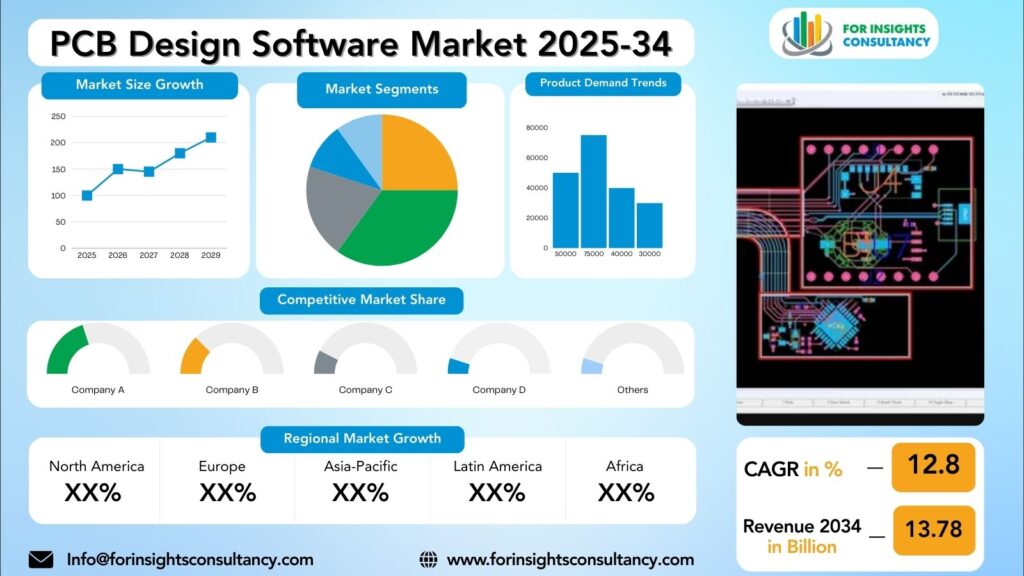
PCB Design Software Market is forecast to increase from USD 4.06 billion in 2025 to USD 13.78 billion by 2034, at a CAGR of 12.8%.
PCB Design Software Market: A Comprehensive Overview and Future Developments
The Printed Circuit Board (PCB) Design Software Market consists of electronic design automation (EDA) and computer aided design (CAD) packages used for the creation, simulation, validation and optimization of printed circuit boards (PCBs) by electronic systems designers. PCB design packages are used by engineers to perform circuit schematics, PCB layout, component placement, signal integrity analysis, thermal analysis, design rule checks, manufacturing documentation, hardware design collaboration and other tasks required to develop high quality electronic products. PCB design software is used across a broad range of industries including consumer electronics, automotive, aerospace & defense, telecommunications, industrial automation, healthcare, semiconductor manufacturing and IoT devices.
From last decade, the rapid growth of electronic device complexity, its digitization, the shrinking of electronic components, and the broader usage of advanced semiconductors technologies have resulted in a maximum volume change of the industry so far. As the products have been designed to be smaller, faster, and connected, the PCB design has been advanced from now and then single layer PCB to the more sophisticated multilayer, high density interconnect (HDI), flexible PCB, rigid-flex, high speed PCB design iterations. Also, the surging electric vehicle (EV), 5G architectures, artificial intelligent hardware, edge computing, and wearable electronics are inducing a strong tendency of PCB design tools.
An ever increasing demand for high performance consumer equipment, connected devices and intelligent industrial systems continues to be a major growth factor. Manufactures are continuously launching smarter phones and laptops, more sophisticated medical devices, driverless vehicles, robotic machinery, telecommunication systems and industrial control systems demanding highly reliable and miniature PCB designs. As such, design teams are inevitably turning to the use of integrated PCB design tool incorporating simulation, verification and co-design features to optimize time-to-market, reduce design iteration and bring product to conclusion faster.
Even more legacy and new emerging technologies are impacting the competitive environment. Various forms of AI/ML (artificial intelligence/machine learning), cloud based design platforms, digital twins, collaborative real-time design platforms, 3D visualization, automated routing algorithms and simulations etc. Are significantly enhancing engineering productivity and design precision. Today‘s PCB design software is expected to have comprehensive EMI analysis, SI simulation, thermal management optimization, DFM/DFT design for manufacturing, digital prototyping etc. functionalities to bring about complex electronic product development with minimized manufacturing uncertainties and expenses.
The regulation standards and manufacturing demands are shaping the market as well. Industrial standards on product safety, electromagnetic compatibility (EMC), green environment policies, quality assurance, and so on, are applying to electronic products. For those manufacturers serving in heavily regulated sectors, passing IPC design guides, RoHS, REACH, ISO quality system, and sector-based regulations, is no longer an option but a prerequisite. To meet manufacturers’ needs, PCB design software developers are embedding tools for automatic detection, documentation management and manufacturing validation.
North America will still be the largest regional market with comprehensive semiconductor ecosystem and hi-tech electronics manufacturing, high level of investment in aerospace and defense technologies, and widespread digital engineering applications. Europe will also show stable growth led by automotive electrification, industrial automation, and high investment in next-generation manufacturing. But the fastest growth in the world will be seen from Asia-Pacific regions due the fast-growing electronics manufacturing, semiconductor output, consumer electronics segment in the short range, and growing investments in electrification of vehicles, Communication networks, and industrial digitalization in the long range from China, Japan, South Korea, Taiwan, and India.
The PCB Design Software Market is forecast to witness sustained long-term growth driven by rising adoption of intelligent (AI-based) design automation, cloud-integrated electronic engineering, rapid advances in digital fabrication, next generation chip design and emerging simulation tools over the coming years. This would offer a wide range of opportunities to PCB software developers, electronics manufacturers, semiconductor firms and engineering solution providers during the forecast period.
PCB Design Software Market Dynamics
Growth Drivers
The Internet of Things (IoT) has significantly impacted the way we interact with technology, leading to the need for advanced PCB design software to support the development of these devices. As technological advancements continue to advance, the complexity of modern electronic devices demands software that can handle multiple layers, high-speed signals, and tight design constraints. The globalization of the electronics industry necessitates software that supports collaboration across borders, such as cloud-based PCB design software, enabling teams to work in real-time regardless of their location. Companies are also looking for ways to streamline operations and reduce costs. PCB design software with automation, simulation, and design validation features can help save time and resources, improving efficiency and profitability. By investing in the right software tools, companies can stay ahead of the curve and deliver superior products to their customers.
Restraints
The PCB design software market is evolving and offering solutions to address design engineers’ challenges. To enhance the design process, companies can invest in training and education programs, such as online courses, workshops, and certifications. Collaborative design platforms, which offer cloud-based solutions, can help mitigate compatibility issues and streamline the design process. These platforms enable real-time collaboration, version control, and seamless integration with multiple software tools, enhancing productivity and efficiency. Companies can also explore cost-effective alternatives, such as subscription-based pricing models or open-source software tools, to make advanced PCB design software more accessible to a wider range of users without compromising on quality or performance.
Opportunity
To stay competitive in the electronics industry, companies should invest in research and development, build strategic partnerships, focus on customer experience, and remain agile and adaptable. Continuous investment in research and development helps companies develop innovative solutions that meet customer needs. Collaboration with technology providers, manufacturers, and industry associations can expand reach and create new business opportunities. Offering exceptional customer support and training programs can build loyalty and attract new customers.
Challenges
PCB design is a complex process requiring meticulous planning, precise engineering, and attention to detail. With advancements in technology, modern PCBs are becoming more intricate and compact, requiring sophisticated software tools to design them effectively. Businesses face challenges in finding software that can handle the complexities of modern PCB design while being user-friendly and intuitive.
Compatibility and integration with other tools and systems used in the design process are another challenge in the PCB design software market. Ensuring seamless integration with other tools and systems is crucial for a smooth workflow.
Cost is a significant factor when choosing PCB design software, especially for small to medium-sized businesses with budget constraints. Calculating the return on investment (ROI) of the software is essential to determine if the benefits outweigh the costs in the long run.
Effective training and support are essential for businesses to get the most out of their PCB design software. Many companies invest in software without considering the time and resources needed to train employees on how to use it effectively. Access to reliable customer support and resources is critical when issues or questions arise during the design process.
PCB Design Software Market Top Companies Covered In This Report:
Evaluate The Strategic Positioning And Innovation Pipelines Of Leading Market Companies-From Multinational Enterprises To Disruptive Regional Firms. Understand How Key Players Are Innovating, Expanding, And Capturing Value, And Use Competitive Benchmarks To Plan Your Next Move.
- Siemens
- Mentor Graphics
- Cadence Design Systems, Inc.
- ZUKEN INC.
- Altium Limited
- CadSoft Computer Inc.
- Novarm
- Shanghai Tsingyue Software Co., Ltd
- Forte Design Systems, Inc.
- Synopsys, Inc.
- Dassault Systemes SE
- Westdev Ltd
- Ansys, Inc.
PCB Design Software Market News
2025 News
June 23, 2025 Siemens turbocharges semiconductor and PCB design portfolio with generative and agentic AI
Siemens adds AI capabilities across EDA portfolio, enhancing productivity, accelerating innovation and speeding time-to-market. New AI system enables EDA engineers to leverage AI securely within established EDA environments. Increased access to generative and agentic AI with NVIDIA NIM microservices and NVIDIA Nemotron models accelerates system-on-a-chip (SoC) and chip design flows, PCB systems design and verification
Cadence Design Systems, Inc.: Cadence continued to leverage the “AI Supercycle.” In its Q2 2025 earnings report, the company cited AI-driven growth across its portfolio. It also launched its Millennium M2000 AI Supercomputer to accelerate design and simulation tasks. In a move to expand its offerings, Cadence also announced the acquisition of embedded security firm Secure-IC.
Mentor Graphics (now Siemens EDA): As part of Siemens Digital Industries Software, Mentor Graphics’ news was focused on integrating AI into its tools. Siemens EDA’s 2025 updates to its electronic design automation solutions include generative and agent-based AI features. The company also continued to refine its cloud-based offerings and terms of service to align with the evolving market.
2024 News
Novarm: The UK-based company behind the PCB design software DipTrace was dissolved in July 2024.
ZUKEN INC.: Zuken’s focus in 2024 and 2025 was on digital transformation. The company launched its CR-8000 2025 update, which includes AI-enhanced support for high-speed, high-density PCB designs, intelligent layout acceleration, and real-time reliability validation. Zuken also emphasized its commitment to Model-Based Systems Engineering (MBSE) to help customers manage the complexity of modern product development.
Segmented View of the Industry:
The PCB Design Software Market Is Mapped Through A Multidimensional Lens-Tracking Shifts Across Product Type, Applications, And Geographic Regions. This Segmented Approach Enables Businesses To Localize Their Growth Plans And Align Offerings With The Most Profitable Demand Centers.
Segmentation by Component
- Software/Tools
- Services
Segmentation by Offering
- Standalone Software
- Integrated Suites
Segmentation by Deployment Mode
- On-Premise
- Cloud-based
Segmentation by Design Complexity
- High-end Software
- Mainstream Software
- Low-end Software
Segmentation by End-User Industry
- Consumer Electronics
- Automotive
- Telecommunications
- Aerospace & Defense
- Medical Devices
- Industrial & Manufacturing
- Computers
Global Geographic Coverage:
The Report Provides In-Depth Qualitative and Quantitative Data On the PCB Design Software Market For All Of The Regions And Countries Listed Below:
North America
The United States is a leading player in the PCB design software market, with companies like Altium, Cadence Design Systems, and Mentor Graphics leading the way in developing advanced tools for engineers and designers. Canada, despite being smaller in market share, has several key players in the industry, including Autodesk and Zuken, offering eco-friendly solutions for electronics design. Mexico, a key player in the global electronics manufacturing industry, has seen significant growth in the PCB design software market due to its skilled workforce and strategic location. Mexico’s role in the supply chain for electronic components makes it an attractive market for PCB design software providers. Overall, the US, Canada, and Mexico are driving innovation and setting new standards in the PCB design software market.
Europe
Germany, France, the United Kingdom, and Italy are major players in the PCB design software market in Europe. Germany’s competitive market is driven by a strong manufacturing sector, with companies in automotive, aerospace, and electronics relying on advanced software for innovative products. France’s market is characterized by large multinational corporations and small to medium-sized enterprises, with a strong focus on research and development. The demand for PCB design software in France is expected to grow due to the increasing adoption of IoT technologies across various industries. The UK’s electronics industry is well-established, with a high demand for cutting-edge PCB design solutions. The UK’s market is dynamic, with a strong emphasis on technological advancements and product innovation. Italy’s diverse manufacturing base, including automotive, consumer electronics, and industrial machinery, also prioritizes the use of advanced PCB design software to streamline design processes and enhance productivity. The market in Italy is poised for growth due to the increasing adoption of automation and digitalization in the manufacturing sector.
Asia Pacific
China is a major player in the PCB design software market in Asia Pacific due to its rapidly growing electronics manufacturing industry. Chinese companies are investing heavily in research and development to stay ahead of the competition. Japan is known for its precision engineering and technological innovation, leading to high-quality products and cutting-edge design software. South Korea is leveraging its technological expertise to fuel growth, developing advanced PCB design solutions that cater to diverse industry needs. South Korean companies are known for their ability to adapt to changing market demands and deliver cutting-edge products. India has become a hub for PCB design software development, with a growing number of startups and established companies offering innovative solutions. The country’s skilled workforce and competitive pricing make it an attractive destination for businesses looking to outsource PCB design services. Indian companies are known for their flexibility and ability to tailor solutions to meet specific client requirements.
Middle East and Africa
The Middle East, particularly the UAE and Saudi Arabia, is a major player in the global PCB design software market, with a surge in the adoption of advanced software solutions due to the region’s rapid growth in the electronics industry. The UAE has become a hub for technology innovation, attracting top PCB design software companies worldwide. Meanwhile, South Africa and Nigeria are making significant strides in the field, with South Africa’s growing electronics manufacturing industry and Nigeria’s booming tech sector creating opportunities for PCB design software providers to expand their presence in the region.
Reasons to Buy:
- The Research Would Help Top Administration/Policymakers/Professionals/Product Advancements/Sales Managers And Stakeholders In This Market In The Following Ways.
- The Report Provides PCB Design Software Market Revenues At The Worldwide, Regional, And Country Levels With A Complete Analysis To 2034 Permitting Companies To Analyze Their Market Share And Analyze Projections, And Find New Markets To Aim For.
- To Understand The Most Affecting Driving And Restraining Forces In The Market And Their Impact On The Global Market.
- Major Changes And Assessment In Market Dynamics And Developments.
- The Objective Of The PCB Design Software Market Report Is To Identify New Business Opportunities Using Quantitative Market Forecasts.
- Formulate Sales And Marketing Strategies By Gaining An Understanding Of Competitors, Their Positioning, And Strengths & Weaknesses.
Faq – What Global Leaders Are Asking
What Is The Growth Prospect For The PCB Design Software Market By 2034?
PCB Design Software Market Is Expected To Achieve A Stable Growth Rate With A Compound Annual Growth Rate (Cagr) Of About 12.8% From 2025 Through 2034.
What Is Driving The Growth Of The PCB Design Software Market?
The growth of the PCB design software market is driven by the increasing complexity and miniaturization of electronic devices across various industries, from consumer electronics to automotive. Additionally, the proliferation of the Internet of Things (IoT) and the integration of AI are fueling demand for advanced design tools that can handle high-density and multi-layered boards.
Who Are The Key Players In The PCB Design Software Market, And What Are Their Market Shares?
The PCB Design Software Market Includes Major Companies Like Siemens, Mentor Graphics, Cadence Design Systems, Inc., ZUKEN INC., Altium Limited, CadSoft Computer Inc., Novarm, Shanghai Tsingyue Software Co., Ltd, Forte Design Systems, Inc., Synopsys, Inc., Dassault Systemes SE, Westdev Ltd, Ansys, Inc.
Specific Market Share Data Is Not Publicly Available and Is Typically Provided In Detailed, Proprietary Market Research Reports.
Which Regions Are Leading the PCB Design Software Market Growth?
North America currently holds the largest market share in the PCB design software market, driven by a high concentration of leading technology companies and supportive government initiatives like the CHIPS Act. However, the Asia-Pacific region is the fastest-growing market, propelled by its role as a major electronics manufacturing hub and the rapid adoption of new technologies in countries like China, Japan, and India.
Customization: We Can Provide Following Things
1) On Market More Company Profiles (Competitors)
2) Data About Particular Country Or Region
3) We Will Incorporate The Same With No Additional Cost (Post Conducting Feasibility).
Any Requirement Contact Us: Https://Www.Forinsightsconsultancy.Com/Contact-Us/
Related Report
Flexible Printed Circuit Board (FPCB) Market
https://www.forinsightsconsultancy.com/reports/flexible-printed-circuit-board-fpcb-market
Printed Circuit Board (PCB) Market
https://www.forinsightsconsultancy.com/reports/printed-circuit-board-pcb-market
Table of Contents
For TOC Contact us: https://forinsightsconsultancy.com/contact-us/