

Connected Home Security Market Size, Trends Analysis Research Report by hardware vs software/services (Smart Cameras, Video Doorbells, Smart Locks, Motion Sensors, Door and Window Sensors, Smart Alarms, Smart Lighting (Security-focused), Security Hubs and Control Panels, Surveillance Systems (CCTV + Cloud Storage), DIY Home Security Solutions), and By Region Global Market Analysis And Forecast, 2025-2034
Oct-2025 Formats | PDF | Category: IT | Delivery: 24 to 72 Hours
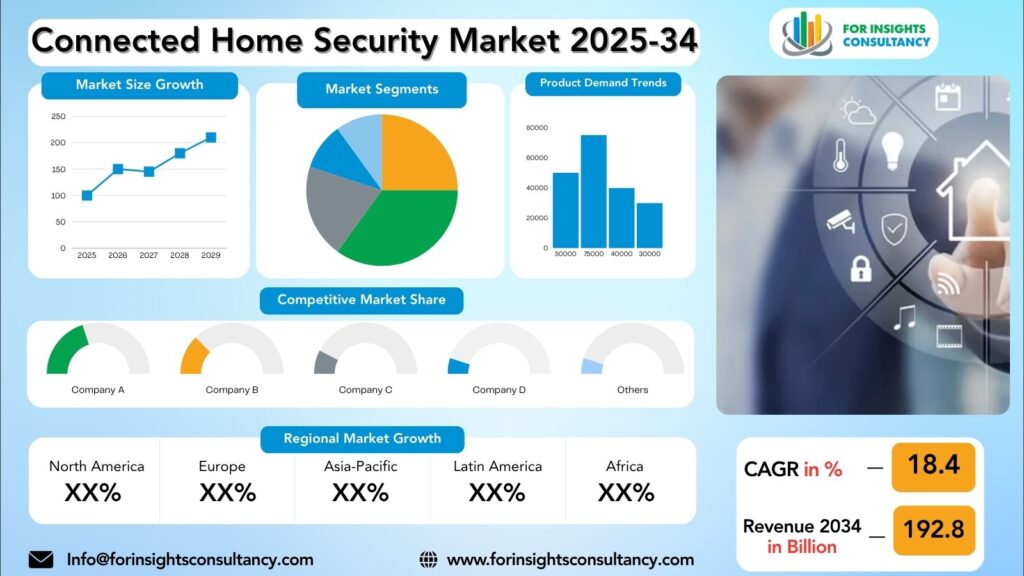
Connected Home Security Market Is Forecast to Increase from USD 96.8 Billion In 2025 To USD 192.8 Billion By 2034, At A CAGR Of 18.4%.
Connected Home Security Market: A Comprehensive Overview and Future Developments
Connected Home Security Market include various smart security products which assist customers to keep watch, secure and monitor their residential spaces in a connected network using internet enabled devices and cloud based products. This includes a broad category of smart cameras, video doorbells, smart locks, motion detectors, intrusion alarms, environmental sensors, access control systems, connected lighting, integrated security hubs etc. Using internet of things (IoT), AI, cloud computing, mobile apps etc. Connected home security systems can cost effectively provide instant monitoring, remote access, instant alerts, and integration with other smart home devices.
Within the last ten years, the market has experienced a major shift in trend caused by increased smart home adoption, proliferation of the internet, and advancement of wireless communication standards. Alarm panels are no longer simple security systems but have grown to become sophisticated, connected security ecosystems that can offer predictive surveillance, facial recognition, AI threat detection and cloud-based video backups as standard. High speed broadband broadband, Wi-Fi 6 and 5G is providing the backbone for connected home security solutions, and making them widely available to residential consumers.
Increasing consumer perception of home safety, security, and property security issues is a significant supporting factor contributing to market growth. Growing anxieties over break-ins, stolen packages, trespassers, and emergency situations have motivated consumers to adopt sophisticated security solutions and systems capable of providing live updates and remote monitoring 24/7. Remote working and smart home automation trend further augment this rising demand.
Innovations in technology are further revolutionizing the Connected Home Security Market. Knowledge of threat detection is enhanced, for instance, by artificial intelligence and machine learning that differentiate between people, pets, running or parked cars, and changing weather conditions to reduce false alarms. Increasing knowledge of the system is achieved through computer vision, facial identification, behavioral analysis, cloud video storage, edge computing, and encrypted wireless transmission. Compatibility with smart home, voice-controlled virtual assistants, connected lighting, and home automation is allowing users to develop customized security procedures along with automated reactions to arise.
Government regulations and industry standards of cybersecurity, consumer privacy, and data protection are also affecting of the development of the market. The manufacturers are more and more likely to adopting end-to-end encrypting, multi-factor authentication, secure cloud storage and respecting the regional privacy regulations to ensure the safety of data. And also the insurance companies and governmental safety organizations are incentivizing of the adoption of smart security technologies that can mitigate the risk to property by any connected home protection system.
North America is expected to be the largest market for Connected Home Security Market, owing to high penetration of smart home products, high disposable income of consumers, high broadband penetration and presence of key vendors in the region. Europe accounts for secondlargest market for Connected Home Security Market owing to high demand for smart homes and need for energy efficiency in home automation, high security regulations and investments in automation of residential applications. APAC is the fastest growing market for Connected Home Security Market owing to increasing number of home owners adopting smart homes, rising levels of urbanization, rise in middle class population, availability of new mobile devices and government initiatives for smart cities, homes in countries such as China, India, Japan and South Korea.
Driven by the increasing connectivity and intelligence of smart homes, the Connected Home Security Market will also enjoy a long-term growth trajectory. Steady pace of new product development in areas like AI enabled surveillance, IoT enabled home connectivity, cloud security, edge computing analytics, biometric authentication, integrated home automation ecosystems will translate into customers gainings greater convenience and peace of mind, while market players grow revenues.
Market Insights
- In 2024, the Connected Home Security Market is projected to witness significant growth, with North America leading in regional revenue share and growth forecast.
- The U.S. is expected to have a high percentage of its population residing in urban areas, driving the demand for home security solutions.
- Within the market segments, the largest revenue share is anticipated to come from smart cameras and video doorbells, reflecting the growing emphasis on surveillance and monitoring technologies in connected homes. These segments are expected to continue to dominate the market due to the increasing awareness and adoption of advanced security features among consumers.
Market Dynamics
Trends
- Artificial Intelligence (AI) adoption for sophisticated threat detection and management is one of the main trends to shape 2024.
- The requirement for intelligent security cameras equipped with facial recognition technology is increasing rapidly.
- Development of connected home security systems that utilize IoT devices to achieve uninterrupted surveillance.
- Introduction of 5G technology allowing security solutions at homes to benefit from high-speed and dependable connectivity.
- A voice-controlled security system gaining popularity for its user-friendliness and hands-free operation.
- Growth of DIY (Do-It-Yourself) home security solution segment as a result of the increasing preference of consumers for partaking in the installation process and product customization.
Growth Drivers
One of the factors to the growth of the market is the rising consumer demand for the security of their homes. Just a few years ago, security systems were quite expensive and difficult to set up and operate. Today, due to technological progress, home security is becoming more and more affordable and user-friendly.
The number of thefts and burglaries has gone up, and one of the consequences is the growing demand for connected home security systems. Some examples of tech integration that have resulted in better home security are AI and machine learning are being used in security devices.
The increasing use of smart home devices and IoT technology is benefiting the market for connected home security solutions. Remote monitoring and control are the main features that many consumers look for in home security systems and these are the features that are highlighted.
The integration of security systems with city infrastructure is one result of the development of smart cities initiatives. The trend of rising investments in home automation and security by consumers and businesses is one of the factors contributing to the growth of the market.
Restraints
High Initial Cost: Many consumers may be discouraged from purchasing a fully comprehensive connected home security system due to its high initial cost, which is often cited as the main reason for low adoption rates.
Privacy Concerns: The gathering of more and more data on users by connected home security devices has made users more cautious and suspicious of what will become of their privacy and data.
Lack of Standardization: One significant drawback of non-standardized home security devices is the possibility of different product compatibility leading to user experience obstacles because they cannot work together as a whole.
Cybersecurity Threats: The more security systems in smart homes keep getting connected to each other, the more vulnerabilities there will be for hackers to carry out their attacks that can threaten not only individual users but also the entire security system.
By taking these restraints into account and finding ways to resolve them, the connected home security market can still face the challenges and grow over the next few years.
Opportunities
People have become more aware of the safety of their homes, which has resulted in a demand for smart security systems that are on top of the trend. On the other hand, the Security industry has been welcoming the adoption of AI and IoT to enhance the protection of the home.
One of the reasons for the wide range of connected security devices available for consumers is the growth of e-commerce platforms. Additionally, home owners are inclined to use remote monitoring and control capabilities in their home security systems.
Connected home security systems enabled with 5G technology to allow the fast and secure communication is also among the trends in home security systems. Among the trends in smart homes is the development of new biometric identification methods for access control that is more secure.
There is a general trend of increased investments in cybersecurity to prevent possible vulnerabilities in the various connected gadgets. Manufacturers of home security products have been offering eco-friendly and sustainable solutions as an environmentally conscious consumer base is growing.
Challenges
- One of the main reasons for the growth in the number of IoT devices is that more and more users are discovering the security weaknesses of these devices. The fact that several smart home devices can be integrated leads to the complexity of security administration.
- There are also privacy issues raised by the data that is being gathered by smart security systems in homes. Over time, hackers are developing new ways to attack home networks that are connected.
- The lack of security measures for devices that communicate with each other across industries is a contributory factor to these security vulnerabilities.
Connected Home Security Market Top Companies Covered In This Report:
Evaluate The Strategic Positioning And Innovation Pipelines Of Leading Market Companies-From Multinational Enterprises To Disruptive Regional Firms. Understand How Key Players Are Innovating, Expanding, And Capturing Value, And Use Competitive Benchmarks To Plan Your Next Move.
- Symantec Corporation (Broadcom)
- Commscop (ARRIS)
- Cisco Systems, Inc.
- F-Secure Corporation
- Avast Software
- Ring
- ADT Inc
- Trend Micro
- Honeywell International Inc.
- McAfee, LLC
- Bitdefender
- D-Link Corporation
Connected Home Security Market Company News 2024 and 2025
ADT Inc reported unauthorized access via a third‑party partner to its network; no customer security systems compromised but internal data was accessed.
Ring (in partnership with Kidde) launched Wi-Fi smart smoke and carbon monoxide alarms that integrate with the Ring app; available in Spring 2025.
Segmented View of The Industry:
The Connected Home Security Market Is Mapped Through A Multidimensional Lens-Tracking Shifts Across Product Type, Applications, And Geographic Regions. This Segmented Approach Enables Businesses to Localize Their Growth Plans And Align Offerings With The Most Profitable Demand Centres.
Segmentation By hardware vs software/services
- Smart Cameras
- Video Doorbells
- Smart Locks
- Motion Sensors
- Door and Window Sensors
- Smart Alarms
- Smart Lighting (Security-focused)
- Security Hubs and Control Panels
- Surveillance Systems (CCTV + Cloud Storage)
- Environmental Sensors (Smoke, CO, Water Leak)
- Integrated Home Security Systems
- Mobile App and Cloud Services
- AI-Based Threat Detection
- Professional Monitoring Services
- DIY Home Security Solutions
Global Geographic Coverage:
The Report Provides In-Depth Qualitative And Quantitative Data On The Connected Home Security Market For All Of The Regions And Countries Listed Below:
North America
The Connected Home Security market in North America is ready to grow by leaps and bounds and is expected to experience a GDP rise of 3.5% accompanied by an inflationary rise of 2.1%. Within the US, the market is uniquely energized by government subsidies escalating the affordability of smart-home tech-based security systems for consumers. The chief distribution mode is through online retail, whereas the channel with the highest rate of growth is comprising the collaboration with home builders and ESPs.
In Canada consumers, the concepts of sustainability and ethically sourced products play an essential role in purchasing decisions of home security systems, turning these into must-have items from their point of view. In frontier markets such as Mexico and Brazil, consumer preferences continue to be led by price and status which, in turn, lead to the growth of demand for security solutions that are less expensive but also technologically advanced. Overall, North America offers the Connected Home Security market a green light to expand with different sub-regions having diverse trend and preference influences.
Europe
According to predictions, a market for connected home security in Europe can expect to see substantial growth over the following years. This growth is backed by the region’s steady GDP and moderate inflation rate. In the case of Germany, the market is driven by local factors, mainly the government’s financial support for smart home installations, which has encouraged the uptake of connected security solutions. Meanwhile in France, the demand is growing as a result of a particular cultural festival that is gaining popularity and is centered around home safety.
The most frequented method to buy connected home security products in Europe is through the online retail channel that offers customers a wide selection of products and an easy purchasing experience. Nevertheless, the channel that has the most rapid growth is the one comprising the specialized smart home stores which are dedicated to the tech-savvy consumers looking for customized solutions.
The consumers in Europe are gradually giving more importance to sustainable and ethically-sourced products when purchasing connected home security devices which is a reflection of a rising concern for environmental issues. In several developing countries of the region, prices and prestige still have the upper hand in consumers’ decisions, thus affordable yet reliable solutions remain necessary.
Asia Pacific
Asia Pacific Connected Home Security market is to grow by a large margin due to such factors as a 5% projected GDP growth, and an inflation rate of 2.5%. One of the main factors in Japan is a subsidy given by the government for smart home security systems, as a result of which, the adoption rates of the consumers have been rising comfortably. The most popular method of selling the products is via online retail in South Korea, whereas the stores that are specialized in direct sales hold the largest number of the fastest-growing channels in China.
Consumers in Australia demand ethical sourcing as a basic requirement, and sustainability continues to be a vital factor in decision-making regarding purchases. On the other hand, prices and the desire to belong dominate the market in less developed countries such as India and Indonesia. In general, companies wanting to take advantage of the increasing Connected Home Security market must first decipher the various drivers and consumer preferences in each sub-region of Asia Pacific.
Middle East and Africa
The Connected Home Security Market in the Middle East and Africa is a connected market with volatile behavior that is affected by the anticipated GDP growth and the inflation rate as the most critical factors for consumers and the sector, respectively. A GDP growth of 3.5% and an inflation rate of 2.9% have been forecasted, which is a good basis for the market to be creative and to grow.
Another unique, local-market-only, non-reproducible driver in the area is the government& subsidy on smart home technology in South Africa, which is one of the main reasons for the connected security systems rise in households. This extraordinary subsidy has made South Africa the market leader in this region.
The most used way for product distribution still is through traditional stores especially for high-tech products, on the other hand, the online sales channel is the fastest-growing channel gaining with customer convenience and wider geographical reach.
The consumers in this area highly appreciate sustainability and morally acceptable resource gathering, thus which become a highly desirable feature for connected home security devices. Moreover Consumer behavior influenced by locality in terms of buying products from local businesses and helping the community shows up in this case too.
Price and prestige are still the main elements behind consumer purchasing decisions in most of the region& emerging markets, which underscores the need for an offering that is both affordable and valued to fuel market growth.
FAQ – What Global Leaders Are Asking
What is the Connected Home Security market size and growth forecast?
Connected Home Security Market Is Projected to Reach USD 192.8 Billion by 2034, Growing from USD 96.8 Billion In 2025, At A CAGR Of 18.4% During The Forecast Period.
Who are the key players in the Connected Home Security market?
The Connected Home Security Market Includes Major Companies D-Link Corporation, Symantec Corporation (Broadcom), Commscop (ARRIS), Cisco Systems, Inc., F-Secure Corporation, Avast Software, Trend Micro, Honeywell International Inc., McAfee, LLC, Bitdefender, Others.
What are the current and future trends for Connected Home Security market?
Current trends in the connected home security market include AI-powered cameras, cloud integration, and mobile app control. Future trends point to increased adoption of subscription-free models, edge computing, and greater interoperability with smart home ecosystems.
Which regions dominate the Connected Home Security market?
North America dominates the connected home security market due to high smart home adoption and advanced infrastructure. Europe and the Asia-Pacific are rapidly growing regions, driven by rising urbanization and increasing consumer awareness.
What are the challenges facing the Connected Home Security market?
The connected home security market faces challenges like data privacy concerns and cybersecurity vulnerabilities. Additionally, high costs and interoperability issues between different device brands hinder widespread adoption.
Valuable Points from Connected Home Security Market Research Report 2025-2034
- Significant changes in Market dynamics.
- Reporting and assessment of recent industry developments.
- A complete background analysis, which includes a valuation of the parental Connected Home Security Market.
- Current, Historical, and projected size of the Connected Home Security Market from the viewpoint of both value and volume.
- Connected Home Security Market segmentation according to Top Regions.
- Connected Home Security Market shares and strategies of key Manufacturers.
- Emerging Specific segments and regions for Connected Home Security Market.
- An objective valuation of the trajectory of the Market.
- Recommendations to Top Companies for reinforcement of their foothold in the market.
Customized Report as per your Business Needs
- Our analysts will work directly with you and understand your needs
- Get data on specified regions or segments, competitor and Vendors
- Data will be formatted and presented as per your requirements
Any Requirement Contact Us: Https://Www.Forinsightsconsultancy.Com/Contact-Us/
Related Report
Smart Home Automation Technology Market
https://www.forinsightsconsultancy.com/reports/smart-home-automation-technology-market
Internet of Things (IoT) Managed Services Market
https://www.forinsightsconsultancy.com/reports/internet-of-things-iot-managed-services-market
Table of Contents
For TOC Contact us: https://forinsightsconsultancy.com/contact-us/