

Field-Programmable Gate Array (FPGA) Market Size, Trends Analysis Research Report by Technology (SRAM-Based FPGA, Antifuse-Based FPGA, Flash-Based FPGA), by Configuration (Low-End FPGA, Mid-Range FPGA, High-End FPGA), By Application (Data Processing, Consumer Electronics, Automotive, Telecommunication, Industrial, Aerospace & Defense), by End User, and By Region Global Market Analysis And Forecast, 2025-2034
Nov-2025 Formats | PDF | Category: Semiconductor & Electronics | Delivery: 24 to 72 Hours
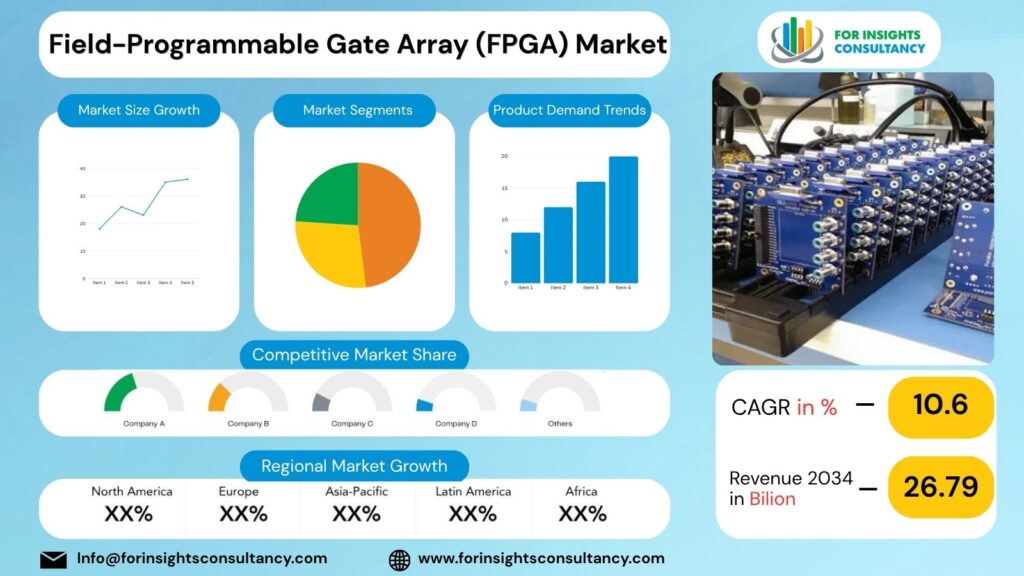
Global revenue from the Field-Programmable Gate Array (FPGA) market is predictable at US$ 11.78 Billion in 2025 and has been concerned to existing at a CAGR of 10.6% to size US$ 26.79 Billion by the end of 2034.
Field-Programmable Gate Array (FPGA) Market Research Summary
Field-Programmable Gate Arrays (FPGAs) have become a leading technology in the semiconductor industry, providing the ability to change and reconfigure the same hardware for different applications. The growth in FPGA market is largely to the high speed computing, artificial intelligence, and data analytics needs.
The first main reason for the FPGA market expansion is to be found in the increasing use of FPGAs in cloud computing and data centers where the aim is to accelerate complex computations and consequently to improve overall processing performance. Besides that, the boom of IoT devices and the necessity of flexible solutions have also contributed greatly to the demand for FPGAs.
Consequently, the FPGA industry will likely experience the benefit of lighting technological progress such as the development of more energy-efficient and high-performance FPGAs to address the demand of various industries. Furthermore, AI and ML capabilities built-in FPGAs’ devices will create many unexplored possibilities in autonomous vehicles, robotics, and healthcare fields.
The FPGA market stands at the verge of major expansion and breakthrough innovations as it keeps adapting itself to the requirement of customizable, high-performance computing solutions across different industries.
Market Insights
- In 2024, the Field-Programmable Gate Array (FPGA) Market is expected to experience significant growth, with the largest revenue share projected to come from the Asia-Pacific region.
- The growth forecast for this region is promising due to increasing demand for FPGA technology in various industries.
- In the U.S., approximately 80% of the population is expected to reside in urban areas by 2024, indicating a high concentration of potential FPGA market consumers.
- Additionally, the largest revenue share for segments within the FPGA market is anticipated to come from the telecommunications and automotive sectors, driven by the need for advanced hardware solutions tailored to specific industry requirements.
Market Dynamics
Trends
Increased Adoption of FPGA in Artificial Intelligence (AI): AI-related applications are estimated to extensively utilize FPGA technology, thus leading to a significant rise in the demand of such technology. These applications include machine learning, deep learning, and natural language processing.
Rapid Growth in IoT and Edge Computing Applications: The situation of IoT device and edge computing system deployments is trending upwards, and so is the demand for FPGAs, which are the devices that can enable efficient data processing and real-time analytics.
Expansion of 5G Infrastructure: As 5G networks are being introduced internationally, there will be a great need for FPGAs in telecommunications infrastructure to carry out tasks such as signal processing and optimization.
Focus on Energy Efficiency and Performance: It is expected that FPGA producers will be compelled to come up with energy-efficient solutions that will also feature performance aspects, thus meeting the requirements of data centers and high-performance computing environments.
Growth Drivers
First of all, the demand of FPGA has been on the rise in AI-based scenarios which are the part of high-performance computing applications like data centers, and Internet of Things (IoT) devices. Another major factor is the progressive incorporation of FPGA components in the automotive and aerospace sectors geared towards the production of advanced driver assistance systems (ADAS), autonomous vehicles, and avionics applications. Besides, the surging need for FPGA in 5G infrastructure is one of the foremost reasons for its usage for fast data processing and short communication latency. Also, the utilization of FPGA has been extended to the medical field for imaging techniques, personalized medicine, and genomic analysis. In addition to these, the market has been invigorated with the growth in diverse industries brought about by technological breakthroughs in FPGA, which include low power consumption, high density, and enhanced programmability. These issues are likely to become a substantial contribution to the expansion of the FPGA market during the period of 2024-2025.
Restraints
Complexity of Programming: As FPGA designs get more complicated, programming them becomes a harder task and needs more specialized skills and knowledge.
High Initial Investment: The initial cost of developing FPGA-based solutions might be a barrier to small companies or startups, thus limiting the penetration of the market.
Limited Scalability: FPGA designs are generally optimized for certain applications, so it is hard and expensive to extend the technology to a wider area.
Power Consumption: In general, FPGAs consume more power than other alternatives, so their use is limited in energy-efficient applications.
Competition from ASICs: Application-Specific Integrated Circuits (ASICs) are attracting more attention because of their better performance and lower power consumption, thus being a competitive threat to FPGAs in some market segments.
Opportunities
5G Technology Growth:
As the need for speedy data handling is continuously rising, FPGAs will be the key instruments to 5G network implementation thus leading to a bright growth prospect of the market in 2024-2025.
Surge in AI-Based Solutions:
The widespread use of AI-based solutions in different sectors pushes the demand for FPGAs that can fasten AI algorithms and computations hence a great opportunity for the FPGA market to expand by the next few years.
Global IoT Growth:
The rapid spread of IoT devices and applications has resulted in an increased demand for FPGAs as they are the most suitable solution for efficient connectivity and data processing thus allowing the market to grow in the next two years.
Challenges
Increased Competition: To meet the rising demand for FPGA technology, more players entering the market will escalate competition.
Technological Advancements: It will be challenging for FPGA manufacturers to keep up with rapidly changing technology and trends.
Cost Pressures: It will be essential to meet cost demands while keeping high-quality standards for long-term success in the market.
Security Concerns: Besides cybersecurity threat, the FPGA manufacturers should ensure data protection within FPGA devices.
Supply Chain Disruptions: Dealing with supply chain disruptions due to global situations and geopolitical tensions will be difficult for the industry.
Field-Programmable Gate Array (FPGA) Market Top Companies Covered In This Report:
Evaluate The Strategic Positioning And Innovation Pipelines Of Leading Market Companies-From Multinational Enterprises To Disruptive Regional Firms. Understand How Key Players Are Innovating, Expanding, And Capturing Value, And Use Competitive Benchmarks To Plan Your Next Move.
- Microchip Technology Inc.
- Advanced Micro Devices, Inc.
- Altera Corporation
- Lattice Semiconductor
- Achronix Semiconductor Corporation
Field-Programmable Gate Array (FPGA) Market Company News 2024 and 2025
Microchip Technology Inc
Microchip Technology Inc. announced in December 2024 the release of its PolarFire® FPGA and SoC solution stacks targeting smart robotics and medical imaging applications.
Advanced Micro Devices
Advanced Micro Devices, Inc. (AMD) announced on March 5 2024 an extension of its FPGA portfolio with the Spartan UltraScale+™ family, with sampling and evaluation kits expected in 2025
Key Segments
Segmentation By Technology
- SRAM-based
- Antifuse-based
- Flash-based
Segmentation By Configuration
- Low-End FPGA
- Mid-Range FPGA
- High-End FPGA
Segmentation By Application
- Telecommunications
- Consumer Electronics
- Automotive
- Industrial
- Data Centers
- Aerospace & Defense
Global Geographic Coverage:
The Report Provides In-Depth Qualitative And Quantitative Data On The Field-Programmable Gate Array (FPGA) Market For All Of The Regions And Countries Listed Below:
North America
The expected GDP growth and inflation rate of the Field-Programmable Gate Array (FPGA) market in North America are instrumental in determining the industry environment. One of the most significant factors that drive the region is the subsidies granted by the government to the enterprises which invest in the development of the FPGA technologies, thus increasing the opportunities for growth. Most of the sales of FPGA products are carried out through online retail, while the channel that records the highest growth in sales is direct sales to businesses. Buyers in this market are highly concerned about the environment and the ethical sourcing of the products they purchase, and therefore, these are the two factors that companies have to meet in order to operate in the region. In developing markets, where price and status are the most important aspects, companies have to ensure that their products are competitively priced without compromising on quality or ethical standards if they want to be a part of the growing demand for FPGA technology.
Europe
The Field-Programmable Gate Array (FPGA) market in Europe is very much alive and well and growing steadily. This is majorly influenced by the anticipated GDP growth of 3.5% and a low inflation rate of 1.8%. A very particular government subsidy for technology innovation in Germany is the main factor that is pushing the demand for FPGAs and thus leading to it becoming the region’s dominant driver. The quickest method to FPGA distribution via the different channels in Europe is through the online platforms which are gaining popularity because of the ease and wide range of products offered to customers.
European consumers care deeply about the environment and the ethical sourcing of products when considering the purchase of an FPGA, thereby making these factors absolute necessities for manufacturers operating in the market. Besides that, the move towards localism is having an impact on purchasing decisions as consumers are exhibiting a preference for products made within Europe.
In emerging markets where the price and status are the most important factors, like Eastern Europe, producers will need to highlight price policies that are competitive and good brand reputation if they want to become leaders in the FPGA market.
Asia Pacific
The Field-Programmable Gate Array (FPGA) market in the Asia Pacific region is going to be significantly expanded. This is going to happen against the backdrop of a projected GDP growth rate of 5% and an inflation rate of 2%. Amid the local factors in China, a major driver for FPGA adoption is the government’s subsidies given to the industries which embrace AI technology. The preferred channel for FPGA sales is through big technology distributors, whereas online sales are the most rapidly developing channel due to the digitization of businesses that is going on.
Consumers in Japan highly value sustainability and ethical sourcing, thus they are the characteristics without which FPGA products cannot be sold. On the other hand, in the developing markets of Indonesia and Vietnam, the price and the status even now are the most influential factors of consumer preferences. The FPGA market in South Korea gets its momentum from the country’s peculiar media trend of live-streaming technology events, which increases the awareness and demand of FPGA products.
Middle East and Africa
The Field-Programmable Gate Array (FPGA) Market in the Middle East and Africa is expected to undergo a major expansion fueled by the region’s strong GDP growth and moderate inflation rate. In the Middle East, the main impetus for FPGA adoption is a certain government subsidy specifically aimed at fostering technological innovation. In Africa, a growing cultural festival devoted to celebrating tech advancements is resulting in an increased demand for FPGA solutions.
The primary channel for FPGA products in the region is through collaborations with local distributors and system integrators. The quickest expanding channel is e-commerce platforms, which is indicative of the region’s increasing digitalization trends.
Consumers in the Middle East and Africa are becoming more and more conscious of the need for sustainability and ethical sourcing when buying FPGA products. Localism is also a must-have for many consumers, particularly in emerging markets where price and status factors largely influence purchasing decisions.
Frequently Asking Questions
What is the Field-Programmable Gate Array (FPGA) market size and growth forecast?
Field-Programmable Gate Array (FPGA) Market is predicted to grow from USD 11.78 Billion in 2025 to approximately USD 26.79 Billion by 2034. the industry is estimated to expand at a CAGR of 10.6%.
Who are the key players in the Field-Programmable Gate Array (FPGA) market?
The Field-Programmable Gate Array (FPGA) Market Includes Major Companies Microchip Technology Inc., Advanced Micro Devices, Inc., Altera Corporation, Lattice Semiconductor, Achronix Semiconductor Corporation, Others.
What are the current and future trends for Field-Programmable Gate Array (FPGA) market?
The Field-Programmable Gate Array (FPGA) market is trending toward increased adoption in AI, 5G, and automotive applications, with future growth driven by demand for high-performance, low-power, and reconfigurable computing solutions.
What are the challenges facing the Field-Programmable Gate Array (FPGA) market?
The main challenges facing the FPGA market include high design complexity, limited software tool support, and competition from ASICs and GPUs in specific performance-intensive applications.
Which regions dominate the Field-Programmable Gate Array (FPGA) market?
North America and Asia-Pacific dominate the Field-Programmable Gate Array (FPGA) market due to strong semiconductor manufacturing bases and rising adoption in data centers and automotive industries.
Report Features
This report gives the most complete information. The report on Field-Programmable Gate Array (FPGA) Market format has been designed so that it can provide the best value to the business. It offers crucial insights into the market’s dynamic and will aid in strategic decision-making for current players as well as those looking to join the market.
What Deliverables Will You Get in this Report?
Key questions this report answers | Relevant contents in the report |
How big is the sales opportunity? | In-depth analysis of the Global Field-Programmable Gate Array (FPGA) Market |
How lucrative is the future? | Market forecast and trend data and emerging trends |
Which regions offer the best sales opportunities? | Global, regional and country level historical data and forecasts |
Which are the most attractive Field-Programmable Gate Array (FPGA) market Key segments? | Market segment analysis and |
Which are the top Key players and Their Field-Programmable Gate Array (FPGA) market positioning? | Competitive landscape analysis, Market share analysis |
How complex is the business environment? | Porter’s five forces analysis, PEST analysis, Life cycle analysis |
What are the factors affecting the Field-Programmable Gate Array (FPGA) market? | Drivers & Restraints |
Will I get the information on my | Customized Report as per your Business Needs Our analysts will work directly with you and understand your needs Get data on specified regions or segments, competitor and Vendors Data will be formatted and presented as per your requirements Any Requirement Contact Us: Https://Www.Forinsightsconsultancy.Com/Contact-Us |
Table of Contents
For TOC Contact us: https://forinsightsconsultancy.com/contact-us/