
Natural Food Colors Market Report | Market Size, Growth & Future Outlook 2034
Jun-2026 Formats | PDF | Category: Food Beverages | Delivery: 24 to 72 Hours
Natural Food colors Market Size & Forecast
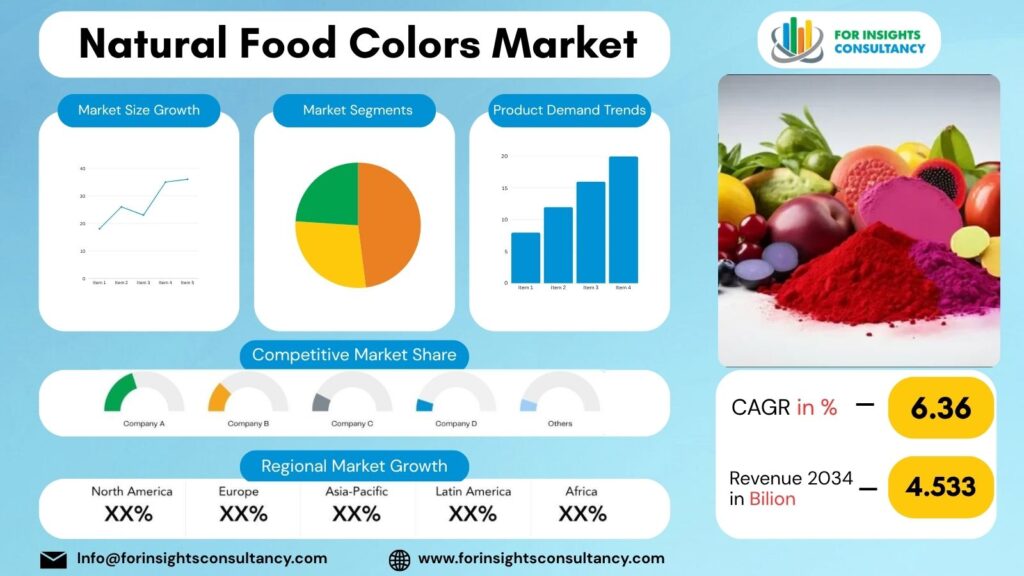
- Market Size (2026): USD 2.244 Billion
- Forecast (2034): USD 4.533 Billion
- CAGR (2026–2034): 6.36%
- Base Year: 2025
- Key Segments: The Natural Food Colors market is segmented into carotenoids, anthocyanins, curcumin, chlorophyll, caramel color, and spirulina-based natural pigments, with plant-based and clean-label colorants emerging as the fastest-growing segment due to rising demand for natural ingredients in processed foods and beverages.
- Top Regions: Europe dominates the market, driven by strict food safety regulations, high consumer preference for clean-label products, and strong adoption of natural and organic food ingredients across the food & beverage industry.
Natural Food colors Market Executive Summary
The worldwide market for Natural Food Colors is witnessing strong and sustained growth due to consumer demand for clean label food products, awareness of the hazards associated with synthetic additives and the rapid growth of the processed and packaged food industry. The trend of consumers and food manufacturers for producing healthier, greener and organic ingredients for use in their food and beverage products is forming a key focus for market growth and the implementation of toughened global food safety standards and associated labeling practices is hastening the move towards more natural colour systems.
The market is also enjoying growth in the use of natural food colors in bakery, confectionery, dairy, beverage and functional food applications. Companies are investing more in developing breakthrough extraction systems and more stable formulation methods to enhance color strength, amount of color used, shelf life and heat stability of natural colors. Some brands are incorporating plant-based natural colors made from fruits, vegetables, spices and algae due to steadily increasing demand for more attractive, healthful foods.
Second, the trend movements like Premiumization by the use of natural and organic colors will catch the market attention, Sustainability of development by natural sourcing, biodegradable production process, Digital movement by the reformulation of food through technological advancement and supply chain enhancement now…Thus, market players encounter the fierce technological and strategic innovation race and concentrate on innovation, strategic co-operation, global expansion etc. toward the Natural Food Colors market.
Natural Food colors Market Overview (2026)
Natural Food Colors 1620 covers a broad spectrum of colorants made from all natural origins such as plants, minerals and even microorganisms. These encompass pigment classes such as carotenoids, anthocyanins, chlorophyll, curcumin, spirulina extracts and beetroot-based colors. The colors are predominantly used across food and drinks items such as bakery, confectionery, dairy, beverages, snacks, convenience and functional foods. The market largely sells to industrial food manufacturers but increasingly to clean-label product brands looking for a safer and more trusted alternative to synthetics.
In the last 10 years, the industry has been developed substantially, as a result of consumer interest in health and wellness, preference for natural foods and fears about harm from the artificial ingredients used in food manufacturing. Consequently, there has been a great trend to clean-label and organic food formulations. That trend is accompanied with innovations in food processing, extraction and stabilization of natural food colors, thus enhanced the quality and stability of natural color and broadened the scope of their applications.
Consumer demand for traceability in terms of ingredients, as well as health benefits and sustainable source, is significantly impacting the market, forcing companies to re-think formulations and production processes. Technology developments such as micro encapsulation, formation of natural pigment from fermentation, and precision product formulation for optimising product quality and performance are also helping to advance use of Natural Food Colors. Regional Regulatory developments such as tightening of food labelling laws, and banning/preventing the use of synthetic colorants in certain snacks and beverages are also driving adoption of Natural Food Colors.
Natural Food colors Market Dynamics 2026
Growth Driver
Rising Demand for Clean-Label and Natural Ingredients
The global Natural Food Colors market is witnessing a major growth due to rising consumers demand for clean-label food products. Modern consumers are extremely conscious regarding ingredients and actively avoiding synthetic dyes such as tartrazine and sunset yellow, worried about the health implications. This has been observed in developed markets such as North America and Europe, where stringent regulation and health consciousness is high. As such, food manufacturers are replacing these artificial compounds by a variety of natural colorants from sources such as fruits and vegetables and plants like beetroot, turmeric, spirulina and Anthocyanin. This is adding to demand for natural food colors in bakery, confectionery, dairy and beverages segment.
Growth in Processed and Packaged Food Industry
Another major growth driver for the Natural Food Colors market is the rapid growth of the global processed and packaged food industry. Due to increased urbanization, hectic lifestyle, and the paradigm shift towards convenience food, consumption of packaged food products with high visual appeal is growing. Food colors help improve the visual appeal of such products significantly, besides adding to brand differentiation and consumer attraction to food. With ready-to-eat meal, snack, beverage and frozen food segments’ growth, application of natural colors will only increase. New food processing technologies in the natural food colors industry are also making natural pigments more versatile and resistant.
Key Trends
Premiumization of Natural and Clean-Label Color Solutions
Premiumisation in the Natural Food Colors market appears to be gathering pace as food and beverage manufacturers continue to look for premium, clean-label and organic coloring options. Consumers are happy to pay a premium for products that they perceive to be healthier, safer and more natural. This is stimulating demand for plant-based colorants from sources such as beetroot, spirulina, turmeric, paprika and berries, particularly in bakery, confectionery, dairy and functional beverages, where ingredient transparency and visual appeal are key drivers. The premium natural colors trend is also prevalent in the gourmet/ artisanal category.
Sustainability Through Ethical Sourcing and Eco-Friendly Production
Sustainable practices are emerging as a key trend in the Natural Food Colours industry, considering the increasing consumer/producers environmental fears and tightening regulations. Manufacturers are increasingly working towards using sustainably-sourced raw ingredients, ‘greener’ extraction & processing methods, lower use of chemicals and supporting farming practices. The process of obtaining botanical ingredients in an ethically sound manner is receiving significant attention at all levels of the value chain. The shift towards additional sustainability during processing and packaging, and waste reduction during pigment processing forms part of this trend.
Technological Innovation in Extraction and Stability Enhancement
The Natural Food Colors markets are experiencing changes in the form of technological advancements. A number of technologies are emerging which are greatly improving how color pigments are applied and have greater stability, solubility and better color values. For example, microencapsulation of pigments and colorant production through fermentation or enzymatic method are reducing the impact of variation in pH, heat or light and hence, extending shelf-life. New research and development is also allowing for stable hybrid color systems and finer targeted formulation in order to use natural colors more extensively in processed foods, beverages and supplements like nutraceuticals, which in turn increases global markets.
Natural Food colors Market Top Companies Covered In this Report are
- Sensient Technologies Corporation
- Givaudan SA
- International Flavors & Fragrances Inc. (IFF)
- Hansen Holding A/S
- DSM-Firmenich AG
- Naturex (Givaudan Group)
- DDW The Color House
- Roha Dyechem Pvt. Ltd.
- FMC Corporation
- Archer Daniels Midland Company (ADM)
- Kalsec Inc.
- Döhler Group
- Allied Biotech Corporation
- San-Ei Gen F.F.I., Inc.
- Synthite Industries Ltd.
Natural Food colors Market company news 2025 and 2026
Sensient Technologies
Sensient Technologies is expanding its clean-label color portfolio, focusing on stable plant-based pigments for beverages and confectionery applications.
Givaudan (Naturex)
Givaudan (Naturex) is investing in natural extraction technologies, enhancing color stability and shelf-life for fruit- and vegetable-based pigments.
Natural Food colors Market Segments
Source Outlook
- Natural
- Synthetic
Application Outlook
- Food and Beverages
- Cosmetics and Personal Care
- Pharmaceuticals
- Textiles
- Packaging
Natural Food colors Market Regional Insights
North America
Insight (NOT generic): Growing North American demand for clean-label, plant-based colors, as a result of consumers’ continued eschewing of synthetic additives in processed foods and beverages. Food manufacturers in the U. S. and Canada are leading reformulation efforts to meet FDA label requirements and increasingly health-conscious consumer expectations. U. S. and Canadian bakery, dairy, and beverage applications have been experiencing faster than usual growth in use of beetroot, spirulina, turmeric, and anthocyanin colors.
Europe
Europe is the largest market for the Natural Food Colors industry. This is because of the stringent regulations and clean label culture prevalent in the European countries. The regulations on food safety guidelines of EU enforcing restrictions and regulations on the use of synthetic dyes is resulting in the cosmetics industry shifting to natural colors. In addition the high level of consumer consciousness regarding sustainable sourcing of ingredients and eco-friendly manufacturing processes in the continent is resulting in increased demand for Organic, Non-GMO, Sustainably sourced Food Colors, especially within the premium Food categories such as confectionery, dairy and beverages.
Asia-Pacific
Growth Driver Asia-Pacific: Asia-Pacific is characterized by growing processed foods industries, urbanization and strengthening purchasing power. Highly visible, packaging foods and beverages are seeing high demand from China, India, Japan and South Korea. Growing influence of west here, growth in organized retail and QSR chains are also emphasizing use of natural food colors across applications.
Otherworld
Emerging Trends: Several markets such as Latin America, Middle East & Africa are showing a slow but steady upward trend for natural food colorings, driven by evolving lifestyle as well as increasing consumption of packaged foods. Some of the major trends in these markets are increased acceptance of affordable natural colorants, growth of foreign food brands and increased consciousness about food safety. Further, the upgradation in food processing infrastructure is also paving the way for extensive use of these colorants in region specific food manufacturing industry.
Analyst Insights
According to For Insights Consultancy the Natural Food Colors market is experiencing a sector- wide transformation from a niche, specialty ingredient component to a mainstream formulation requirement in global food and beverage development. Increased consumer aversion to synthetic ingredients and additives; tightened global food safety regulation; and pressure upon manufacturers to provide full disclosure of ingredients has seen natural colorants become a necessary inclusion in clean-label product development strategies across bakery and confectionery, drinks and dairy formulations.
Market is likely to experience strong structural change toward high performance, stable and multifunctional natural color systems resulting from improved extraction technologies, fermentation-based pigment manufacturing and microencapsulation technologies improving heat stability, solubility and shelf life performance and an increasing appetite for plant-derived, organic and ethically sourced raw ingredients transformations across the entire food industry supply chains. These three factors will have a significant impact on the competitive dynamics and underpinned long-term value creation potential of the Natural Food Colors market.
Natural Food colors Market Research Methodology
This report on Natural Food Colors Market has been prepared with the help of very strong and multi level research methodologies so as to make the insights and findings highly accurate and credible and useful to the market players.
Primary Research: In-depth interviews and discussions with industry specialists, food and beverage manufacturers, ingredient suppliers, regulators and other value chain players. This research is key to getting current information on market trends, consumer behavior, product innovation and regulatory influence on natural coloring introduction.
Secondary Research: Valuable information from established, credible sources of industry knowledge such as any food science reports, company annual reports, investor presentations, trade magazines, gov databases and: imported foods safety regulatory bodies can be found to further clarify the structure of the market place, competitiveness, and innovation trends.
Data Validation: Information we collect is subjected to intensive validation procedures in several stages, derived through multiple source methods, statistical modeling and a triangulation of market technique. This data is then validated through the guidance of expert opinions and forecast modeling to ensure the consistency, authenticity and accuracy of insights derived for Natural Food Colors Market.
Natural Food colors Market – Data Sources
Government Publications
The report uses information from cybersecurity bodies, telecommunications departments, digital infrastructure bodies and regulatory bodies to assess trends in cloud security, digitalization in companies and changes in policy on cybersecurity.
Industry Databases
Market intelligence is collected from sources such as cybersecurity database, cloud networking platforms, source of research of enterprise IT and tech analytics providers to analyze market size, adoption rates, competitive landscape and innovation trends.
Company Financial Reports
Revenue trends, strategic investments, technology evolution, product expansion are monitored by analyzing annual reports, SEC filings, investor presentations, press releases and financial statements of the top SASE vendors, cloud security vendors and networking companies. Methodology This Natural Food colors Market report is backed by strong research methodology involving primary research, secondary analysis and sophisticated market modeling to derive precise, dependable and usable industry insights.
Trade Journals
This report will use references of cybersecurity journals, cloud computing magazines, enterprise networking publications, white papers and technical research articles to study the trends over the AI-based security improvements, Zero Trust adoption and SASE architecture change from around the world.
Proprietary Research (For Insights Consultancy):
Broader validation and learning are then produced by way of internal databases, experienced interviews and specialist analysis by For Insights Consultancy, providing accurate, trustworthy, current market intelligence to meet client needs.
Customization: We Can Provide Following Things
1) On Market More Company Profiles (Competitors)
2) Data About Particular Country Or Region
3) We Will Incorporate The Same With No Additional Cost (Post Conducting Feasibility).
Any Requirement Contact Us: https://www.forinsightsconsultancy.com/contact-us
Related Market Reports
Food Ingredients Market
Source: https://www.forinsightsconsultancy.com/reports/food-ingredients-market
Naturally Healthy Foods Market
Source: https://www.forinsightsconsultancy.com/reports/naturally-healthy-foods-market
Table of Contents
For TOC Contact us: https://forinsightsconsultancy.com/contact-us/