

Solar Module Market Size to Surge with Clean Energy Transition and Net-Zero Goals
Jun-2026 Formats | PDF | Category: Energy & Power | Delivery: 24 to 72 Hours
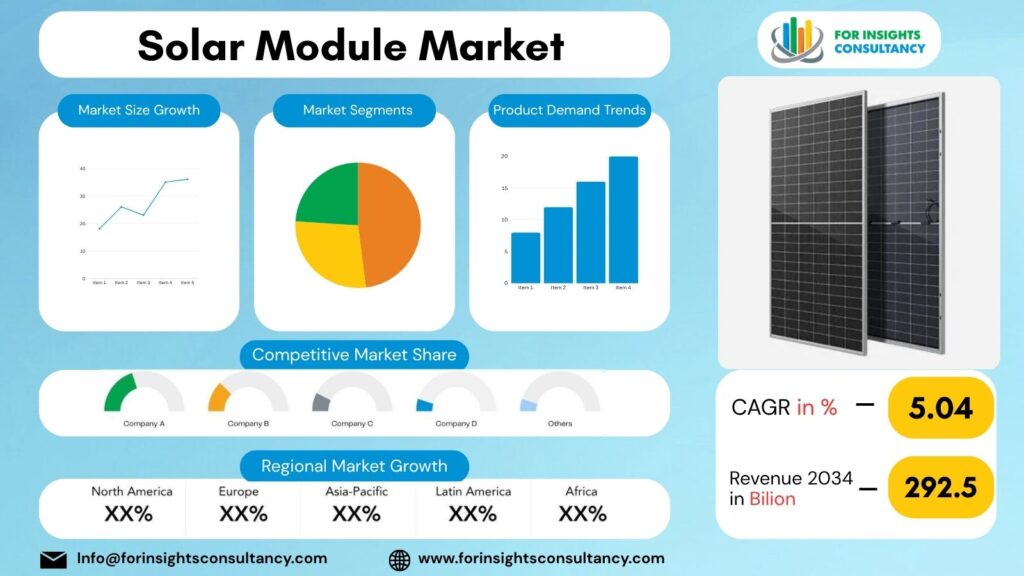
Solar Module Market Size & Forecast
- Market Size (2026): USD 185.3 Billion
- Forecast (2034): USD 292.5 Billion
- CAGR (2026–2034): 5.04%
- Base Year: 2025
- Key Segments: By Technology (Monocrystalline, Polycrystalline, Thin-Film), By Connectivity (On-Grid, Off-Grid), By Application (Residential, Commercial, Utility-Scale), By Mounting Type (Ground-Mounted, Rooftop).
- Top Regions: North America, Europe, Asia-Pacific, Latin America, Middle East & Africa, with Asia-Pacific leading the market due to large-scale solar installations, manufacturing dominance, and strong renewable energy investments in China and India.
Solar Module Market Executive Summary
The Global Solar Module Market has emerged as a lucrative one owing to an increasing number of investments in renewable energy infrastructure, policies in favor of renewable energy adoption, and rising demand of clean power generation. The steadily rising global shift toward low-carbon energy frameworks, and the magnitude of targets to achieve net-zero emissions are facilitating the growth of solar modules. Solar modules are an integral part of the renewable energy ecosystem representing the conversion of sunlight into electricity for use at residential, commercial, industrial, and utility scales.
One of the most significant factors contributing to the market growth is the rising demand for high-efficiency photovoltaic (PV) modules and the quick proliferation of large scale solar power projects. Organizations from developing and developed nations are allocating tremendous investment in solar energy to meet the rising power needs with enhanced energy security, lower reliance on fossil fuels and environment friendly operations. Technologies which are already being deployed are getting more cost effective in relation to standard power sources.
New trends including premiumization, sustainability and digital transformation are changing the competition scenario of Solar Module Market. Premiumization trend has been fueling the growth of advanced solar modules which are more energy efficient, more durable, incorporating bifacial technology, and more proficient, working in different weather conditions and environments. Sustainability trend has been urging for mass scale adoption of solar energy solutions and energy utility in various countries while requiring to reduce greenhouse gas emissions. The digital transformation enables the utilization of intelligent solar systems incorporated with IoT enabled monitroing platforms, predictive maintenance tools, and innovative energy management softwares.
Industry players are investing in technological innovation, ramping up capacity, forming strategic alliances and optimizing the supply chain to reinforce their market position. Deploying next-generation technologies, including TOPCon, HJT, bifacial modules and tandem solar cells is anticipated to boost efficiency and create promising market opportunities in the long term. Meanwhile, factory capacity is increased to cater to rising global demand while lowering manufacturing costs and upgrades product quality.
Solar Module Market Overview (2026)
Solar Module Market The solar module market consists of different types of photovoltaic modules and panels which are used to harness the energy from the sunlight and generate electricity for residential, commercial, industrial and utility scale applications. The market encompasses mono crystalline, poly crystalline, thin film, bifacial, TOPCon, and heterojunction (HJT) solar modules and other related components that form the bedrock of a solar power system.
The industry has experienced rapid growth and change over the last ten years, not only through advances in photovoltaic technology, but also due to mass manufacturing, cost reductions in PV production, and a growing interest in renewable energy applications. As a result, todays solar modules, which were once considered a costly energy source, are now high efficiency and competitive power generation technologies. This has been enabled by advances in cell architecture, materials science, energy conversion efficiency and manufacturing automation.
Increasing consumer awareness around issues such as climate change, long-term energy security and environmental sustainability are impacting the development of the broader market. More companies, households and national governments are turning to solar energy systems to lower energy expenses, service demands, reduce greenhouse gases and provide different sources of power. The increase of distributed energy generation, rooftop solar and community day site generation projects are increasing market opportunities within all sectors..
Despite the challenges outlined above, market development is expected to be driven by both technological innovation as seen by the introduction of bifacial modules, advanced solar monitoring systems, integrated energy storage, AI-enabled system performance optimization, and next-generation solar cell technologies and supportive regulatory policies (namely government incentives, renewable energy standards, tax incentives, feed-in tariffs and net-metering).
Solar Module Market Dynamics 2026
Growth Driver
Rising Demand for Renewable Energy and Clean Power Generation
A key factor propelling the Solar Module Market is rising global demand for renewable energy and sustainable electricity. Governments, businesses and consumers are investing in solar energy systems to cut carbon emissions, secure energy supply and achieve climate targets. Increasing demand for electricity and rising worries about reliance on fossil fuels as well as price fluctuations are boosting large-scale, commercial and residential adoption of solar power.
Global installations of large scale solar power systems are also continuing to grow as countries are setting high renewable and net zero commitments and targets. With a reduction in the cost of PV technology and new advances that have increased the efficiency of solar modules, these modules are increasingly a favoured method of clean and efficient electricity production. Globilly we have seen the market increase significantly.
Growth in Advanced Solar Technologies and Utility-Scale Projects
The growth of high-efficiency solar technologies and utility-scale solar farm deployments are having a significant impact on the Solar Module Market. Technological developments including bifacial modules, TOPCon cells, heterojunction (HJT) technology, PERC Modules, and smart solar monitoring solutions are increasing energy yield, project operational reliability, and payback for project developers and end users.
Growth of large solar farms, distributed generation, and solar-plus-storage projects is driving a growing market for innovative solar modules. Many utility and independent power projects are choosing high-performance solar to generate more electricity and minimize system ownership costs over time. At the same time, solar-battery-storage, smart grid, artificial intelligence, and digital energy platforms are improving performance and enabling widespread use of renewable energy.
Key Trends
Premiumization of High-Efficiency Solar Modules
The Solar Module Market is witnessing a robust premiumization trend with end users giving high emphasis on high energy yield, durability and long term performance. Global manufacturers are innovating new Photovoltaic technologies such as TOPCon, Heterojunction (HJT), bifacial modules and N-type solar cells which provide higher efficiency than regular solar panels. Developers of commercial and utility scale projects are increasingly investing in premium solar modules so as to maximize power generation, optimize land using and enhance ROI.
Sustainability Driving Renewable Energy Adoption
Environmental sustainability continues to be a major growth engine for the Solar Module Market as governments, businesses and consumers inch forward with initiatives to curb carbon emissions and shift to cleaner energy sources. Solar energy is now being considered an integral attribute of global decarbonization and net-zero campaigns. Investment in renewable energy infrastructure, green commercial construction and sustainable industrial operation is driving demand for solar modules for myriad uses. Manufacturers are prioritizing environment-friendly manufacturing processes, recycling technologies and sustainable supply chains to enhance their environmental image and adhere to emerging regulations.
Technological Innovation Transforming Solar Power Generation
Along with the swift technological advancement taking place around the globe, the industry of Solar Modules market is witnessing new developments. Breakthroughs are taking place in photovoltaic efficiencies, energy management and intelligentized systems. The use of human-free mechanisms like artificial intelligence-based performances monitoring, IoT-based solar-assets managing and monitoring, adaptive inverters, Digital Twin platform-based diagnostics, predictive maintenance, etc. is improving the operational efficiency. Furthermore, the evolution of innovative cell structure designs, lightweight material designing for high energy storage system as well as automated manufacturing techniques has been impacting the modules’ efficiency and ultimately reducing the system costs.
Solar Module Market Top Companies Covered In this Report are
- LONGi Green Energy Technology Co., Ltd.
- JinkoSolar Holding Co., Ltd.
- Trina Solar Co., Ltd.
- Canadian Solar Inc.
- JA Solar Technology Co., Ltd.
- First Solar, Inc.
- Hanwha Qcells
- Risen Energy Co., Ltd.
- TCL Solar
- Adani Solar
- Vikram Solar Limited
- Waaree Energies Limited
- RenewSys India Pvt. Ltd.
- Tata Power Solar Systems Limited
- REC Group
Solar Module Market company news 2025 and 2026
LONGi Expands High-Efficiency Module Production
LONGi Green Energy Technology Co., Ltd. continues investing in next-generation N-type and high-efficiency solar module technologies to improve energy conversion rates and support global renewable energy demand.
JinkoSolar Accelerates Global Solar Deployment
JinkoSolar Holding Co., Ltd. is expanding manufacturing capacity and strengthening its portfolio of advanced TOPCon solar modules to meet rising utility-scale and commercial project requirements.
Solar Module Market Segments
Breakup by Region
North America
- United States
- Canada
Europe
- Germany
- France
- United Kingdom
- Italy
- Spain
- Others
Asia Pacific
- China
- Japan
- India
- South Korea
- Australia
- Indonesia
- Others
Latin America
- Brazil
- Mexico
- Others
Middle East and Africa
Solar Module Market Regional Insights
North America – Insight (Non-Generic)
North America is experiencing tremendous growth in Solar Modules Market investments in domestic solar manufacturing, utility-scale renewable projects and modernizing the grid. Need for high-efficiency modules is growing as energy providers try to meet their energy security needs and lessen reliance on traditional power plants. Large-scale solar farms, corporate renewable energy procurement campaigns and growing solar plus storage deployments offer lucrative opportunities.
Europe – Insight
Europe still represents a significant market for solar modules with its challenging climate targets, plans for increasing renewables and the increasing investments in energy transition projects. Countries are increasingly opting to deploy solar modules in order to become less dependent on imported energy and to have a more resilient energy system in the long term. The demand for high-quality, high-efficiency modules for use in residential, commercial and utility building rooftop systems is also growing, along with the integration of PV with storage batteries.
Asia-Pacific – Growth Driver
Asia-Pacific is the largest in Solar Module Market worldwide owing to massive solar deployment projects, powerful manufacturing base and several incentives and subsidies by Government. China, India, Japan, South Korea and Australia are heavily investing in infrastructure for cleaner and sustainable power solutions with burgeoning demand for electricity. Asia-Pacific is also the biggest manufacturing location of solar modules. The region enjoys advantage of technology development, low cost manufacturing and increased utilization of utility-scale and distributed plants which make it the fastest growing market of solar modules.
Rest of the World –Emerging Trends
The Solar Module Market in Latin America, Middle East & Africa is also grabbing pace on the back of growing focus on investments in utility-scale solar projects, electrification of rural areas and further diversification of clean energy pathways. Trends for new product technologies emerging are in the direction of bifacial solar modules, solar & storage based projects, floating solar projects and off-grid renewable energy projects.9 Governments along with private investors are placing greater emphasis on solar through direct interventions, incentives and financial policies, as it is viewed as a most cost efficient and sustainable option for expanding electricity access and contributing to economic growth.
Analyst Insights
According to consultants at For Insights Consultancy, in the Solar Module Market, the emphasis will shift from volume to technology. Efficiency, yield and lifecycle design, rather than a delivered watt, will be what differentiate suppliers. While utility scale will still dominate procurement, suppliers will be competing in module technology, manufacturing and integrated energy solutions.
An important trend of the market is the swift transition to high-efficiency N-type, TOPCon, Heterojunction (HJT) and bifacial solar modules that will overtake their standard crystalline photovoltaic counterpart. Energy producers and project developers are focused on the use of modules that will generate more electricity on less land and at a lower cost, especially for utility scale projects where better efficiencies will directly impact project economics and profitability.
Solar Module Market Research Methodology
The report on Solar Module Market is prepared through systematic researches, specifically utilizing industry expertise and advanced market research techniques to provide accurate, reliable and updated market intelligence. The report assesses the market forces, technology progression, competitive landscape, regulatory framework and opportunities to grow within the global solar modules market.
Primary Research
Interviews with solar module manufacturers, c-si photovoltaic suppliers, project developers, EPC Contractors, distributors, renewable energy consultants, industry experts, government authorities and other relevant parties have contributed substantially to the report. These primary research have helped to establish an understanding on system prices, market development, technology trends, investment flows, supply chain and growth potential of the sector.
Secondary Research
Secondary research: Information that has been gathered and collected from reliable industry sources, different company annual reports, investor presentations, from the industry, government renewable energy reports, energy agencies (international) sources, trade journals, technical and white papers and regulatory documents. The research provides a framework of past market performance, competitor dynamics, regulations, technological trends and other relevant aspects of the market.
Data Validation and Market Modeling
All data that are gathered are subject to a rigorous validation process consisting of multiple steps. Data from primary and secondary sources is corroborated with market triangulation methodologies as well as proprietary analytical models. Market sizing, forecasting and other modeling tools such as statistical analysis, various market simulation tools, industry demand estimation, and other methodologies.
Solar Module Market – Data Sources
Government Publications
The report uses information from cybersecurity bodies, telecommunications departments, digital infrastructure bodies and regulatory bodies to assess trends in cloud security, digitalization in companies and changes in policy on cybersecurity.
Industry Databases
Market intelligence is collected from sources such as cybersecurity database, cloud networking platforms, source of research of enterprise IT and tech analytics providers to analyze market size, adoption rates, competitive landscape and innovation trends.
Company Financial Reports
Revenue trends, strategic investments, technology evolution, product expansion are monitored by analyzing annual reports, SEC filings, investor presentations, press releases and financial statements of the top SASE vendors, cloud security vendors and networking companies. Methodology This Solar Module Market report is backed by strong research methodology involving primary research, secondary analysis and sophisticated market modeling to derive precise, dependable and usable industry insights.
Trade Journals
This report will use references of cybersecurity journals, cloud computing magazines, enterprise networking publications, white papers and technical research articles to study the trends over the AI-based security improvements, Zero Trust adoption and SASE architecture change from around the world.
Proprietary Research (For Insights Consultancy):
Broader validation and learning are then produced by way of internal databases, experienced interviews and specialist analysis by For Insights Consultancy, providing accurate, trustworthy, current market intelligence to meet client needs.
Customization: We Can Provide Following Things
1) On Market More Company Profiles (Competitors)
2) Data About Particular Country Or Region
3) We Will Incorporate The Same With No Additional Cost (Post Conducting Feasibility).
Any Requirement Contact Us: https://www.forinsightsconsultancy.com/contact-us
Related Market Reports
Solar PV Panels Market
Source: https://www.forinsightsconsultancy.com/reports/solar-pv-panels-market
Renewable Energy Management Solution Market
Source: https://www.forinsightsconsultancy.com/reports/renewable-energy-management-solution-market
Table of Contents
For TOC Contact us: https://forinsightsconsultancy.com/contact-us/