

Advanced Composites Market Growth Analysis Research Report By Fiber Type (Carbon Fiber Composites, Aramid Fiber Composites, S-Glass Fiber Composites, Others), By Resin Type (Thermoset Composites, Thermoplastic Composites), By Application - and Global Forecast to 2034
Mar-2026 Formats | PDF | Category: Chemical & Material | Delivery: 24 to 72 Hours
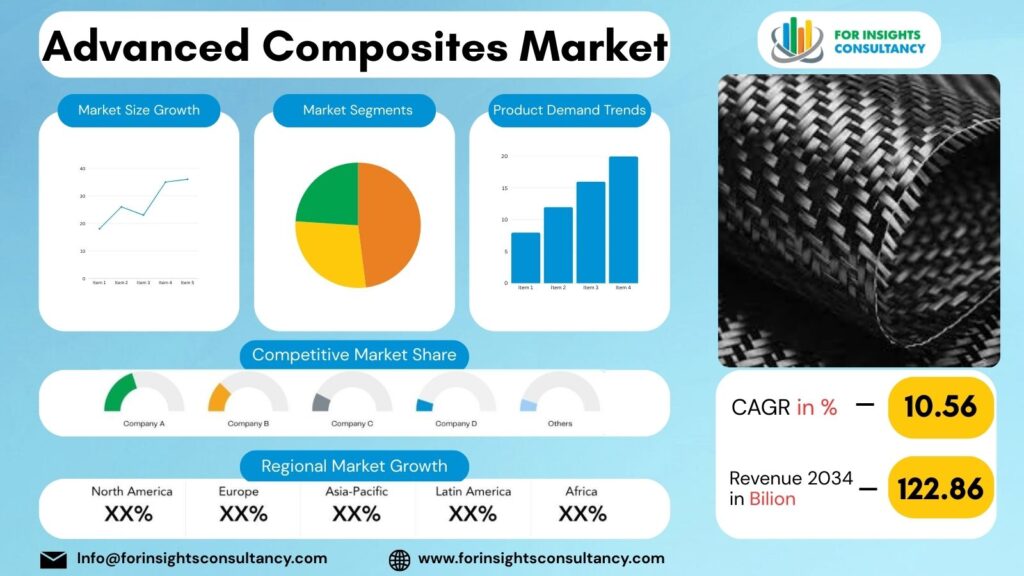
Advanced Composites Market analysis: valued at USD 48.92 Billion in 2025 and projected to reach USD 122.86 Billion by 2034 with 10.56% CAGR. Explore trends and insights.
Overview of the Advanced Composites Market and Expected Growth (2026)
In 2026, the Advanced Composites Market is expected to achieve considerable growth, owing to the increasing demand from different industries for materials that are lighter, stronger, and high performing in order to improve efficiency and sustainability of their products. Advanced composites are materials engineered for high specific strength and stiffness, and corrosion resistance, through the combination of high-strength fibers (carbon fibers, aramid fibers, or specialized glass fibers) with polymer resins.
Due to the weight, and extremity of the operational conditions, advanced composites are increasingly used in aerospace, automotive, renewable energy, and high-end industrial equipment manufacturing. In aerospace engineering, advanced composites are used in the manufacturing of the fuselages, wings, and other structural and non-structural components of the aircraft because of the benefits of reduced weight, and improved structural strength and durability; which are required for the optimum performance and economic operational efficiency. According to the National Aeronautics and Space Administration, the use of composite materials in the design of modern airplanes enhances the structural efficiency and reduces the total maintenance of the aircraft.
As manufacturers in the automotive sector look to incorporate cutting-edge composites in the design of vehicles to address emissions regulations and enhance vehicle efficiency, the use of lightweight composites will reduce fuel consumption and improve the driving range of electric vehicles. Meanwhile, the growing use of wind energy has created a demand for advanced composites in turbine blades due to their superior strength and environmental resistance.
The International Energy Agency reports that modern wind turbines use advanced composites in their blades to increase efficiency and reduce weight. Additionally, governments and academia are funding next-generation recyclable thermoplastic composites that can be used in circular supply chains. Increasingly, industrial sectors are seeking energy efficiency, durability, and enhanced performance in order to drive the growth of advanced composites over the next decade.
Market Dynamics 2026
Growth Drivers
Rising Demand for Lightweight Materials in Aerospace
Aircraft manufacturers have started to use new composite materials that aid in the reduction of the structural body of the aircraft, leading to better fuel efficiency across the board. Stronger and lighter aircraft body materials, such as carbon fiber composites, improve overall performance of the aircraft and reduce operational costs.
Expansion of Electric and Fuel-Efficient Vehicles
Composite materials have been used by automobile manufacturers for the purpose of decreasing fuel consumption and the overall body weight of the vehicle. Specifically, in the case of electric vehicles, the use of lightweight composite materials leads to an increased driving range which is essential for meeting the required emissions and fuel-economy levels.
Growth of Renewable Energy Infrastructure
The increased use of wind energy has led to an increased use of advanced composites in the manufacture of turbine blades, as they have a better strength, resistance to fatigue, and durability. Thus, the use of advanced composites allows the production of much larger turbines which are economically advantageous.
Restraints
Increase in Costs of Raw Materials and Production
Cutting-edge composites like carbon fiber and high-performance resins require costly precursors and very involved manufacturing procedures. The high price of composites, as compared to traditional materials like steel or aluminum, restricts usage in industries where costs are a primary concern.
Manufacturing Advanced Composites is More Complex
The manufacture of advanced composites requires specific processes like resin transfer molding, autoclave curing, and automated fiber placement. The aforementioned processes require specialized labor, and may decrease the fectiveness of the quality control, and advanced equipment needed to manufacture the composites.
Opportunities
Increased Need for Advanced Composites due to Space Research and Satellite Production
The growing need for advanced composites in products and services associated with satellite production, reusable launch vehicles, and commercial space travel is due to the great number of satellite launches and commercial space missions currently taking place. Advanced composites also support theless vehicle and structure weight, thus rapid vehicle and structure changes.
Greater Use in Hydrogen and Other Energy Storage Systems
The development of new high-pressure hydrogen storage tanks with advanced composites has been supported by the growing need for safe storage of hydrogen gas at high pressures, especially in fuel-cell vehicles and clean energy systems, thereby facilitating the transition to hydrogen energy. Advanced composites for high-pressure hydrogen storage tanks and systems will support the global transition to a hydrogen-based energy infrastructure.
Challenges
Extensive Costs for Manufacturing and Processing
The requirements for production and processing of advanced materials, which include high-performance composites, such as carbon fiber–reinforced polymers, are sophisticated production procedures, specialized production equipment, and expensive raw materials of higher quality than those which are required, for example, for aluminum and steel construction materials. The above requirements add to the cost of manufacturing and processing of the advanced composites, which constrains their use in manufacturing and processing industries where cost is a significant concern.
Repair and Maintenance are More Complex
The repair of composites is more complex than traditional repair materials, and often requires specialized training to know how to repair the composites and how to evaluate the repair after completion. These are internal problems and therefore difficult to repair, es[ecially delamination of the composites and such problems would require a high level of assessment to detect. The above issues and challenges are operationally disruptive in the aerospace and automotive markets.
Top Companies Covered In This Report
(Major global and regional players shaping the industry)
- Toray Industries, Inc.
- Teijin Limited
- Hexcel Corporation
- Mitsubishi Chemical Group Corporation
- SGL Carbon SE
- Solvay SA
- Owens Corning
- Hyosung Advanced Materials
- Kureha Corporation
- Kolon Industries, Inc.
Advanced Composites Industry Company News 2025 and 2026
Toray Industries, Inc.
In 2025, the company showcased next-generation composite technologies such as TORAYCA™ carbon fiber and thermoplastic composite materials at the global composites exhibition JEC World. The innovations targeted applications in aerospace, hydrogen storage tanks, electric vehicles, and sustainable composite recycling solutions.
Teijin Limited
During 2025–2026, Teijin continued expanding its advanced composite portfolio and strengthening partnerships with aerospace and automotive manufacturers to supply lightweight carbon-fiber reinforced materials designed to improve energy efficiency and structural performance in next-generation vehicles and aircraft.
Hexcel Corporation
In 2026, Hexcel announced participation in the WINGS India 2026 aerospace exhibition, presenting new lightweight composite materials and high-performance carbon-fiber solutions developed for commercial aviation, advanced air mobility platforms, and defense aircraft structures.
Mitsubishi Chemical Group Corporation
The company has continued focusing on expanding its carbon-fiber and composite materials business for automotive, aerospace, and industrial applications. Industry updates during 2025 highlight efforts to improve manufacturing efficiency and support large-scale adoption of lightweight composite materials.
Detailed Segmentation and Classification of the report (Market Size and Forecast – 2034, Y-o-Y growth rate, and CAGR):
By Fiber Type
- Carbon Fiber Composites
- Aramid Fiber Composites
- S-Glass Fiber Composites
- Others (Hybrid and Specialty Fibers)
By Resin Type
- Thermoset Composites
- Thermoplastic Composites
By Manufacturing Process
- Automated Fiber Placement (AFP)
- Automated Tape Laying (ATL)
- Resin Transfer Molding (RTM)
- Filament Winding
- Pultrusion
- Others
By Application
- Aerospace & Defense
- Automotive & Transportation
- Wind Energy
- Construction & Infrastructure
- Marine
- Electrical & Electronics
- Others
Regional Deep-dive Analysis:
The report provides in-depth qualitative and quantitative data on the Advanced Composites Market for all of the regions and countries listed below:
North America
The North American advanced composites market will continue growing steadily until 2026, with strong demand from the aerospace, defense, automotive, and renewable energy sectors. The region has a mature manufacturing ecosystem, advanced research institutions, and a strong focus in the area of research investment in next-generation materials. The production of lightweight aircraft parts, wind turbine blades, and structures for electric vehicles is driving the demand for carbon fibers and high-performance composite materials. Government initiatives that support sustainable transportation and energy-efficient technologies also spur the advancement of composite materials use in various sectors.
United States:
With the most developed aerospace and defense sector in North America, the US is the largest contributor to the regional market. Advanced composites are used for lightweight and durable turbine blades in wind energy installations, a sector in which the US also operates to a large extent. Most of the large aircraft manufacturers are also located in the US. Most of the US located large scale materials science research centers are focused on the development of high-performance composites for commercial aviation, military aviation, and space exploration.
Canada:
Canada’s market is growing in the manufacturing sector of aerospace and the investments in clean energy start to pay off. Composite technologies enhance the components of vehicles, the vehicles themselves, along with the infrastructure that supports transportation. The innovative advanced materials are developed in research partnerships of universities and industry.
Mexico has positioned itself as a leading manufacturer of automotive and aerospace supply chains in North America. The demand for lightweight composite materials that reduce fuel cost and improve structural performance has positive correlation for increasing overseas investments for automotive and aircraft components manufacturing.
Europe
Germany:
Germany is influential in the market due to its automotive and industrial manufacturing sectors. The engineering firms and automotive companies have been implementing the use of carbon-fiber reinforced composites in order to decrease the weight of their vehicles as well as to increase the overall energy efficiency of the vehicles, specifically on the electric and hybrid vehicle platforms.
France:
France’s aerospace industry is globally recognized, and this, in turn, makes France important in Europe’s composites market. Fuel efficiency, durability, and overall performance of aircrafts are of great concern to researchers and manufacturers of aircrafts. Because of this, they develop advanced composite structures to meet this need.
Italy and Spain:
The growing use of advanced composites in automotives, marine manufacturing, and renewable energy infrastructure is evident in Italy and Spain. The development of wind energy is also being invested in by these countries, and for large turbine blades, composite materials are a necessity.
Asia-Pacific
The Asia-Pacific advanced composites market is predicted to grow significantly by 2026 due to the region’s growing industrial manufacturing, aerospace activities, and increasing need for lightweight materials in transportation and renewable energy. During the past several years, the Asia-Pacific has become a vital region for the production of composite materials. Strong manufacturing and supply chains, along with a region-wide demand for advanced materials, a more cost-effective manufacturing region, and government-imposed infrastructure, and energy projects, has shown a more sustainable economy. All of these elements contribute to the increasing demand for advanced composite materials manufacturing. Combined with manufacturing materials, focuses the region’s growing d sustainable development framework, creates a more cost-effective manufacturing region for composite materials.
China:
China has an established position in the manufacturing ecosystem, with multiple large-scale production facilities as well as extensive investment and production capacity in the aerospace, renewable energy, and electric vehicle sectors. To support industry and technology development, the country is also expanding its domestic production capabilities in carbon fiber and composite components.
Japan:
Japan is regarded as a global leader in the production of advanced materials and carbon fibers. With its strong capabilities in research and development, Japan is able to supply its own advanced materials for aerospace, automotive engineering, and electronic equipment.
India and Southeast Asia:
India along with Southeast Asian countries like Thailand, Malaysia, and Indonesia, is an emerging market for advanced composites. The region’s growing investments in infrastructure, automotive manufacturing, and wind energy projects, are driving demand for composites in these emerging economies.
Middle East and Africa
By 2026, the market for advanced composites in the Middle East and Africa is predicted to grow due to the rise in investment in aerospace, renewable energy, construction, and transportation infrastructures. Desert and coastal regions often have harsh environments which provide the need for high-performance materials like carbon and glass-fiber composites. These composites provide lightweight, durable, and corrosion-resistant solutions. Several governments in Middle East and Africa regions are focusing their efforts on economic diversifaction and industrial modernization which has led to the increased demand for high-performance materials.
Gulf Cooperation Council (GCC) Countries:
Saudi Arabia, the United Arab Emirates, and Qatar are major investors in renewable energy, aerospace manufacturing, and high-performance construction materials. An increase in the use of composite materials in the construction of wind turbine blades, the manufacture of aircrafts and the construction of large infrastructures for the purposes of enhancing energy conservation and improving structural composite materials is noted.
South Africa:
South Africa has one of the most advanced composite markets in Africa, largely due to its automotive manufacturing base and increasing construction of renewable energy facilities. Advanced composites are utilized in the construction of wind turbines and in transportation and other industrial applications.
North Africa: Countries like Morocco and Egypt are slowly incorporating composite materials into their construction, transportation, and renewable energy projects. The modernization of transport systems and the construction of wind energy farms are driving the need for lightweight and corrosion-resistant materials.
Frequently Asked Questions with Answers
What is the Advanced Composites market size and growth forecast?
Advanced Composites Market is projected to reach a value of USD 122.86 Billion in 2025 and is anticipated to grow to approximately USD 122.86 Billion by 2034. This expansion reflects a compound annual growth rate (CAGR) of 10.56% during the forecast period from 2026 to 2034.
Who are the key players in the Advanced Composites market?
The Advanced Composites Market Includes Major Companies Toray Industries, Inc., Teijin Limited, Hexcel Corporation, Mitsubishi Chemical Group Corporation, SGL Carbon SE, Solvay SA, Owens Corning, Hyosung Advanced Materials, Kureha Corporation, Kolon Industries, Inc, Others.
What are the current and future trends for Advanced Composites market?
The growing demand for lightweight materials in aerospace and electric vehicles, expansion of wind energy applications, advancement in recyclable and bio-based composites, and increased use of automation in composite manufacturing, are all factors driving development in the advanced composites market.
Which regions dominate the Advanced Composites market?
The Asia-Pacific region dominates the Advanced Composites market, driven by strong manufacturing activity and growing demand from aerospace, automotive, and renewable energy industries.
Key insights provided by the report that could help you take critical strategic decisions?
- Regional reports analyse product/service consumption and market factors in each region.
- Reports highlight possibilities and dangers for suppliers in the Advanced Composites Market business globally.
- The report identifies regions and sectors with the highest growth potential.
- It provides a competitive market ranking of major companies, as well as information on new product launches, partnerships, business expansions, and acquisitions.
- The report includes a comprehensive corporate profile with company overviews, insights, product benchmarks, and SWOT analysis for key market participants.
Customization: We can provide following things
1) On request more company profiles (competitors)
2) Data about particular country or region
3) We will incorporate the same with no additional cost (Post conducting feasibility).
Any Requirement Contact us: https://www.forinsightsconsultancy.com/contact-us/
Table of Contents
For TOC Contact us: https://forinsightsconsultancy.com/contact-us/