
12 October 2026 Formats | PDF | Category: Aerospace and Defense | Delivery: 24 to 72 Hours
Anti-Drone Market Size Statistics
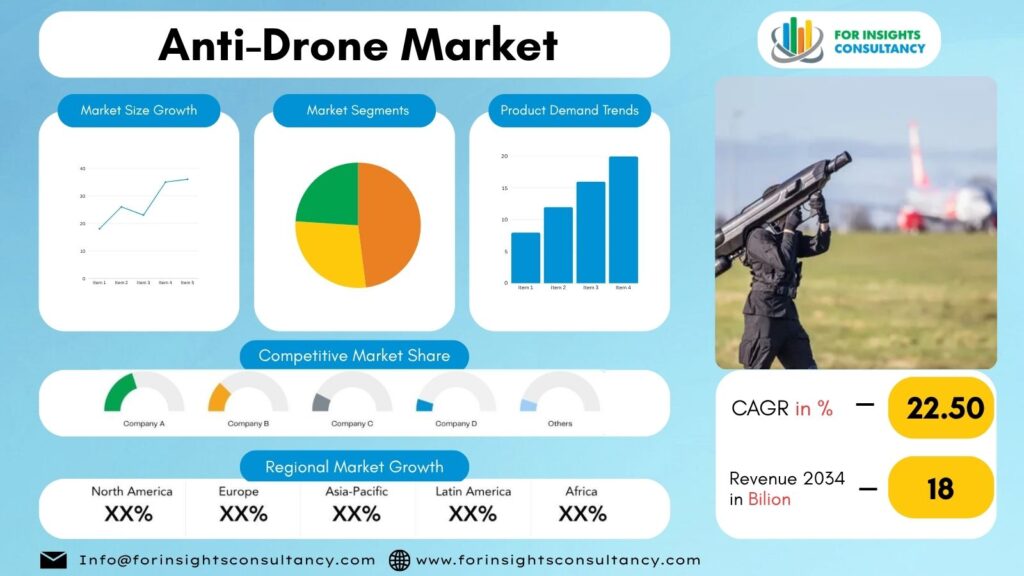
Market Size (2026): USD 3.55 Billion
Forecast (2034): USD 18.00 Billion
CAGR (2026–2034): 22.50%
Base Year: 2025
Leading Segment (2026): Detection and tracking systems — proposed leading segment; validate against your defined market scope.
Leading Region (2026): North America — approximately 40–45% share (estimated)
Core Trends: AI-enabled detection, multi-sensor surveillance, electronic countermeasures, and directed-energy systems are expanding layered protection against unauthorized drones.
Anti-Drone Market Definition
The anti-drone system is constituted by various technologies that can be used to detect, identify, monitor, and take down any rogue or hostile unmanned aerial vehicles (UAV). Such technology includes radars, radio frequency detection, electro-optical and thermal sensors, acoustic detection, jamming, navigation jamming, and interceptors. The anti-drone technology is used in defense bases, airports, critical infrastructure facilities, government offices, businesses, and other public places for protection against UAV intrusion.
Anti-Drone Market Overview 2026
The market of the anti-drone market in 2026 will be determined by the increasing need for detection, identification, tracking, and defeating of UAVs used without permission both in the military, commercial, and civilian sectors. Anti-drone technology, also referred to as counter-drone technology or C-UAS, is used to provide security of military bases, airports, government institutions, energy facilities, industry plants, and large-scale events from any unauthorized UAV activity. Radar-based solutions, radio frequency (RF) surveillance, electro-optic/infrared (EO/IR) systems, acoustic detection, jamming systems, navigation spoofing, and interceptor systems are included into the market. The rising number of UAV applications for surveillance purposes, reconnaissance missions, smuggling, and malicious activities as well as commercial UAVs usage in logistic services, agricultural activities, construction, and infrastructure inspection will have an impact on demand.
Speaking about the demand, the defense sector will still play a key role in it as it needs to have a reliable system for protection from reconnaissance drones, coordinated drone attack, and emerging autonomous aerial threats. Among other demand markets can be mentioned airports, seaports, power plants, oil and gas facilities, prisons, and large-scale public events.
Integration and use of a layered defense system that will consist of a variety of sensors, threat identification, C2 systems and countermeasures represents another trend driving the anti-drone market in 2026. This defense strategy can be enhanced through the use of artificial intelligence (AI) and machine learning for fast classification of air vehicles and prioritization of threat, and deployment of directed energy weapons and drones as additional countermeasures against drones. According to the Congressional Budget Office, there is no such counter-drone solution that guarantees full protection against aerial threats in all cases.
In the future, drivers of the anti-drone market will include defense modernization programs, increased investment in the security of critical infrastructure, developments in inexpensive production of drones, and necessity of defense against evolving aerial threats. At the same time, high cost of acquisition and maintenance, false alarms, integration issues, vulnerability to electronic interference, and bans on the use of some countermeasures can hinder the development of the market, especially civilian segment. As for the business, the focus will be on detection/tracking systems, AI-based sensor fusion, mobile counter-UAS platforms, electronic warfare, interceptors and legal solutions to the problem.
Request a Free Sample Copy: https://forinsightsconsultancy.com/reports/request-sample-anti-drone-market (Sample Include key points such as 2026 market size, 2034 forecast, CAGR, leading product segment, fastest-growing segment, dominant region, major companies, trends, growth drivers, challenges, and opportunities.)
Trends 2026
Cost-per-intercept is the central problem
The disparity in price between the cost of an attacking drone and the cost of defense against the attacker has made it economically impractical to use kinetic interception. It has therefore forced buyers to go for cheap intercepting drones. According to reports from Ukraine, it was constructing about 1,500 FPV-based interceptors per day as early as January 2026. The US Army plans to award a multi-year contract for Coyote interceptors by fiscal 2027.
Procurement is moving to fast, pooled contracts
The United States JIATF 401 (Joint Interagency Task Force) offers a C-UAS marketplace with multi-award contracts. In September, it gave out $4.15 billion ceiling to ten companies through its Domestic Shield program. The year before that, in June, it made its first big counter-drone deal, awarding Perennial Autonomy a $500 million ceiling contract. Actual spending will depend on task orders and Congress funding the fiscal year which started in October.
Directed energy is arriving, but slowly
2026 marks the first practical usage of directed energy only within the lowest power category of the United States Army. The LOCUST X3 laser from AeroVironment has received orders for production, however, directed energy against mass assault has not been proven in warfare conditions yet. Authority remains ambiguous, as the reports imply no obvious scheme regarding which authority has the right to use such weapons and in which conditions. High-power microwave seemed promising when a fiber-optic controlled drone was neutralized through microwave impact in January 2026.
Threats are outpacing single-layer defenses
Drones using fiber optics resist jamming. Geran-3 class jet powered drones fly at over 300 km/h and are increasingly using optical terminal guidance, which makes quadcopter interceptors ineffective against them. This is what leads to layered defenses.
Anti-Drone Market Growth Drivers 2026
Large, rising government budgets
The US fiscal 2027 request puts more than $74 billion into drone and counter-drone technologies, triple the FY2026 amount. Most of it sits in mandatory funding, and the House bill left out the tens of billions in mandatory funding that was requested, so it is not guaranteed.
Cheap drones are making the old defenses uneconomic
Ukraine’s war showed that a $500 FPV drone can disable a $10 million armored vehicle. The Army’s budget push follows mounting concerns over using expensive interceptors against inexpensive drones. This favors low-cost interceptors, electronic warfare and, eventually, lasers.
Threats are evolving, which forces upgrades
Many current defenses work by interfering with the radio link between a drone and its operator, but newer drones guided by fiber-optic cable or flying autonomously don’t use that link. Existing systems therefore need replacing or supplementing, which creates repeat demand.
Airspace incursions in Europe and the Middle East
The EU is building a “drone wall” after incursions over Poland, Estonia, Romania and Denmark exposed gaps. Its European Drone Defence Initiative targets initial capacity by the end of 2026 and completion by the end of 2027.
Top Companies Covered in the Anti-Drone Market are
- Allen Control Systems
- Digital Force Technologies
- DroneShield
- L3Harris WESCAM
- Napatree Technology
Anti-Drone Market Company news 2026
DroneShield
Committed 2026 revenue rose to AUD 251M. That sits within its AUD 250–270M full-year outlook, and the company has about AUD 46M committed for 2027 and beyond.
Saab
Sweden ordered a mobile, modular counter-drone system worth about SEK 2.6B, with deliveries in 2027–2028.
Anti-Drone Market Segments
By solution
- Detection, tracking and identification: Radar, RF, optical and acoustic sensors that find and classify drones.
- Command and control (C2): Software that fuses sensor data and coordinates the response.
By technology
- Electronic warfare: Jamming or spoofing the control or navigation link. It is cheap and non-destructive but fails against fiber-optic and autonomous drones.
- Kinetic: Guns, missiles, nets and interceptor drones that physically destroy or capture the target.
By range
- Short range (under 6 km): Handheld and point defense against nearby threats.
- Medium range (6–20 km): Projected to lead the market, protecting bases, airports, borders and critical infrastructure.
By platform
- Fixed/ground-based: Permanent installations at bases, airports, stadiums and power plants.
- Mobile/vehicle-mounted: Systems that move with troops or convoys.
Anti-Drone Market Regional Insights 2026
North America
Leading brands: RTX (Coyote), Anduril, Lockheed Martin, Northrop Grumman, L3Harris, DroneShield, Epirus, Fortem, Echodyne, SRC, Allen Control Systems.
Buyer trends:
The Pentagon’s JIATF-401 buys from a pool of pre-approved vendors, with $4.15B in ceilings awarded to 10 companies in September.
The Army wants $994M for small counter-drone systems in FY27.
A new buyer group is emerging: the SAFER SKIES Act interim rule, effective July 1, 2026, authorizes state, local, tribal and territorial agencies to conduct counter-drone operations.
Europe:
Leading brands: Rheinmetall, Thales, Saab, MBDA, Airbus, Leonardo, DroneShield (via EU manufacturing), Sensofusion.
Buyer trends:
Spending is mostly national. Poland signed a EUR 3.5 billion contract in January for what will be the continent’s largest integrated counter-drone system, and Sweden ordered a SEK 2.6B Saab system.
EU-level plans move slowly: the European Drone Defence Initiative targets initial capacity by end of 2026.
Asia-Pacific:
Leading brands: IAI, Rafael, DroneShield, CETC (China), Bharat Electronics and Zen Technologies (India), RTX, Lockheed Martin, Thales, Leonardo.
Buyer trends:
One published figure puts the region at about $1.05B in 2025 growing about 30% a year, on a broader scope than mine.
India is a major demand pole. The Border Security Force has deployed anti-drone systems along the Punjab and Jammu border sectors against cross-border drones.
Japan and Australia buy for airports, seaports and infrastructure.
Ground-based systems are the largest category, and Southeast Asian budget limits slow adoption outside the major economies.
Middle East
Leading brands: Rafael, Israel Aerospace Industries, Elbit, RTX (Coyote; a proposed $2.10B UAE sale), Tytan and Ukrainian interceptor makers.
Buyer trends:
The Iran war that began February 28 is the dominant driver. Early reports said the UAE had been targeted by 1,276 projectiles, most of them intercepted.
Cost-per-intercept is the central worry: one analyst estimated the UAE spent roughly $20–28 for every $1 Iran spent. Gulf buyers are shifting toward cheaper interceptors and orchestration software.
Frequently Asked Questions
What is the anti-drone market size in 2026?
We estimate the market at USD 3.55 billion in 2026, up from USD 2.18 billion in the 2025 base year.
What is the counter-UAS market CAGR through 2034?
The percentage would be approximately 22-25% annually. The percentage estimates published are approximately 14.6-26.5%.
Why do anti-drone market forecasts differ so much?
While some only consider specialized C-UAS systems, others also include radar and electronic warfare systems. There is fragmentation within the market because customers do not buy just one box.
What are the main anti-drone market segments?
By means of: Detection, Tracking & Identification; Command and Control; and Mitigation. By technology: Electronic Warfare; Kinetic; Directed Energy; and Protocol Takeover.
What is the difference between fixed, mobile and portable anti-drone systems?
Fixed systems are used to protect locations like airports and industrial plants. Mobile systems are vehicle-based for use with convoys and troops. Portable and hand-held units are ideal for police and soldiers.
What’s Included in This Report — Anti-Drone Market
This report provides a comprehensive analysis of the Anti-Drone Market, covering the following:
- Market size and growth: We estimate the market at USD 3.55 billion in 2026, up from USD 2.18 billion in the 2025 base year.
- Core trends: The main shifts of 2026, including cheaper interceptors, directed energy, layered defense, and faster US procurement.
- Growth drivers: Why demand is rising: government budgets, low-cost drone threats, airspace incursions, new civil authority, and evolving threats.
- Segmentation: The market split by solution, technology, range, platform, end user and region, with a one-line explanation of each.
- Regional insights: Values, shares and buyer trends for North America, Europe, the Middle East and Asia-Pacific, with leading brands in each.
- Company landscape: The main players, from defense primes to specialists, plus the biggest 2026 contract awards, acquisitions and funding news.
- Buyer FAQs: Short answers to common questions, organized by search and buyer intent: sizing, segments, regions, competition and procurement.
Why Buy This Research Report?
- Current, dated information: It covers developments through October 2026, including the September US Domestic Shield awards, the Motorola/D-Fend deal and Drone Shield’s latest results.
- Regional detail in one place: It sets out values, shares, growth and buyer behavior for North America, Europe, the Middle East and Asia-Pacific, so you can compare where to enter or expand.
- Understanding of what is driving demand: It separates durable drivers, such as budgets and cheap drone threats, from temporary ones, such as war-related spikes.
- Competitive view: It identifies who is winning contracts, who is being acquired and where funding is moving, which helps investors and competitors judge positioning.
- Procurement guidance: It covers what buyers should check before purchase, including legal authority, supply-chain compliance, coverage of fiber-optic drones and total cost of ownership.
- Honest about uncertainty: It marks which figures are estimates, where sources disagree and which claims are unverified, so decisions rest on known limits.
Buy This Report Now — https://forinsightsconsultancy.com/buy-now-anti-drone-market (Access In-Depth Analysis, Forecasts & Company Profiles)
Related Market Reports of Aerospace and Defence Industry
Electronic Warfare (EW) & Counter-UAS Market Size, Share & Forecast 2034
Drone Identification Systems Market Size, Share
Table of Contents
- Market Overview
- Table 1.1: Global Anti-Drone Market Size and Growth Rate (2024-2030)
- Table 1.2: Market Revenue by Region (2024-2030)
- Table 1.3: Market Share by Type of Anti-Drone System (Jamming Systems, Interceptor Drones, Directed Energy Weapons, etc.) (2024-2030)
- Market Segmentation
- Table 2.1: Anti-Drone Market Segmentation by Type of Technology (Jamming, Kinetic, Directed Energy, etc.) (2024-2030)
- Table 2.2: Anti-Drone Market Segmentation by Application (Military, Homeland Security, Commercial, etc.) (2024-2030)
- Table 2.3: Anti-Drone Market Segmentation by End User (Government, Private Sector, Law Enforcement) (2024-2030)
- Regional Analysis
- Table 3.1: Anti-Drone Market Size and Forecast by Region (North America, Europe, Asia-Pacific, Latin America, Middle East & Africa) (2024-2030)
- Table 3.2: Anti-Drone Market Growth Rate by Region (2024-2030)
- Table 3.3: Regional Market Share of Key Players (2024)
- Competitive Landscape
- Table 4.1: Key Players in the Anti-Drone Market and Their Market Share (2024)
- Table 4.2: Company Profiles and Strategies of Major Anti-Drone Providers
- Table 4.3: Mergers, Acquisitions, and Partnerships in the Anti-Drone Market (2024-2030)
- Technological Trends
- Table 5.1: Emerging Technologies in Anti-Drone Systems (2024-2030)
- Table 5.2: Investment Trends in Anti-Drone Technologies (2024-2030)
- Regulatory and Policy Landscape
- Table 6.1: Key Regulations Impacting the Anti-Drone Market (2024-2030)
- Table 6.2: Policy Developments by Region Affecting Anti-Drone Technologies
- Market Drivers and Challenges
- Table 7.1: Major Drivers of Growth in the Anti-Drone Market (2024-2030)
- Table 7.2: Key Challenges Facing the Anti-Drone Market (2024-2030)
- Financial Analysis
- Table 8.1: Revenue Projections and Profit Margins for Key Market Players (2024-2030)
- Table 8.2: Investment Analysis in the Anti-Drone Sector
- Forecasts and Projections
- Table 9.1: Market Forecast by Type of Anti-Drone System (2024-2030)
- Table 9.2: Market Forecast by Application (2024-2030)
- Table 9.3: Market Forecast by Region (2024-2030)
- Consumer Insights
- Table 10.1: Customer Preferences and Buying Behavior in the Anti-Drone Market (2024-2030)
- Table 10.2: Survey Results on Anti-Drone Technology Adoption and Usage
Select PDF License
Single User: $3499
Multiple Users: $4499
Corporate Users: $5499