

Labor Shortages Drive Bakery Processing Equipment Market to $30 Billion by 2034
21 September-2026 Formats | PDF | Category: Food and Beverages | Delivery: 24 to 72 Hours
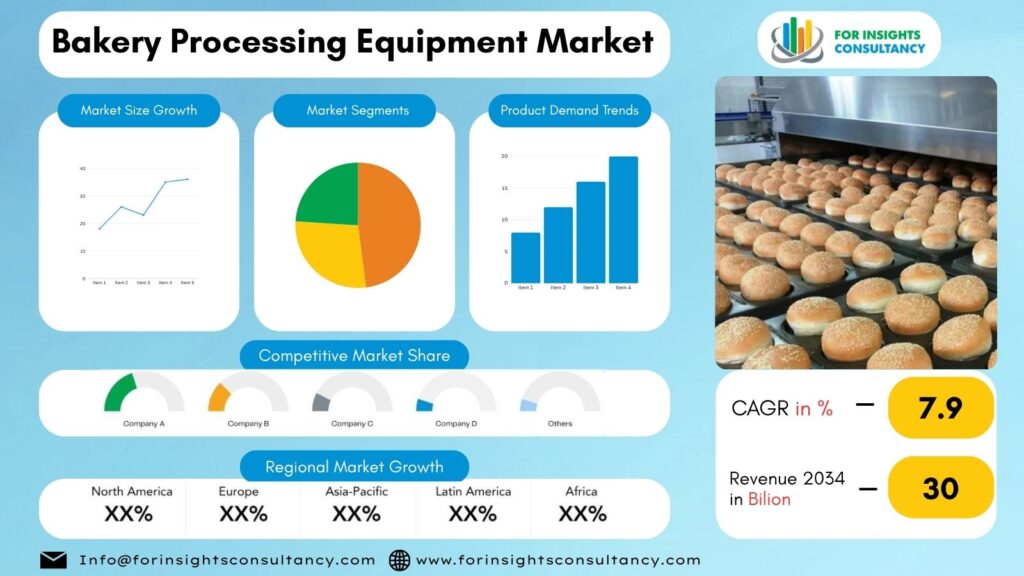
Bakery Processing Equipment Market Size & Growth Forecast
- Market Size (2026): 16.3 Billion
- Forecast (2034): 30.0 Billion
- CAGR (2026–2034): 7.9%
- Base Year: 2025
- Leading Segment (2026): Ovens & Proofers (~37–40% share, ahead of mixers and sheeters/molders).
- Top Region (2026): Asia Pacific (largest current market; Middle East & Africa is the fastest-growing).
- Market Trends: Growth is being driven by rising automation to offset bakery labor shortages, alongside a shift toward energy-efficient, digitally-controlled ovens as chains scale production.
Bakery Processing Equipment Market Quick Market Briefing
Bakery Processing Equipment market comprises all types of machines that are used for large-scale manufacturing of bakery products such as ovens/proofers, mixers, sheeters/molders, slicers, and packaging machines that cater to the requirements of bakeries, food service providers, and food processors.
The global bakery processing equipment market size is expected to grow to USD 16.3 billion by 2026, from an estimated USD 15.1 billion in 2025 and is expected to reach USD 30.0 billion by 2034, growing at a CAGR of 7.9% during 2026 and 2034 period. The growth of the market is attributed to the growing automation to counter labor shortage in bakeries and increase in the demand for energy-efficient and digital control equipment due to growth in production capacity of the bakery chains.
Ovens & Proofers segment held the largest share of roughly 37-40% as Ovens & Proofers are the basic processing equipment used in any bakery operation, ahead of Mixers and Sheeters/Molders segments.
Asia-Pacific region held the largest market share owing to increased bakery manufacturing capacity and demand for baked goods in packaging form, while the Middle East & Africa regions is growing at the highest pace.
Increased adoption of automation due to ongoing labor shortages, trend towards energy efficient and climate/humidity sensitive ovens and increased demand for equipment suitable for both small-batch and industrial production runs.
Request a Free Sample Copy: https://www.forinsightsconsultancy.com/reports/request-sample-bakery-processing-equipment-market
Bakery Processing Equipment Market Growth Driver 2026
Increase in Packaged and Convenience Foods Consumption
As more families opt for pre-packaged ready-made breads, pastries and snacks in order to cope with their fast lifestyle, bakeries will require more production-efficient mixing, proofing and baking lines that would not be possible to manage using manually operated machines.
Labor Shortages Leading to Adoption of Automation
With an increase in the difficulty to attract and retain skilled bakery workers in many regions, it becomes a must-have solution for bakeries to use automated dough handling and packaging machines that are able to sustain the same level of productivity regardless of the number of available workers.
Growth of Organized Retail and QSR Bakery Chain Operations
As more in-store bakeries of retail stores and quick-service restaurants open up, each new location becomes an opportunity to introduce more bakery equipment – commercial ovens, spiral mixers, proofing cabinets, which are required to produce consistent quality of products in different locations.
Increasing Consumer Demand for Diversity of Products
The consumers have come to expect more variety of bakery products such as gluten-free, multi-grain or artisanal products, requiring more easily configurable equipment.
Trends 2026
Trade policy is now a first-order variable in equipment pricing
This is where government information becomes essential. The Section 232 underwent major amendments in April 2026: instead of tariffs on metal content, now they apply to the total value of imported items at 10% for derivative items that are made from 95% of U.S.-made steel or aluminum, and without the inclusions program. Further, on June 1, 2026, a proclamation reduced industrial equipment tariffs from 25% to 15%, revised the coverage of 15% industrial machinery, and introduced 10% tariffs on foreign-made capital equipment consisting of at least 85% U.S.-derived steel or aluminum by weight. The amendments entered into force on June 8, 2026, and will expire on December 31, 2027.
Two compliance clocks OEMs are designing against
The EU Machinery Regulation 2023/1230 will be in effect as of 20 January 2027, taking the place of the Machinery Directive. The significance of the Machinery Regulation 2023/1230 lies in its provision for digital instructions by default, the addition of essential requirements for cybersecurity in the safety functions, artificial intelligence and self-evolving behaviour, as well as the definition of “substantial modification” (Art. 3(16)), which makes the third party responsible as the manufacturer when retrofitting AI vision systems into an existing line. This brings us directly to trend #1, that of the retrofit phenomenon, with increased liability.
Supplier landscape is consolidating into focused pure plays
Middleby finished the spin-off of its food processing segment to Midera Food Processing on July 6, 2026 — over 30 brands, more than 100,000 units in installed base and the stated M&A pipeline in the protein, bakery and snacks categories; Middleby retained commercial foodservice, with second-quarter 2026 sales up 9.9%, and adjusted EBITDA of $193.2m. In addition, Middleby built a 65,000 square-foot innovation center in proximity to Venice in October 2025 for bakery and snack processing. With JBT-Marel having merged already, the acquisition of bakery equipment assets in 2026-27 will have a limited number of potential buyers.
Labour is no longer the automation argument it was in 2021-22
The US government figures challenge the standard pitch from the vendors. According to BLS, there are approximately 1.78 million people employed in food manufacturing industry, and employment is relatively stable until early 2026, while number of production and nonsupervisory employees totals 1.41 million. Overall, according to JOLTS, job openings decline to 7.3 million in July 2026 at a rate of 4.4%, and quits totaled 3.1 million with a quits rate of 2.0% – a much softer labor market compared to the one behind the automation boom after the pandemic.
Top Companies Covered
- Bühler (Switzerland, privately owned) — milling, dough, extrusion, chocolate and coffee; over 30,000 active customers, currently with services representing 38.3% of turnover. Strongest upstream, in grains, flours and mixing.
- GEA (Germany, DAX-listed) — bakery expertise derived from Comas and Imaforni acquisitions; ingredient handling, liquids and powders, refrigeration and packaging covered. Restructured into four divisions in 2026, so segment data is not directly comparable.
- JBT Marel — since merger, protein-focused but with bakery-relevant thermal and portioning technology.
- Ali Group (Italy) — predominantly foodservice with industrial overlap.
- Alfa Laval, Heat and Control – processing and thermal specialists featuring in bakery and snacks equipment lines.
Bakery Processing Equipment Market Company news 2026
Feb 10, 2026 — Lone Star Funds completed its $3.8 bn all-cash acquisition of Hillenbrand, parent of Coperion (Coperion’s Food, Health and Nutrition arm holds Baker Perkins, Shaffer, Diosna, Shick Esteve, Unifiller, VMI, Bakon, Peerless). Announced Oct 15, 2025; shareholder approval Jan 8, 2026; Hillenbrand is now private and delisted from the NYSE.
July 6, 2026 — Middleby completed the spin-off of its food processing business as Midera Food Processing (Nasdaq: MFP), distributed one-for-one to Middleby shareholders. Midera holds 30+ brands and an installed base over 100,000 units spanning protein, bakery and snack; Middleby continues as a pure-play commercial foodservice company. Trading began under “MFP” on July 7.
July 31, 2026 — Rise Baking Company completed its acquisition of Jimmy’s Gourmet Bakery, expanding cookie-category manufacturing in the Northeast — one data point on continued M&A appetite among the customer base that buys this equipment.
April 1, 2026 — Coperion celebrated the opening of a new Unifiller manufacturing facility in Richmond, BC (cake decorating/depositing equipment).
Bakery Processing Equipment Market Segments
By process stage
Mixing and dough formation — mixers, dividers, dough-handlers. Coperion brands in this segment are VMI and Shaffer; for Bühler, this encompasses Consumer Foods and Grains & Food brands for upstream ingredient handling. AMF’s Mixer Guardian (automated closed loop dough management eliminating reliance on operator skill assessment) represents the obvious area of automated technology investment in this area.
Forming, sheeting, and laminating — Rademaker (sheeting, laminating, croissant, pizza forming, enhanced by Form & Frys acquisition), Rondo, Fritsch. Here the pressure of variety drives technology choices; the panelists of BEMA (Bimbo Bakeries, Roskam, Rise Baking, Campbell’s) cite ability to quickly change over to new SKUs as critical to capital spend, not throughput.
Deposition and filling — Unifiller (Coperion), AMF Powershot (machine learning adjusted sauce/topping deposition to allow for variation in shell weight). The new Unifiller plant from Coperion in Richmond, BC (opened April 2026) indicates that this sub-segment is being provided its own manufacturing capacity.
Baking (ovens & proofers) — high value and where energy policy hits equipment selection hard. Here you will find AMF’s hydrogen/electric/hybrid ovens and Den Boer’s oven hydrogen retrofit, GEA’s E-Bake/G-Bake families, Bühler’s Z-Mission energy system for dryers (saving up to 45%), among others. This stage is splitting into two: new construction hybrid/hydrogen ovens for greenfield bakeries, and retrofit burner/conveyor packages for existing tunnel and rack ovens – that’s where order volumes are rising, according to Bühler itself.
Cooling & conveying – spiral coolers, step coolers, ambient conveyors (AMF Vesta, Den Boer), and intra-bakery transport of product/pan/trays (AMF Convay). Neglected by nearly all industry market research segmentations but operationally vital – here is the stage where you will have to deal with the cost of steel/aluminium due to sheer conveyor and structural frame mass, which makes it one of the stages most sensitive to Section 232 tariffs.
Packaging & post-packaging – slicing and bagging (AMF PackTech), container/pallet handling (AMF Workhorse, derived from the 2025 Workhorse Automation). Vendors are selling the stage specifically on quick changeover and preset recipe recall ability to address workforce turnover and SKU proliferation, not speed.
By mode of operation
Completely automated, continuous flow lines are prevalent in high volume baking for bread, buns, and rolls (AMF BakeTech, Kaak, Mecatherm space) where round-the-clock production and manpower savings take precedence. Semi-automatic and modular unit systems still exist in craft, on-site, and small scale co-pack bakeries where flexibility in SKUs supersedes throughput volume – this is where BEMA’s Baker Panel came from.
In end-use / Application
Soft breads & buns — AMF BakeTech, Kaak, Rheon; highest-volume, most price-competitive category.
Viennoiserie / laminate pastries (croissants) — Rademaker expertise, gentle handling focus.
Cakes, muffins, batter products — GEA, AMF cake/muffin product line (to 100,000/hr), Coperion/Shick Esteve.
Cookies, biscuits — Baker Perkins (Coperion) traditionally strong in this category.
Pizza, flatbreads — Rademaker, AMF Tromp topping/sauce product lines; highlighted as a growth market in several vendor literature sets.
Snacks / extruded products — growing overlap with Bühler extrusion and Cerex puffing systems; boundary blur between “bakery equipment” and “snack equipment” market segments, as seen in the very nature of Midera’s self-description as encompassing “protein, bakery and snack.”
Bakery Processing Equipment Market Regional Insights
Europe
EU Machinery Regulation 2023/1230 becomes legally binding January 20, 2027. Machinery that is ordered prior to this date and placed on the market will be covered by the old directive, while any machinery placed on the market later will be covered by new cybersecurity, AI-behavior and digital instruction provisions, and any retro-fitting work performed by a third party that introduces new risks will move liability from the equipment manufacturer to the integrator. This is causing capital expenditure in Europe to advance to 2026 due to buyers trying to beat the deadline using well-known compliance criteria.
Company-level European activity: Lotus Bakeries broke ground in 2026 on a new production hall addition at its Lembeke, Belgium site (described as the largest single product cookie production facility in Europe); Ferrero announced a €60 million investment in France for industrial and logistics capacity. Bühler, headquartered in Uzwil, Switzerland, continues to dominate the upstream (milling/dough) supply chain in Europe but saw a 1.1% drop in orders in its Grains & Food business in 2025.
North America
Activity for Concrete 2026: H-E-B launched its commercial bakery in San Antonio as part of a $700 million supply chain upgrade; Bauducco launched Phase 1 of its three-phase manufacturing facility in Zephyrhills, Florida mid-2026. This comes on top of the Grupo Bimbo’s prior $630 million Georgia/Ohio build-out, which kept building into 2026.
However, against this backdrop, Bühler’s own 2025 results indicate that the US order intake for equipment is off by 31% due to Section 232 tariff uncertainties and deferred investment decisions – so while end-product manufacturers are building facilities, the purchase of the equipment for these facilities is where the hesitation lies. In April and June 2026, Section 232 revisions (total value tariffs assessment, followed by partial 25% -> 15% tariff reduction for certain industrial machinery, and 10% tariff for 85%+ US melted and poured steel/aluminium) make for decisions on procurement of ovens.
Asia-Pacific
Two separate trends are emerging at once. At the low end, China provides a significant number of domestic oven manufacturers and equipment providers (e.g., Guangzhou Hongling/RONO) that compete on cost basis and largely cater to regional and international markets without challenging the established turnkey solution suppliers. At the high-end, multinational corporations are expanding their Asia-Pacific capacity on purpose — in 2026, Lotus Bakeries has finished the construction of a new greenfield Biscoff plant in Chonburi, Thailand in order to serve Asia-Pacific growth (accounting for 15% of Biscoff sales).
Middle East & Africa — Smallest, Early-Stage Region
It is the only one area where I would challenge the market report format most strongly, due to very tangible developments in companies’ activities. Tiger Brands announced a greenfield, high-capacity inland bakery production facility in South Africa’s East Rand, opening in 2026, with the capacity of 12,000 loaves per hour – actual greenfield industrial project, not just forecast. In Saudi Arabia, the SFDA strengthened labeling regulations, promoting reformulation; the wheat milling and bakery manufacturing incentives related to Saudi Arabia’s Vision 2030 food security policy have been attracting greenfield investments.
Frequently Asked Questions
How big is the bakery processing equipment market?
The global Bakery Processing Equipment market revenue is valued at USD 16.3 Billion in 2026 and is projected to rise to USD 30 billion by 2034, register a CAGR of 7.9% during the 2026–2034 forecast period.
Who are the largest bakery equipment suppliers in 2026?
Bühler, GEA, and Midera Food Processing (formerly Middleby’s food division) lead the diversified suppliers, alongside bakery specialists AMF/Markel Food Group, Kaak Group, Mecatherm, and Rademaker.
Which region is seeing the most new bakery capacity right now?
Middle East & Africa — corroborated by both buyer-side capex (e.g., Tiger Brands’ 12,000 loaves/hour South Africa facility) and Bühler independently reporting Africa as its largest food and feed region by turnover for the first time in 2025.
What’s the difference between fully automatic and semi-automatic bakery lines, and which do I need?
Fully automatic suits high-volume, single-SKU industrial production with lower labor costs but less flexibility, while semi-automatic suits craft, in-store, or co-manufacturing operations needing frequent product changeovers — and current industry sentiment (per a 2026 BEMA panel of major bakers) actually favors flexibility over raw throughput.
What’s Included in This Report — Bakery Processing Equipment Market
- Verified company and structural developments — Ownership changes (Lone Star’s $3.8bn Hillenbrand/Coperion acquisition, completed Feb 2026), corporate spin-offs (Middleby → Midera Food Processing, July 2026), and named capital projects (Tiger Brands’ 12,000 loaves/hour facility, Lotus Bakeries’ Chonburi and Lembeke expansions) — sourced from company filings, press releases, and trade press, not syndicated summaries.
- Regulatory and policy timelines that affect purchasing decisions — EU Machinery Regulation 2023/1230 (mandatory Jan 20, 2027), US Section 232 tariff structure (current relief tiers expire Dec 31, 2027), and FSMA 204 (compliance date now July 20, 2028) — each with the actual deadline, what changes, and who it affects, sourced from EUR-Lex, the Federal Register, and FDA directly.
- Demand signals from primary financial disclosures — Supplier order intake and segment performance (Bühler, GEA, Coperion/Hillenbrand) reported as companies actually disclosed them, including where bakery-specific lines underperformed broader food-equipment growth — not a single blended “market growth rate.”
- Technology and segment analysis grounded in named products — What suppliers are actually building (AMF’s Mixer Guardian, Bühler’s SmartMill, hydrogen oven retrofits) mapped to process stages (mixing, forming, baking, cooling, packaging), rather than a generic “by type” taxonomy with invented growth percentages per slice.
- Customization Options: Ability to request additional country-level breakdowns, company profiles, or a narrower/broader market scope tailored to specific research needs.
Who Should Buy This Report?
- Food & Beverage Companies: Bakery, dairy, smoothie, and confectionery brands sourcing frozen fruit as an ingredient can use this data to anticipate input-cost trends and identify emerging application categories.
- Distributors & Retailers: Supermarket chains, online grocery platforms, and specialty frozen food retailers looking to optimize category mix and channel strategy based on regional demand patterns.
- Investors & Private Equity Firms: Evaluate market attractiveness, growth trajectory, and competitive concentration before funding or acquiring frozen food assets.
- New Market Entrants & Startups: Understand competitive intensity, regional entry points, and underserved segments (such as Latin America and Middle East & Africa) before committing capital.
- Trade Associations & Policy Researchers: Reference regional and segment-level data for industry reporting, trade policy analysis, or agricultural planning.
Buy This Report Now — https://www.forinsightsconsultancy.com/buy-now-bakery-processing-equipment-market/ (Access In-Depth Analysis, Forecasts & Company Profiles)
Related Market Reports of Food Industry
Food Ingredient and Additive Market Size, Share & Growth Forecast 2034
Food Cans Market Size & Forecast to 2034
Frozen Drinks Market Size, Trends 2026
Dairy Beverages Market Report 2026–2034
Request a TOC: https://www.forinsightsconsultancy.com/reports/request-sample-bakery-processing-equipment-market
Select PDF License
Single User: $3499
Multiple Users: $4499
Corporate Users: $5499