

18 September-2026 Formats | PDF | Category: Food & Beverages | Delivery: 24 to 72 Hours
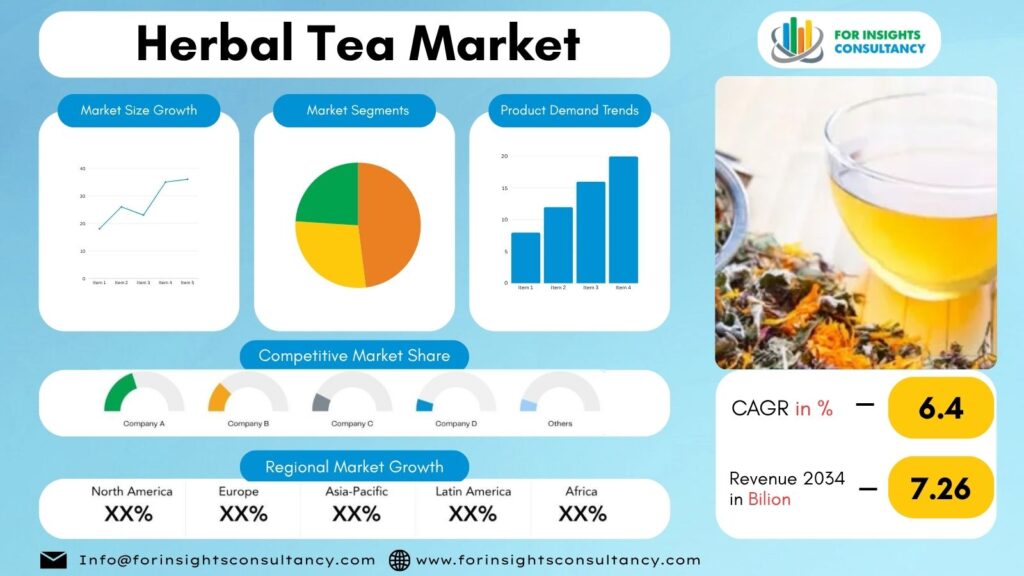
Herbal Tea Market Statistics
- Market Size (2026): 4.42 Billion
- Forecast (2034): 7.26 Billion
- CAGR (2026–2034): 6.4%
- Base Year: 2025
- Largest Segment (2026): Chamomile & Peppermint (Product Type) / Tea Bags (Packaging Type)- ~40% combined share
- Leading Region (2026): Europe — For Insights Consultancy Estimate: ~33–35% share.
Herbal Tea Market Overview (2026)
Herbal tea refer to caffeine-free teas that do not use leaves of the Camellia sinensis plant used in making regular tea, but rather use dried herbs, flowers, fruits, spices, and plants instead, and the global herbal tea market is projected to be worth about $4.42 Billion in 2026 and reach almost $7.26 Billion by 2034, at a Compound Annual Growth Rate (CAGR) of about 6.4% over the assumed period, driven mainly by increasing consumer interest in natural and functional beverages as substitutes for regular caffeinated drinks. Growth is also fueled by increased awareness of wellness benefits of herbal teas, growing trend of organic and clean label product, and innovations in flavorings and premium herbal blend; chamomile and peppermint are the current leading types of products in the market, whereas ginger will witness the highest growth in the future.
In terms of region, Europe commands the biggest market share with 33–35% owing to its traditional tea-drinking culture and the tendency of consumers towards natural wellness products, followed by North America, while the Asia-Pacific region is anticipated to be the fastest-growing region through 2034. Tea bags account for the largest product packaging form, whereas supermarkets and hypermarkets continue to be the top distribution channel, but online sales channel is the fastest-growing one since more people opt to buy their herbal teas online. As far as future prospects of the market go, it is likely that it will witness stable growth driven by increasing range of organic products, increasing demand for plant-based functional beverages, and sustainable packaging.
Request a Free Sample Copy: https://www.forinsightsconsultancy.com/reports/request-sample-herbal-tea-market
Herbal Tea Market Dynamics
Growth Driver 2026
- Increasing demands for natural and functional beverages — More people are moving from drinking caffeinated beverages and those that have artificial flavors to herbal tea, which is appreciated for its naturalness and health benefits.
- Increased focus on health and wellness — The knowledge of the benefits of drinking such beverages as improved digestion, reduced stress levels, immune function enhancement, and anti-oxidant functions has contributed to the consumption of herbal tea becoming more common.
- Increased desire for caffeine-free beverages — Individuals who wish to reduce their caffeine intake, including pregnant women and children, use herbal tea as an alternative to regular tea and coffee.
- Premium and flavor innovation — Premium and flavorful herbal tea products are being created through the introduction of unique herbs, blends, and adaptogenic ingredients.
Trends 2026
- Convergence of Functional Beverage
- The herbal tea beverages are being increasingly sold as functional beverages that focus on particular health benefits (relaxation, immune system, digestion), incorporating the use of herbs such as chamomile, ginger, peppermint, and turmeric.
- Ginger as the Fastest Growing Type
- In terms of types, the type of herbal teas that will be growing rapidly would be the ginger based ones owing to the increasing interest of consumers in its digestive and anti-inflammatory effects.
- Preference for Organic/Clean Label Products
- Increasing preference of organic, plant-based, and clean label products is one of the factors influencing purchase decisions.
- Online Retail as the Fastest Growing Distribution Channel
- E-retail is becoming the fastest growing distribution channel, influenced by greater product availability and subscription services.
Herbal Tea Market Top Companies Covered In this Report are
- Unilever (Lipton, Pukka Herbs)
- Twinings (Associated British Foods Plc)
- The Republic of Tea
- Celestial Seasonings (Hain Celestial Group)
- Tata Consumer Products Limited (Tetley, Tata Tea)
- Yogi Tea (East West Tea Company)
- Traditional Medicinals
- Bigelow Tea Company
- DAVIDsTEA
- Numi Organic Tea
- Harris Tea Company
- Assam Company India Ltd
- Ito En Ltd (Japan)
- Dilmah Ceylon Tea Company PLC
Herbal Tea Market Company news 2026
Twinings
Twinings has been notably active in 2026 — the company introduced a new string-and-tag format as part of a packaging refresh for its green tea and infusions range (September 2026), and separately expanded into the cold beverage space with a new “Refreshers” line, signaling a push beyond traditional hot tea into ready-to-drink herbal/infusion formats.
Celestial Seasonings (Hain Celestial Group)
2026 announcement surfaced, though the brand continues its “TeaWell” functional tea line (targeting sleep, mood, and gut health with added melatonin, prebiotics, and probiotics) and remains a fixture at major industry trade events like Expo West 2026, which drew significant coverage for innovation and trendspotting in the natural products space this year.
Herbal Tea Market Segments
By Type
- Chamomile — widely favored for its calming, sleep-supporting properties
- Peppermint — popular for digestive support and refreshing flavor profile
- Ginger — fastest-growing type segment, driven by rising demand for its digestive and anti-inflammatory benefits
- Hibiscus — valued for antioxidant properties and vibrant flavor/color appeal
- Lemongrass — growing niche, often blended for citrus-forward wellness profiles
- Turmeric — rising functional segment, tied to anti-inflammatory wellness trends
- Fruit Blends — popular for flavor-forward, approachable entry points into herbal tea
- Other Blends — multi-herb functional combinations targeting specific wellness outcomes
By Raw Material
- Green Tea-Based — leading raw material base, aligned with broader antioxidant/wellness positioning
- Black Tea-Based — traditional base, though less common in pure herbal (caffeine-free) formulations
- Yellow Tea-Based — smaller, specialty segment
- Other — pure herbal/botanical bases with no tea-plant derivative at all
By Packaging
- Tea Bags — dominant packaging format, driven by convenience and portion control
- Loose Tea — premium/specialty segment, favored by connoisseurs for flavor customization
- Plastic Containers — common retail format for bulk or powdered blends
- Aluminum Tins — premium/gifting-oriented packaging format
- Other — sachets, capsules, and single-serve innovative formats
By Distribution Channel
- Supermarkets & Hypermarkets — largest channel, primary access point for mainstream household purchasing
- Online — fastest-growing channel, driven by expanding e-commerce and subscription-based specialty tea models
- Specialty Stores — key channel for premium, single-origin, or wellness-focused herbal tea brands
- Convenience Stores — relevant for on-the-go, single-serve purchases
- Other — direct-to-consumer, farmers markets, and wellness/health food stores.
Herbal Tea Market Regional Insights
North America
Market Share (2026): 28-30%
Top Brands: Celestial Seasonings (Hain Celestial), Yogi Tea, Traditional Medicinals, Bigelow Tea, The Republic of Tea, Numi Organic Tea
Consumer Trends: Functional wellness orientation is prevalent, with brands such as the “TeaWell” range by Celestial Seasonings being developed to achieve certain effects on health via additional melatonin, prebiotics, and probiotics, and the herbal tea category within the U.S. being estimated to be worth 35% of the North American tea market; Expo West 2026 highlights innovation in the realm of functional beverages in this region.
Asia Pacific
Market Share (2026): ~22-24%
Key Players: Ito En Ltd (Japan), Tata Consumer Products (India), Assam Company India Ltd, and local companies operating in China and Southeast Asia
Consumer Trends: Expected to be the fastest growing region until 2034 due to increased disposable income among middle classes, evolving wellness consciousness, and long-standing history/traditions of traditional/herbal medicine (e.g. Ayurveda in India, Chinese TCM inspired blends in China); shifting consumer preferences towards packaged herbal teas.
Europe
Market Share (2026): ~33-35%
Leading Products: Twinings, Pukka Herbs (Unilever), Yogi Tea, Dilmah Ceylon Tea Company
Consumer Trends: The presence of a strong tradition of tea drinking in the region underlies the highest per capita consumption of herbal tea products; packaging innovations from Twinings and Refreshers collection show an increasing trend towards high-quality, eco-friendly, and format diverse products; high attention to organic certification and herbal origin traceability (UK, Germany, France).
Middle East & Africa
Market Share (2026): ~5-6% — For Insights Consultancy Estimation
Key Brands: Limited presence of branded offerings; mainly imported offerings and regional practices of herbal infusion
Consumer Behavior: Emerging market associated with health awareness in rich urban markets (UAE, Saudi Arabia, South Africa); presence of traditional practices of herbal remedy consumption creates opportunities for category growth in future.
Latin America
Market share (2026): ~7% – For Insights Consultancy Estimation
Leading Brands: Very limited branded product presence; local players and foreign brands are dominant
Consumer trends: The increase is largely urban-centric with health consciousness on the rise; cultural acceptance of herbal infusion drinks (similar to yerba mate) means easy entry into herbal tea segment.
Frequently Asked Questions
What’s the size of the global herbal tea industry right now?
The global market for Herbal Tea has a valuation of about $ 4.42 Billion in 2026 and will reach $7.26 Billion in 2034, growing at a 6.4%.
Is chamomile or peppermint the bigger seller?
Both sit near the top, but together they’re estimated to account for close to 40% of the category — chamomile leans toward the relaxation/sleep angle, peppermint toward digestion.
Which brands come up most often when people talk about herbal tea?
Twinings, Celestial Seasonings, Yogi Tea, and Traditional Medicinals tend to dominate conversation and shelf space, especially across the US and UK markets.
What’s driving companies to launch so many new herbal tea products?
Competition for shelf space plus consumer appetite for novelty — brands are experimenting with adaptogens, cold-brew formats, and function-specific blends (energy, focus, digestion) to stand out.
Which segment of this market would a new investor want to look at closely?
Ginger-based and functional/adaptogen blends are flagged across multiple sources as the fastest-growing sub-segment — worth more attention than the overall market average suggests.
Key target audiences for the Herbal Tea market include:
- Consumers: Health and wellness-conscious individuals, caffeine-sensitive consumers (pregnant women, children), millennials/Gen Z seeking functional beverages, older adults managing specific health concerns (sleep, digestion, immunity).
- Manufacturers & brand owners: Established tea companies, functional beverage startups, and herbal supplement brands expanding into tea formats.
- Retail & distribution channels: Supermarkets/hypermarkets, specialty health food stores, online grocery/e-commerce platforms, convenience stores.
- Foodservice operators: Cafés, tea houses, wellness-focused restaurants, and hotels offering herbal tea menus.
- Ingredient & raw material suppliers: Herb, botanical, and spice growers/exporters, packaging suppliers (biodegradable tea bags, sustainable packaging).
- Investors & venture capital firms: PE/VC firms funding functional beverage and wellness-focused CPG startups.
- Regulatory & health bodies: Food safety authorities and regulators overseeing health-claim labeling and herbal product safety standards.
- Market research analysts & consultants: Firms and buyers tracking market sizing, competitive landscape, and consumer trend shifts in the functional beverage space.
- Retailer private-label teams: Supermarket chains developing in-house herbal tea product lines to compete with branded players.
Customization Available
This report can be tailored to meet specific client requirements. The following customization options are available upon request:
Regional & Country-Level Customization
- Detailed analysis for any specific country not covered in the standard report (e.g., Indonesia, Mongolia, Mozambique)
- Deeper sub-regional breakdowns within Asia-Pacific, North America, Europe, or Middle East & Africa
Company-Specific Analysis
- Detailed profiling of additional companies beyond those covered (financials, SWOT, product portfolio, recent developments)
- Competitive benchmarking of up to 5 additional company profiles
Segment-Level Customization
- Additional breakdown by any specific grade, application, or end-use segment not covered in the base report
- Historical data extension beyond the standard base year.
Any Requirement Contact Us: https://www.forinsightsconsultancy.com/contact-us
Related Market Reports
Energy Drink Market Size, Shares and 8.18% CAGR by 2034
Ready-To-Drink Market Report: Size, Share & Analysis 2034
Beer and Energy Drinks Market Insights 2026: Trends & Forecast 2034
Alcoholic Drinks Market Report — Beer, Spirits, RTD Beverages, Wine, 2034
Table of Contents
For TOC Contact us: https://forinsightsconsultancy.com/contact-us/
Select PDF License
Single User: $3499
Multiple Users: $4499
Corporate Users: $5499