

20 October 2026 Formats | PDF | Category: IT | Delivery: 24 to 72 Hours
Musical Instruments Market Size Statistics
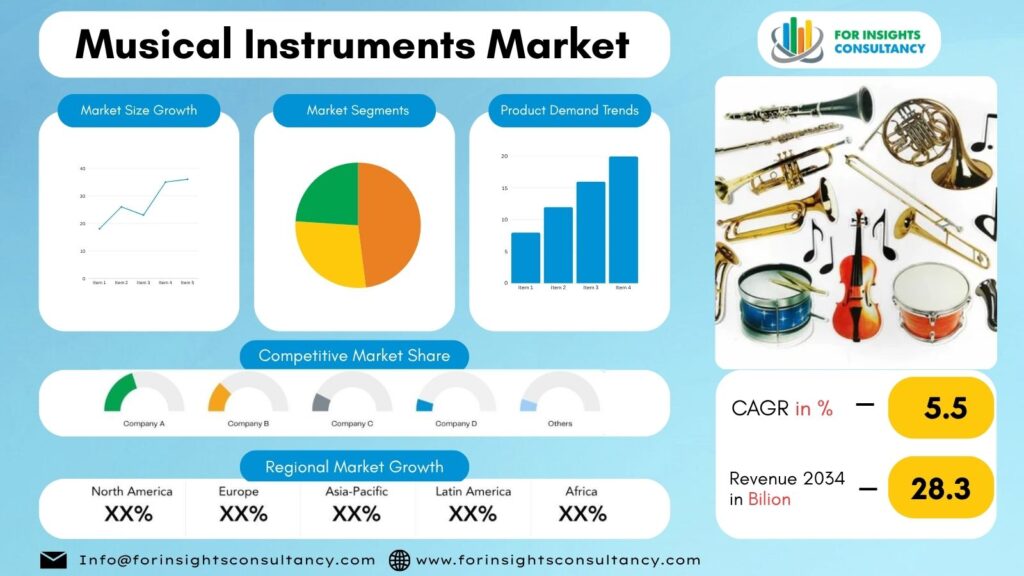
Market Size (2026): USD 18.5 Billion
Forecast (2034): USD 28.3 Billion
CAGR (2026–2034): 5.5%
Base Year: 2025 (USD 17.5 Billion)
Leading Segment (2026): String instruments
Leading Region (2026): Asia-Pacific (~38–44% share)
Core Trends: Hybrid and electronic instruments with digital integration, paired with online learning and e-commerce, are drawing a new wave of home players.
Musical Instruments Market Definition
The musical instruments market is composed of the manufacturing and distribution of musical instruments used by players to produce sounds and their complementary products. The key product segments include string instruments like guitar and violin, keyboard instruments including piano and synthesizer, percussion, wind and brass, and electronic instruments. The available segmentations include string instruments, electronic and electromechanical musical instruments, percussion instruments, wind instruments, acoustic pianos and stringed keyboard instruments, and parts and accessories. End users include novices, hobbyists, students, institutions and professionals.
Musical Instruments Market Overview 2026
Musical Instruments Market, Forecast 2026: This market covers the production and sale of musical instruments used for the making and performing of music in 2026. The various musical instrument types include string musical instruments, keyboards and pianos, percussion instruments, wind instruments, brass instruments, and electronic musical instruments. These musical instruments will find use in music education, live music performances, music production in homes, music recordings, and learning to play musical instruments.
Factors that drive the musical instruments market include the demand for guitars, pianos, digital keyboards, drums, violins, flutes, saxophones, and electronic musical instruments including synthesizers and digital drums. Acoustic musical instruments are significant for performance music and music education whereas digital musical instruments are significant for their mobility, inbuilt sounds, recording capabilities, and practice flexibility.
The market of musical instruments also benefits from the growing number of people taking part in music education programs, individual lessons, musical programs in schools, and self-study. The beginners and students mostly buy cheap musical instruments like guitars, keyboards, digital pianos, and percussions, while professional musicians are more interested in sound quality and high performance. There is also a demand for musical instruments coming from educational institutions, music academies, religious organizations, orchestras, and recording studios.
What are the main trends in the musical instruments market in 2026? They include the digitalization of the market, the use of electronic instruments and hybrid acoustic-electronic products, home recording, and online music learning. Digital keyboards, synthesizers, electronic drums, and recording connected instruments attract consumers interested in practicing and creating music with digital means. Social networks and video performances also help consumers find new instruments to buy.
Request a Free Sample Copy: https://forinsightsconsultancy.com/reports/request-sample-musical-instruments-market (Sample Include key points such as 2026 market size, 2034 forecast, CAGR, leading product segment, fastest-growing segment, dominant region, major companies, trends, growth drivers, challenges, and opportunities.)
Trends 2026
Hybrid and digital-ready instruments
One analyst says that there is an increasing demand by musicians for instruments that can blend with recording and streaming software and live performance system especially guitars, electronic keyboards, and electronic drums. At the NAMM 2026, Korg introduced its product Liano Live! which is a digital piano designed specifically for streamers; it comes with a built-in mixer, microphone stand and can be easily connected with a single USB-C cable. Electronic drums have advanced to such an extent that they have acoustic shells and a deeper modeling engine.
Online and used-gear channels
Online sales of the instruments are forecast to increase at an annual rate of 8.9% from 2026 to 2033 because customers can make assessments on the specifications of the products from demo videos and reviews, while offline sales accounted for 69.5% of the income in 2025. According to the website of one seller, according to NAMM, the share of online retail of music products exceeds 50%. This figure contradicts the distribution of channels in the above information, and therefore should be treated skeptically. In the secondhand market, almost 80% of Reverb’s gross merchandise sales consist of used musical instruments, and used Gibson and Fender products have stabilized 20% higher than those in 2019.
A return to tactile, physical design
According to one report on the NAMM 2026 conference, the trend in the industry has shifted from screen-focused minimal interfaces to designs that are more tactile in nature, with knobs, pads, and faders made for touch. There have also been innovations in AI technology in pedals.
Guitar demand and share gains
Yamaha has indicated double-digit growth in guitar sales in its fiscal year ended March 2026 owing to an increase in market share in North America and developing markets. This has been obtained from a summary of Yamaha’s report by a retailer.
Musical Instruments Market Growth Drivers 2026
Live concerts and performances
One analysis says the market is driven by the increasing popularity of live concerts and performances, noting that more live events, such as music festivals and global tours, require advanced sound equipment and instruments. After the pandemic, the return of large live events has also increased demand, as artists and event organizers invest in new gear.
Music education and a growing base of learners
Fortune Business Insights’ summary points to rising consumer interest in musical education as a growth trigger. Other coverage says as more users get interested in music through streaming services and social media, they want to learn how to play instruments, and online courses, tutorials and music schools have made music education more accessible.
New technology and digital integration
One summary lists the integration of innovative technologies in musical equipment as a growth driver. Consumers are investing in guitars, keyboards, electronic drums and hybrid instruments that support recording, live performance and digital integration. Product examples include a 2026 digital piano tailored for streamers, with a built-in mixer and microphone stand.
Artist influence, endorsements and customization
Collaborations between artists and instrument brands, often through endorsements, further boost the industry, as fans buy the same instruments their favorite performers use, and the same source lists customization of musical instruments as a key driver.
Top Companies Covered in the Musical Instruments Market are
- Yamaha Corporation
- Roland Corporation
- Gibson Brands
- Casio Computer Co.
- Steinway & Sons
Musical Instruments Market Company news 2026
Yamaha Corporation
for the fiscal year ending March 2026, total sales amounted to JPY 465.33 billion with net income being recorded at JPY 23.72 billion. This compares to the previous year when total sales were JPY 462.08 billion and net income was JPY 13.35 billion. In the call transcript, management stated that while total revenue had remained constant, the core operating income had fallen by 13.1% due to rising expenses and unfavorable market conditions; the musical instrument segment registered a sharp increase in performance.
Fender Musical Instruments
Fender is rebranding PreSonus Studio One Pro as Fender Studio Pro 8 and relaunching the DAW with new native amp and effects plugins, as part of a connected music ecosystem of software and hardware. Its USB-C Quantum series audio interfaces, formerly under the PreSonus name, now carry the Fender brand.
Musical Instruments Market Segments
By Product Type
- String instruments: Guitars, basses, violins and similar instruments, and the leading product type, driven by the popularity of acoustic and electric guitars.
- Keyboard instruments and pianos: Acoustic pianos, digital pianos, keyboards and synthesizers for learning, performance and recording.
By Type
- Acoustic instruments: Traditional instruments that produce sound without electronics, valued for tone and craftsmanship.
- Electric and electronic instruments: Instruments that amplify or generate sound electronically, and the main route for digital integration.
By Price Tier
- Entry level: Starter instruments for beginners, students and casual players, supported by affordable options.
- Mid-range: Instruments for committed hobbyists and advancing students.
- Premium: High-end instruments for professionals and collectors, including limited editions and custom builds.
By End User
- Beginners and hobbyists: The largest group of buyers, drawn in by online lessons and streaming culture.
- Students and schools: Music education programs buying wind, string and percussion instruments.
Musical Instruments Market Regional Insights 2026
North America:
The North American market is very big, developed, and has strong demand from professional artists, educational institutions, and entertainment companies. North America is the homeland of the big online market and used instruments market.
Europe:
Europe is characterized by its rich culture, classical music, and existing professional music societies.
Asia-Pacific:
Asia-Pacific region is ahead in terms of manufacturing and education. This is due to the manufacturing prowess of the region and government policies aimed at enhancing musical education.
Latin America & Middle East & Africa
Latin America is growing from a modest base, with Brazil and Mexico dominating consumption in the strings category.
The Middle East & Africa region is smaller but is growing rapidly. According to one report, this is due to increased interest in traditional musical instruments, while according to another report, this is due to increased interest in Western instruments such as electric guitars and keyboards.
Frequently Asked Questions
What is the size of the musical instruments market in 2026?
The global musical instruments market is valued at about USD 18.5 billion in 2026, up from USD 17.5 billion in the 2025 base year. The figure covers acoustic, electric, electronic and hybrid instruments sold through retail and online channels.
How fast is the musical instruments market growing?
It is projected to grow at a CAGR of about 5.5% from 2026 to 2034. That is a steady mid-single-digit pace, helped by new home players, online learning and e-commerce. Published rates range from about 2.8% to 5.4%.
What will the market be worth by 2034?
About USD 28.3 billion, roughly 1.5 times its 2026 size. Growth rests on hybrid and electronic instruments, rising spending in Asia-Pacific and the move of music learning and shopping online.
Why do research firms report different market sizes?
Scope and definitions differ. Published 2026 estimates run from about USD 7.7 billion to USD 16.0 billion, so some reports likely cover only core instruments while others add accessories, amplification or pro-audio gear. Check what is included before comparing figures.
What are the main types of musical instruments?
Stringed, keyboard, percussion, and brass and woodwind instruments. By technology, they include acoustic, electric or amplified, electronic or digital, and hybrid instruments. String instruments, mainly guitars, lead the market.
What’s Included in This Report — Musical Instruments Market
This report provides a comprehensive analysis of the Musical Instruments Market, covering the following:
- Market sizing and forecast: 2025 base year (USD 17.5 billion), 2026 estimate (USD 18.5 billion) and forecast to 2034 (USD 28.3 billion at a 5.5% CAGR).
- Segmentation analysis: by instrument type (string, keyboard, percussion, brass and woodwind), technology (acoustic, electric, electronic, hybrid), price tier, distribution channel and end user.
- Regional insights: Asia-Pacific, North America, Europe, Latin America and Middle East & Africa, with the share and growth outlook for each.
- Growth drivers and trends: home players, hybrid and electronic instruments, online learning and e-commerce.
- Competitive landscape: profiles of leading manufacturers such as Yamaha, Roland, Casio, Kawai, Fender, Gibson and Steinway.
- Trade and tariff analysis: how US tariffs and sourcing shifts are changing costs and demand.
- Buyer and procurement insights: sourcing by price tier, channel choices and school and retailer purchasing.
- Buyer-intent FAQs: answers for researchers, product teams, market-entry planners, investors and brand owners.
Why Buy This Research Report?
- Clear, defensible numbers: Market size, forecast and CAGR are presented with the base year and scope stated, so you can compare them with other sources. Published 2026 estimates range from about USD 7.7 billion to USD 16.0 billion, which makes a stated scope important.
- Segment data you can act on: It shows where revenue sits by instrument type, technology, price tier and channel. String instruments lead, and hybrid and electronic products are the growth story.
- Focus on the new home-player wave: It covers online learning, e-commerce and digital integration, the trends changing who buys instruments and how.
- Regional and trade insight: Asia-Pacific leads with about 38% to 44% of revenue. The report also covers tariff effects, such as the US effective rate of 16.6% in Q1 2026, and sourcing shifts between China, Indonesia, Japan, Europe and the US.
- Competitive intelligence: Leading brands and a moderately fragmented structure show where an investor, supplier or new entrant can find room.
- Built for different buyers: Analysts get sizing, product teams get segment detail, retailers and schools get sourcing guidance, and investors get competitive context.
- Time saved: It replaces weeks of reconciling reports that use different definitions and base years.
Buy This Report Now — https://forinsightsconsultancy.com/buy-now-musical-instruments-market (Access In-Depth Analysis, Forecasts & Company Profiles)
Related Market Reports of Information Technology Industry
Table of Contents
Contact us: https://forinsightsconsultancy.com/contact-us/
Select PDF License
Single User: $3499
Multiple Users: $4499
Corporate Users: $5499