

27 October 2026 Formats | PDF | Category: Aerospace | Delivery: 24 to 72 Hours
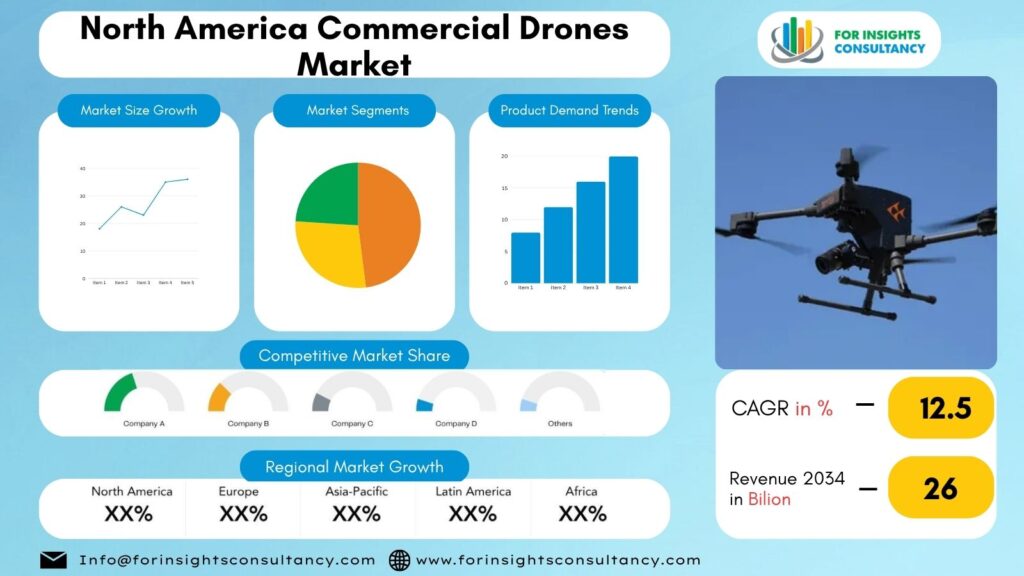
North America Commercial Drones Market Size Statistics
Market Size (2026): USD 10.1 Billion
Forecast (2034): USD 26.0 Billion
CAGR (2026–2034): 12.5%
Base Year: 2025 (USD 9.0 Billion)
Leading Segment (2026): Infrastructure (inspection and construction)
Leading Region (2026): United States (~86% of North America)
Core Trends: Routine beyond-visual-line-of-sight (BVLOS) operations are moving from waivers toward a standard rule, which is scaling drone delivery, infrastructure inspection and first-responder programs.
North America Commercial Drones Market Definition
North America Commercial Drones Market is an unmanned aerial vehicle (UAV) system together with the software and services for UAV which is employed by private corporations and public bodies in the USA, Canada, and Mexico for commercial applications and not military purposes. These applications could be infrastructure/ construction monitoring, surveying and mapping, precision agriculture, utilities and energy inspection, package and medical delivery, security, and filming. The market includes both the UAVs as well as the payloads and sensors, flight and data analytics software, and service operations such as drones as a service (DaaS).
North America Commercial Drones Market Overview 2026
The North America commercial drones market is changing as more and more businesses are incorporating the usage of UAVs in their inspection, surveying, mapping, agricultural, logistics, construction, and safety operations. This demand can be attributed to the increasing ability of organizations to improve their efficiency, cut down inspection costs and reach unreachable areas because of developments in the technology used in autonomous flight, high-quality imaging, artificial intelligence, and data analysis. There are many uses of commercial drones in the United States, including investment, innovative technology, and applications in infrastructure, energy, agriculture, and industrial operations. Canada also makes contributions to the regional demand for commercial drones in the form of mining, forestry, infrastructure monitoring, and resource management.
The major growth drivers of the North America commercial drones market in 2026 are the demand for real-time aerial data, labor-efficient inspections, precision agriculture, and automated site monitoring. Commercial drones allow energy firms to perform inspection on power lines, pipelines, wind turbines, and other facilities. At the same time, they assist construction firms in land surveying, tracking the progress of projects, and creating three-dimensional maps. Aerial imagery provided by commercial drones helps agricultural businesses monitor crops’ condition and conduct precision spraying.
Some of the key trends driving the North America commercial drones market through 2026 are the use of AI-powered analytics, drones with autonomous flights, the use of hybrid drone technology, advances in battery technologies, and growth in BVLOS operations. The rotary drones will continue to be used for short-range inspection and photogrammetry applications while the fixed-wing drones and the hybrid drones will be used for long-distance surveys and larger coverage. The emergence of the delivery services using the drones and other integrated software services is also creating opportunities in this field.
The United States contributes significantly to the regional commercial drone market demand, which includes many enterprise customers as well as the use of drones for agriculture, construction, utilities, energy, and public safety applications. In Canada, drones can be used for mining, forestry, environment monitoring, and remote infrastructure inspection. The adoption of commercial drones within North America is driven by regulations of airspace, pilot certifications, privacy laws, cybersecurity issues, equipment cost, and operator availability. Business companies that will offer drones along with software will have an edge in addressing these customer needs.
Request a Free Sample Copy: https://forinsightsconsultancy.com/reports/request-sample-north-america-commercial-drones-market (Sample Include key points such as 2026 market size, 2034 forecast, CAGR, leading product segment, fastest-growing segment, dominant region, major companies, trends, growth drivers, challenges, and opportunities.)
Trends 2026
Part 108 is the regulatory hinge for the whole market
The defining trend of 2026 is the wait for the FAA’s Part 108 rule on routine beyond-visual-line-of-sight (BVLOS) flight. The rule would replace one-off waivers with a standardized approval path. It has missed two deadlines, the statutory one of January 16, 2026 and the executive-order one of February 1, 2026. The final text reached White House review on July 10, 2026. Publication is expected in late 2026 or into 2027, with staggered compliance dates afterward. Until then, routine BVLOS flight still runs on Part 107 waivers or Part 135 certification, so operators are building waiver-based programs now rather than waiting.
Drone delivery is moving from pilot to network scale
Delivery is the most visible commercial trend. Walmart passed 1 million drone deliveries on May 29, 2026, with an average order-to-drop time of 23 minutes. Wing and Walmart plan more than 270 drone delivery locations by 2027, reaching over 40 million Americans. Amazon announced in August 2026 a roughly sixfold expansion of Prime Air to nearly 500 US cities and towns by year-end. DoorDash has received FAA approval to run its own network, and Uber is partnering with Zipline. Payloads are still small (Wing 2.5 lb, Amazon MK30 5 lb, Zipline Platform 2 8 lb), so the growth is in small, high-frequency orders rather than bulky freight.
Drone as First Responder (DFR) is scaling across public safety
Police and fire agencies are shifting from drones as a tool that officers carry to drones that launch automatically and arrive before units do. Chula Vista, California is the pioneer, launching an autonomous drone to nearly every priority call. One forecast values the global DFR market at USD 3.0 billion in 2025, rising to USD 3.5 billion in 2026 and USD 11.0 billion by 2033, a 17.7% CAGR. Automated docking stations and integration with computer-aided dispatch drive it, while BVLOS rules remain the main restraint. Agencies are also standardizing on NDAA-compliant platforms.
Drone-in-a-box turns drones into infrastructure
Enterprises are moving from pilot-flown missions to docked, autonomous drones that launch, fly, land, charge and upload data without an on-site operator. One estimate sizes the drone-in-a-box market at USD 1.72 billion in 2026, growing about 20% a year to USD 7.42 billion by 2034, though other publishers’ figures differ widely. A reported Chevron pilot with Percepto cut field-team inspection time by 52%. Energy, utilities, security and mining lead adoption, and thermal imaging is the largest payload category at 28.9% of the market.
North America Commercial Drones Market Growth Drivers 2026
Pro-drone federal policy and the BVLOS rulemaking
The strongest structural driver is a federal push to commercialize drones at scale. Executive Order 14307, “Unleashing American Drone Dominance” (June 2025), directs agencies to accelerate commercialization, integrate drones into the National Airspace System and strengthen the domestic industrial base. It also tells federal agencies to prioritize US-made drones. Its centerpiece, FAA Part 108, would turn BVLOS from a waiver into a routine authorization. That is widely seen as the unlock for delivery, remote inspection and drone-as-first-responder programs. The rule reached White House review on July 10, 2026 and is expected to publish in late 2026 or into 2027. Even before it lands, the expectation is pulling investment and operator planning forward.
Clear return on investment from replacing manual work
Drones win where they do dangerous, slow or costly jobs more cheaply than the alternative. Inspecting utility pipelines is one example where drones deliver greater precision and cost-effectiveness than conventional methods. Infrastructure was the largest end-user segment by revenue in 2024. A reported Chevron pilot using Percepto’s docked drones with AI analytics cut field-team inspection time by 52%. The same logic applies in construction, mining, energy and utilities, where drones reduce crew exposure to hazardous environments.
Agriculture is moving from novelty to necessity
Spray drones are the clearest adoption story. Acres treated by drones in the US grew from 3.7 million in 2023 to 16.4 million in 2025. Over 2024 to 2025, the average service cost reportedly fell from $21 to $13 per acre, which pushes adoption among growers and custom applicators. By one industry tally, 1,710 FAA Part 137 operators were active as of September 2025, and 27% of US agricultural retailers offered drone-applied inputs in 2025. Drones also reach wet or steep fields where ground rigs cause compaction or can’t operate. These agricultural figures come from industry trackers and aggregators rather than government statistics, so attribute them accordingly.
Consumer and retail demand for faster delivery
Large retailers are building drone networks because speed is a competitive advantage. Walmart passed 1 million drone deliveries in May 2026, averaging 23 minutes order to drop. Wing and Walmart plan more than 270 locations by 2027, Amazon targets nearly 500 US cities and towns by the end of 2026, and DoorDash and Uber have both entered the field. Zipline has set a target of one million deliveries per day by the end of 2029. These networks create demand for aircraft, docking and landing infrastructure, airspace-management software and maintenance services.
Top Companies Covered in the North America Commercial Drones Market are
- Skydio
- DJI
- Autel Robotics
- AeroVironment
- Teledyne FLIR
North America Commercial Drones Market Company news 2026
Skydio
Skydio raised USD 110 million in April 2026 at a USD 4.4 billion valuation, then committed USD 3.5 billion over five years to US manufacturing through its “SkyForge” program. The plan includes a facility five times the current size, more than 2,000 direct jobs and more than USD 1 billion directed to domestic suppliers. The company reports more than 1,200 public safety customers, double the prior year. On September 24, 2026 it announced the F10 Lightrunner, its first fixed-wing aircraft, plus a five-aircraft MegaDock, at its Ascend conference.
BRINC
BRINC closed a USD 125 million Series D on July 14, 2026, led by Motorola Solutions, bringing total funding past USD 250 million. It aims to put a 911 response drone on the roof of the roughly 80,000 US police and fire stations. The company says it tripled revenue in 2025 and plans a new Seattle headquarters and factory.
North America Commercial Drones Market Segments
By Type
- Multi-Rotor Drones: Vertical-takeoff aircraft that hover, widely used for inspection, mapping, public safety and photography.
- Fixed-Wing Drones: Long-endurance aircraft suited to corridor mapping, large-area surveying, agriculture and medical delivery.
By Offering
- Hardware: Aircraft, payloads, batteries, docking stations and ground control equipment.
- Software: Flight planning, fleet management, airspace-awareness and data analytics platforms.
By Technology (Level of Autonomy)
- Remotely Piloted: Operated by a pilot in line of sight, the standard model under current Part 107 rules.
- Semi-Autonomous: Pilot-supervised flights with automated navigation, obstacle avoidance and return-to-home.
By Weight Class
- Small (Under 55 lb): The bulk of commercial operations, covered by Part 107.
- Medium and Heavy (55 lb and Above): Larger platforms for cargo, heavy-lift agriculture and long-range missions.
North America Commercial Drones Market Regional Insights 2026
North America:
The largest regional market, led by the US and supported by enterprise adoption, delivery networks, public safety programs and a push toward routine BVLOS flight. Canada and Mexico add smaller but growing demand in inspection, resources and agriculture.
Europe:
A regulation-led market focused on integrating drones safely into shared airspace under harmonized EU rules. Demand centers on inspection, mapping, agriculture and urban delivery pilots.
Asia-Pacific:
A high-growth region driven by China, India, Japan and Southeast Asia, with strong manufacturing capacity and rapid uptake in agriculture, surveying and infrastructure. Growth is helped by supportive government programs and falling hardware costs.
Latin America & Middle East & Africa
An emerging market where drones are used for agriculture, environmental monitoring and natural resource management. Growth is gradual, shaped by evolving national aviation rules and expanding service providers.
Frequently Asked Questions
What is the size of the North America commercial drones market in 2026?
The North America commercial drones market is valued at USD 10.1 billion in 2026, up from USD 9.0 billion in 2025. The United States accounts for about 86% of the regional total, or roughly USD 8.7 billion.
What is the forecast for the North America commercial drones market?
The market is forecast to reach USD 26.0 billion by 2034, growing at a 12.5% CAGR from 2026 to 2034. Growth is supported by routine BVLOS flight, delivery expansion, infrastructure inspection and public safety programs.
How fast is the North America commercial drones market growing?
It is growing at a 12.5% CAGR over the 2026 to 2034 forecast period. That is roughly a 2.6x increase from the 2026 value to the 2034 forecast.
Which segment leads the North America commercial drones market?
Infrastructure, covering inspection and construction, is the leading segment in 2026. Utilities, energy operators and builders use drones to inspect assets, map sites and track progress faster and more safely than manual methods.
Which country dominates the North America commercial drones market?
The United States leads with about 86% of North American value. Canada and Mexico together account for the remaining USD 1.4 billion or so, with Canada’s lower-risk BVLOS rules and Mexico’s agriculture demand supporting growth.
What’s Included in This Report — North America Commercial Drones Market
This report provides a comprehensive analysis of the North America Commercial Drones Market, covering the following:
- Market Size and Forecast: North America commercial drones market valued at USD 10.1 billion in 2026, growing to USD 26.0 billion by 2034 at a 12.5% CAGR.
- Segmentation Analysis: Breakdown by type, offering, level of autonomy, weight class, application and end-user.
- Regional and Country Insights: Coverage of the United States, Canada and Mexico, with the US holding about 86% of regional value.
- Growth Drivers and Restraints: Policy support, cost savings, delivery expansion and public safety demand, balanced against regulatory delays and supply chain limits.
- Key Trends: Routine BVLOS adoption, drone delivery scaling, drone-as-first-responder programs, docked autonomous systems and AI-driven analytics.
- Regulatory Landscape: FAA Part 107 and the proposed Part 108, FCC Covered List rules and Canada’s lower-risk BVLOS framework.
- Competitive Landscape: Profiles of leading manufacturers, delivery operators and software providers, with recent funding and strategic developments.
- Company News 2026: Latest funding rounds, product launches, expansions and partnerships.
- FAQs by Search and Buyer Intent: Answers for analysts, product teams, market-entry planners, investors and procurement buyers.
Why Buy This Research Report?
- Clear Market Sizing: Get a defined USD 10.1 billion 2026 baseline and a USD 26.0 billion 2034 forecast, so you can size opportunities with confidence.
- Regulation Explained: Understand how FAA Part 108, FCC Covered List rules and Canada’s BVLOS framework affect operations, sourcing and timing.
- Growth Opportunities Identified: See which segments and applications, from infrastructure inspection to delivery and first response, offer the strongest returns.
- Competitive Intelligence: Track leading brands, 2026 funding rounds and strategic moves to benchmark competitors and spot partners or targets.
- Regional Clarity: Compare the US, Canada and Mexico to decide where to enter, expand or invest.
- Supply Chain Guidance: Learn how domestic manufacturing and component restrictions shape procurement and vendor choices.
- Decision-Ready Format: Segment data, trends and FAQs organized by buyer intent, so analysts, investors and procurement teams find answers quickly.
Buy This Report Now — https://forinsightsconsultancy.com/buy-now-north-america-commercial-drones-market (Access In-Depth Analysis, Forecasts & Company Profiles)
Related Market Reports of Aerospace and Defense Industry
Table of Contents
Request for TOC- https://forinsightsconsultancy.com/contact-us/
Select PDF License
Single User: $3499
Multiple Users: $4499
Corporate Users: $5499