

Rotational Rheometer Market Trend Analysis Report by Type (Stress Controlled Type Rotational Rheometer, Strain Controlled Type Rotational Rheometer), and by Application (Paint and Coating, Textile, Food and Drug, Cosmetics, Others) & Region (North America, Europe, APAC, MEA, South America) - Global Forecast to 2030
Pages: 300 | Jul-2024 Formats | PDF | Category: Energy and Power | Delivery: 24 to 72 Hours
Rotational Rheometer Market Overview
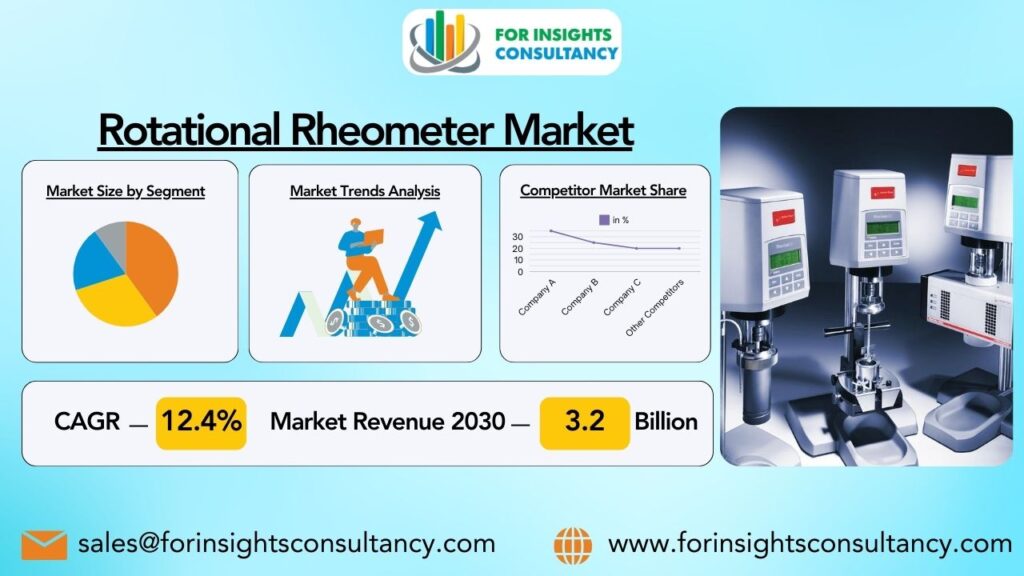
Rotational Rheometer Market is expected to grow rapidly at 12.4% CAGR consequently, it will grow from its existing size of from $ 1.4 Billion in 2023 to $3.2 Billion by 2030.
The Rotational Rheometer Market is a broad spectrum of high-precision analytical equipment used in determining the rheological characteristics of different types of liquids, semi-solids, polymers, gels, suspensions, emulsions, pastes, and others by analyzing their flow properties, viscometrics, elasticity, deformation behaviour with modern rotational forces. This type of research equipment has application in various fields like pharmaceuticals, chemicals, food products, beverages, cosmetics, bio-technology, oil & gas, paints & coating, paper, adhesive, polymers, construction materials, research institutes, and others for various purposes such as research work, quality check, formulation, and development.
In the last ten years, the market has experienced a major revolution, likely as a consequence of the augmented necessity for, and application of sophisticated material characterization, a permanent evolution of analytical instrumentation as well as the empowerment of product quality and process optimization. Ever more engineered, complex flow natural materials are emerging from industry, as well as the demand for an evermore reliable and precise rheological test method for characterising them. The creation of smart laboratories, laboratory automation, digital data, centralised technical work flows have all played a role in promoting modern rotational rheometers in factory and laboratory.
As product consistency, manufacturing efficiency, and regulatory compliance requirement gains recognition, the market growth is driven by the increasing demand. For example, rotational rheometers are used by manufacturers to measure viscosity, viscoelasticity, yield stress, thixotropic behavior, curing behavior and temperature-dependent properties of their products throughout product development and manufacturing process. Pharmaceutical manufacturers utilize rheometry to achieve the desired formulation of drugs and topical products. The food industry examines the texture, stability, and rheologic properties of new product designs. Manufacturers of paint and coatings, polymers, cosmetics, and building materials, rely on rheology evaluation to produce better products, reduce batch variability, prevent excess waste, and speed product development.
Ongoing technological development is still modifying the competitive environment. The progress in fields such as artificial intelligence (AI), machine learning, laboratory automation, cloud based laboratory information management systems (LIMS), Internet of Things (IoT) connectivity, digital sensors and innovative software analytics is revolutionizing rheological testing capabilities. AI enabled analytical software is enabling scientists to communicate complex rheological information, automate and standardize test procedures, reorganization patterns of material behavior, and optimize formulation development. High precision torque measurement, automated sample loading, temperature-controlled testing set-up, oscillatory measurement methodology, and multi-functions testing units are establishing conditions for reliable reproducible testing results and increased laboratory productivity. Extending in a laboratory digital ecosystem is giving rise to synergetic benefits in terms of traceability, remote operation, predictive maintenance and record keeping.
Regulatory standards and quality assurance demands are also important market drivers for the Rotational Rheometer Market. Increasingly demanding instrument manufacturers and end users have to adhere to testing standards across national and international validation standards, international accreditation regulation standards and requirements, GLP, GMP, ISO quality norms and various validation procedures specific to the respective industries. Pharmaceutical, food, biotechnology and chemical industries are quickly adopting standardized rheological testing method for safety reasons, industry regulatory commands and manufacturing parameters control. Increasing investment in laboratory modernization and digital quality management systems are adding to market traction.
North America continue to be the number one regional market due to the better research infrastructure, the existence of well established pharmaceutical and bio technology industries, the higher investment to analytical instruments and modern laboratory automation technique. Europe continue keep on growing steadily owing to the matured chemical, polymer and food industries, the vigorous academic research capabilities and the tighter regulation on product quality. However, the Asia –Pacific area is expected to have the fastest growth rate in the prediction period due to the increase in manufacturing and R&D activities, manufacturing and R&D investments, the production of pharmaceuticals, swift industrialization as well as the increase of laboratory infrastructures in China, India, Japan, South Korea, Southeast Asia, etc.
The Rotational Rheometer Market is poised to witness a sustained long term growth on account of the ever rising demand from various strategic sectors such as advanced material characterization, product and process innovation and quality control. Growing deployments of AI integrated laboratory analytics, wide use of laboratory automation including computerized rheo-logical testing systems, data-rich, lab-connected cloud-based laboratory platforms, accelerated R&D in advanced materials science, the use of smart manufacturing paradigms would catalyze huge opportunities for analytical instrument vendors, laboratory equipment providers, industrial research organizations and industrial quality control laboratories over the forecast horizon.
Market Drivers:
- Industrial Demand: Sectors such as pharmaceuticals, food and beverage, and chemicals rely heavily on rheological data for process optimization and product development.
- Technological Advancements: Innovations in rheometer design and capabilities are expanding the range of applications and improving measurement accuracy.
- Regulatory Compliance: Stringent quality and safety standards necessitate precise rheological characterization.
Market Challenges:
- High Investment: The purchase and maintenance of advanced rheometers can be costly.
- Operator Expertise: Skilled personnel are required to operate and interpret rheological data effectively.
Despite these challenges, the rotational rheometer market is poised for continued growth as industries increasingly recognize the value of precise fluid characterization.
Rotational Rheometer Market Trends 2024
- Technological Innovation: Advancements in sensor technology and data analysis capabilities are enhancing the precision and versatility of rotational rheometers.
- Industry Adoption: The market is broadening its reach across industries, with increased demand from sectors such as pharmaceuticals, food and beverage, and materials science.
- Customization and Automation: The trend towards tailored instruments and automated testing processes is improving efficiency and data management.
- Sustainability Focus: The industry is increasingly focused on developing environmentally friendly and energy-efficient rheometers.
- Global Expansion: Emerging markets are driving growth, with Asia-Pacific emerging as a key region.
These factors collectively contribute to the market’s dynamic nature and ongoing growth.
Rotational Rheometer Market Dynamics
Growth Drivers
- Quality Assurance and Control: The increasing emphasis on product quality and consistency across industries is driving demand for precise viscosity measurement.
- Technological Advancements: Enhanced measurement capabilities and automation are expanding the applications of rotational rheometers.
- Research and Development: The growing focus on material science and product development is fueling demand for advanced rheological analysis.
- Industrial Applications: Sectors such as automotive, aerospace, and consumer goods are adopting rotational rheometers for process optimization and quality control.
- Regulatory Compliance: Stringent regulations in industries like pharmaceuticals and food require precise viscosity measurements, driving rheometer adoption.
Market Challenges
- High Initial Investment: The cost of acquiring and implementing rotational rheometers can be prohibitive for some businesses.
- Operational Complexity: The equipment often requires specialized training and expertise to operate effectively.
- Maintenance Requirements: Regular maintenance and calibration are essential, adding to operational costs.
- Market Competition: Intense competition among rheometer manufacturers can impact pricing and profitability.
- Economic Fluctuations: Economic downturns can reduce investment in new equipment.
The rotational rheometer market is poised for growth, but overcoming these challenges will be crucial for sustained success.
Rotational Rheometer Market Segment Analysis
The rotational rheometer market is categorized by instrument type, application, and end-user industry.
Rheometer Types
The market primarily comprises rotational rheometers and viscometers. Rotational rheometers, capable of measuring material flow under controlled conditions, dominate the market due to their versatility.
Rheometer Applications
Key applications include quality control, research and development, and process monitoring. Rheometers are essential for ensuring product consistency and advancing material science.
Rheometer End-Users
Major end-users encompass the chemical, pharmaceutical, food and beverage, and materials science industries. These sectors rely on rheometers for product development, quality control, and process optimization.
By Type
- Stress Controlled
• Strain Controlled
By Application
- Paint and Coating
• Textile
• Food and Drug
• Cosmetics
• Others
Competitive Landscape of the Rotational Rheometer Market
The rotational rheometer market is characterized by a competitive landscape with several key players.
Market Share and Key Players
Market Leaders: Companies like [Company A] dominate the market with a broad product portfolio and strong market penetration.
Technology Focus: [Company B] and [Company C] differentiate themselves through advanced technology and specialized rheometer solutions.
Market Penetration: [Company D] focuses on a wider customer base with affordable options.
- Haake
- Brookfield
- Thermo fisher Scientific
- Anton Paar
- TA Instruments
- Malvern
These companies compete based on factors such as product innovation, pricing, and customer support.
Rotational Rheometer Market Regional Outlook
The rotational rheometer market is experiencing substantial growth driven by advancements in technology and increasing industrial applications.
Regional Dynamics
- North America: A mature market characterized by technological leadership and a robust research infrastructure.
- Europe: A stable market with a focus on high-quality standards and advanced manufacturing.
- Asia-Pacific: The fastest-growing region due to rapid industrialization and increasing R&D investments.
These regions exhibit distinct market characteristics influenced by factors such as industrial development, regulatory frameworks, and technological advancements.
Frequently Asked Questions:
What is the Market Size and CAGR?
Rotational Rheometer Market is expected to grow rapidly at 12.4% CAGR consequently, it will grow from its existing size of from $ 1.4 Billion in 2023 to $3.2 Billion by 2030.
What factors are driving the growth of the rotational rheometer market?
Key drivers include increased demand for quality control and assurance in manufacturing processes, advancements in technology, and growing applications across different industries.
What are the main challenges faced by the rotational rheometer market?
Challenges include high initial costs, the need for regular calibration and maintenance, and competition from alternative viscosity measurement technologies.
Which regions are witnessing the highest growth in the rotational rheometer market?
The Asia-Pacific region is experiencing significant growth due to industrial expansion and increasing demand from various end-use industries.
Key Benefits to Stakeholders:
- This study offers a quantitative examination of Rotational Rheometer Market trends, estimations, and dynamics from 2023-2030 to identify potential opportunities in this space.
- Porter’s five forces study emphasizes the value of buyers and suppliers in helping stakeholders to make profitable business decisions while expanding their network.
- Undergoing in-depth analyses on market size and segmentation is vital in identifying current Rotational Rheometer Market opportunities.
- Each region’s largest countries are mapped according to their revenue contribution for an accurate picture of this global industry.
- The Rotational Rheometer Market research report offers a thorough examination of its major players. As such, purchasing this report provides many advantages to any organization looking to enter this competitive industry.
Reasons to Purchase Rotational Rheometer Market Report:
- Current and Future Prospects of Rotational Rheometer Market in both developed and emerging markets.
- Porter’s Five Force Analysis to help analyze various perspectives within this market. Major regions should experience rapid increases during this time.
- Uncover the most up-to-date industry developments, Rotational Rheometer Market shares, and top market players’ strategies.
Research Methodology:
To estimate and validate the size of the Rotational Rheometer Market as well as several of its dependent submarkets in its entirety, both top-down and bottom-up methodologies were used. Secondary research identified key players within the market while primary sources and verified primary sources provided an accurate picture of all percentage share breakdowns and splits within this global industry.
Related Report
Procurement Performance Management Software Market
https://www.forinsightsconsultancy.com/reports/procurement-performance-management-software-market
Food Safety Testing Market
https://www.forinsightsconsultancy.com/reports/food-safety-testing-market
Table of Contents
- Market Overview and Segmentation
- Global Rotational Rheometer Market Size and Forecast (2024-2030)
- Global Market by Type (2024-2030)
- Desktop Rotational Rheometers Market Size and Forecast (2024-2030)
- Portable Rotational Rheometers Market Size and Forecast (2024-2030)
- Global Market by End-Use Industry (2024-2030)
- Chemical Industry Rotational Rheometers Market Size and Forecast (2024-2030)
- Food & Beverage Industry Rotational Rheometers Market Size and Forecast (2024-2030)
- Pharmaceuticals Industry Rotational Rheometers Market Size and Forecast (2024-2030)
- Plastics & Polymers Industry Rotational Rheometers Market Size and Forecast (2024-2030)
- Global Market by Application (2024-2030)
- Quality Control and Assurance Rotational Rheometers Market Size and Forecast (2024-2030)
- Research and Development Rotational Rheometers Market Size and Forecast (2024-2030)
- Global Market by Region (2024-2030)
- North America Global Market Size and Forecast (2024-2030)
- Europe Global Market Size and Forecast (2024-2030)
- Asia-Pacific Global Market Size and Forecast (2024-2030)
- Latin America Global Market Size and Forecast (2024-2030)
- Middle East & Africa Global Market Size and Forecast (2024-2030)
- Competitive Landscape of Global Market (2024-2030)
- Key Players in the Global Market and Their Market Share (2024-2030)
- Recent Developments and Innovations in Global Market
- Market Drivers and Restraints for Rotational Rheometers (2024-2030)
- Opportunities and Challenges in Global Market (2024-2030)
- Technological Advancements in Global Market (2024-2030)
- Regulatory and Compliance Considerations in Global Market
- Investment Analysis and Funding Opportunities in Global Market
- SWOT Analysis of Key Players in Global Market
- Future Outlook and Projections for Global Market (2024-2030)
Select PDF License
Single User: $3499
Multiple Users: $4499
Corporate Users: $5499