
Smart Agriculture Market Size, Trends Analysis Research Report By Offering (Hardware, Software, Services, Solutions, Connectivity Technology), by Agriculture Type (Precision Farming, Livestock Monitoring (or Livestock Management), Precision Aquaculture, Precision Forestry, Smart Greenhouse, Others (or Post-Harvest & Supply Chain)), by Farm Size, by Application, and By Region Global Market Analysis And Forecast, 2025-2034
Oct-2025 Formats | PDF | Category: Agriculture | Delivery: 24 to 72 Hours
The report highlights that the market outlook is significantly influenced by swift shifts in global trade relations and tariffs. It emphasizes the necessity of updating the report before delivery to incorporate the most current status, which includes revised market forecasts and a comprehensive analysis of the quantified impacts of these changes.
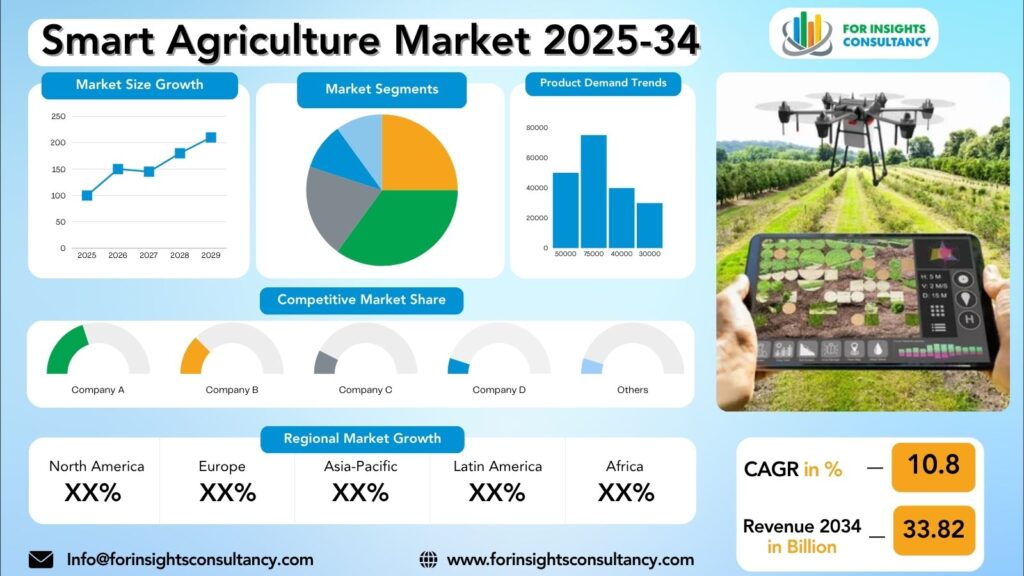
Smart Agriculture Market Is Forecast to Increase from USD 18.67 Billion In 2025 To USD 33.82 Billion By 2034, At A CAGR Of 10.8%.
Smart Agriculture Market: A Comprehensive Overview and Future Developments
The Smart Agriculture Market. It consists of modern digital systems, interconnected devices, software programs and automation tools that are designed to make farm operation more productive, energy efficient and environmentally sustainable. Smart agriculture uses networked sensors, internet of things (IoT) solutions, GPS-guided machinery, aerial imaging using drones, robotics, data analysis, machine learning, cloud technologies and other innovative solutions for crop production, feed management, irrigation, application of fertilizer and pesticides, and harvesting. The smart agriculture solutions are implemented by common commercial farms, farms and fish farms, agribusinesses, greenhouses, livestock and poultry farms, cooperatives, research organizations and government agencies.
In last 10 years, overall agricultural market has evolved and transformed with unprecedented speed driven by the rapid digitalization of farming practices, rising global food demands, the worries about climate change, and the increased development of new agricultural technologies and the rise of creation of new digital infrastructure in the farm sector. While traditional agrarian practices and technologies persisted, increasingly modern, data-driven precision agriculture techniques were implemented which allowed the real-time monitoring of soil health, macroweather, crop health and growth, and operational efficiency. The proliferation of connected sensors, cloud computing, automated and satellite-based monitoring facilities, and self-propelled farm machines greatly empowered farm operators to optimize efficiency, reduce waste, and increase farm profitability with adopting more digital applications that greatly improved default yields and overall profitability of the farm.
The rising awareness among consumers about sustainable agriculture, food safety and security and resource utilization efficiency is acting as one of the prominent catalysts for market growth. Adoption of advanced smart technologies by the farmers to optimize water usage, minimize fertilizers and pesticides, enhance crop quality and address labor shortages will be a driving factor in market growth. Government and programs by agricultural bodies are providing incentives to the farmers using precision farming practices, digital farm reporting and sustainable programs to curb the emission of greenhouse gases and protect natural resources. Growing consumer preference for demand for traceable food processing, weather resistant farming systems and high-value crops will act as a key market growth driver in both developed and emerging economies.
Technology is still changing the competitive process. Artificial intelligence (AII), machine learning, internet of things (IoT), cloud computing, edge computing, computer vision, blockchain, robotics, geospatial analytics are streamlining farming practices. AI-enabled analytics platforms analyze thousands of data points to help farmers anticipate crop health trends, identify diseases, manage pests, and accurate predict yields. IoT-enabled sensors relay real-time data about soil moisture & nutrients, weather conditions, herd dynamics, and climate controlled greenhouses to automated systems for optimized water & fertilizer application. Agricultural drones, satellite imaging, and cloud-based data platforms facilitate field mapping, crop scouting, multispectral imaging, and natural resource management. Automated tractors, robotic harvesters, and AI-powered sprays make farming processes efficient, reduce reliance on labor, and integrate with platforms for inventory management and digital marketplace engagement.
Regulatory Policy & Sustainability Projects demand for the Smart Agriculture Market. Green initiatives and government programs that promote precision farming, digital agriculture, water and land conservation, efficient resource use, and carbon dioxide emission reduction are driving the trend toward the adoption of new technology in the agriculture sector. The high adoption of quality standards and certification systems, consumers’ demand for products safe for their health and the environment, as well as an increasing farm focus on food safety, environmental practices and safety procedures, all are shaping the trend to ramp up investments in information and communication technologies to advance traceability and transparency, optimize water, fertilizer and pesticide application, and improve resource management.
North America will continue to be the leading regional market because of the high rate of penetration of PFM/IPM, dairy and argo machinery, adoption of advanced agricultural practices and sustainable development practices. Europe‘s market will continue to grow in the forecast period, supported by policies favoring sustainable farming and environmental regulations. With increased reliance on modern farming techniques for intensive production, agricultural modernization, and supporting policies, the Asia-Pacific region will likely register the highest growth in the forecast period. This growth can be attributed to many key factors such as a rise in demand for food, modernization of agricultural operations, increasing mechanization, rising adoption of IoT and AI, support policies under these countries including China, India, Japan, Australia, South Korea and Southeast Asia to implement smarter farming practices.
The smart agriculture market is poised to register a healthy long-term growth rate in line with the ongoing digital transformation in worldwide agriculture and growing demand for sustainability in food production. The growing proliferation of farm analytics solutions driven by artificial intelligence, autonomous farm machinery, precision irrigation systems, drone-based monitoring of crop health, field sensors enabled by the Internet of Things, advanced traceability solutions powered by blockchain technology, and the higher adoption of climate-smart agriculture practices will generate abundant scope for agritech vendors, machinery and equipment manufacturers, software developers, sensor manufacturers and agricultural service organizations worldwide within the forecast timeframe.
Market Insights
- North America held the largest revenue share, accounting for over 43.2% of the global market in 2024.
- Asia Pacific is expected to be the fastest-growing region over the forecast period (e.g., 2025-2030), with a projected CAGR of over 16.2%
- The Hardware segment typically holds the largest market share (e.g., over 66.5% in 2024).
- 8% of the U.S. population was reported as living in urban areas in 2024.
AI Impact
Smart agriculture, also referred to as precision agriculture, is fundamentally altering crop cultivation and livestock management by incorporating advanced technology into traditional farming practices. A critical driving force behind the expansion of the smart agriculture market is the substantial influence of artificial intelligence (AI) in streamlining farming operations. AI-driven tools and algorithms are capable of analyzing extensive data gathered from various sources, including sensors and drones, to deliver real-time insights that empower farmers in their decision-making processes.
The application of AI facilitates predictive analytics that encompasses essential tasks such as weather forecasting, crop monitoring, pest detection, and yield estimation. This technology enables farmers to enhance productivity and efficiency by making informed, data-driven choices. Furthermore, smart agriculture solutions utilize AI technologies to automate numerous farming tasks, reducing resource wastage and promoting both sustainability and profitability within agricultural practices. As a result, the adoption of AI in smart agriculture is revolutionizing conventional methods of farming, leading to the development of a more intelligent and interconnected agricultural ecosystem.
Market Dynamics
Trends
The smart agriculture market is experiencing significant transformation driven by the integration of advanced technologies. Notably, the adoption of Internet of Things (IoT) technology allows for remote monitoring of crops, soil conditions, and farming equipment, enhancing operational efficiency. Alongside IoT, the use of drones and satellite imagery is rising, enabling precision farming practices that aim to maximize crop yields and optimize resource utilization.
Additionally, the application of artificial intelligence (AI) and machine learning algorithms plays a crucial role in data analysis and informed decision-making processes within agriculture. This technological evolution supports the growing trend of vertical farming and hydroponics, particularly in urban settings, as these methods promote sustainable and efficient crop production.
Blockchain technology is also making an impact by providing traceability and transparency throughout the food supply chain, which is essential for consumer trust and regulatory compliance. Furthermore, there is a strong emphasis on sustainable farming practices aimed at minimizing environmental impacts while ensuring optimal resource management and utilization. The rise of smart sensors and automation systems further enhances the monitoring and management of agricultural operations, marking a shift towards more data-driven and technology-enabled farming practices.
Growth Drivers
Smart Agriculture Market is witnessing significant advancement, primarily propelled by several crucial factors. The burgeoning integration of Internet of Things (IoT) devices and sensors in agricultural practices is enhancing both efficiency and productivity for farmers. By utilizing data analytics alongside cloud computing, agricultural stakeholders can make well-informed decisions that lead to the optimization of resource usage and the attainment of greater crop yields. Furthermore, the escalating demand for precision agriculture technologies—notably GPS-guided systems and drones—is considerably stimulating market growth. These innovations allow farmers to meticulously monitor and manage their fields, facilitating precision in cultivation practices. Additionally, the increasing emphasis on sustainable farming techniques and food security is fostering the uptake of smart agriculture solutions, which aim to reduce environmental impact while addressing the urgent global food demand. Collectively, these elements are not only catalyzing the expansion of the Smart Agriculture Market but are also instrumental in defining the future trajectory of the agricultural industry.
Restraints
Restraints in the smart agriculture market present significant challenges that hinder the adoption of advanced agricultural technologies, particularly for small and medium-sized farmers. One major constraint is the high initial investment costs associated with implementing these technologies, which can be prohibitive for less financially robust agricultural operations. Additionally, limited access to technology and inadequate digital infrastructure in rural areas further complicate the situation, making it difficult for farmers to embrace smart agriculture practices.
Furthermore, concerns regarding data privacy and security are prevalent, as many farmers are hesitant to disclose sensitive information required for cloud-based agricultural platforms. This reluctance stems from fears over potential misuse or breaches of their data. The lack of skilled labor and expertise in handling sophisticated agricultural technologies is another barrier, as farmers may not have the necessary training or knowledge to effectively utilize these advanced systems.
Lastly, uncertainty surrounding the return on investment and the long-term sustainability of smart agriculture initiatives can dissuade farmers from transitioning to digital farming methods. Many are cautious about adopting new technologies due to doubts about their economic viability and impact on traditional farming practices. Overall, these restraints form a complex web of challenges that necessitate targeted strategies to promote the broader adoption of smart agriculture solutions.
Opportunities
Smart agriculture is rapidly evolving, presenting considerable opportunities primarily fueled by advancements in precision farming technologies, which include the Internet of Things (IoT), artificial intelligence (AI), and data analytics. These innovations empower farmers to optimize crop yields, minimize resource waste, and enhance farm management practices. Key components such as drones, sensors, and automation systems facilitate more efficient monitoring and management of agricultural operations. Additionally, smart agriculture solutions contribute to improved sustainability practices and environmental stewardship, while also providing cost-saving advantages for farmers. As global food demand increases and the impacts of climate change intensify, the smart agriculture market emerges as a fertile ground for innovation and significant growth within the agricultural landscape.
Challenges
Smart agriculture is increasingly seen as a transformative solution for enhancing agricultural productivity and sustainability; however, it currently faces significant challenges that hinder its widespread adoption. One of the foremost issues is the high initial investment required for smart technology solutions, which can be particularly burdensome for farmers in developing countries. This financial barrier limits access to advanced farming tools and techniques that utilize smart technologies.
Another critical challenge is the interoperability between various smart devices and systems. The seamless integration and data sharing capabilities that are essential for achieving optimal performance in smart agriculture are often compromised due to compatibility issues. This fragmentation can lead to inefficiencies and underutilization of technological investments.
Moreover, rural areas frequently lack high-speed internet connectivity, which is vital for enabling real-time data monitoring and analysis. Without reliable internet access, the full potential of smart agriculture technologies cannot be realized, as timely decision-making and data-driven strategies are significantly hampered.
Data privacy and security also present complex issues that complicate the adoption of these technologies. The collection and storage of sensitive agricultural data raise concerns among stakeholders, and a lack of robust security measures could deter farmers from embracing smart solutions for fear of data breaches or misuse.
Finally, there exists a notable gap in awareness and technical expertise among farmers and other agricultural stakeholders. The effective implementation of smart agricultural solutions is often impeded by insufficient knowledge of the technologies available and the skills needed to operate them effectively.
To ensure the effective growth and sustainable development of the smart agriculture market, it is imperative to address these multifaceted challenges through targeted strategies, such as financial support, enhanced infrastructure, and educational initiatives aimed at increasing technical proficiency and awareness among all stakeholders involved in agriculture.
Smart Agriculture Market Top Companies Covered In This Report:
Evaluate The Strategic Positioning And Innovation Pipelines Of Leading Market Companies-From Multinational Enterprises To Disruptive Regional Firms. Understand How Key Players Are Innovating, Expanding, And Capturing Value, And Use Competitive Benchmarks To Plan Your Next Move.
- Deere & Company (US)
- Trimble Inc. (US)
- AGCO Corporation (US)
- Topcon (US)
- DeLaval (Sweden)
- AKVA Group (Norway)
- Innovasea Systems Inc. (US)
- Afimilk Ltd. (Israel)
Smart Agriculture Market Company News 2024 and 2025
Trimble Inc. / PTx Trimble
(2024/2025): Trimble Agriculture completed a joint venture with AGCO Corporation, creating PTx Trimble. This new entity focuses on delivering mixed-fleet (brand-agnostic) precision agriculture solutions, autonomy, and retrofit equipment.
Topcon
(Late 2024): Topcon Agriculture introduced this new autosteering system designed specifically for mid-range tractors on small to medium-sized farms. The goal is to “democratize” precision technology by offering high-quality, reliable, and affordable solutions compatible with a wide range of machinery.
Segmented View of The Industry:
The Smart Agriculture Market Is Mapped Through A Multidimensional Lens-Tracking Shifts Across Product Type, Applications, And Geographic Regions. This Segmented Approach Enables Businesses to Localize Their Growth Plans And Align Offerings With The Most Profitable Demand Centres.
Segmentation By Offering
- Hardware
- Software
- Services
- Solutions
- Connectivity Technology
Segmentation ByAgriculture Type
- Precision Farming
- Livestock Monitoring (or Livestock Management)
- Precision Aquaculture
- Precision Forestry
- Smart Greenhouse
- Others (or Post-Harvest & Supply Chain)
Segmentation ByFarm Size
- Small Farms
- Medium Farms
- Large Farms
Segmentation by Application
- Yield Monitoring
- Field Mapping
- Crop Scouting
- Weather Tracking & Forecasting
- Irrigation Management
Global Geographic Coverage:
The Report Provides In-Depth Qualitative And Quantitative Data On The Smart Agriculture Market For All Of The Regions And Countries Listed Below:
North America
The Smart Agriculture market in North America is anticipated to witness considerable growth, driven by favorable economic conditions such as a high GDP growth rate coupled with a low inflation rate. Unique regional factors play a crucial role in this market’s expansion; for example, in the United States, government subsidies aimed at promoting sustainable agricultural practices are a significant catalyst for development. In Canada, an increasing emphasis on ethical sourcing is influencing consumer choices and preferences.
The primary distribution channel for Smart Agriculture products remains online platforms, which facilitate convenient access to a diverse assortment of offerings. Notably, the most rapidly expanding sales channel is the direct-to-consumer model, exemplified by farmer’s markets and community-supported agriculture (CSA) initiatives.
In North America, consumer priorities have shifted toward sustainability, ethical sourcing, and support for local products, making these elements essential for attracting buyers. In contrast, emerging markets tend to focus on price and status; however, there is an observable shift towards appreciating ethical and sustainable agricultural practices. This growing awareness reflects a broader trend across different markets, highlighting the increasing importance of environmentally conscious purchasing decisions among consumers.
Europe
In the burgeoning Smart Agriculture market in Europe, it is essential to consider the projected GDP Growth and Inflation Rate for accurate market analysis. One key driver in the region is the generous government subsidies provided to farmers in countries like Germany, which significantly boosts the adoption of smart agriculture technologies. The dominant channel for smart agricultural products in Europe is through specialized agricultural equipment dealers, while e-commerce emerges as the fastest-growing channel.
Consumers in Europe prioritize sustainability and ethical sourcing when it comes to agricultural products, making it a must-have for brands to succeed in the market. On the other hand, in many emerging markets within Europe, price and status continue to dominate consumer preferences. Understanding these dynamics is crucial for businesses looking to thrive in the evolving Smart Agriculture landscape across the continent.
Asia Pacific
The Smart Agriculture market in the Asia Pacific region is expected to experience notable growth, driven by a projected GDP increase of 6% and an inflation rate of 2.5%. Key developments in India highlight the role of government subsidies aimed at modernizing agricultural practices, which have significantly encouraged the adoption of smart agriculture technologies. The primary channel for distributing these products in India remains government-led initiatives, whereas e-commerce platforms represent the fastest-growing distribution method.
Consumer behavior in emerging markets such as Indonesia tends to emphasize price and status significantly more than sustainability, ethical sourcing, or local production. In contrast, consumers in more developed markets, including South Korea, Japan, and Australia, are increasingly prioritizing sustainable and ethically sourced products. Recognizing and understanding these varying regional consumer attitudes and preferences is essential for businesses aiming to engage effectively with the burgeoning smart agriculture market across Asia Pacific.
Middle East and Africa
The Smart Agriculture market in the Middle East and Africa is anticipated to experience substantial growth, propelled by rising GDP and stable inflation rates within the region. Each sub-region has its unique drivers influencing market trends. In Egypt, government subsidies for smart agricultural technologies serve as a significant market catalyst. Meanwhile, Saudi Arabia primarily distributes smart agriculture products through specialized agricultural retailers, whereas in Nigeria, the e-commerce sector emerges as the fastest-growing channel for these products. Additionally, South African consumers emphasize the importance of ethical sourcing, making it essential for businesses in this market to adopt sustainable practices. Despite a prevailing focus on price and status among consumers in various emerging markets, including parts of Africa, there is a noticeable shift towards sustainability as a growing consumer preference. Overall, the Smart Agriculture market in this area presents numerous opportunities for innovative strategies to meet the varied demands of consumers.
Reasons To Buy:
- The Research Would Help Top Administration/Policymakers/Professionals/Product Advancements/Sales Managers And Stakeholders In This Market In The Following Ways.
- The Report Provides Smart Agriculture Market Revenues At The Worldwide, Regional, And Country Levels With A Complete Analysis To 2034 Permitting Companies To Analyze Their Market Share And Analyze Projections, And Find New Markets To Aim For.
- To Understand The Most Affecting Driving And Restraining Forces In The Market And Their Impact On The Global Market.
- Major Changes And Assessment In Market Dynamics And Developments.
- The Objective Of The Smart Agriculture Market Report Is To Identify New Business Opportunities Using Quantitative Market Forecasts.
- Formulate Sales And Marketing Strategies By Gaining An Understanding Of Competitors, Their Positioning, And Strengths & Weaknesses.
Faq – What Global Leaders Are Asking
What Is The Growth Prospect For The Smart Agriculture Market By 2034?
Smart Agriculture Market Is Expected To Achieve A Stable Growth Rate With A Compound Annual Growth Rate (CAGR) Of About 10.8% From 2025 Through 2034.
What Is Driving The Growth Of The Smart Agriculture Market?
The Smart Agriculture Market growth is primarily driven by the confluence of rising global food demand, acute farm labor shortages, and the accelerating integration of advanced technologies like IoT, AI, and robotics to enable precision and sustainability.
Who Are The Key Players In The Smart Agriculture Market, And What Are Their Market Shares?
The Smart Agriculture Market Includes Major Companies Deere & Company (US), Trimble Inc. (US), AGCO Corporation (US), Topcon (US), DeLaval (Sweden), AKVA Group (Norway), Innovasea Systems Inc. (US), Afimilk Ltd. (Israel), Others.
Specific Market Share Data Is Not Publicly Available And Is Typically Provided In Detailed, Proprietary Market Research Reports.
Which Regions Are Leading The Smart Agriculture Market Growth?
North America holds the largest market share, while Asia-Pacific is projected to be the fastest-growing region.
Customized Report as per your Business Needs
- Our analysts will work directly with you and understand your needs
- Get data on specified regions or segments, competitor and Vendors
- Data will be formatted and presented as per your requirements
Any Requirement Contact Us: Https://Www.Forinsightsconsultancy.Com/Contact-Us/
Related Report
Artificial Intelligence in Agriculture Market
https://www.forinsightsconsultancy.com/reports/artificial-intelligence-in-agriculture-market
Indian Agricultural Market
https://www.forinsightsconsultancy.com/reports/indian-agricultural-market
Table of Contents
For TOC Contact us: https://forinsightsconsultancy.com/contact-us/