

Stainless Steel Market Research Report By Product (Flat Products, Semi-Finished Products, Long Products), By Grade (Austenitic, Ferritic, Martensitic, Duplex, PH (Precipitation Hardening)), by End-User Industry (Building & Construction, Automotive & Transportation, Heavy Industries (Oil & Gas, Power), Pipes & Tubes, Consumer Goods, Machinery, Medical & Surgical, Other Industries), and Region Global Market Analysis and Forecast, 2025-2034
Aug-2025 Formats | PDF | Category: Manufacturing & Construction | Delivery: 24 to 72 Hours
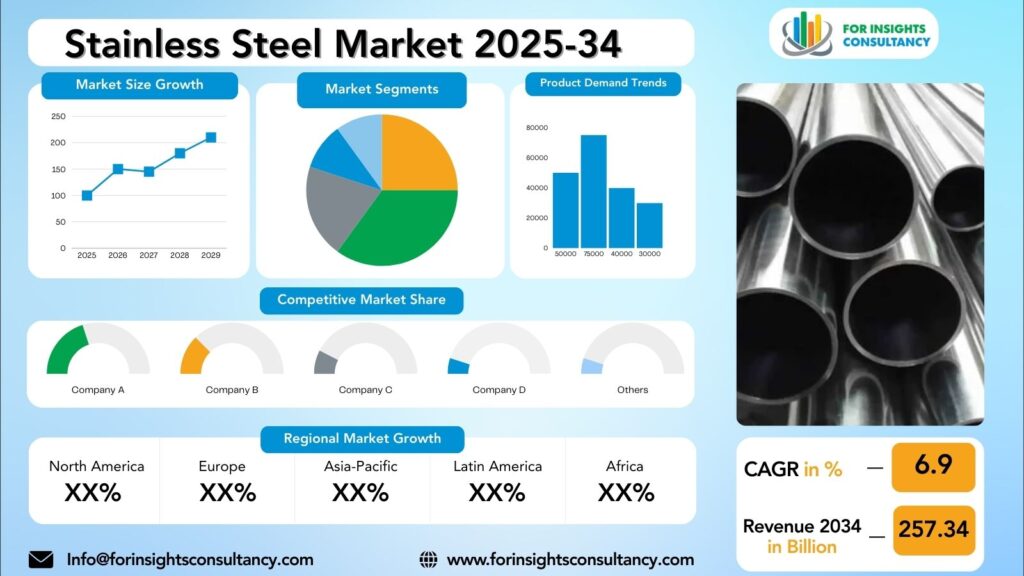
Stainless Steel Market is forecast to increase from USD 133.67 Billion in 2025 to USD 257.34 Billion by 2034, at a CAGR of 6.9%.
Stainless Steel Market: A Comprehensive Overview and Future Developments
The stainless-steel market deals with all activities related to stainless-steel alloy and its products like manufacturing, processing, selling & marketing, etc. Stainless-steel alloy is made of corrosion resistance steel alloys, containing mainly chromium with combination of other alloying elements like nickel, molybdenum, manganese and nitrogen etc. The stainless steel is one of the most widely used engineering materials due to their corrosion resistance, strength, durability, heat resistance, recyclability and good looks. It is used in almost every industry in the world. The alloy is available in form of sheets, coils, plates, bars, pipes & tubes, wire, structural sections, finished or in semi-finished fabricated form. Various types of stainless steel available are austenitic, ferritic, martensitic, duplex and precipitation-hardening.
The stainless steel market has experienced profound change over the last decade. A number of key factors have driven this evolution: the expansion of industrial activity and urban infrastructure; advancements in steel manufacturing technology; and, most recently, a heightened focus on sustainable materials. Up-to-date production processes allow a much higher level of product quality; increase manufacturing efficiency; optimize materials characteristics; and utilize resources in a more efficient manner, reducing emissions and energy consumption. Moreover, from the industry perspective investments in EAF technology, digital manufacturing systems, new alloys development and improved recycling processes are accelerating. More stringent environmental regulations and infrastructure requirements are increasing the demand for lightweight, corrosion resistant and high-performance materials that can withstand harsh operating environments…
Increasing consumers understanding of sustainability, product longevity, hygiene and eco-consciousness is a significant market growth driver. There is a trend toward stainless steels for stainless steels because of their excellent longevity, minimum maintenance needs, high recyclability and compliance with increased demanding health and safety regulations. Prosperous new urbanization, commercial build up, rising new build in residential, water infrastructure and renewable energy sector drive significant stainless steel demand. New opportunities for stainless steel grades are also occuring as a result of investments into electric vehicles (EVs), hydrogen infrastructure, food processing, pharmaceutical production and medical devices.
The firm’s value chain is being reshaped by technological developments. AI, IIoT, with the integration of smart manufacturing, robotics, predictive maintenance, digital twins, and advanced metallurgy are restructuring the stainless steel supply chain and production. AI-supported quality inspection procedures are being streamlined to facilitate optimal alloy compositions, identify production flaws, improve yields, and optimize processes. Automated rolling mills, state of art casting techniques, additive manufacturing, laser machining and advanced surface finishing technology are allowing the manufacturer to produce customizable stainless steel products with vastly improved mechanical properties and corrosion-resistance. Cloud-based production management systems, real-time analytical tools and energy-optimization platforms are helping improve the firm’s operational efficiency.
Environmental legislations and worldwide quality standards influence the Stainless Steel Market to a large extent. The producers are to cope with the emission legislations, occupational safety standards, certification of the qualities of products, and legislarion favoring environment everywhere in the world. Growing emphasis on carbon neutrality, circular economy etc., is leading to higher recycle stainless steel scrap use and adoption of low-carbon technologies, clean and renewable energy sources and environment-friendly manufacturing practices. Meanwhile, the traditional standards for food, medical, construction and industrial materials need to be easily met to further the scope of application and reaffirm customer confidence.
Asia-Pacific continues to lead the Global Stainless Steel Market driven by large scale manufacturing bases, facilitating rapid industrialization, increasing infrastructure investments and the rising demand from automotive, construction and consumer goods sectors. China, India, Japan and South Korea continue to lead demand and supply regionally. North America remains a key market supported by a matured manufacturing base, energy infrastructure enhancement, and demand from industrial, healthcare and aerospace sector. Europe continues its gradual growth driven by sustainable construction, automotive innovation, renewable energy investments, and similar strict guidelines on usage and disposal of products applying green materials; high-yield recyclable stainless steel.
Mature industrial economies still demand rugged, recyclable, high-performance steels and materials, and this trend towards longer-term growth is also evident in the Stainless Steel Market. Greater take-up of next-generation stainless steel alloys, AI-based steel manufacturing equipment, intelligent production lines, green steel developments, hydrogen-enabled materials, accurate fabrication, sustainable industry practices etc., will provide numerous opportunities for the steel/ alloy fabricator, construction firms, automakers, industrial equipment manufacturers, infrastructure builders etc. in the predicted period.
Stainless Steel Market Dynamics
Growth Drivers
Stainless steel is gaining popularity in the construction industry due to its corrosion resistance, durability, and aesthetic appeal. Its widespread use in manufacturing and processing industries, such as food processing, chemical production, and automotive manufacturing, ensures efficiency, reliability, and safety. Stainless steel’s high strength, heat resistance, and hygiene properties make it an ideal material for machinery, equipment, and components. This eco-friendly aspect is driving its adoption in green building projects, renewable energy systems, and eco-conscious industries.
In the context of environmental sustainability, stainless steel is highly recyclable, with minimal impact on the environment. It can be recycled multiple times without losing its properties or quality, making it a popular choice for green building projects and renewable energy systems.
Technological advancements and innovation drive stainless steel manufacturers to evolve to meet the changing needs of industries and consumers. This commitment to innovation ensures that stainless steel remains a top choice for applications requiring high performance, durability, and reliability.
Restraints
The stainless steel market faces several challenges, including rising raw material costs, trade restrictions, environmental regulations, growing competition, and technological advancements. Rising costs of essential materials like nickel and chromium can significantly impact the overall cost of stainless steel products. Trade restrictions, such as tariffs, quotas, and anti-dumping duties, can disrupt the flow of stainless steel products, leading to market instability and increased prices. Environmental regulations concerning the production and disposal of stainless steel products can also pose challenges, as compliance with strict standards can increase production costs and limit market growth. The highly competitive stainless steel market can lead to price wars, reduced profit margins, and a saturation of the market with substandard products. Manufacturers must adapt quickly to new innovations and processes to stay ahead of the competition.
Opportunities
The stainless steel market presents significant opportunities in various sectors, including manufacturing, construction, and automotive. Manufacturers are increasingly turning to stainless steel for its superior properties, as demand for high-quality, durable products continues to rise. Stainless steel is used in construction for its strength, flexibility, and resistance to corrosion, enhancing the durability and aesthetics of buildings. The automotive sector is also experiencing growth, with the shift towards electric vehicles and the need for lightweight, high-performance materials. By developing innovative solutions incorporating stainless steel, automotive companies can create efficient and durable vehicles. To capitalize on these opportunities, businesses should focus on innovation, quality, and customer satisfaction. Staying ahead of industry trends and developing cutting-edge products can differentiate businesses from competitors and attract new customers. Additionally, investing in research and development to improve existing products and explore new applications for stainless steel can open up new revenue streams and drive growth.
Challenges
The stainless steel market faces several challenges, including rising production costs, intense competition, economic uncertainty, environmental regulations, and supply chain disruptions. Rising production costs are influenced by factors like fluctuating raw material prices, energy costs, and labor expenses. To address these challenges, companies must focus on operational efficiency, optimizing production processes, and exploring cost-effective sourcing strategies.
Intense competition is another significant challenge, with numerous players vying for market share. Differentiation is crucial in this competitive landscape, and companies must invest in research and development to innovate new products, improve quality standards, and offer unique value propositions. Economic uncertainty, geopolitical tensions, and trade disputes can also impact the market, making it difficult for companies to forecast market trends.
Environmental regulations are crucial for the stainless steel industry, as failure to comply can result in fines, reputational damage, and loss of market opportunities. To address these challenges, companies should invest in sustainable practices, adopt eco-friendly production processes, and engage in corporate social responsibility initiatives.
Lastly, supply chain disruptions, such as raw material shortages, transportation delays, and logistics issues, can impact the production and distribution of stainless steel products. Mitigating these disruptions requires diversifying suppliers, maintaining strong relationships, and implementing risk management strategies.
Stainless Steel Market Top Companies Covered In This Report:
Evaluate The Strategic Positioning And Innovation Pipelines Of Leading Market Companies-From Multinational Enterprises To Disruptive Regional Firms. Understand How Key Players Are Innovating, Expanding, And Capturing Value, And Use Competitive Benchmarks To Plan Your Next Move.
- Acerinox S.A.
- Aperam Stainless
- ArcelorMittal
- Baosteel Group
- Jindal Stainless
- Nippon Steel Corporation
- Outokumpu
- POSCO
- ThyssenKrupp Stainless GmbH
- Yieh United Steel Corp.
Stainless Steel Market News
ArcelorMittal
In the first half of 2025, ArcelorMittal saw a slight increase in Stainless Steel production compared to the same period in 2024. However, it faced challenges in its long Stainless Steel division, which led to a strategic divestment of plants in Bosnia and Herzegovina.
POSCO
In August 2025, POSCO and JSW Stainless Steel, India’s largest privately owned Stainless Steel company, signed a joint venture to explore setting up a new 6 MTPA integrated Stainless Steel plant in India.
Segmented View of the Industry:
The Stainless Steel Market Is Mapped Through A Multidimensional Lens-Tracking Shifts Across Product Type, Applications, And Geographic Regions. This Segmented Approach Enables Businesses To Localize Their Growth Plans And Align Offerings With The Most Profitable Demand Centers.
Segmentation by Product
- Flat Products (Sheets, Plates, Coils)
- Long Products (Bars, Rods, Wires)
- Semi-finished Products
Segmentation by Grade
- Austenitic
- Ferritic
- Martensitic
- Duplex
- PH (Precipitation Hardening)
Segmentation by End-User Industry
- Building & Construction
- Automotive & Transportation
- Heavy Industries (Oil & Gas, Power)
- Machinery
- Consumer Goods
- Other Industries
Global Geographic Coverage:
The Report Provides In-Depth Qualitative and Quantitative Data On the Stainless Steel Market For All Of The Regions And Countries Listed Below:
North America
North America is a major player in the stainless steel market, with the United States leading in production and consumption. The automotive and manufacturing industries in the country are major consumers of stainless steel, driven by its strength and durability. Canada, on the other hand, is a significant market due to its construction sector. The United States is home to some of the largest stainless steel producers globally, catering to both domestic and international markets. Major automotive giants like Ford and General Motors use stainless steel in various components due to its strength and durability. Canada’s stainless steel market is primarily driven by the construction industry, with a growing demand for its products in building structures and infrastructure projects. The region’s strict environmental regulations have led to widespread adoption of stainless steel, particularly in appliances, cookware, and machinery.
Europe
Germany, Italy, France, Spain, and the United Kingdom are major players in the European stainless steel market. Germany’s strong manufacturing sector drives demand for high-quality products, while Italy’s design and fashion industries rely on stainless steel for its durability and aesthetic appeal. France’s automotive industry fuels the demand for stainless steel, with its focus on sustainability and eco-friendly production methods. French stainless steel manufacturers are known for their reliability and durability. Spain’s construction industry is a major consumer of stainless steel, with its manufacturers offering cost-effective solutions and quick turnaround times. The United Kingdom, despite Brexit, remains a key player in the market, with its aerospace and defense industries relying on stainless steel for its superior strength and corrosion resistance. British stainless steel manufacturers adhere to strict quality standards, ensuring the reliability of their products.
Asia Pacific
China is the world’s largest producer and consumer of stainless steel, with a well-established infrastructure supporting its growth. Rapid industrialization and urbanization are expected to continue increasing demand for stainless steel in China. Chinese stainless steel manufacturers are expanding their production capacities to meet these demands. Japan, a key player in the Asia Pacific region, has a strong automotive and electronics industry, major consumers of stainless steel. Japanese stainless steel manufacturers are known for their high-quality products and technological advancements. With a focus on innovation and sustainability, Japan is expected to maintain its position as a leading producer of stainless steel. India is a growing market for stainless steel, with rising demand from sectors like construction, automotive, and consumer goods. The Indian government’s initiatives to boost domestic manufacturing and infrastructure development have further fueled the growth of the industry. Indian stainless steel manufacturers are focusing on product diversification and quality enhancement to cater to changing market trends.
Middle East and Africa
The Middle East region is a significant player in the global stainless steel market, driven by robust industrial sectors and infrastructure projects. Countries like Saudi Arabia, UAE, and Qatar are leading the demand due to construction activities, oil and gas projects, and manufacturing industries. The UAE is also a key player, driven by construction projects, manufacturing industries, and infrastructure development. The UAE’s demand for stainless steel is expected to rise with ongoing projects like Expo 2020 and Dubai Metro expansion.
Africa’s stainless steel market is also experiencing steady growth, driven by infrastructure projects and increasing investments in the manufacturing sector. Countries like South Africa, Nigeria, and Egypt are leading the demand for stainless steel products in the region. South Africa is the largest market, with strong demand in construction, automotive, and mining sectors. Nigeria is also growing due to construction activities, oil and gas projects, and increasing industrialization.
Reasons to Buy:
- The Research Would Help Top Administration/Policymakers/Professionals/Product Advancements/Sales Managers And Stakeholders In This Market In The Following Ways.
- The Report Provides Stainless Steel Market Revenues At The Worldwide, Regional, And Country Levels With A Complete Analysis To 2034 Permitting Companies To Analyze Their Market Share And Analyze Projections, And Find New Markets To Aim For.
- To Understand The Most Affecting Driving And Restraining Forces In The Market And Their Impact On The Global Market.
- Major Changes And Assessment In Market Dynamics And Developments.
- The Objective Of The Stainless Steel Market Report Is To Identify New Business Opportunities Using Quantitative Market Forecasts.
- Formulate Sales And Marketing Strategies By Gaining An Understanding Of Competitors, Their Positioning, And Strengths & Weaknesses.
Faq – What Global Leaders Are Asking
What Is The Growth Prospect For The Stainless Steel Market By 2034?
Stainless Steel Market Is Expected To Achieve A Stable Growth Rate With A Compound Annual Growth Rate (Cagr) Of About 6.9% From 2025 Through 2034.
What Is Driving The Growth Of The Stainless Steel Market?
The growth of the stainless steel market is driven by rising demand from key end-use industries like construction, automotive, and consumer goods due to its durability, corrosion resistance, and aesthetic appeal. Additionally, the increasing global focus on sustainability is propelling its use, as stainless steel is a highly recyclable and long-lasting material.
Who Are The Key Players In The Stainless Steel Market, And What Are Their Market Shares?
The Stainless Steel Market Includes Major Companies Like Acerinox S.A., Aperam Stainless, ArcelorMittal, Baosteel Group, Jindal Stainless, Nippon Steel Corporation, Outokumpu, POSCO, ThyssenKrupp Stainless GmbH, Yieh United Steel Corp.
Specific Market Share Data Is Not Publicly Available and Is Typically Provided In Detailed, Proprietary Market Research Reports.
Which Regions Are Leading the Stainless Steel Market Growth?
The Asia-Pacific region is the clear leader in the stainless steel market, with a market share of over 68% and is also the fastest-growing region. This is driven by rapid industrialization, extensive infrastructure projects, and robust demand from key industries in countries like China and India.
Customization: We Can Provide Following Things
1) On Market More Company Profiles (Competitors)
2) Data About Particular Country Or Region
3) We Will Incorporate The Same With No Additional Cost (Post Conducting Feasibility).
Any Requirement Contact Us: Https://Www.Forinsightsconsultancy.Com/Contact-Us/
Related Report
Steel Market
https://www.forinsightsconsultancy.com/reports/steel-market
Steel Market
https://www.forinsightsconsultancy.com/reports/steel-market
Table of Contents
For TOC Contact us: https://forinsightsconsultancy.com/contact-us/