
Steel Casting Market Research Report By Process (Die Casting, Sand Casting, Shell Molding, Investment Casting, Others (Lost Foam Casting, Centrifugal Casting)), By Material (Carbon Steel, Alloy Steel, Stainless Steel, Tool Steel, Others (High-Speed Steel)), by End-User Industry (Automotive & Transportation, Construction, Aerospace & Defense, Oil & Gas, Industrial Machinery, Mining), and Region Global Market Analysis and Forecast, 2025-2034
Aug-2025 Formats | PDF | Category: Manufacturing & Construction | Delivery: 24 to 72 Hours
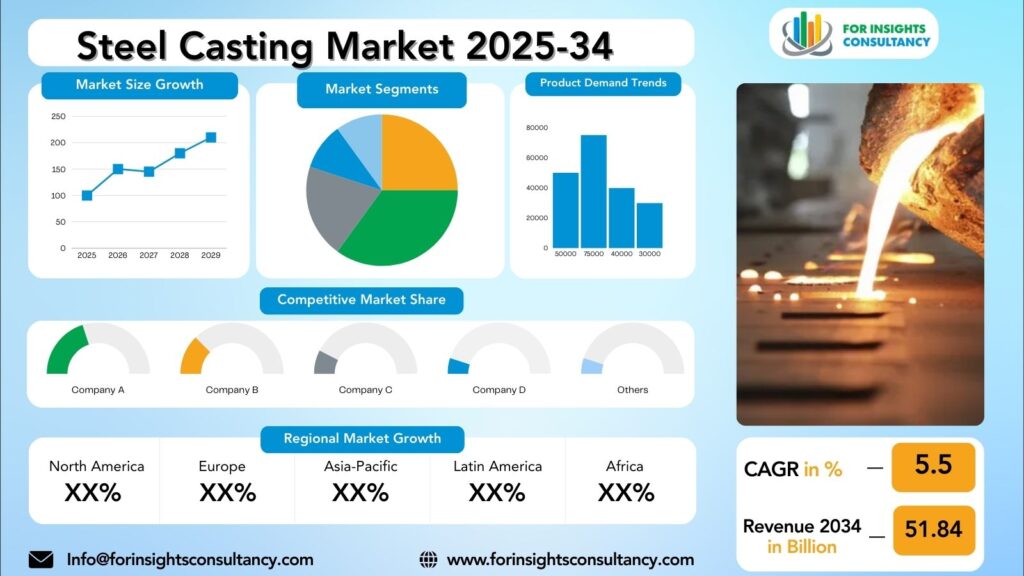
Steel Casting Market is forecast to increase from USD 33.67 Billion in 2025 to USD 51.84 Billion by 2034, at a CAGR of 5.5%.
Steel Casting Market: A Comprehensive Overview and Future Developments
The Steel Casting Market is the casting, processing and supplying of steel castings made by pouring liquid steel into a mold for producing complex, high-strength steel components for a wide variety of industrial uses. Steel Castings provide excellent mechanical strength, toughness, wear resistance, corrosion resistance, high temperature and heavy load resistance, etc. in obtaining critical technical application of steel castings and cast steel parts. It can be classified as Carbon steel casting, Alloy Steel Castings, stainless steel casting, heatresisting steel casting, manganese steel casting, Precision Investment Casting. Steel casting is widely used in Automotive, Construction, Mining Industry, Oil & Gas Industry, Power Industry, Aerospace Industry, Defense Industry, Railway Industry, Marine Industry, Industrial Machinery and Heavy Equipment etc.
There has been a rapid change in steel casting industry over the last few years worldwide through rapid industrialization, production expansion, foundry technology development and growing market requirement of high performance engineered component. The conventional steel casting process market has been moved to advanced steel casting process with automated molding system, casting simulation, investment casting, vacuum casting, metallurgic process technology development for better dimensional and design accuracy, product quality uniformity and increase in productivity. Increased investments on smart manufacturing, digital foundries and environmentally friendly production technology development has further strengthened the steel casting manufacturers in the world.
One of the significant reasons for the market growth is the increasing demand for heavy duty and high strength industrial products. Establishment of new infrastructure, rising production of heavy machinery and equipments, prospects of investments in renewable sources of power, and growth of transportation industry are some of the factors favoring the demand of steel castings. Also, automotive industry is in demand of lighter weight components for transmission, engine, and suspension and electric vehicles. Owing to its high corrosion resistivity, steel castings are used widely by oil and gas industries for manufacture of pumps, valves, and offshore platforms. Mining, marine, defense and railway sectors are gravitating towards more sophisticated steel castings that can function withstanding extreme mechanical and environmental conditions.
Modern technology keeps revolutionizing the competitive situation. From the use of the artificial intelligence (AI), industrial internet of things (IIoT), robots, digital twins, additive manufacturing, advanced metallurgy, predictive analytics and still to come, the way in which steel casting is delivered. AI based quality inspection systems allow mold design optimization, prediction of casting defect, process parameter improvement, and yield efficiency gains. Computer simulation software allow companies to simulate metal flow, solidification process and thermal stress prior to casting production, minimizing scrap produced and improving casting quality. Automated pouring systems, robotic finishing, advanced machining and cloud connected manufacturing execution system (MES) sharpen the operating efficiencies.
Environmental policies, rules, and quality standards are gaining greater influence on the Steel Casting Market. Producers are required to follow various occupational health & safety regulations, air & water emission standards, energy efficiency standards, and quality assurance schemes for their specific industry segment. Growing focus on the environmental impact of production processes is incentivizing foundries to introduce electric melting furnaces, steel scrap recycling, energy saving processes, waste heat recovery, and eco-friendly material handling practices.
Asia-Pacific is the leading region in the Steel Casting Market, driven by widespread industrial manufacturing, massive infrastructure projects, increasing automobile manufacturing and expanding heavy engineering sectors in China, India, Japan, South Korea and South-East Asian nations. North America has emerged as an important market due to heavy industry along with aerospace, defense, oil and gas, mining and industrial equipment goods manufacturing. Europe has experienced consistent growth amid the focused drive towards automotive innovation, renewable energy plants, precision engineering and strict manufacturing norms.
With the continued growth in global demand for industrial manufacturing, infrastructure investment and advanced manufacturing, the Steel Casting Market is forecast to grow long-term. Growing use of AI led foundry automation, precision casting technology, advanced alloy development, integration of additive manufacturing, digital quality assurance and control systems and sustainable steelmaking techniques will open up major opportunities for foundries, industrial equipment manufacturers, automotive suppliers, aerospace enterprises, energy infrastructure developers, and engineering service providers in the period ahead.
Steel Casting Market Dynamics
Growth Drivers
The steel casting market is experiencing significant growth due to the increasing demand from the automotive industry, which relies on steel castings for manufacturing engine components, transmission parts, and chassis. The shift towards lightweight yet durable materials in global automobile production is driving this demand. Steel castings are also being used in infrastructure development projects, such as bridges, railways, dams, and buildings, due to their toughness, impact resistance, and corrosion resistance. The energy sector, including oil and gas, power generation, and renewable energy, heavily relies on steel castings for various components, such as turbine blades, valves, pumps, and drilling equipment.
The steel casting market is also benefiting from advancements in manufacturing technologies, such as computer-aided design (CAD), simulation software, 3D printing, and automated processes, which enhance product quality and efficiency. Additionally, the steel casting industry is focusing on sustainable practices and environmental concerns, adopting eco-friendly processes like recycling scrap steel and reducing carbon emissions. This shift in focus is driving the demand for eco-conscious steel casting products.
Restraints
The steel casting market is a vital sector in the manufacturing industry, providing essential components for various applications. However, it faces several challenges and restraints that need to be addressed for sustainable growth and success. Economic fluctuations, which are heavily dependent on global economic conditions, can directly impact the demand for steel castings, leading to overcapacity and pricing pressures. Stringent environmental regulations also pose a significant restraint, as steel casting companies are under pressure to reduce their carbon footprint and adopt sustainable practices.
Technological advancements have led to improvements in the steel casting process, but they also present challenges for companies. Adopting new technologies and upgrading equipment can be costly and time-consuming, especially for smaller companies with limited resources. Keeping up with rapidly evolving technologies can be a daunting task, making it difficult for steel casting companies to stay competitive.
Global competition can drive down prices and margins for steel casting companies, making it challenging to maintain profitability. Companies need to constantly innovate and differentiate themselves from competitors to stand out in the market and attract customers.
Supply chain disruptions, such as raw material shortages or transportation delays, can also pose a significant restraint for the steel casting market. These disruptions can impact production schedules and delivery timelines, leading to increased costs and customer dissatisfaction, affecting the overall performance of steel casting companies.
Opportunities
The steel casting market is heavily influenced by economic fluctuations, environmental regulations, technological advancements, global competition, and supply chain disruptions. Economic downturns can decrease demand, leading to overcapacity and pricing pressures for steel casting companies. Stringent environmental regulations also pose a challenge, as companies must reduce their carbon footprint and adopt sustainable practices. Technological advancements have improved the steel casting process but also present challenges, as adopting new technologies and upgrading equipment can be costly and time-consuming, especially for smaller companies.
Global competition can drive down prices and margins, making it difficult for steel casting companies to maintain profitability. Companies need to innovate and differentiate themselves from competitors to stand out and attract customers. Supply chain disruptions, such as raw material shortages or transportation delays, can impact production schedules and delivery timelines, leading to increased costs and customer dissatisfaction, affecting the overall performance of steel casting companies. Overall, these factors contribute to the competitive nature of the steel casting market.
Challenges
The steel casting market faces several challenges, including material selection, casting process optimization, and supply chain management. The quality of raw materials directly impacts the final product’s mechanical properties, performance, and durability. Companies must consider factors like alloy composition, heat treatment, and impurity levels to meet industry standards and customer requirements. Advanced testing and quality control measures are often employed to ensure material integrity and consistency. Non-destructive testing techniques like ultrasonic testing and magnetic particle inspection are crucial for detecting defects and ensuring overall quality.
Optimizing the casting process is another significant challenge, as inefficient parameters can lead to defects like porosity, shrinkage, and cracks, requiring costly rework or scrap. Companies use computer-aided design software, simulation tools, and advanced process controls to improve process efficiency and product quality.
Supply chain management is crucial in the steel casting market, as inconsistencies in material availability, lead times, and shipping logistics can disrupt production schedules and impact customer satisfaction. Strategies like maintaining strong supplier relationships, implementing robust inventory management systems, and adopting lean manufacturing principles can mitigate risks and ensure timely product delivery.
Steel Casting Market Top Companies Covered In This Report:
Evaluate The Strategic Positioning And Innovation Pipelines Of Leading Market Companies-From Multinational Enterprises To Disruptive Regional Firms. Understand How Key Players Are Innovating, Expanding, And Capturing Value, And Use Competitive Benchmarks To Plan Your Next Move.
- The Japan Steel Works, Ltd. (Japan)
- Nelcast Limited (India)
- Ferralloy, Inc. (US)
- POSCO (South Korea)
- Waupaca foundry, Inc. (US)
- Hitachi Power Solutions Co., Ltd. (Japan)
- The Japan Steel Works, Ltd. (Japan)
- Nelcast Limited (India)
- Waupaca foundry, Inc. (US)
- Hitachi Power Solutions Co., Ltd. (Japan)
- Peekay Steel Castings (India)
- Liaoning Borui Machinery Co., Ltd. (China)
- Dandong Fuding Engineering Machinery Co., Ltd. (China)
Steel Casting Market News
26- 3-2024 JFE Steel and Hitachi Jointly Started Providing Solutions for the Steel Industry
JFE Steel Corporation (“JFE Steel”) and Hitachi, Ltd. (TSE:6501, “Hitachi”) today announced that they have started to provide a solution (the “Solution”), which combines JFE Steel’s consulting programs and Hitachi’s automatic cold-rolling flatness control system, to steel companies in both Japan and overseas. The Solution features the combination of Hitachi’s system, which uses an artificial intelligence (AI) to automatically control the steel sheet flattening process by a rolling mill, and JFE Steel’s consulting programs (regarding the introduction of systems and optimal operations), a service that leverages its high-level operational expertise in ways that meets customer needs.
Traditionally, wavy steel sheets are flattened by a rolling mill that must be finely adjusted manually by skilled operators. The Solution will address relevant issues such as the deterioration of yields due to differences in operators’ technical skills and the transfer of expert skills, and in addition, help customers improve their skills and product quality.
POSCO
In August 2025, POSCO and JSW Steel Casting, India’s largest privately owned Steel Casting company, signed a joint venture to explore setting up a new 6 MTPA integrated Steel Casting plant in India.
Segmented View of the Industry:
The Steel Casting Market Is Mapped Through A Multidimensional Lens-Tracking Shifts Across Product Type, Applications, And Geographic Regions. This Segmented Approach Enables Businesses To Localize Their Growth Plans And Align Offerings With The Most Profitable Demand Centers.
Segmentation by Process
- Die Casting
- Sand Casting
- Shell Molding
- Investment Casting
- Others (Lost Foam Casting
- Centrifugal Casting)
Segmentation by Material
- Carbon Steel
- Alloy Steel
- Stainless Steel
- Tool Steel
- Others (High-Speed Steel)
Segmentation by End-User Industry
- Automotive & Transportation
- Construction
- Aerospace & Defense
- Oil & Gas
- Industrial Machinery
- Mining
Global Geographic Coverage:
The Report Provides In-Depth Qualitative and Quantitative Data On the Steel Casting Market For All Of The Regions And Countries Listed Below:
North America
The United States is a major market for steel casting due to its robust manufacturing sector and demand from major industries like automotive, aerospace, and construction. Key players in the industry include Precision Castparts Corp and American Axle & Manufacturing Holdings, Inc. Canada, with its strong mining and oil & gas industries, contributes significantly to the steel casting market in North America. The country’s focus on sustainable practices and advanced manufacturing technologies has led to growth in the steel casting sector, with major companies like Amsted Rail and Canada Metal driving innovation.
Europe
The steel casting market is a crucial part of the manufacturing industry, providing essential components for sectors like automotive, aerospace, and construction. Germany, a leading player in the industry, is known for its high-quality production and advanced technology. France, with its strategic location and well-established supply chain network, is an attractive hub for steel casting manufacturers.
French companies prioritize precision engineering and customer satisfaction, driving growth and expansion. Italy, renowned for its craftsmanship and attention to detail, offers a diverse range of products and services. The UK, a key player in the industry, focuses on technological innovation and sustainability. Despite challenges like Brexit and economic fluctuations, the UK remains a key player. Spain, a significant player in the market, emphasizes quality assurance and cost-effective solutions. Its companies prioritize customer-centric approaches and operational excellence, driving competitiveness and growth. With a strategic geographical location and access to diverse markets, Spain continues to expand its foothold in the European steel casting sector.
Asia Pacific
China, a major steel producer, leads the steel casting market in the Asia Pacific region due to its advanced manufacturing capabilities and technological advancements. The country’s strong infrastructure and skilled workforce, coupled with the growing automotive and construction industries, have contributed to its significant market share. India, another key player, attracts foreign investments due to its abundant raw materials, cost-effective labor, and favorable government policies. Its focus on innovation and research and development has led to the production of high-quality steel casting products.
The demand for steel casting is expected to rise significantly in the coming years due to the growth of industries like automotive, aerospace, and energy. Japan, known for its precision engineering and high-quality manufacturing processes, is a major contributor to the steel casting market due to its stringent quality standards and environmental regulations. The automotive and machinery sectors in Japan drive the demand for steel casting products. South Korea, with its strong focus on technology and continuous innovation, is an ideal manufacturing hub for steel casting products due to its strategic location and well-developed infrastructure.
Middle East and Africa
The steel casting market in the Middle East and Africa region is experiencing dynamic growth prospects and evolving industry trends. The United Arab Emirates (UAE) is a major player in the market due to rapid industrialization and infrastructure development, while Saudi Arabia is a key market due to government initiatives like Vision 2030. Saudi Arabia’s robust manufacturing sector and growing investments in industrial infrastructure offer lucrative opportunities for steel casting manufacturers.
South Africa, with its skilled workforce and advanced manufacturing capabilities, is a key player in the global steel casting market. Despite challenges like fluctuating raw material prices and competition from emerging markets, South Africa continues to drive innovation and efficiency in steel casting production. Nigeria, with its emphasis on local production and value addition, is a growing market for steel casting due to its expanding construction and automotive sectors. Nigeria’s focus on sustainability and technology adoption will play a significant role in shaping the future of the steel casting market in Africa. A proactive approach towards innovation and quality assurance is crucial for sustained success in the global steel casting market.
Reasons to Buy:
- The Research Would Help Top Administration/Policymakers/Professionals/Product Advancements/Sales Managers And Stakeholders In This Market In The Following Ways.
- The Report Provides Steel Casting Market Revenues At The Worldwide, Regional, And Country Levels With A Complete Analysis To 2034 Permitting Companies To Analyze Their Market Share And Analyze Projections, And Find New Markets To Aim For.
- To Understand The Most Affecting Driving And Restraining Forces In The Market And Their Impact On The Global Market.
- Major Changes And Assessment In Market Dynamics And Developments.
- The Objective Of The Steel Casting Market Report Is To Identify New Business Opportunities Using Quantitative Market Forecasts.
- Formulate Sales And Marketing Strategies By Gaining An Understanding Of Competitors, Their Positioning, And Strengths & Weaknesses.
Faq – What Global Leaders Are Asking
What Is The Growth Prospect For The Steel Casting Market By 2034?
Steel Casting Market Is Expected To Achieve A Stable Growth Rate With A Compound Annual Growth Rate (Cagr) Of About 5.5% From 2025 Through 2034.
What Is Driving The Growth Of The Steel Casting Market?
The steel casting market’s growth is driven by the increasing demand for durable, lightweight components from the automotive and industrial machinery sectors. This is further fueled by rapid global infrastructure development and the adoption of advanced technologies like automation and 3D printing to improve production efficiency and quality.
Who Are The Key Players In The Steel Casting Market, And What Are Their Market Shares?
The Steel Casting Market Includes Major Companies Like The Japan Steel Works, Ltd. (Japan), Nelcast Limited (India), Ferralloy, Inc. (US), POSCO (South Korea), Waupaca foundry, Inc. (US), Hitachi Power Solutions Co., Ltd. (Japan), The Japan Steel Works, Ltd. (Japan), Nelcast Limited (India), Waupaca foundry, Inc. (US), Hitachi Power Solutions Co., Ltd. (Japan), Peekay Steel Castings (India), Liaoning Borui Machinery Co., Ltd. (China), Dandong Fuding Engineering Machinery Co., Ltd. (China).
Specific Market Share Data Is Not Publicly Available and Is Typically Provided In Detailed, Proprietary Market Research Reports.
Which Regions Are Leading the Steel Casting Market Growth?
The Asia-Pacific region is the clear leader in the steel casting market, accounting for the largest market share and the fastest growth rate. This is primarily driven by rapid industrialization, extensive infrastructure projects, and robust demand from the booming automotive and construction sectors in countries like China and India.
Customization: We Can Provide Following Things
1) On Market More Company Profiles (Competitors)
2) Data About Particular Country Or Region
3) We Will Incorporate The Same With No Additional Cost (Post Conducting Feasibility).
Any Requirement Contact Us: Https://Www.Forinsightsconsultancy.Com/Contact-Us/
Related Report
Semiconductor Foundry Market
https://www.forinsightsconsultancy.com/reports/semiconductor-foundry-market
India Special Steel Market
https://www.forinsightsconsultancy.com/reports/india-special-steel-market
Table of Contents
For TOC Contact us: https://forinsightsconsultancy.com/contact-us/