
Rum Market Size, Growth, Trends & Competitive Landscape 2034
September-2026 Formats | PDF | Category: Food & Beverages | Delivery: 24 to 72 Hours
Rum Market Size and Share
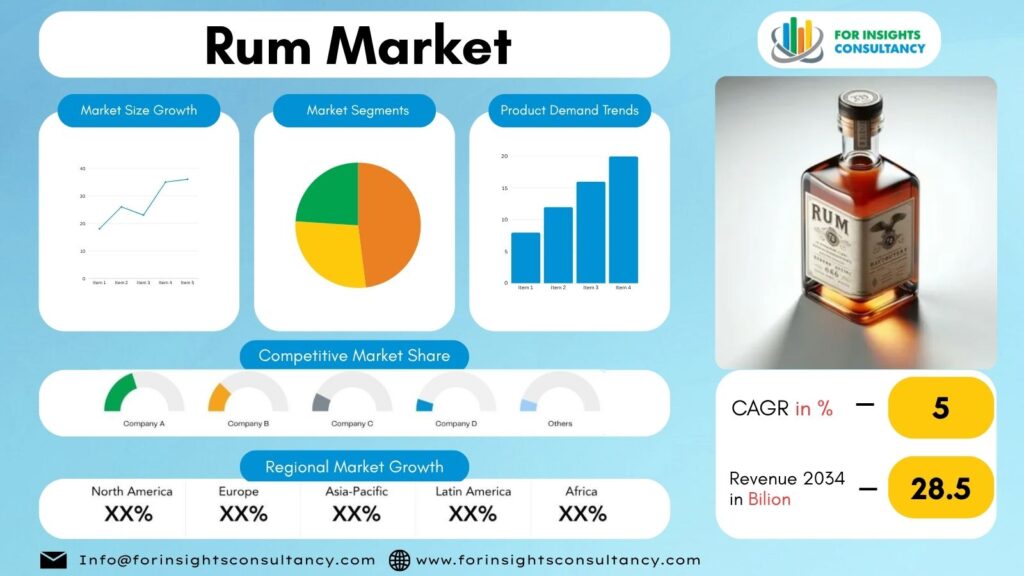
- Market Size (2026): USD 19.5 Billion
- Forecast (2034): USD 28.5 Billion
- CAGR (2026–2034): 5.0%
- Base Year: 2025
- Largest Segment (2026): White Rum — leading current volume share
- Leading Region (2026): Asia-Pacific — ~35–38% share, driven by strong production bases and rising regional consumption.
Rum Market Exclusive Summary
Worldwide, the value of the rum market is estimated to be $19.5 billion in 2026 and forecasted to grow to $28.5 billion by 2034, representing a 5.0% CAGR, with 2025 being the base year. Currently, white rum is the biggest segment, based on its ability to be used in many cocktails such as mojitos and daiquiris. The leading region is Asia-Pacific, accounting for about 35-38% of the market. The region leads due to the presence of well-established production bases and fast-growing consumer demand.
Rum Market Overview (2026)
In 2026, the value of the global rum market will be estimated at $19.5 billion, growing further to $28.5 billion in 2034 at a CAGR of 5.0%. The factors responsible for such growth are the increased popularity of cocktails and home bartending, promoted through social networks, along with the process of premiumization, as the segment of premium rum will account for nearly 28% of the global volume demand due to the preference of the aged and craft versions. White rum represents the biggest share of the current volume, being valued due to its neutral taste that fits perfectly into popular mojito and daiquiri cocktails, whereas spiced rum is the most rapidly growing segment because brands try to satisfy the tastes of younger consumers through innovations. There is a moderate level of consolidation in the industry; the top-five companies, such as Bacardi, Diageo, and Pernod Ricard, control the majority of the global brand share.
In terms of region, the Asia-Pacific segment will dominate the market with approximately 35-38% share in 2026 because of well-developed production infrastructure and fast-growing consumer demand. However, North America and the Caribbean remain deeply associated with rum in terms of its traditional production due to their rich cultural and historical background of consuming this drink, with the USA alone taking an important part in the global consumption of rum. An increasing trend of traveling to the regions of rum production such as Latin America and the Caribbean will only drive up the demand of the market through making people consume rum not only as a vacationing product but also as a souvenir.
Rum Market Dynamics
Growth Driver 2026
Increasing Popularity of Cocktails and Home Mixology
With the growing popularity of mixology thanks to social media influence, there is increasing demand for mixable spirits such as white rum, as more than 35% of all top-selling cocktails include rum and there is high on-premise and at-home consumption.
Tourist-Driven Demand
The increased tourism in countries that produce rum, such as the Caribbean and Latin America, still drives rum consumption as young tourists make rum their drink of choice when traveling on vacation and purchase it as a souvenir.
Innovation in Flavor and Attracting Young Consumers
The increased consumption of spiced and flavored rum products — which have shown the highest growth rate of 7.8% CAGR — illustrates how producers work on making flavors that appeal to young consumers.
Consolidation and Portfolio Building
Consolidation and portfolio building activities of major market leaders (Bacardi, Diageo, Pernod Ricard), accounting for 60% of the market share globally, continue to increase category awareness and distribution worldwide.
Trends 2026
Spiced Rum is Becoming the Fastest Growing Category
The spiced rum category is outperforming all other categories in terms of growth rate (~7.8% CAGR) due to changing palate preference that demands more bold and unique experience from mature spirits categories.
Sustainability in Procurement Practices
Bacardi achieved 100% sustainably-certified sugarcane sourcing (via Bonsucro certification) ahead of its original 2022 target, and separately references a 100% sustainability-certified raw material goal by 2025.
Craft and Independent Distillery Trend
Growing trend of independent producers of craft rums and new product launches has driven the development of this artisanal category, targeting consumers who value authenticity and uniqueness.
On-Premise Channel Importance
On-premise (bars/restaurants) channel is a big player in terms of volumes generated and especially in the US market, which has a high share of cocktail occasions among total consumption.
Rum Market Top Companies Covered In this Report are
- Bacardi Limited
- Superior, Bacardi Reserva Ocho, Gran Reserva Diez
- Diageo plc — Owner of Captain Morgan, the second-ranked global rum brand
- Pernod Ricard SA — Owner of Malibu and Havana Club
- Suntory Holdings Ltd
- Asahi Group Holdings Ltd
- Davide Campari-Milano Spa
- Demerara Distillers Ltd
- Brown-Forman
- Destilería Serrallés — Producer of Ron Barceló
- Mount Gay Distilleries (Barbados)
- Appleton Estate (Jamaica)
- Flor de Caña (Nicaragua)
Rum Market Company news 2026
Bacardi
Continuing its “Do What Moves You” marketing campaign across MTV, NBC, Bravo, Netflix, and Hulu to reach younger LDA (legal drinking age) consumers, while maintaining focus on aged/premium expressions like Bacardi Reserva Ocho ($32) and Gran Reserva Diez ($40).
Pernod Ricard
Havana Club saw a premiumization pattern in 2026 reporting: volumes declined, but price and mix improved — consistent with the industry’s broader “less volume, more value” shift, alongside ultra-aged/luxury positioning moves like Appleton Estate’s premium launches.
Rum Market Segments
By Technology
- White Rum — biggest by volume share, preferred for its taste-neutral, mixable spirit to make cocktails such as mojitos and daiquiris
- Dark Rum — aged type, considered valuable for its taste profile
- Spiced Rum — fastest-growing category (7.8% CAGR), due to changing preferences toward stronger flavors
- Gold Rum — mid-aged category, offering a balance between flavor and mixability
- Premium Aged Rum — smaller but valuable category, riding on premiumization in the industry (comprising about 28% of the total global volume demand)
- Flavored Rum — for attracting younger consumers.
By Application
- Beverages/Cocktails — dominant application, driven by on-premise bar consumption and home mixology trends
- Cooking — smaller application segment, used as a flavoring ingredient in culinary contexts
By Distribution Channel
- On-Trade (Bars/Restaurants) — significant volume driver, particularly in markets like the US, where rum features prominently in cocktail menus
- Off-Trade (Retail/Liquor Stores) — primary channel for at-home consumption and souvenir/travel-retail purchases
By Production Type
- Mass-Produced/Commercial Rum — dominant by volume, led by major players (Bacardi, Diageo, Pernod Ricard)
- Craft/Independent Distillery Rum — smaller but rapidly growing segment, driven by rising demand for authenticity, transparency, and small-batch quality
Rum Market Regional Insights
North America- Historically Dominant, Currently Softening
Volume weakness is being seen in the US market, with rum volumes down by 8.9%, along with supplier sales declining by 7.0% in the most recent reported year, with RTDs and cocktails-in-a-can driving consumption into convenient forms.
Leading brands: Bacardi, Captain Morgan (Diageo), Malibu (Pernod Ricard)
Trends among consumers: Premiumization despite volume decline (volume down but price/mix up with the decline in mixing volume through bottles); flavored rum innovation with new legal-drinking-age consumers; increasing competition from RTD/canned cocktails.
Asia Pacific — Leading Region (~35–38% share)
Asia-Pacific is ahead of other regions when it comes to the global rum business, thanks to a powerful base of production within the region along with the increasing trend of consumption, especially in India, the Philippines (Tanduay) and China.
Top selling brands: Tanduay Distillers, Bacardi, McDowell’s No.1 (local brands in addition to international brands)
Consumption trends: Middle-class disposable income driving demand for premium and aged rum; increased cocktail bar trend in cities; fierce competition between loyal local brands (like Tanduay’s stronghold in the Philippines) and international brands.
Europe
Europe is an established and stable market led by Germany, the UK, and France, where the consumption of white rum is rapidly growing (6.8% CAGR) due to growing popularity of cocktails.
Top brands: Bacardi, Havana Club (Pernod Ricard), Diplomático
Trends among consumers: Return of home mixology (boosted by social media), resulting in white rum consumption for mojito/daiquiri making; increased interest in ultra-aged rums (such as Appleton Estate).
Middle East & Africa
Smallest share in the region at present, with potential for future benefit depending on increasing urbanization and disposable incomes in certain markets.
Leading Brands: Internationally known players (Bacardi, Diageo) through distribution tie-ups, few local manufacturing facilities
Trends in Consumer Demand: Slow development of urban cocktail culture in certain Gulf countries and South Africa; overall regional growth hampered by cultural and regulatory restrictions on alcohol consumption in some areas of the region.
Frequently Asked Questions
What is the rum market size?
The global market for rum has a valuation of about $19.5 billion in 2026 and will reach $28.5 billion in 2034, growing at a 5.0%
Which type of rum is most popular?
White rum is the dominant volume category, appreciated for its purity and mixability, which is particularly useful in making cocktails such as the mojito and daiquiri.
Which region leads the rum market?
Asia-Pacific dominates the market with a share of about 35-38%, owing to well-established production sites and increasing consumption in the region; North America and the Caribbean still hold valuable historical brand equity.
Who are the biggest rum brands in the world?
The three leading rum brands of the world are Bacardi, Captain Morgan (Diageo) and Malibu /Havana Club (Pernod Ricard).
Why is rum consumption declining in the US?
US rum sales declined as consumers began preferring convenience products such as RTD cocktails and canned cocktails. These products led consumers to reduce the demand for bottled cocktails.
What is the fastest-growing rum segment?
The spiced rum category is the fastest growing category, with growth at about 7.8% CAGR, fueled by changing consumer preferences for bolder, more experience-oriented flavors.
What drives current consumer demand?
Cocktail trends, premiumization, flavor innovation, RTDs, and sustainable authenticity are the factors that drive today’s rum demand.
Customization Available
This report can be tailored to meet specific client requirements. The following customization options are available upon request:
Regional & Country-Level Customization
- Detailed analysis for any specific country not covered in the standard report (e.g., Indonesia, Mongolia, Mozambique)
- Deeper sub-regional breakdowns within Asia-Pacific, North America, Europe, or Middle East & Africa
Company-Specific Analysis
- Detailed profiling of additional companies beyond those covered (financials, SWOT, product portfolio, recent developments)
- Competitive benchmarking of up to 5 additional company profiles
Segment-Level Customization
- Additional breakdown by any specific grade, application, or end-use segment not covered in the base report
- Historical data extension beyond the standard base year.
Request A Free Sample Copy: https://www.forinsightsconsultancy.com/reports/request-sample-rum-market
Related Market Reports
Flavored Spirits Market 2026–2034: Trends, Regional Analysis & Growth Drivers
Alcoholic Drinks Market Insights 2026
India Alcohol Market Research Report — Forecast to 2034
Vodka Market Trend Analysis — Global Forecast to 2034
Select PDF License
Single User: $3499
Multiple Users: $4499
Corporate Users: $5499