

Vodka Market Trend Analysis Research Report by alcohol content, flavor type, and by Region (North America, Latin America, Europe, Asia Pacific, Middle East, and Africa)- Global Forecast to 2034
Feb-2025 Formats | PDF | Category: Food & Beverages | Delivery: 24 to 72 Hours
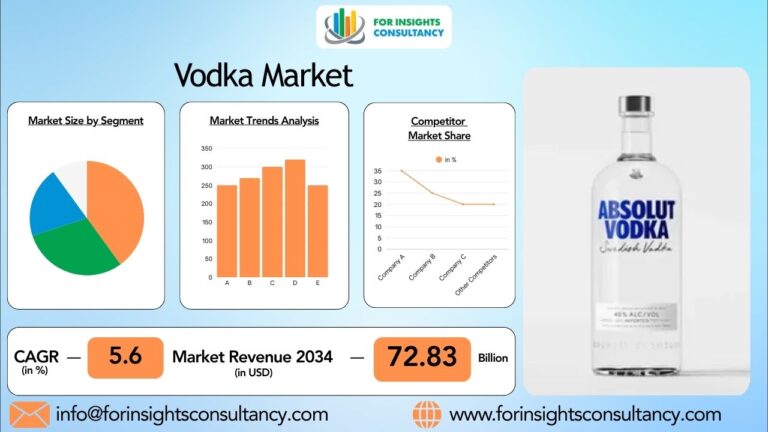
Vodka Market Size
Vodka
Market is projected to grow from $42.84 Billion in 2025 to $72.83 Billion by
2034 at a 5.6% CAGR, reaching an estimated $ 45.24 Billion in 2026, driven by
premiumization trends, evolving consumer preferences, and expanding global
distribution.
Overview of the Vodka Market and Expected Growth (2026)
The 2026
vodka market represents a largely matured, yet successfully setting up sector,
in the mass of distilled spirits. Consumer, trading and distribution variables
are very much dependent on the global economic situation, changing consumer
tastes and trends and the perceived quality of the products. Due to this, the market is expected to grow
at a mid-single digit pace. As the budget markets of Western Europe and North
America stabilize, demand will shift to the faster-growing developing markets
such as Asia-Pacific.
Production
is heavy and there are vast volumes traded globally, due to the ease in
transporting the spirit as opposed to other distillates. Increased competition
from premium and craft spirits and increased availability of products at retail
chains have impacted on the drinking habits and purchasing behavior of
consumers. Increased offer in premium flavors
and reduced alcohol spirits have played a role too. All factors will lead to
overall progression of the market with a gradual stagnation in volume share but
growth through the values of higher prices.
Premiumisation
and innovation have transformed the vodka market from volume to value (minimum
26%) by 2026. Consumption is moving from
habitual drinking to experience-led consumption (cocktails, RTDs, craft spirits),
making vodka perhaps the most flexible category within the global spirits
industry.
Vodka in
2026 is characterized by an industrial shift from mass consumption to valuing a
lifestyle rather than volume consumption. Premiumisation, RTDs, sustainability
and digitalisation of sales are a 2026-structural signs indicating a brand
experience, transparency and innovation oriented market rather than volumetric
achievements.
Market Dynamics 2026
Growth
Drivers
Rising
Premiumization Trend
· Customers
are progressively moving from cheap alcohol to high-end and super-premium vodka
brands.
· The
purchasing power is higher due to an increased disposable income The desire for
quality, authenticity and a brand story is also leading this trend.
· Premium
spirits, which however have a lower volume than beer and wine, deliver a higher
value share worldwide.
Growth
of Ready-to-Drink
(RTD) Beverages
· RTD
cocktails (pre-mixed vodka drinks) are now one of the fastest growing sectors.
· Demand
comes from people‘s demand for more convenient,
portable, time-saving consumption methods.
· Younger
people like ready-made premium experience, without bartending complication.
Shift
Toward Spirits Over Beer & Wine
· Observation
on worldwide consumption trends indicates a transition from usual drinks like
beer, wine to spirit group.
· Consumers
are opting for ‘less but better’ alcohol; it‘s about the quality of the
experiences.
· Most
valuable share is leaded by spirits for their high value share due to premium
pricing power.
Expansion
of Hospitality & Tourism Industry
· Consumption
of vodka (consumption of alcoholic drinks, such as vodka (within bars, clubs,
hotels and restaurants)).
· Tourism
producing night life economies increases consumption of high end spirits
worldwide.
·
And Vodka continue to enjoy on trade success.
Trends
Premium
& Luxury Vodka Dominance
· Premium
and ultra-premium segments are now dominant within the global vodka
market, as consumers opt for higher
quality.
· Consumers
are making values such as artisanship,
sourcing and provenance of the ingredients, and the history of the
brand–where it comes from, and how it came about a significant part of their
purchasing decisions.
· The
premium vodkas are still gaining in value, compared to the standard brands.
Health-Conscious
& “Better-for-You” Positioning
With consumers more knowledgeable about: alcohol levels, calories and ingredients,
Demand is rising for:
· Vodkas
with low-calorie contents.
· Organic
& gluten free types:
In terms of smaller package sizes and more premium options,
the behavior of ‘moderation drinking’ is beginning to have an impact.
Rapid
Growth of E-commerce Alcohol Sales
· The
growth of online alcohol sales has been fueled by an increasing grasp of
regulatory confines and an increasing penetration of the internet.
· Purchasing
through home delivery, subscriptions and
direct to consumers are among the most appreciated by the final clients.
· Emerging
digital-first brands through focused marketing.
Sustainability
& Ethical Production
Environmental issues are changing the buying decisions.
Brands are focusing on:
· Recycling
packaging
· Carbon-neutral
production.
· Sustainable
procurement of grains and water
·
Sustainability is becoming a brand
differentiator, not just a compliance issue.
Top
Companies Covered In This Report:
·
Brown-Forman
·
Diageo
·
Belvedere
·
Russian Standard, Bacardi
·
Constellation Brands Inc
·
Proximo Spirits
·
Distell Group,
·
Savor Stoli
·
IceBerg Vodka
Vodka Market Company News
2025 and 2026
Pernod
Ricard
· In
March 2026, Pernod Ricard confirmed discussions to merge with Brown-Forman.
· The
deal aims to create a global spirits leader with strong vodka portfolios
(Absolut) and wider distribution scale.
Brown-Forman
Engaged in merger discussions with Pernod Ricard to counter
slowing global alcohol demand and rising
costs. Facing declining demand due to health-conscious consumers and
alternative beverages.
Diageo
Became official spirits supporter for the 2026 FIFA World
Cup, boosting global brand visibility.
Bacardi
Premiumization
& Brand Focus (2025–2026):
Continued investment in premium vodka and cocktail-ready
products.
Competitive
Landscape:
Competing with global giants through brand-led marketing
and innovation in flavored spirits.
Detailed Segmentation and Classification of the report (Market Size and
Forecast – 2034, Y-o-Y growth rate, and CAGR):
Segment
by Type
·
Plain
Vodka
·
Flavored
Vodka
Segment
by Quality
·
Average
·
Premium
·
Ultra-premium
Segment
by Distribution Channel
Off Trade
On Trade
Regional
Analysis of Vodka Market
Each
country is studied in detail, and the study includes qualitative and
quantitative analysis of the Vodka Market in that country.
North America
North
America remains one of the largest vodka markets in 2026 in terms of
value, with the US accounting for the
largest share of the market, followed by Canada. The vodka market in North
America shows high per-capita alcohol consumption, established retail systems and strong
premiumisation.
United States (Largest Market)
Market
Characteristics
·
The U.
S. Rules both North Americas vodka
consumption and North Americas vodka profit share.
· Vodka classic and still a
predominant player as the top selling spirit category and popular in cocktail
and RTD use.
Key Trends (2026)
·
Premiumisation:
Consumers favor more premium and craft vodka brands.
·
Cocktail
Culture:- Huge demand for some drinks like Moscow Mule and the Bloody Mary etc.
·
RTD
Expansion: Vodka is noted as the most popular canned cocktail base by all
retail, off premise channels.
· Growth of E-commerce: Online
alcohol sales are seeing continuous growth due to convenience involved and
relaxing of regulations.
Canada (Stable &
Premium-Oriented Market)
Market
Characteristics
·
Canada:
This is a mature but less significant market, with consistent demand and highly
regulated.
· Government managed liquor boards
affect the price and availability of the product as well as its distribution.
Key Trends (2026)
·
Premium
& Imported vodka demand: There is a
market for imported and best brands.
·
Focus on
sustainability: Demand for environmentally-friendly packaging and sources more
ethically.
· Moderation Trends: Development in low alcohol and moderate
consumption trends.
Mexico (Emerging Opportunity
Market)
Market Characteristics
·
Mexico
still rules over tequila but vodka is quickly making a comeback since its
infant years in the premium and city markets.
· Growth is driven by lifestyle
changes and international drinking.
Key Trends (2026)
·
Urban
Consumption Growth: Growing demand in
cities and tourism centers.
·
Hospitality
& Tourism Impact: Bars, Resorts, Nightlife sectors are responsible for the
increase in Vodka on Cocktails.
· Younger Demographics: Increased usage among younger population
exploring global spirits.
Europe
Europe
will continue to be the worldwide home of sales and cultural treasures of
vodka, where traditions are age-old in production and drinking. The region
boasts a combination of high per-head drinking, significant export power and
premium growth trends.
Biggest
share of world vodka demand is in Europe, which is domestic as well export
market.
However, the market in 2026
reflects a dual structure:
·
Eastern
Europe -> volume driven tradition led consumption
· Western Europe->
premiumisation, innovation and moderation trends
Eastern Europe (Core Vodka Belt)
Key Countries
·
Poland
·
Russia
· Sweden
Market Characteristics
·
Eastern
Europe has been home to the drinking of vodka.
· In a way vodka is by that kind of
the touchstone of the social tradition and identity and them in Poland or in
Russia they are seen even more than in the other countries.
Key Trends (2026)
·
High
Pe-Capita Consumption: Vodka is still a go-to spirit category.
·
While the
domestic market and the national economy are so large that it would be
inefficient to exclusively rely on domestic production, native distilleries
account for a clear majority of supply and exports.
· Shift to Premium &
Export-Oriented Brands: Countries such as Poland are boosting world exports of
premium vodka.
Western Europe (Premium & Innovation
Hub)
Key Countries
·
United
Kingdom
·
Germany
· France
Market Characteristics
Market
Matured (Western Europe) Western Europe is a matured and innovation driven
market where the competition between vodka and wine, beer and super-premium
spirits still exists.
Drink is
more event-led (cocktail, night life,
outings).
Key Trends (2026)
·
Premiumisation: High growth in craft, organic and luxury
vodka brands.
·
Mixology
culture: Vodka has become popular in cocktail making and bargoing culture.
· Health& Moderation Shift:
Consumers are drinking less and drinking better.
Southern Europe (Emerging &
Tourism-Driven)
Key Countries
·
Italy
· Spain
Market Characteristics
·
Markets
traditionally dominated by wine. Increasing success of vodka drinking culture
through tourism and nightlife.
· Demand is focused on city centers
and clubs, and the hospitality industry.
Key Trends (2026)
·
Tourism-Led
Consumption: Heavy consumption in bars,
beach clubs, and resorts.
·
Cocktail
Adoption: Vodka-based cocktails popular among younger people.
· Imported premium brands: Buyers expresses a strong preference of
global brands of vodka to locally-produced brands.
Nordic Countries (Regulated but
Premium-Focused)
Key Countries
·
Norway
·
Finland
· Denmark
Market Characteristics
·
Sales of
alcohols in markets with highly regulation with state owned retail system.
· High Income levels sustain luxury
product market in High tax environment.
Key Trends (2026)
·
Premium
& Sustainable Vodka demand: focus on
the eco friendly and organics.
·
Stricter
Regulation Effect: Scarce supply but
high stable consumption in high-value markets.
· Innovation in Craft Distilling:
Growth in small-scale, artisan vodka production.
Asia Pacific
In 2026,
the Aisa Pacific vodka market is the most dynamic globally, fuelled by urbanization, increasing disposable incomes and evolving
lifestyle trends. Although vodka has
historically played a limited role in these markets, it has gained popularity
due to the influence of western drinking habits, increased convenience,
premiumization and nightlife.
China (Emerging Premium
Opportunity)
Market Characteristics
Normally
allki by local alcoholitas (such as baiji),
now the vodka is more and more popular in urban and high end.
Demand is
heavily pooled in the following type of cities;
tier-1 cities and overseas nightlife centers.
Key Trends (2026)
·
Growth of
Premium & Imported Vodka: Increasing
demand of foreign brands.
·
The rise
of cocktail culture. Growing number of western-style bars and mixology/
bartending.
· Young Consumer Power: Millennials
and Generation Z (Gen Z) are leading the evolution of shake up the global
spirits category.
India (High-Growth Market)
Market Characteristics
·
The
largest and fastest growing vodka market. As a big youth population and rising
incomes there.
· Popular in town and club scene,
among friends:.
Key
Trends (2026)
·
Premiumisation
remain affordable : Growing Mid-range to premium vodka brands.
·
Demand
for Flavored Vodka keenly sought after flavors such as fruit and unique new
flavors.
· Retail Growing in modern trade
and online alcohol delivery (state-dependent).
Japan (Mature &
Innovation-Oriented)
Market Characteristics
·
A
developed beverage market with a fierce competition from strong competitors
such as sake, whisky
and beer.
· The demand of vodka is in
cocktail bars and high end.
Key Trends (2026)
·
Craft
& High-quality Vodka: Love premiums
and importvodka.
·
Cocktail
Innovation: Strong mixology culture fuels the demand for vodka.
· Moderation Trend: Consumers are
interested in quality rather than quantity.
South Korea (Trend-Driven Market)
Market Characteristics
·
This
segment being traditionally dominated by soju, we can observe that now premium
nightlife segments are showing some vodka effect.
· Much influences by global culture,
western drinking culture.
Key Trends (2026)
·
Cocktail &
Cocktail Culture: Growing popular as
more and more bar and lounges use vodka.
·
Youth-Led
Demand: Consumers who are younger are
beginning to migrate to international spirits.
· Premium Imports: Increased consumption of imported branded
vodka.
Australia & New Zealand
(Developed Premium Markets)
Market Characteristics
·
Markets
that are well-developed in terms of alcohol consumption and have high buying
power and well-established regulations.
· Vodka is one of the most heavily
taken spirits in the on trade and off trade.
Key Trends (2026)
·
Premium
& craft vodka growth; (Mexican and domestic) • Customers looking for a
premium brand which is grown here or imported
·
Sustainable
Focus: Choices that are environmentally
friendly, organic.
· RTD Expansion: Ready-to-drink products that are vodka-based
are extremely popular.
Southeast Asia (Emerging &
Tourism-Driven)
Key Countries
·
Thailand
·
Vietnam
· Indonesia
Market Characteristics
·
Demand
for vodka is increasing in these sectors of tourism, urban and hospitality.
· High dependence on imports and
foreign brands.
Key Trends (2026)
·
Tourism-Led
Demand: Resorts, beach clubs, bars
produce vodka.
·
Climbing
middle class incomes: More disposable
income means a greater propensity to buy premium images.
· Western orientation: Cocktail drinking practice and world drinking
customs.
Middle East and Africa
The
Middle East & Africa (MEA) vodka market in 2026 appears to be a mixed
island dominated by structurally diverse, regulated categories with a promising
long-term outlook. To elaborate, in
comparison to mature markets, MEA is a diversified…
Middle East,
low consumption but high value premium demand emerged from expatriates.
Africa-> emerging high-growth market,
attractive opportunities at the crossroads of demographics and urbanization
While
there is downtrend in alcohol consumption overall in some parts of the world
thanks to culture and religion, premium spirits (such as vodka) are picking up
in some of the large, tourism-based economies.
Middle East (Regulated but
Premium Niche Market)
Key Countries
·
United
Arab Emirates
·
Saudi
Arabia
· Israel
Market Characteristics
Alcohol:
In many countries (based on religious and legal reasons) alcohol is restricted
and regulated.
Demand is concentrated among:
·
Expatriate
groups
·
Tourists
· Within the hospitality industry
(retail, international airports;
hotel, taxis, bars,)
Key Trends (2026)
·
Premium
Vodka demand: limited selection of
premium brands, since its costly products that target rich consumers.
·
Hospitality-Led
Consumption: Hotels, resorts and venues across the globe will accelerate
penetration of vodka.
· Duty-Free & Travel Retail
Growth Airports are significant as distribution channels.
Sub-Saharan Africa (High-Growth
Opportunity Market)
Key Countries
·
South
Africa
·
Nigeria
· Kenya
Market Characteristics
Africa
represents one of the fastest-growing consumer markets globally, driven by:
·
Fast
population increasing
·
Urbanization
· Growing middle class
Key Trends (2026)
·
Increasing
consumption of Vodka: demands increasing in the cities and in the centers of
nightlife.
·
Age
demographics: a younger population is
growing the legal drinking population.
· Affordable Premiumization:
Consumers transition from cheap alcohol towards branded spirits.
Southern Africa (Most Developed
Alcohol Market in Africa)
Key Countries
·
South
Africa
· Namibia
Market Characteristics
·
The South
African alcohol market is the most developed and organized in the continent.
· Sound retail infrastructure and
local manufacturing.
Key Trends (2026)
·
Premium
& Flavored Vodka Growth: Increasing demand for innovation and variety.
·
Expansion
of Retailing: Distribution is largely
controlled by liquor chains and supermarkets.
· RTD Segment Growth: Ready-to-drink vodka on the rise.
Frequently Asked Questions with Answers
What is
the Vodka market size and growth forecast?
Global Vodka Market projected to grow from $42.84 Billion
(2025) to $72.83 Billion by 2034 at 5.6% CAGR, reaching $45.24 Billion in 2026.
Who are
the key players in the Vodka market?
The Vodka Market Includes Major Companies Brown-Forman,
Diageo, Pernod Ricard, Belvedere, Russian Standard, Bacardi, Constellation
Brands Inc, Proximo Spirits, Distell Group,, Savor Stoli, IceBerg Vodka,
Others.
What are
the current and future trends for Vodka market?
Premiumization, RTD (ready-to-drink) growth, flavor
innovation, sustainability, and health-conscious “less but better” consumption
are the key current and future trends shaping the vodka market.
Which
regions dominate the Vodka market?
Europe dominates the vodka market, followed by North
America, with Asia-Pacific emerging as the fastest-growing region.
Key insights provided by the report that could help you take critical
strategic decisions?
·
Regional
reports analyse product/service consumption and market factors in each region.
·
Reports
highlight possibilities and dangers for suppliers in the Vodka Market business
globally.
·
The
report identifies regions and sectors with the highest growth potential.
·
It
provides a competitive market ranking of major companies, as well as information
on new product launches, partnerships, business expansions, and acquisitions.
·
The
report includes a comprehensive corporate profile with company overviews,
insights, product benchmarks, and SWOT analysis for key market participants.
Customization: We can provide following things
1) On
request more company profiles (competitors)
2) Data
about particular country or region
3) We
will incorporate the same with no additional cost (Post conducting
feasibility).
Any
Requirement Contact US: https://www.forinsightsconsultancy.com/contact-us
Related Reports
RTD
Alcoholic Beverages Market
Table of Contents
For TOC Contact us: https://forinsightsconsultancy.com/contact-us/
Select PDF License
Single User: $3499
Multiple Users: $4499
Corporate Users: $5499