

Next Generation Solar Cell Market Insights: Perovskite and Tandem Cells Driving Innovation
Jun-2026 Formats | PDF | Category: Electronics & Semiconductor | Delivery: 24 to 72 Hours
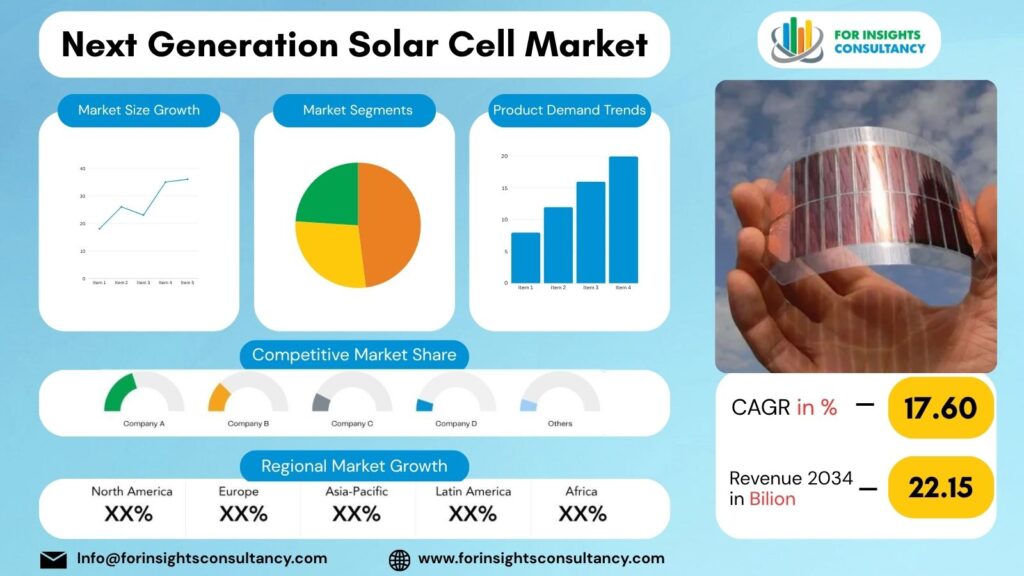
Next Generation Solar Cell Market Size & Forecast
- Market Size (2026): USD 4.374 Billion
- Forecast (2034): USD 22.15 Billion
- CAGR (2026–2034): 17.60%
- Base Year: 2025
- Key Segments: The Next Generation Solar Cell market is segmented by technology into perovskite solar cells, tandem solar cells, organic photovoltaic (OPV) cells, quantum dot solar cells, and dye-sensitized solar cells, with perovskite and tandem solar cells leading due to their high efficiency and commercialization potential.
- Top Regions: Asia-Pacific dominates the market owing to strong solar manufacturing capabilities and renewable energy investments in China, Japan, and South Korea, while Europe is emerging as a major innovation hub driven by advanced research and clean energy initiatives.
Next Generation Solar Cell Market Executive Summary
On a global perspective, Next Generation Solar Cell market size is projected to witness vigorous expansion in the upcoming years due to rising funding for renewable energy projects, growing adoption of high efficiency photovoltaic products, and worldwide aims for achieving carbon neutrality.. Furthermore, adoption of innovative solar energy solutions along with increasing shift towards sustainable power generation are fueling its growth.
Growing demand for perovskite solar cells, tandem solar cells, OPV cells and other next-generation technologies is serving to boost industry growth. All of these next-generation solar cells have the potential to outperform traditional silicon solar technology in the areas of energy conversion efficiency, manufacturing costs, design flexibility and quality of performance. Various stakeholders including government, research institutions and private investors are backing commercialization initiatives, adding toa positive trend.
Furthermore, several new trends like premiumisation by ultra-high-efficiency solar modules, clean energy initiatives for sustainability and digitalization in solar manufacturing and energy management systems are emerging to disrupt the existing competitive dynamism. Companies are strategizing on new technological innovation, capacity expansion, collaboration, research and development investments to gain a competitive edge and grow in this market. This is likely to result in the Next Generation Solar Cell market to grow significantly in the developed and developing countries in this sector, as a parallel growth in the global renewable energy sector is observed.
Next Generation Solar Cell Market Overview (2026)
Next Generation Solar Cell market is high-tech Photovoltaic technologies, which serve to provide higher energy conversion efficiency, lower cost of manufacture, increased flexibility and increased sustainability in comparison with standard silicon cells. These technologies include perovskite, tandem, organic, quantum dot, dye-sensitized and other applicable photovoltaic solutions for use on residential, commercial, industrial, and utility scales.
During the last decade, the industry has undergone considerable changes, driven mainly by advances on the latest photovoltaic materials, growth of renewable generation and constant transition to high efficiency solar energy through continuous efforts on solar cell performance. During this period, ongoing research and development and manufacturing improvements have emphasized on i) next-generation efficiencies to surpass silicon efficiency, and ii) production simplification and material reduction. As a result, commercialization of new high performance tools has been advanced, and investments to renewable energy industry have increased.
Evolving perceptions of the environment, advancements in PV materials and manufacturing techniques, and regulatory policies encouraging investment in clean energy sources are affecting the markets. A variety of policies, including government incentives, carbon emission reduction targets, renewable portfolio standards, and increasing funding for sustainable infrastructure, are driving the global deployment of advanced solar technologies. With energy security and decarbonization as strategic objectives, Next Generation Solar Cell market has a bright future in global renewable energy generation.
Next Generation Solar Cell Market Dynamics 2026
Growth Driver
Rising Demand for High-Efficiency Renewable Energy Solutions
The global market for Next Generation Solar Cell is largely motivated by the rising worldwide demand for clean, reliable and high-efficiency renewable energy sources. The conventional silicon-based solar cells are nearing their theoretical maximum efficiency limit, which is compelling industry stakeholders to pursue new and emerging photovoltaic innovations like perovskite, tandem, organic, quantum dot and other next generation solar cells, for higher efficiencies, lower material usage and better environmental performance. Increasing investments in utility-scale and distributed energy applications are also contributing to the market growth.
Growth in Advanced Photovoltaic Technology Innovation
A number of exciting innovations in photovoltaic materials, manufacturing techniques, and commercialization are propelling substantial market advances. Governments, academia and private venture capitalists are pouring resources into the development and commercialization of next generation solar technologies to achieve higher efficiencies at lower manufacturing costs. Tandem solar cells, ultra-thin flexible solar modules, and highly portable lightweight photovoltaic systems are broadening the application fields into residential, commercial, industrial, and portable sectors. Such technological development should further build the competitiveness of solar energy generation and hasten its adoption to a greater extent globally.
Key Trends
Premiumization
Premiumization is a growing trend in the Next Generation Solar Cell Market as consumers, utilities and commercial customers begin to value higher efficiency solar technologies that produce more power and last longer. Major developments in premium photovoltaic include the emergence of high-efficiency tandem cells such as perovskitesilicon and other advanced thin-film technologies and high-efficiency photovoltaic moduleswith high conversion efficiencies. Such premium photovoltaics will be used in utility and distributed generation systems where the generation of more energy is desired.
Sustainability
Sustainable development continues to be a major catalyst for developing new markets as governments and industries continue to increasing their campaigns to limit greenhouse gas emissions and advance the transition into renewables. Next-generation solar cells are designed to incorporate lower amounts of materials while requiring less energy during manufacturing and providing improved recyclability relative to traditional photovoltaic technology. Increasing adoption of renewable energy sources and the target of carbon neutrality, as well as the rising focus on clean infrastructure development, are likely to intensify worldwide demand for these solar cell technologies.
Technological Innovation
Breakthroughs in perovskite materials, tandem solar cell designs, flexible PV modules, and new manufacturing processes are revolutionizing the market in the near term. Continued R&D progress on efficiency, stability, manufacturability, and cost reduction is facilitating commercialization and widespread adoption. Furthermore, innovations in intelligent energy management systems, machine learning-based performance optimization, and integrated energy storage infrastructure are bringing value to next-generation solar products and opening new markets for adoption in residential, commercial, and utility scale applications.
Next Generation Solar Cell Market Top Companies Covered In this Report are
- First Solar, Inc.
- Oxford PV Ltd.
- Hanwha Qcells Co., Ltd.
- LONGi Green Energy Technology Co., Ltd.
- JinkoSolar Holding Co., Ltd.
- Trina Solar Co., Ltd.
- Canadian Solar Inc.
- Meyer Burger Technology AG
- Tandem PV, Inc.
- Heliatek GmbH
- Saule Technologies S.A.
- Swift Solar Inc.
- Miasolé (Hanergy)
- SunDrive Solar Pty Ltd.
- Microquanta Semiconductor Co., Ltd.
Next Generation Solar Cell Market company news 2025 and 2026
Oxford PV Accelerates Commercial Deployment of Perovskite Solar Cells
Oxford PV expanded commercialization efforts for perovskite-silicon tandem solar cells, focusing on improving module efficiency and accelerating large-scale market adoption.
LONGi Advances High-Efficiency Tandem Solar Technology
LONGi announced new developments in tandem photovoltaic technology aimed at increasing conversion efficiency beyond conventional silicon-based solar modules.
Next Generation Solar Cell Market Segments
Efficiency Outlook
- Low Efficiency (up to 10%)
- Medium Efficiency (11-15%)
- High Efficiency (16-20%)
- Ultra-High Efficiency (over 20%)
Type Outlook
- Monocrystalline Solar Panels
- Polycrystalline Solar Panels
- Amorphous Thin Film Solar Panels
- Copper Indium Gallium Selenide (CIGS) Solar Panels
Next Generation Solar Cell Market Regional Insights
North America – Insight
The USA market for next generation solar cells is developing strongly, with investments in solar energy technology innovation, national incentives towards advanced photovoltaic applications, and the proliferation of high performance PV systems. Collaboration between research institutes, solar manufacturers, and energy companies is on the rise to commercialize perovskite and tandem solar cell technology. High incentives for clean energy technologies and manufacturers are also contributing to regional market growth.
Europe – Insight
Europe: Continues to be a major innovator in solar technology, driven by the region‘s stringent climate neutrality objectives and the strong financial backing for R&D in renewable energy projects. Funding for new and innovative PV projects in Germany, France, UK and Netherlands is robust as they seek improvements in fuel security and lower carbon emissions. Europe‘s focus on several pilot/scale-up productions and commercialization along with a faster deployment of perovskite and tandem solar cells has put it at the forefront of innovation.
Asia-Pacific – Growth Driver
Asia-Pacific has been the dominant market in Next Generation Solar Cell with the region enjoying a thriving solar manufacturing infrastructure, surging renewable energy capacity, and high investments in next-generation photovoltaic technologies. China, Japan, South Korea, and India are the key drivers with respect to high-efficiency solar adoption. The over-all large scale manufacturing base, robust government initiatives, increase in electricity requirement and continuous investments in clean energy infrastructure in the region have propelled Asia Pacific as the fastest-growing market worldwide.
Rest of World – Emerging Trends
Latin America, the Middle East, and Africa are beginning to market some emerging, more efficient solar technology to meet the energy and cost requirements of governments as they transition to more sustainable and affordable energy sources. Shared emerging trends in the next-generation solar space include increased use of high-efficiency solar modules on large scale utility projects, combinations of improved solar cells with energy storage, and investment in decentralized renewable energy. Increasing emphasis on energy security and climate change resilience is likely to generate new development opportunities throughout these regions.
Analyst Insights
According to For Insights Consultancy the market of Next Generation Solar Cell is moving away from a largely research-driven industry towards a commercialized market supported by the rapid development of photovoltaic materials and the ever-growing need for highly efficient renewable energy solutions. The competition among the market players is being redefined by the production of Perovskite and Tandem Solar Cells that provide three to six times higher energy conversion efficiencies compared to traditional crystalline Silicon based solar panels and the commitment of players to pilot production, partners and mass production to speed up the commercial penetration.
This market is likely to see a rising advantage towards more commercially feasible tandem and perovskite modules in the future as efficiency advances, production costs decrease and investments in clean energy infrastructure magnify. With stronger governmental mandates around carbon reductions and renewable energy goals anticipated to growing rapidly among the residential, commercial, industrial and utility markets consumers, demand is set to soar for high profile photovoltaic technology. The winner is expected to be the one that can deliver on long term durability, scalability of design and mass-production cost targets.
Next Generation Solar Cell Market Research Methodology
Next Generation Solar Cell Market report is created by market research based approach encompassing primary research, secondary research and advanced market modeling techniques with an aim to generate precise, valid and decisive industry insights for setting up the right long term strategies. The report analyses the technology attributes, commercialization trends, competition landscape, regulatory framework and future growth opportunities in global PV industry.
Primary Research:
Prepared a dozen or so interviews with all relevant stakeholders, including. Solar cell manufacturers, photovoltaic technology developers, renewable energy specialists, research institutions, material suppliers, industry consultants. These interviews offered first-hand information on emerging technologies, commercialization issues, investment flows, product developments, and future outlook.
Secondary Research:
In-depth secondary research was also conducted using industry journals, company annual reports, investor presentations, government energy information sources, published research from academia, reports from associations for renewable energy, patent filings and credible trade journals to cross-verify market trends, adoption rate of technologies, future competition, and growth in selected regions.
Data Validation:
The entire data collection was validated using multiple approaches, such as crosschecking from multiple sources, statistical analysis, expert validation, and inhouse forecasting model. All market estimates and projections were validated with scenario analysis and technology penetration modeling. This approach allows providing stakeholders with reliable market intelligence and strategic insight of the global Next Generation Solar Cell market.
Next Generation Solar Cell Market – Data Sources
Government Publications
The report uses information from cybersecurity bodies, telecommunications departments, digital infrastructure bodies and regulatory bodies to assess trends in cloud security, digitalization in companies and changes in policy on cybersecurity.
Industry Databases
Market intelligence is collected from sources such as cybersecurity database, cloud networking platforms, source of research of enterprise IT and tech analytics providers to analyze market size, adoption rates, competitive landscape and innovation trends.
Company Financial Reports
Revenue trends, strategic investments, technology evolution, product expansion are monitored by analyzing annual reports, SEC filings, investor presentations, press releases and financial statements of the top SASE vendors, cloud security vendors and networking companies. Methodology This Next Generation Solar Cell Market report is backed by strong research methodology involving primary research, secondary analysis and sophisticated market modeling to derive precise, dependable and usable industry insights.
Trade Journals
This report will use references of cybersecurity journals, cloud computing magazines, enterprise networking publications, white papers and technical research articles to study the trends over the AI-based security improvements, Zero Trust adoption and SASE architecture change from around the world.
Proprietary Research (For Insights Consultancy):
Broader validation and learning are then produced by way of internal databases, experienced interviews and specialist analysis by For Insights Consultancy, providing accurate, trustworthy, current market intelligence to meet client needs.
Customization: We Can Provide Following Things
1) On Market More Company Profiles (Competitors)
2) Data About Particular Country Or Region
3) We Will Incorporate The Same With No Additional Cost (Post Conducting Feasibility).
Any Requirement Contact Us: https://www.forinsightsconsultancy.com/contact-us
Related Market Reports
Green Hydrogen Market
Source: https://www.forinsightsconsultancy.com/reports/green-hydrogen-market
Solar PV Panels Market
Source: https://www.forinsightsconsultancy.com/reports/solar-pv-panels-market
Table of Contents
For TOC Contact us: https://forinsightsconsultancy.com/contact-us/