

Automotive Battery Management System (BMS) Market Size, Trends Analysis Research Report by Component (Hardware, Software), by Vehicle Type (Passenger Vehicles, Commercial Vehicles, Two-Wheelers), and by Topology (Centralized, Distributed, Modular), by Battery Type (Lithium-Ion, Lead-Acid, Nickel-based), and by Region Global Market Analysis and Forecast, 2025-2034
Sep-2025 Formats | PDF | Category: Automotive | Delivery: 24 to 72 Hours
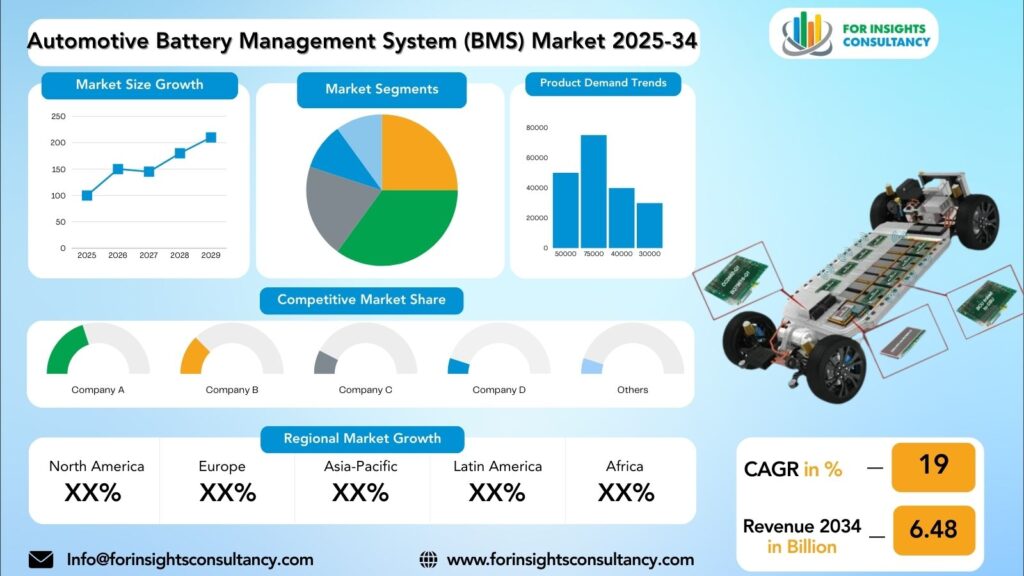
Automotive Battery Management System (BMS) Market is forecast to increase from USD 6.48 Billion in 2025 to USD 21.6 Billion by 2034, at a CAGR of 19%.
Automotive Battery Management System (BMS) Market: A Comprehensive Overviewand Future Developments
The automotive Battery Management System (BMS) Market includes various hardware and software that is meant to monitor, protect and enhance the battery performance of rechargeable batteries used in EVs, HEVs, PHEVs and more sophisticated energy storages. These battery management systems constantly monitor key parameters including voltage, current, temperature, state of charge(SOC), state of health provides cell balancing, and safety measures of the batteries so as to extend their life and enhance the vehicle efficiency. With the market leaning towards mobility and new energy vehicles to be the next generation car, BMS market is an inevitable technology.
In the last ten years, the Automotive BMS Market has seen rapid evolution fueled by the surging take-up of electric mobility, innovation in lithium-ion batteries and rising investments in smarter electronics for vehicles. Today‘s BMS innovations encompass cutting-edge sensors, micro-controllers, wireless connectivity, AI driven intelligence, cloud linkages and predictive analytics for real-time diagnostics, remote vehicle monitoring, seamless charger compatibility, efficient energy management and safer battery performance.
Increasing international demand for electric vehicles is another main driver for market growth. To encourage the adoption of zero-emission vehicles, governments are pushing for additional growth, including increased incentives for consumers, higher emission standards for vehicles, and funding for EV charging infrastructure. The proliferation of electric vehicles in manufacturers’ product portfolios is driving an increased demand for advanced battery management systems that can support larger battery packs and fast-charging applications.
Technologies are radically transforming the competition strategy of Automotive Battery Management System (BMS) Market. Although the functional features are similar throughout the industry, manufacturers are adopting wireless battery management systems (wBMS), cloud-enabled battery platform, AI-powered battery health forecasting and over-the-air software updates to offer next generation products that cut wiring, save weight, drive manufacturing efficiencies and facilitate predictive maintenance for both passenger and commercial electric vehicles.
Among other factors, current consumer understanding of vehicle safety, battery life and range are helping push the market higher. Market demand for electric vehicles to include greater reliability, faster charging, improved safety during operation and longer lasting batteries is prompting major automotive OEMs and battery manufacturers to focus on advanced battery monitoring systems that allow for safer operation while decreasing the tendency for dangerous thermal runaway.
Of course, market dynamics are also being driven by strict government regulations on vehicle safety and CO 2 emissions, battery recycling and the environment. Regulatory agencies in North America, Europe and Asia pacific are developing new standards covering battery safety, thermal management, transportation and recycling of batteries at the end of life, which has in turn increased the adoption of cutting edge BMS solutions that can deal with greater performance and safety stipulations.
North America and Europe will continue to be lucrative markets for the Automotive Battery Management System (BMS) Market owing to intensities of electric vehicle adoption, strong automotive manufacturing base, and favorable policies. In Asia-Pacific, the Automotive BMS Market is projected to grow significantly during the forecast period owing to high production volumes of electric vehicles, high rate of automotive battery manufacturing capacities, favorable policies, and investments in electric mobility, especially in China, Japan, South Korea, and India.
In conclusion, the Automotive BMS Market is set to grow significantly alongside the broader automotive industry as economies worldwide adopt electric vehicles, connected mobility and increasingly sophisticated energy management solutions. The ongoing evolution of battery chemistries, innovations in wireless communication, artificial intelligence, and the convergence of automobile and computer will result in new markets and opportunities for Automotive BMS manufacturers to continue to enable the automotive revolution.
Automotive Battery Management System (BMS) Market Dynamics
Growth Drivers
The global demand for electric vehicles (EVs) is on the rise due to the need for advanced battery management systems (BMS) to optimize battery efficiency and performance. Technological advancements, such as the integration of artificial intelligence and machine learning algorithms, have revolutionized battery management, allowing for better optimization of usage, maintenance needs, and overall battery life. Government regulations and incentives have incentivized automotive companies to invest in electric and hybrid vehicle technologies, with BMS playing a critical role in ensuring compliance with safety standards and optimizing battery performance.
The increasing focus on energy storage systems for renewable energy sources like solar and wind power also relies on advanced battery technologies. BMS enables efficient energy storage, balances supply and demand, and ensures reliability. With the growing emphasis on renewable energy integration and grid stability, the demand for BMS in energy storage applications is accelerating.
Collaboration and partnerships between BMS manufacturers, automotive OEMs, and technology companies are driving innovation and market growth in the automotive industry. By leveraging each other’s expertise and resources, companies can develop cutting-edge BMS solutions that cater to the evolving needs of the market, fostering the development of advanced BMS technologies and market expansion.
Restraints
The Automotive Battery Management System (BMS) Market faces several challenges, including high costs associated with implementing advanced battery management systems, limited infrastructure, technological complexity, regulatory uncertainty, and market fragmentation. The high cost of integrating BMS technology into vehicles can drive up prices for consumers, making widespread adoption challenging. Additionally, the lack of adequate infrastructure, such as charging stations and maintenance facilities, can deter consumers from investing in vehicles equipped with advanced BMS technology.
The complex nature of BMS systems requires specialized knowledge and expertise, making it difficult for manufacturers to keep up with rapidly evolving technology. Regulatory uncertainty can create roadblocks for companies looking to adopt innovative BMS solutions, making it difficult for manufacturers to meet compliance standards while staying competitive.
Market fragmentation contributes to challenges in standardization and interoperability, as multiple players develop diverse BMS solutions, making compatibility and seamless integration across different systems a daunting task. By addressing these restraints head-on and fostering a climate of cooperation and innovation, the Automotive BMS Market can unlock its full potential and drive sustainable growth in the automotive sector.
Opportunities
The Automotive Battery Management System (BMS) Market is expected to experience substantial growth in the coming years due to the increasing adoption of electric vehicles and a growing focus on sustainability. Key opportunities for companies operating in the automotive industry include the rising demand for electric vehicles, technological advancements in battery technology, collaboration between automotive manufacturers, battery suppliers, and technology companies, the industry shift towards sustainable practices, and global expansion.
To capitalize on these opportunities, companies need to adopt a strategic approach, focus on innovation, collaboration, and market expansion. Key strategies include investing in research and development to develop cutting-edge BMS solutions, forming strategic partnerships with key industry players, prioritizing sustainability by developing energy-efficient and environmentally friendly BMS solutions, and exploring international markets.
Investing in research and development allows companies to stay ahead of the curve in terms of technology and performance, while forming strategic partnerships helps expand product offerings and reach new market segments. Prioritizing sustainability aligns with the industry’s goals, attracting environmentally conscious customers and establishing a strong presence internationally.
Exploring emerging markets and adapting to the unique needs of different regions can help companies tap into new customer segments and drive growth. By focusing on these areas, companies can capitalize on the growing demand for BMS technologies and establish a strong presence in the global market.
Challenges
The Automotive Battery Management System (BMS) Market faces several challenges, including the need for high-performance solutions that can effectively monitor and control the battery pack in electric vehicles. These systems must accurately measure parameters such as voltage, current, and temperature in real-time to ensure optimal performance. Cost is another significant challenge, as the demand for electric vehicles grows, leading to a greater need for cost-effective BMS solutions that can be integrated into EVs without significantly increasing the overall vehicle cost.
Safety is a top priority for automotive manufacturers and BMS providers, as they must quickly detect and respond to potential safety issues to prevent damage to the vehicle and ensure passenger safety. BMS providers must work closely with automotive manufacturers to ensure seamless integration of their systems with existing vehicle architecture. This requires a deep understanding of automotive electronics and the ability to customize BMS solutions to meet the specific requirements of each vehicle model.
To overcome these challenges, BMS providers must continue to innovate and develop advanced BMS solutions that meet the evolving needs of the market. By investing in research and development, companies can stay ahead of the competition and deliver cutting-edge BMS solutions that offer superior performance and reliability. Cost-efficient BMS solutions are key to driving the growth of the market, as optimizing manufacturing processes and leveraging economies of scale can minimize production costs and offer competitively priced solutions to automotive manufacturers. Collaboration is essential for overcoming safety and integration challenges, as working closely with automotive manufacturers ensures their systems meet the highest safety standards and are seamlessly integrated into EVs.
Automotive Battery Management System (BMS) Market Top Companies Covered In This Report:
Evaluate The Strategic Positioning And Innovation Pipelines Of Leading Market Companies-From Multinational Enterprises To Disruptive Regional Firms. Understand How Key Players Are Innovating, Expanding, And Capturing Value, And Use Competitive Benchmarks To Plan Your Next Move.
- Ficosa Internacional SA
- Leclanché SA
- Panasonic Holdings Corporation
- Renesas Electronics Corporation
- Infineon Technologies AG
- Eberspächer
- Sensata Technologies, Inc.
- LG Energy Solution
- AVL
- STMicroelectronics
- NXP Semiconductors
- Analog Devices, Inc.
- Texas Instruments Incorporated
- BMS PowerSafe
Automotive Battery Management System (BMS) Market News
AVL
In December 2024, AVL established a new test infrastructure in Germany to enhance BMS testing capabilities, focusing on improving battery safety and lifecycle analysis.
Bosch
In August 2025, the European Commission approved a joint venture between Bosch and Mitsubishi for EV battery services.
LG Energy Solution
LG Energy Solution launched its “B. around” brand in September 2024, offering a battery management total solution with advanced software and AI-based diagnostics. This enables real-time, on-vehicle analysis and predictive maintenance.
Segmented View of the Industry:
The Equipment segment holds the largest market share due to the high cost of terminals, antennas, and modems. However, the Connectivity Services segment is expected to show the highest growth rate.
The Automotive Battery Management System (BMS) Market Is Mapped Through A Multidimensional Lens-Tracking Shifts Across Product Type, Applications, And Geographic Regions. This Segmented Approach Enables Businesses To Localize Their Growth Plans And Align Offerings With The Most Profitable Demand Centers.
Segmentation by Component
- Hardware
- Software
Segmentation by Battery Type
- Lithium-Ion
- Lead-Acid
- Nickel-based
Segmentation by Topology
- Centralized
- Distributed
- Modular
Segmentation by Vehicle Type
- Passenger Vehicles
- Commercial Vehicles
- Two-Wheelers
Global Geographic Coverage:
Based on recent market analysis, North America is the largest and most mature market for Very Small Aperture Terminals (VSAT). Its leading position is driven by significant investments in defense and government sectors and a well-established telecommunications infrastructure.
The Report Provides In-Depth Qualitative and Quantitative Data On the Automotive Battery Management System (BMS) Market For All Of The Regions And Countries Listed Below:
North America
North America is leading the way in the adoption of electric vehicles, with major automotive manufacturers investing heavily in developing these technologies. This shift towards sustainable transportation solutions is driving the demand for Automotive Battery Management Systems (BMS). The United States is the largest market for electric vehicles, driven by government initiatives promoting clean energy. Canada is also experiencing a surge in demand for electric vehicles due to environmental consciousness and government efforts to reduce carbon emissions. Mexico’s automotive industry is rapidly transforming, with a focus on electric vehicle manufacturing. Investments in electric vehicle infrastructure and the presence of major automotive OEMs contribute to the expansion of the BMS market in the country. As the automotive industry evolves, the demand for advanced BMS technologies is expected to grow, making North America a significant player in the global BMS market.
Europe
The Automotive Battery Management System (BMS) market is experiencing significant growth globally, with Europe being a key region contributing to this expansion. Germany, a leader in the European automotive industry, is driving the adoption of advanced BMS technology in electric vehicles, with companies like Bosch and Continental developing cutting-edge solutions. France’s government initiatives to promote clean mobility solutions have led to a surge in electric vehicle sales, creating a growing demand for high-quality BMS systems. French companies like Valeo and Saft are shaping the future of automotive electrification through their innovative BMS offerings.
The United Kingdom remains a key market for Automotive BMS technology, with British automakers investing heavily in electric vehicle development, driving the need for sophisticated BMS solutions to optimize battery performance and efficiency. Companies like Dyson and Williams Advanced Engineering are pushing the boundaries of BMS innovation in the UK market. Italy, known for its luxury sports cars, is also making strides in the Automotive BMS market, leading to a growing demand for advanced BMS systems that ensure the reliability and safety of battery packs.
Spain is emerging as a key market for Automotive BMS technology, driven by a growing interest in electric mobility solutions. Spanish automakers are incorporating BMS systems into their vehicles to enhance battery efficiency and overall performance. By staying ahead of the curve and investing in cutting-edge BMS solutions, European countries can lead the way towards a sustainable and electrified automotive future.
Asia Pacific
The Asia Pacific region is a hub for automotive innovation and production, with countries like China, Japan, and South Korea leading the way. China, the world’s largest automotive market, is heavily influenced by the shift towards electric vehicles and strict emission regulations. Japan, known for its technological prowess, is focusing on developing advanced systems with cutting-edge features, enhancing battery performance, safety, and efficiency. Automakers are also incorporating BMS technology into their vehicles to stay ahead of the competition. South Korea, with companies like Samsung SDI and LG Chem, is also a major player in the Asia Pacific BMS market, driven by its innovative battery technologies and robust manufacturing infrastructure. The country’s skilled workforce and robust manufacturing infrastructure have made it a key hub for BMS production.
Middle East and Africa
The Middle East and Africa are experiencing significant growth in the Automotive Battery Management System (BMS) market due to the increasing adoption of electric vehicles and the need for efficient energy storage solutions. Countries like Saudi Arabia, the UAE, and Qatar are leading the way in adopting electric vehicles and investing in advanced BMS technologies. The region’s strategic location at the crossroads of Europe, Asia, and Africa makes it an attractive market for BMS manufacturers looking to tap into a diverse customer base.
Africa, with its rapidly growing population and urbanization, presents promising opportunities for the Automotive BMS sector. Countries like South Africa, Nigeria, and Kenya are witnessing a surge in demand for electric vehicles due to concerns over air pollution, energy security, and reducing dependence on fossil fuels. Governments across the continent are incentivizing the shift towards electric mobility, creating a favorable environment for BMS manufacturers to expand their operations.
In conclusion, the Automotive Battery Management System (BMS) Market in the Middle East and Africa is poised for significant growth due to the increasing adoption of electric vehicles and the need for efficient energy storage solutions. Manufacturers and suppliers in the BMS sector must capitalize on these emerging opportunities to stay ahead of the competition and meet the evolving needs of the market.
Reasons to Buy:
- The Research Would Help Top Administration/Policymakers/Professionals/Product Advancements/Sales Managers And Stakeholders In This Market In The Following Ways.
- The Report Provides Automotive Battery Management System (BMS) Market Revenues At The Worldwide, Regional, And Country Levels With A Complete Analysis To 2034 Permitting Companies To Analyze Their Market Share And Analyze Projections, And Find New Markets To Aim For.
- To Understand The Most Affecting Driving And Restraining Forces In The Market And Their Impact On The Global Market.
- Major Changes And Assessment In Market Dynamics And Developments.
- The Objective Of The Automotive Battery Management System (BMS) Market Report Is To Identify New Business Opportunities Using Quantitative Market Forecasts.
- Formulate Sales And Marketing Strategies By Gaining An Understanding Of Competitors, Their Positioning, And Strengths & Weaknesses.
Faq – What Global Leaders Are Asking
What Is The Growth Prospect For The Automotive Battery Management System (BMS) Market By 2034?
Automotive Battery Management System (BMS) Market Is Expected To Achieve A Stable Growth Rate With A Compound Annual Growth Rate (Cagr) Of About 19% From 2025 Through 2034.
What Is Driving The Growth Of The Automotive Battery Management System (BMS) Market?
The market’s growth is primarily driven by the surging global adoption of electric vehicles (EVs) and stringent government regulations aimed at reducing carbon emissions. This increased demand for EVs, in turn, necessitates advanced BMS to ensure battery safety, optimize performance, and extend battery life.
Who Are The Key Players In The Automotive Battery Management System (BMS) Market, And What Are Their Market Shares?
The Automotive Battery Management System (BMS) Market Includes Major Companies Like Ficosa Internacional SA, Leclanché SA, Panasonic Holdings Corporation, Renesas Electronics Corporation, Infineon Technologies AG, Eberspächer, Sensata Technologies, Inc., LG Energy Solution, AVL, STMicroelectronics, NXP Semiconductors, Analog Devices, Inc., Texas Instruments Incorporated, BMS PowerSafe, Others.
Specific Market Share Data Is Not Publicly Available and Is Typically Provided In Detailed, Proprietary Market Research Reports.
Which Regions Are Leading the Automotive Battery Management System (BMS) Market Growth?
Asia-Pacific is leading the Automotive Battery Management System market growth due to its dominance in electric vehicle production and adoption, particularly in China, Japan, and South Korea. Europe and North America also contribute significantly, driven by ambitious emission reduction targets, government incentives, and the presence of major automakers and semiconductor companies.
Customization: We Can Provide Following Things
1) On Market More Company Profiles (Competitors)
2) Data About Particular Country Or Region
3) We Will Incorporate The Same With No Additional Cost (Post Conducting Feasibility).
Any Requirement Contact Us: Https://Www.Forinsightsconsultancy.Com/Contact-Us/
Related Report
Electric Vehicle Battery Repair & Replacement Services Market
EV Charging Panelboard Market
https://www.forinsightsconsultancy.com/reports/ev-charging-panelboard-market
Table of Contents
For TOC Contact us: https://forinsightsconsultancy.com/contact-us/