

22 September-2026 Formats | PDF | Category: IT | Delivery: 24 to 72 Hours
Anti-money Laundering (AML) Market Revenue Size & Future Growth Trends
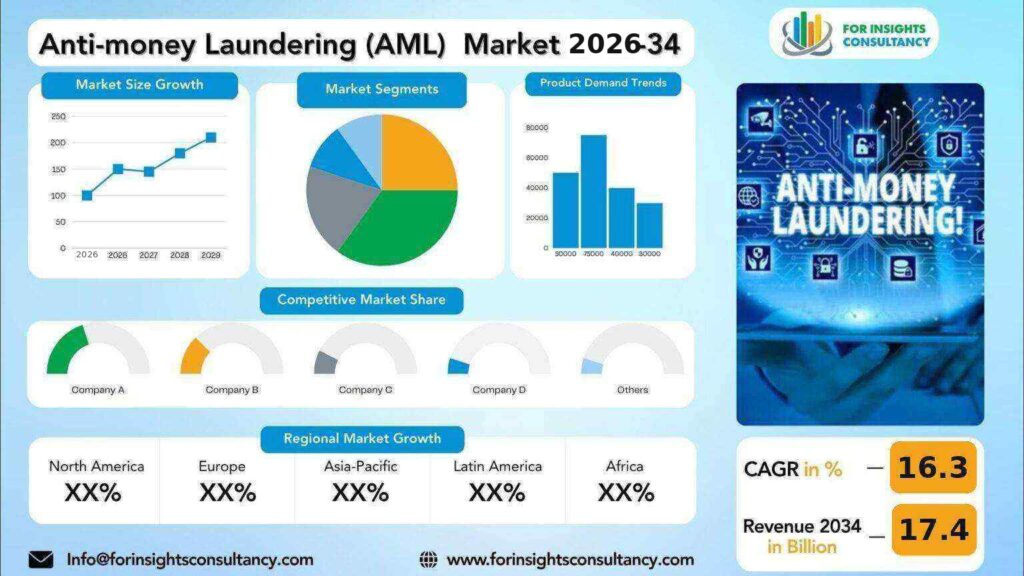
Market Size (2026): USD 5.2 Billion
Forecast (2034): USD 17.4 Billion
CAGR (2026–2034): 16.3%
Base Year: 2025
Leading Segment (2026): Software (by component)
Top Region (2026): North America
Market Trends: Rising adoption of AI- and machine learning-driven transaction monitoring is reducing false positives and strengthening real-time detection of increasingly complex money-laundering typologies.
Anti-money Laundering (AML) Market Quick Insights: Market Overview
The Anti-money Laundering (AML) market is made up of software, platforms, services, and solutions used by banks, financial institutions, and regulated businesses for detecting, preventing, investigating, and reporting any illegal financial activities. These technologies are used for conducting Know Your Customer (KYC), customer due diligence, transaction monitoring, sanctions screening, suspicious activity detection, and risk management. The requirements for Anti-money Laundering (AML) continue to be an integral part of the risk management process in the finance industry.
Some of the trends that are contributing to the growth of the market include complicated financial transactions, growing use of digital payments, cross-border operations, changing techniques for money laundering, and blockchain analytics. In 2026, FATF identified risks relating to cyber-enabled scams, virtual assets, DeFi, underground banking, and digital forms of hawala.
Increasingly, AI and analytics are being used to find unusual transaction patterns, prioritize alerts, conduct investigations, and increase detection of risks. In addition, the ongoing transition to digital financial services is generating a demand for technology that will monitor transactions more efficiently.
These needs have been fueled by the need for compliance with AML/CFT regulations in light of increasing numbers of transactions and advanced methods used in financial crimes. Increasing use of digital wallets, instant payments, fintechs, virtual assets, and cross-border payments introduces new monitoring needs.
The Anti-money Laundering (AML) market is likely to continue being centered around real-time monitoring, artificial intelligence and analytics, digital identification, payment transparency, blockchain intelligence, and automation of compliance. The regulatory scrutiny is also likely to extend beyond new payment systems and virtual assets. FATF’s work until 2026 in payment transparency and virtual assets demonstrates the evolving AML requirements.
Request a Free Sample Copy: https://www.forinsightsconsultancy.com/reports/request-sample-anti-money-laundering-aml-market
Anti-money Laundering (AML) Market Trends 2026
US and EU regulation are actively diverging, not converging
Herein lies the key structural development of 2026. In the United States, FinCEN announced a rollback of specific beneficial ownership information (BOI) reporting obligations for 2026, which will reverse the expectations raised in the context of the reforms introduced in 2020 as part of the AMLA — a reduction in transparency obligations. On the other side, the European Union has taken a contrary step in that AMLA (the European Union’s new Anti-Money Laundering Authority) has become responsible for the EU-wide AML/CFT supervision, replacing EBA from January 1, 2026. As one of the analysts with more than a decade experience in the market puts it, this is an example of “fragmentation and integration happening simultaneously.”
Enforcement is intensifying even as reporting rules loosen
FinCEN settled its biggest-ever civil penalty action related to BSA for $80 million in March 2026 against broker-dealer Canaccord Genuity. The significance of the case is that despite the BOI rule reversal, the regulators’ appetite for enforcement has not diminished, but rather intensified because they are now evaluating results.
Virtual assets and stablecoins are the fastest-moving risk category
FATF has particularly called out rising money laundering threats from stablecoins and is calling for enhanced regulation of virtual asset service providers (VASPs), and transactions involving cryptocurrencies across borders. The revised FATF Travel Rule is making it mandatory for VASPs to exchange information about the sender and receiver, and it is also requiring compliance from decentralized finance (DeFi) platforms.
Real-time payments are outrunning traditional fraud controls
An excellent frame from industry analysis: an instant payment system will have almost no place for a fraud detection mechanism that works on an hours-to-days basis. This is why the development of AI-powered real-time transaction monitoring becomes so crucial for today, not for some distant future but for the year 2026.
Growth Drivers 2026
Regulatory effectiveness testing is forcing real investment, not just compliance box-checking
Moving from technical compliance to effectiveness, as established in the change of the FATF plenary country evaluation policy in Mexico City in February 2026, is a real driver for spending. The institutions will not be able to get through their examination anymore simply by being compliant with the policy but will need to show that their program works, catching the money laundering operations. FinCEN and US banking authorities drove the same point further in their proposal of April 7, 2026, which is called the biggest change in AML policy in more than a decade.
Expansion of AML obligations into previously lighter-touch sectors
Starting from January 1, 2026, there will be a great number of US investment advisers that will be obliged to create AML programs, just as it had been long required of banks and broker-dealers. It’s an underlying factor – not an additional demand by the existing regulated players, but completely different buyers entering the market for the first time.
Alert fatigue and false-positive costs are driving a second wave of AI-driven replacement spending
And here is something that goes beyond just mere regulatory push: companies that have implemented generation one AML monitoring systems are moving away from those systems not due to compliance concerns but purely due to high costs of operations. The promise of 70%–80% reduction in review tasks is what vendors are selling as the key differentiator here. Thus, investments in such systems now become justified both as compliance measures and as cost-cutting steps.
Fraud and AML functions are converging into unified risk platforms
Fraud and money laundering detection technologies becoming one in the same, as more similarities arise between different typologies. This has created an entirely new growth segment called financial crime platforms which wasn’t a buying segment by itself just a few years ago, and increased the overall addressable spend in the market.
Top Companies Covered in the Anti-money Laundering (AML) Market are
- NICE Actimize
- LexisNexis Risk Solutions
- Oracle
- FIS
- Fiserv
- SAS Institute
- FICO
- ACI Worldwide
- Experian
- Wolters Kluwer
- TransUnion
- GB Group plc (GBG)
- ComplyAdvantage
- Jumio
- Friss
- CaseWare International
- Cognizant
- Napier Technologies
- Nelito Systems
- Trulioo
- WorkFusion
- Accenture
Anti-money Laundering (AML) Market Company news 2026
NICE Actimize — NICE Ltd. put Actimize up for sale in late 2025 (initially reported at $1.5–2B, later up to $2.5B) to fund its $955M Cognigy acquisition and refocus on cloud/CRM/AI. By May 2026, five bidders had advanced: Advent International, New Mountain Capital, Stone Point Capital (all PE), plus SymphonyAI as the strategic bidder — notable since Actimize drove ~$158.3M of NICE’s operating profit in 2024, roughly a third of the company total. A completed sale would be one of the largest ownership changes in AML software history and directly affects the #1 name on your list.
Oracle — Announced April 9, 2026 (at Oracle AI World Tour, New York) that it secured rights to technology from Lucinity to add AI agent-driven capabilities to its Financial Crime and Compliance Management (FCCM) portfolio, extending case management and investigation workflows with next-generation AI.
WorkFusion
Actively publishing monthly regulatory/enforcement roundups through 2026 (e.g., its January 2026 edition covering FinCEN’s $3.5 million penalty against Paxful for BSA violations) and citing customer deployments — Raymond James automating entity-data matching, Valley Bank automating sanctions alert adjudication — positioning itself around named enterprise wins rather than funding/M&A news specifically.
Anti-money Laundering (AML) Market Segments
By Component
Software/Solutions — dominant segment, which is continuously quoted at about 63% share by several independent source (For Insights Consultancy), due to transaction monitoring systems, sanctions screening solutions, and compliance automation software.
Services — this smaller but growing sub-segment, which includes implementation, customization, consulting, and training.
By Deployment Mode
On-premises – has been dominant historically (ranging from 68% in older estimates to about consistent up through 2025) since it is preferred by banks and large financial institutions dealing with sensitive information where control and security are important.
Cloud-based – it is the fastest-growing form of deployment because it allows for scalability, affordability, and remote access; gradually becoming the go-to option for fintechs and challenger banks without legacy technology issues.
By Application
- Transaction Monitoring
- Customer Due Diligence (CDD) / KYC
- Sanctions Screening
- Case Management & Investigation
- Compliance Management / Regulatory Reporting
Anti-money Laundering (AML) Market Regional Insights
North America — largest share
Continuously referenced in several independent sources at approximately 29.8% share — one of the better corroborated percentages for this region in all of this research. However, 2026 marks an anomaly in this regard: FinCEN announced a reduction in Beneficial Ownership Information reporting requirements while simultaneously working to put forward, alongside other banking authorities, the biggest AML reform in over a decade (April 7, 2026), moving from compliance-based to results-oriented supervision. Nevertheless, enforcement was stepped up regardless of that — FinCEN issued its largest-ever BSA penalty on a broker-dealer company ($80M to Canaccord Genuity, March 2026) and fined Paxful $3.5M for BSA/virtual assets-related violations.
Europe
The AMLA (new European AML Authority) assumed EU-level supervision of the AML/CFT framework from the EBA as of January 1, 2026, thereby consolidating a process that had been scattered across national authorities – an important consumer-protection and standardization development, not an evolutionary one. Countdown to the EU’s unified AML framework effective as of July 10, 2027, is underway, while the framework actively pulls forward investments made and vendor selections in 2026. Leading names: Wolters Kluwer (provider of compliance/RegTech solutions based in the Netherlands), GB Group plc (UK), ComplyAdvantage (UK; featured in Forrester’s Financial Crime Management Solutions Landscape, Q1 2026).
Asia-Pacific — fastest-growing
The common regional factor is found in all sources; these are the increased penetration of digital banking and the strict AML regulations by national regulators.
Middle East & Africa — Smallest, Early-Stage Region
UAE is no longer on FATF’s grey list, which is a real regulatory development, a past event, and not a vague trend, and an important development if your page is about regional risk perception for compliance buyers.
Consumer/buyer-side trend cutting across all regions
In accordance with the ComplyAdvantage 2026 State of Financial Crime report, the transaction volume for stablecoins is reported at $9.8 trillion, out of which 61% of businesses currently rely on real-time monitoring as their main strategy to counter immediate AML/CFT threats through 24/7 payment rails – this is truly a worldwide phenomenon and needs to be added to the cross-region category.
Frequently Asked Questions
What is the size of the Anti-Money Laundering (AML) market?
Anti-money Laundering (AML) market is anticipated at USD 5.2 Billion in 2026 and is projected to rise to USD 17.4 Billion by 2034, register a CAGR of 16.3% during the 2026–2034 forecast period.
Which region leads the Anti-money Laundering (AML) market?
North America leads with roughly 29.8% market share, driven by stringent FinCEN/BSA regulations and high digital transaction volumes.
What is driving growth in the Anti-money Laundering (AML) market?
Tighter regulatory standards for effectiveness (FATF, FinCen), faster payment rails than monitoring systems, increased oversight of cryptocurrencies and VASPs, and demand from AI technology for fewer false positives and analyst fatigue.
Who are the key players in the Anti-money Laundering (AML) market?
NICE Actimize, Oracle, LexisNexis Risk Solutions, SAS Institute, FICO, ComplyAdvantage, FIS, Fiserv, and ACI Worldwide lead the market, alongside fast-growing AI-native challengers like Hawk AI and TRM Labs.
What’s the difference between AML and fraud detection software?
Historically separate, but Forrester’s Q1 2026 report formally merged AML and enterprise fraud management into one unified “Financial Crime Management Solutions” category, reflecting their growing technical convergence.
What should I ask an AML vendor before buying?
Inquire as to the false positives rate (the industry standard is still at 85–95% at the moment), integration period with the existing core banking/payment system, support for real-time monitoring (it is becoming increasingly important because of 24/7 instant payment rail systems), and how the solution accommodates crypto/VASP requirements if you have them.
What’s Included in This Report — Anti-money Laundering (AML) Market
Verified regulatory and policy developments
Takeover of EU-wide supervision by AMLA (effective January 1, 2026), transition of FATF’s focus to effectiveness assessment (February 2026), FinCEN’s proposal for AML/CFT reform (April 2026) together with roll back of FinCEN’s Beneficial Ownership Information proposal, and EU’s timetable for AML rulebook (effective July 2027). All these events will happen on specific dates through specific processes – as stated by FATF, FinCEN
Company and M&A intelligence
This includes the largest deal in the sector for 2026 (the NICE Actimize $1.5-2.5B sale process with five known bidders), the Oracle acquisition of an AI agent powered by Lucinity, and the Forrester FCMS award to ComplyAdvantage.
Segment analysis grounded in corroborated data
Split into components (software ~63% versus services), delivery methodology (on premises versus cloud), applications, and target end-user industry sectors, identifying instances where data is sufficiently confirmed by various independent sources and those where there is significant variation.
Regional insights tied to specific regulatory milestones
Dual-track approach in North America (rollback + overhaul), European centralized AMLA, and Middle Eastern grey-list movement by FATF (removal of UAE from the list) – actual events compared to a general CAGR chart.
The category-convergence trend
Forrester’s Q1 2026 unification of AML and fraud detection under the umbrella of “Financial Crime Management Solutions,” a change in market definition that deserves to be noted even if your report leaves the sections distinct.
Who Should Buy This Report?
Investors, PE firms, and M&A advisors
Well suited indeed considering the sale process of NICE Actimize is live and included in this report – the identities of the bidders, valuation, and the logic behind it have been covered. Not meant to be taken as a substitute for the financial diligence of any particular target – valuation multiples haven’t been included in this report.
AML/RegTech software vendors and competitors
Relatable to competitive dynamics – acquisitions of who (Actimize), expansion of who through M&A (Oracle/Lucinity), and shifts in analyst classification (AML/fraud convergence at Forrester). Not relatable if you want specific customer win/loss details and competitive analysis down to features – this research is more focused on market structure and regulation drivers.
Buy This Report Now — https://www.forinsightsconsultancy.com/buy-now-anti-money-laundering-aml-market/ (Access In-Depth Analysis, Forecasts & Company Profiles)
Related Market Reports of IT Industry
Blockchain Analysis Software Market Size, Forecast 2034
ID Scanning Software Market Size & Forecast to 2034
Digital Check Scanning Solutions Market Size, Trends 2026
ePayment System Market Report 2026–2034
Table of Contents
For TOC Contact us: https://forinsightsconsultancy.com/contact-us/