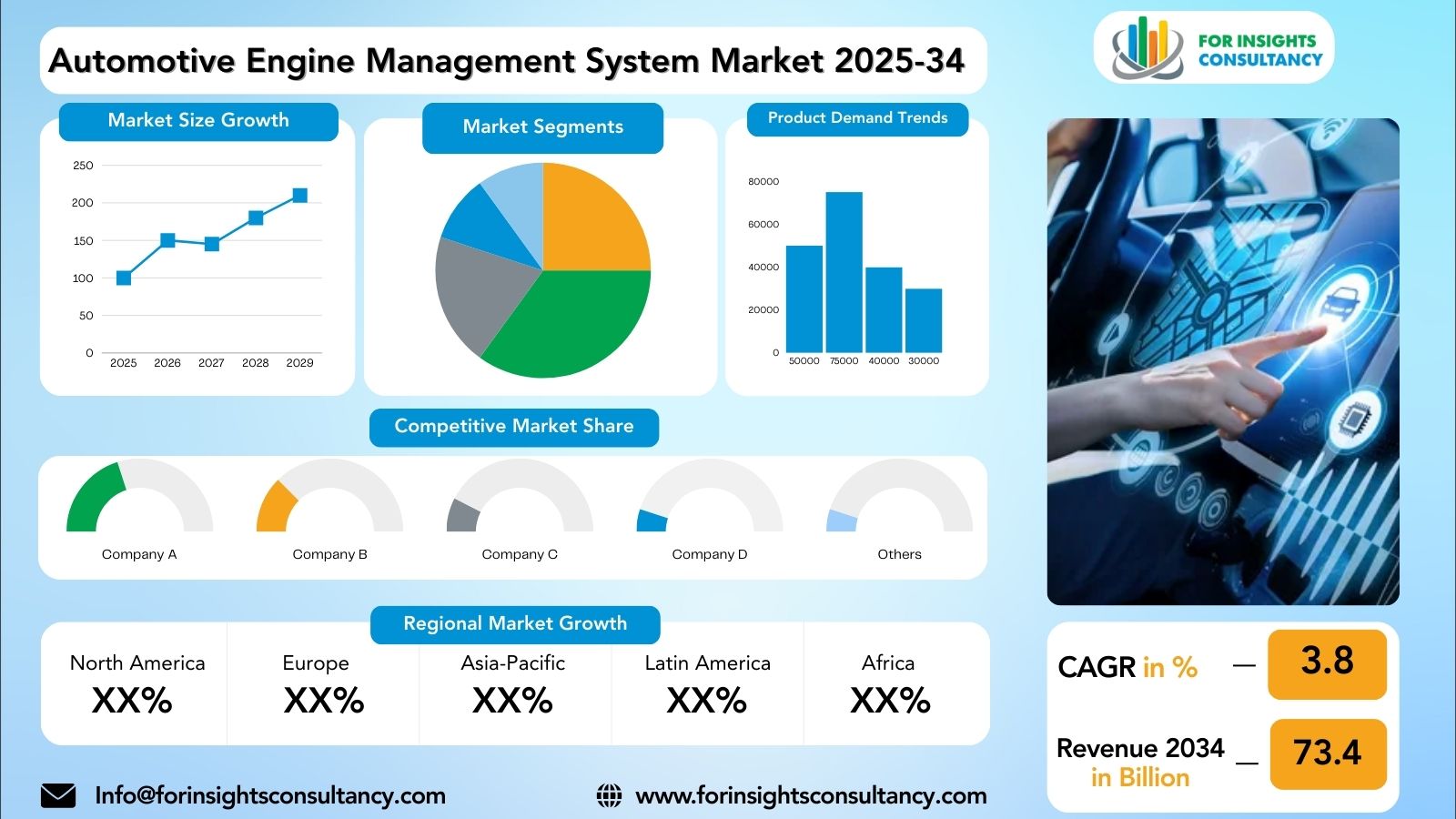
Automotive Engine Management System Market is forecast to increase from USD 63.8 Billion in 2025 to USD 73.4 Billion by 2034, at a CAGR of 3.8%.
Automotive Engine Management System Market: A Comprehensive Overview and Future Developments
The automotive engine management system market is undergoing rapid growth due to the increasing demand for more efficient, reliable, and environmentally friendly vehicles. These systems regulate various aspects of an engine’s operation, such as fuel injection, ignition timing, and emission control, ensuring optimal performance, fuel efficiency, and reduced emissions. Future developments in the market include the focus on electric vehicles, predictive maintenance using IoT and AI technologies, and integration with connected car technologies.
Electric vehicles are expected to drive the development of advanced control algorithms and software to optimize the performance of electric powertrains. This shift towards predictive maintenance will reduce downtime and maintenance costs for vehicle owners. Additionally, the integration of engine management systems with connected car technologies will enable seamless communication between vehicles, infrastructure, and external data sources, enabling intelligent decision-making and enhanced vehicle performance.
In conclusion, the automotive engine management system market is experiencing rapid growth and innovation driven by the demand for more efficient, reliable, and environmentally friendly vehicles.
Automotive Engine Management System Market Dynamics
Growth Drivers
The demand for fuel-efficient vehicles is on the rise due to environmental concerns and strict emissions regulations. Automotive manufacturers are investing in innovative engine management systems to meet these standards, leading to a surge in the adoption of advanced systems in both gasoline and diesel vehicles. Technological advancements have enabled the development of more advanced engine management systems, such as direct injection, variable valve timing, and electronic throttle control.
The focus is now on vehicle performance and driver comfort, with engine management systems playing a crucial role in optimizing engine performance, enhancing drivability, and ensuring a smooth driving experience. Governments worldwide are implementing strict emissions regulations, forcing automotive manufacturers to develop advanced systems to control emissions and reduce environmental impact.
The automotive industry is also shifting towards electric and hybrid vehicles, with engine management systems playing a crucial role in managing battery power, optimizing energy efficiency, and enhancing overall vehicle performance.
Restraints
The automotive engine management system market faces challenges due to the increasing complexity of modern vehicles and the rise of electric vehicles. Manufacturers are tasked with developing sophisticated systems that meet emissions regulations and enhance vehicle efficiency. The shift towards electric propulsion systems is also disrupting the traditional automotive ecosystem, making traditional engine management systems obsolete. However, there are opportunities for growth in the market.
The growing focus on connected vehicles and smart mobility solutions is driving demand for integrated engine management systems that can communicate with other vehicle systems and external infrastructure. By leveraging artificial intelligence and machine learning algorithms, manufacturers can develop predictive maintenance capabilities and optimize engine performance in real-time. In conclusion, the automotive engine management system market faces restraints due to the complexity of modern vehicles and the rise of electric propulsion systems. However, through the development of integrated engine management solutions, manufacturers can overcome these restraints and drive innovation in the industry.
Opportunities
The demand for fuel-efficient vehicles is on the rise due to environmental concerns and rising fuel prices. Automotive engine management systems play a crucial role in improving fuel efficiency by optimizing engine performance. Companies that specialize in developing innovative engine management solutions have a significant opportunity. The automotive industry is constantly evolving, with new technologies like AI, IoT, and machine learning driving innovation. Integrating these technologies into engine management systems can enhance performance, reliability, and efficiency, providing a competitive edge.
Developing countries are experiencing economic growth and increased disposable income, presenting an opportunity for companies to expand their presence in emerging markets. Offering advanced engine management systems tailored to these markets can capitalize on this growth. Collaborating with automotive manufacturers to develop customized engine management systems can lead to mutually beneficial partnerships, providing a competitive edge in the market.
Focusing on research and development is essential for staying ahead of the competition in the automotive engine management system market. By continuously innovating and improving their products, companies can meet the evolving needs of customers and stay relevant in a rapidly changing industry.
Challenges
The Automotive Engine Management System Market faces several challenges due to technological advancements, regulatory compliance, cybersecurity threats, cost pressures, and supply chain disruptions. The increasing complexity and connectivity of vehicles necessitates the development of advanced engine management systems with real-time monitoring and control features. Manufacturers must constantly innovate and upgrade their products to meet the evolving needs of the industry. Regulatory compliance is crucial for reducing harmful emissions and improving fuel efficiency, and manufacturers must invest in research and development to meet these standards. Cybersecurity threats pose a significant risk to the market, as hackers can infiltrate and manipulate vehicle functions, posing safety risks to drivers and passengers.
Robust cybersecurity measures are needed to protect systems from unauthorized access and ensure vehicle safety. Cost pressures are another concern, as the high costs associated with research, development, and production can impact profit margins and competitiveness. The COVID-19 pandemic has highlighted the vulnerability of supply chains in the automotive industry, leading to delays in production, component shortages, and increased costs. Manufacturers must establish resilient supply chains and contingency plans to ensure uninterrupted production.
Automotive Engine Management System Market Top Companies Covered In This Report:
Evaluate The Strategic Positioning And Innovation Pipelines Of Leading Market Companies-From Multinational Enterprises To Disruptive Regional Firms. Understand How Key Players Are Innovating, Expanding, And Capturing Value, And Use Competitive Benchmarks To Plan Your Next Move.
Automotive Engine Management System Market News
Bosch
At CES 2024, Bosch and Qualcomm showcased the first central vehicle computer capable of running both infotainment and ADAS functions on a single system-on-chip (SoC). This “cockpit & ADAS integration platform” consolidates multiple ECUs into one powerful unit, a key step in the transition to software-defined vehicles.
Continental
Continental’s Automotive division continued to showcase its expertise in integrated mobility solutions at events like CES 2025, highlighting new technologies like the Drive-Brake Unit, which combines an electric drive and a brake system into one module for electrified vehicles.
BorgWarner
The company’s news in 2024 and 2025 highlighted its efforts to expand its aftermarket portfolio. This included the launch of new products and diagnostic tools to service a variety of vehicles, including diesel-powered ones.
Segmented View of the Industry:
The Automotive Engine Management System Market Is Mapped Through A Multidimensional Lens-Tracking Shifts Across Product Type, Applications, And Geographic Regions. This Segmented Approach Enables Businesses To Localize Their Growth Plans And Align Offerings With The Most Profitable Demand Centers.
Segmentation by Vehicle Type
- Passenger Cars
- Commercial Vehicles (Light Commercial Vehicles (LCV) and Heavy Commercial Vehicles (HCV))
- Two-Wheelers
Segmentation by Component
- Engine Control Unit (ECU)
- Sensors (including Oxygen, Temperature, Position, Knock, and others)
- Fuel Pump
- Actuators
Segmentation by Communication Technology
- Controller Area Network (CAN)
- Local Interconnect Network (LIN)
- Flexray
Segmentation by Fuel Type
- Gasoline Engine
- Diesel Engine
- Hybrid and Electric Engines
Global Geographic Coverage:
The Report Provides In-Depth Qualitative and Quantitative Data On the Automotive Engine Management System Market For All Of The Regions And Countries Listed Below:
North America
The automotive engine management system market in North America is experiencing significant growth due to the increasing demand for fuel-efficient vehicles and stringent emission regulations.
The United States is leading the market with technological advancements, driven by the increasing demand for electric and hybrid vehicles. Canada is emerging as a key player in the market, focusing on reducing emissions and promoting sustainable transportation.
With a growing automotive industry and increasing investments in research and development, Canada is expected to witness significant growth in the market. OEMs are collaborating with technology partners to develop innovative engine management solutions to meet changing regulatory requirements.
Mexico is also embracing technological innovations in the automotive industry, focusing on increasing vehicle efficiency and reducing emissions. With a growing automotive manufacturing sector and increasing investments in infrastructure development, Mexico is poised to become a key market player in the region. OEMs are investing in research and development to develop next-generation engine management systems to cater to the evolving needs of the market.
Europe
Germany, a pioneer in automotive technology, is renowned for its advanced engine management systems, set by industry giants like BMW, Mercedes-Benz, and Volkswagen. France, on the other hand, is promoting green technology, focusing on reducing emissions and improving fuel efficiency. This approach not only benefits the environment but also enhances vehicle performance. The United Kingdom, known for its innovation and adaptability, is a leader in the automotive industry, constantly improving its engine management systems to meet consumer needs. The UK market offers a diverse range of options, from compact city cars to luxury vehicles, relying on cutting-edge technology. Italy, synonymous with style and performance, is known for its sleek aesthetics and powerful engine performance. Italian car manufacturers focus on precision-engineered engine management systems, delivering optimal power and efficiency. In conclusion, the European automotive engine management system market is a dynamic and innovative industry that continues to evolve and push boundaries.
Asia Pacific
China, Japan, India, South Korea, and Australia are major players in the automotive engine management system market. China’s focus on electric vehicles and stringent emission regulations is driving the demand for advanced systems.
Japan is known for its innovation in automotive technology, and its automakers are constantly upgrading their systems to meet consumer demands. India is one of the fastest-growing markets, with a significant demand for affordable yet reliable vehicles.
South Korea, home to major automotive companies like Hyundai and Kia, is investing in research and development to enhance engine management systems for optimal performance and fuel efficiency.
Australia’s strong automotive market is driven by its love for off-roading and long-distance travel. The Asia Pacific region is a key player in the automotive engine management system market, with each country contributing unique factors to growth and innovation.
Middle East and Africa
The automotive engine management system market in the Middle East and Africa is experiencing steady growth due to factors such as increasing vehicle sales, technological advancements, and stringent emission regulations. Countries like Saudi Arabia, the United Arab Emirates, and Qatar are leading the charge in adopting advanced engine management systems to enhance fuel efficiency and reduce emissions. Saudi Arabia’s government’s initiatives to promote clean energy and sustainable transportation solutions offer significant opportunities for engine management system manufacturers to expand their footprint. The United Arab Emirates, particularly Dubai, is known for its luxury vehicle market, where high-performance engine management systems are in high demand. Qatar, another key market in the Middle East, is experiencing rapid urbanization and infrastructure development, leading to a surge in demand for commercial vehicles with advanced engine management systems. As the country prepares to host the FIFA World Cup in 2022, the automotive sector is undergoing major transformations to meet the transportation needs of the event.
In Africa, countries like South Africa, Nigeria, and Kenya are at the forefront of the automotive engine management system market. South Africa’s well-established automotive industry, growing middle class, and increasing investment in infrastructure development drive the market. Nigeria’s government’s focus on improving road safety and reducing emissions is poised for significant growth in the coming years. Kenya’s vibrant automotive aftermarket is witnessing a surge in demand for fuel-efficient vehicles equipped with advanced engine management systems.
Reasons to Buy:
- The Research Would Help Top Administration/Policymakers/Professionals/Product Advancements/Sales Managers And Stakeholders In This Market In The Following Ways.
- The Report Provides Automotive Engine Management System Market Revenues At The Worldwide, Regional, And Country Levels With A Complete Analysis To 2034 Permitting Companies To Analyze Their Market Share And Analyze Projections, And Find New Markets To Aim For.
- To Understand The Most Affecting Driving And Restraining Forces In The Market And Their Impact On The Global Market.
- Major Changes And Assessment In Market Dynamics And Developments.
- The Objective Of The Automotive Engine Management System Market Report Is To Identify New Business Opportunities Using Quantitative Market Forecasts.
- Formulate Sales And Marketing Strategies By Gaining An Understanding Of Competitors, Their Positioning, And Strengths & Weaknesses.
Faq – What Global Leaders Are Asking
What Is The Growth Prospect For The Automotive Engine Management System Market By 2034?
Automotive Engine Management System Market Is Expected To Achieve A Stable Growth Rate With A Compound Annual Growth Rate (Cagr) Of About 3.8% From 2025 Through 2034.
What Is Driving The Growth Of The Automotive Engine Management System Market?
The market’s growth is driven by increasingly stringent global emission regulations, forcing manufacturers to adopt advanced systems for improved fuel efficiency and reduced pollutants. This is compounded by the rapid adoption of hybrid vehicles, which require sophisticated management systems to seamlessly coordinate power between the internal combustion engine and electric motor.
Who Are The Key Players In The Automotive Engine Management System Market, And What Are Their Market Shares?
The Automotive Engine Management System Market Includes Major Companies Like Continental AG (Germany), Robert Bosch (Germany), Denso (Japan), and BorgWarner (US), Hitachi Automotive (Japan), Infineon technologies (Germany), Hella (Germany), Sanken (Japan), NGK spark plug (Japan), Others.
Specific Market Share Data Is Not Publicly Available and Is Typically Provided In Detailed, Proprietary Market Research Reports.
Which Regions Are Leading the Automotive Engine Management System Market Growth?
The Asia-Pacific region holds the largest market share, driven by a high volume of vehicle production and the implementation of stricter emission norms in countries like China and India. Europe is also a key leader, propelled by stringent regulations like Euro 7 and a strong focus on developing advanced engine technologies for both gasoline and diesel engines.
Customization: We Can Provide Following Things
1) On Market More Company Profiles (Competitors)
2) Data About Particular Country Or Region
3) We Will Incorporate The Same With No Additional Cost (Post Conducting Feasibility).
Any Requirement Contact Us: Https://Www.Forinsightsconsultancy.Com/Contact-Us/