

Automotive Paints Market Size, Share, Trends & Forecast 2027-2034
20 November 2026 Formats | PDF | Category: Automobile and Transportation | Delivery: 24 to 72 Hours
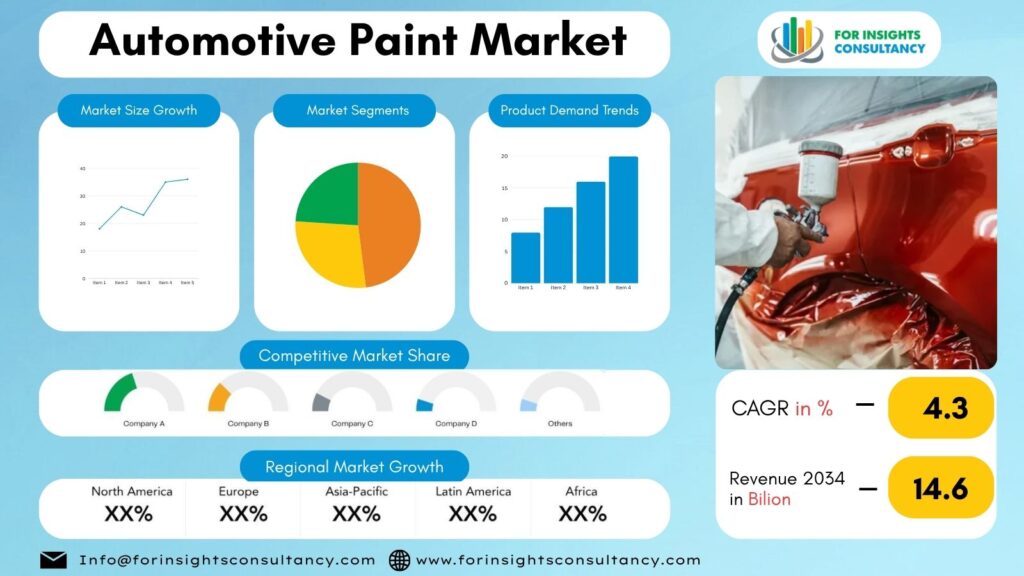
Automotive Paint Market Size, Share & Forecast
Market Size (2026): USD 10.4 billion
Forecast (2034): USD 14.6 billion
CAGR (2026–2034): 4.3%
Base Year: 2025 (about USD 10.0 billion)
Leading Segment (2026): OEM paint (new-vehicle production)
Leading Region (2026): Asia Pacific
Core Trends: Shift from solvent-borne to waterborne, low-VOC paint systems, driven by tightening emission rules.
Automotive Paint Market Definition
The automotive paint market covers the manufacture and sale of paint and coating products applied to vehicle bodies and parts. These products give vehicles color, gloss and visual appeal, and protect surfaces from corrosion, UV exposure, chipping, weather and chemicals. They are applied in layers, typically primer, basecoat (color) and clearcoat (protection and finish), on metal and plastic substrates.
Automotive Paint Market Overview 2026
Automotive paints have a total market value of USD 10.4 billion in 2026 from around USD 10.0 billion in the base year 2025. The market size is projected to rise to USD 14.6 billion by 2034 with a CAGR of 4.3% during 2026-2034. The rate of growth is steady as opposed to fast since it depends on the level of production and the total number of vehicles in the world. These factors are mature and therefore move slowly.
There are two sources of demand for automotive paints. OEM paint refers to the application of paint in factory paint shops to newly manufactured automobiles and is the leading segment in 2026. Refinish paint relates to repainting damaged cars and contributes to the recurring revenue generated by the number of automobiles on the roads and the total age of the fleet. In the paint system, the basecoat provides the color and the majority of value while the primer and clear coat give protection against corrosion and gloss.
In 2026, the largest market is Asia Pacific owing to the presence of major vehicle manufacturing centers in China, Japan, India, and South Korea along with increasing numbers of vehicles. The other significant markets include Europe and North America where there is an emphasis on refinish and higher value-added premium coatings. Latin America and Middle East and Africa are smaller markets but they are growing due to increasing local production and vehicle sales.
The biggest trend in 2026 is towards using water-based, low-VOC paint technology instead of solvents. More stringent regulations force OEMs as well as body shops to adopt more environmentally friendly technologies while manufacturers develop formulations which can retain the characteristics of conventional paints. Electric vehicles are another factor affecting paint coatings demand as manufacturers look for paint finishes for new design requirements and substrates.
Technology Trends 2026
Shift to Waterborne and Low-VOC Systems
Environmental awareness is accelerating the shift toward waterborne and low-VOC coatings, reducing harmful emissions without compromising performance. OEM plants and body shops are converting lines to meet tighter emission rules.
Paint Formulations for Electric Vehicles
Expanding electric vehicle adoption supports demand for automotive paints. Makers want finishes suited to new designs, lightweight substrates and battery-related heat management.
Rising Demand for Customization
Increasing demand for vehicle customization supports market growth. Buyers are choosing special colors, matte and satin finishes and effect pigments.
Growth of the Refinish Segment
A larger and older vehicle fleet creates steady collision repair and repainting demand. Refinish suppliers are launching faster-drying basecoats that keep an accurate OEM color match.
Growth Drives 2026
Rising Global Vehicle Production
Steady growth in vehicle production worldwide is the primary driver of automotive paint demand. Global motor vehicle production reached 96.4 million units in 2025, up 3.9% year on year. Every new vehicle needs a full paint system, so output flows directly into OEM paint demand.
Large and Growing Vehicle Fleet
The global vehicle fleet is estimated at about 1.63 billion units. A large, aging fleet creates recurring collision repair and repainting demand, which supports the refinish segment.
Electric Vehicle Expansion
Expanding electric vehicle adoption supports demand for automotive paints. New EV models need finishes suited to modern designs and lightweight substrates.
Demand for Vehicle Customization
Increasing demand for vehicle customization supports market growth. Buyers are choosing special colors, matte finishes and effect pigments, which raises the value per vehicle.
Top Companies Coveredin the Automotive Paint Market are
- PPG Industries, Inc.
- Axalta Coating Systems Ltd.
- BASF SE (Coatings)
- AkzoNobel N.V.
- The Sherwin-Williams Company
- Nippon Paint Holdings Co., Ltd.
Automotive Paint Market Company news 2026
AkzoNobel and Axalta
- The two companies agreed to an all-stock merger of equals in November 2025. The European Commission gave the merger conditional approval on November 6, 2026. The combined company will be named Axanzo. Completion is expected at the end of 2026 or the beginning of 2027.
Nippon Paint and Sherwin-Williams
- AkzoNobel’s boards rejected a €12.5 billion cash takeover offer from the two companies, which would have split AkzoNobel’s businesses between them, and continued to support the Axalta merger. Nippon Paint and Sherwin-Williams ended their pursuit of AkzoNobel on June 4, 2026.
Market Segmentation by Product Type
By Technology
- Waterborne: Paints that use water as the main carrier, giving low VOC emissions. They are increasingly the standard in OEM plants and body shops under tighter emission rules.
- Solvent-borne: Conventional paints that use organic solvents for strong durability and easy application. They remain widely used in refinish and cost-sensitive markets.
- Powder Coating: Solvent-free dry powder cured by heat, which gives a durable finish with minimal waste. It is used mainly on wheels, underbody parts and other components.
By Coating Layer
- Primer and Electrocoat: The base layers that provide corrosion protection and surface adhesion. They prepare the body for color application.
- Basecoat: The color layer that gives the vehicle its shade and effects such as metallic and pearl. It carries much of the value in a paint system.
- Clearcoat: The transparent top layer that adds gloss and protects against UV, scratches and chemicals.
By Resin Type
- Polyurethane: Offers high durability and gloss, making it a preferred choice for clearcoats and refinish work.
- Acrylic: Valued for color retention, weather resistance and cost efficiency.
- Epoxy: Used mainly in primers for strong adhesion and corrosion resistance.
Regional Market Analysis
Asia Pacific
- 2026 value: USD 4.7 billion, the top region.
- Country level:
- China: it produced about 23.36 million light vehicles in 2025, up 1% from 2024, the largest base in the region.
- Japan: production rose 2.2% to 7.92 million, and Japan’s automotive coatings market, which is broader than paint, is projected at USD 1.23 billion in 2026.
- India: production grew 3.2% to 5.05 million, and India is expected to lead sales growth in 2026, adding 400,000 units.
- Leading brands: Nippon Paint, Kansai Paint, KCC, Kansai Nerolac, Berger Paints, PPG.
- Buyer trends: OEM assembly lines in China and India are converting to waterborne basecoats to meet emission protocols. China’s near-term outlook is weaker, since the end of its vehicle subsidy scheme drove a downgrade to the global production forecast.
North America
- 2026 value: USD 2.4 billion.
- Country level:
- United States: I estimate about USD 1.7 billion, or roughly 73% of the region. That share comes from a coatings forecast putting the US market at USD 4.12 billion of USD 5.65 billion in 2026.
- Mexico: sales are expected to fall more than 8.7%, or about 137,000 units, in 2026.
- Canada: I found no reliable country figure, so I’ve left it out.
- Leading brands: PPG, Sherwin-Williams, Axalta, Surventis (formerly BASF Coatings).
- Buyer trends: Regional production is decreasing as tariff-driven price increases limit demand, which makes collision repair more important. Large repair groups are choosing single refinish suppliers with digital color tools. PPG, for example, became sole supplier to a group of more than 95 repair centers.
Europe
- 2026 value: USD 2.4 billion.
- Country level:
- Germany: it holds 29-30% of regional production. European output fell 1.7% in 2025, from 14.63 million to 14.38 million units.
- France, Italy, Spain and the UK: I did not find reliable country-level paint figures, so I’ve left them out.
- Leading brands: AkzoNobel, Surventis, PPG, Axalta (the AkzoNobel-Axalta combination will be named Axanzo).
- Buyer trends: Stringent EU emissions standards position the region as a leader in sustainable coating technologies. Body shops are adopting low-energy refinish products, such as PPG’s fast-drying clearcoat, which offers up to 60% energy savings. Imports from China are expected to rise, intensifying competition.
Latin America
- 2026 value: USD 0.5 billion.
- Country level: Brazil and Mexico are the main demand centers. Brazil’s production forecast has been trimmed, mainly because of weaker exports.
- Leading brands: PPG, Axalta, Surventis, Sherwin-Williams.
- Buyer trends: Demand is supported by regional vehicle production, replacement parts activity and collision repair.
Frequently Asked Questions
What is the size of the automotive paint market in 2026?
The market is valued at USD 10.4 billion in 2026, up from about USD 10.0 billion in the 2025 base year.
What is the market forecast for 2034?
The market is projected to reach USD 14.6 billion by 2034.
What is the expected growth rate of the market?
It is expected to grow at a CAGR of 4.3% from 2026 to 2034. Growth is steady, since demand follows new vehicle production and the size of the vehicle fleet.
What drives growth in the automotive paint market?
The main drivers are rising vehicle production, a large and aging vehicle fleet, electric vehicle expansion, demand for customization and stricter emission rules that favor waterborne paint.
What are the main segments of the automotive paint market?
The market is segmented by technology (waterborne, solvent-borne and powder), coating layer (primer and electrocoat, basecoat and clearcoat), resin type (polyurethane, acrylic and epoxy), end use (OEM and refinish) and vehicle type (passenger cars and commercial vehicles).
Which segment leads the market in 2026?
OEM paint, applied in factory paint shops on new vehicles, leads the market in 2026.
Why is waterborne paint gaining share?
Waterborne paint gives low VOC emissions, and environmental awareness is accelerating the shift toward waterborne and low-VOC coatings without compromising performance. OEM plants and body shops are converting lines to meet tighter emission rules.
What’s Included in This Report — Automotive Paint Market
This report provides a comprehensive analysis of the Automotive Paint Market, covering the following:
- Market Size and Forecast: Global value for the 2025 base year, the 2026 estimate and the forecast through 2034, with CAGR.
- Market Definition and Scope: What is covered (coatings applied to passenger and commercial vehicles, both at the factory and for repair) and what is excluded.
- Segment Analysis:
- By layer: electrocoat, primer, basecoat and clearcoat.
- By resin type: polyurethane, epoxy, acrylic and others.
- By technology: waterborne, solvent-borne, powder and UV-cured coatings.
- By vehicle type: passenger cars, light commercial vehicles and heavy commercial vehicles.
- By application: OEM coatings and refinish coatings.
- Regional Analysis: North America, Europe, Asia Pacific, Latin America and Middle East & Africa, with country-level demand.
- Core Trends and Growth Drivers: Key forces shaping 2026, such as the shift to low-VOC waterborne coatings, electric vehicle finishes and demand for premium and special-effect colors.
- Competitive Landscape: Profiles of leading paint manufacturers, market positioning and recent company developments.
- Growth Opportunities: Fastest-growing segments, regions and countries.
- Independently-Derived Estimates: For Insights Consultancy’s own values, cross-checked against published benchmarks.
Why Buy This Research Report?
- Independent, Cross-Checked Estimates: Market values are derived by For Insights Consultancy and tested against several published benchmarks, so you aren’t relying on a single source.
- Clear Growth Picture: Shows where demand is heading through 2034, including the fastest-growing technologies, vehicle types and regions.
- Segment-Level Clarity: Breaks the market down by layer, resin type, technology, vehicle type and application (OEM and refinish), helping you target the right opportunity.
- Regional and Country Insights: Identifies leading production and demand centers and high-growth countries, useful for market entry and capacity planning.
- Regulatory and Technology Outlook: Tracks the shift to low-VOC waterborne coatings and new finishes for electric vehicles, so product plans match where the industry is moving.
- Competitive Intelligence: Profiles leading paint manufacturers and recent developments, helping you benchmark rivals and spot partnership or investment options.
- Decision-Ready Format: Short, focused insights that support market entry, investment, product development and sales strategy.
Related Market Reports ofAutomotive Industry
Automotive Refinish Coatings Market Size
Automotive Paints Market: Table of Contents
1. Introduction
1.1 Report Description
1.2 Research Objectives
1.3 Scope of the Study
1.4 Market Definition
1.5 Years Considered
1.6 Currency and Units
1.7 Stakeholders
2. Research Methodology
2.1 Secondary Research
2.2 Primary Research
2.3 Market Size Estimation (Bottom-Up and Top-Down)
2.4 Data Triangulation
2.5 Assumptions and Limitations
3. Executive Summary
3.1 Market Snapshot
3.2 Key Findings
3.3 Segment and Regional Highlights
4. Market Overview
4.1 Market Dynamics
4.1.1 Drivers
4.1.2 Restraints
4.1.3 Opportunities
4.1.4 Challenges
4.2 Value Chain Analysis
4.3 Porter’s Five Forces Analysis
4.4 Pricing Analysis
4.5 Raw Material Analysis
4.6 Regulatory Landscape (VOC and Environmental Norms)
4.7 Technology and Innovation Trends
4.8 Impact of Macroeconomic Factors (Middle-East Crisis, Supply Chain, Inflation)
4.9 Patent Analysis
5. Global Automotive Paints Market, by Layer
5.1 Electrocoat (E-Coat)
5.2 Primer
5.3 Basecoat
5.4 Clearcoat
6. Global Automotive Paints Market, by Resin Type
6.1 Polyurethane
6.2 Epoxy
6.3 Acrylic
6.4 Alkyd
6.5 Others
7. Global Automotive Paints Market, by Technology
7.1 Solvent-Borne
7.2 Water-Borne
7.3 Powder Coatings
7.4 UV-Cured and High-Solids
8. Global Automotive Paints Market, by Vehicle Type
8.1 Passenger Cars
8.2 Light Commercial Vehicles
8.3 Heavy Commercial Vehicles
8.4 Two-Wheelers
8.5 Electric Vehicles
9. Global Automotive Paints Market, by Application
9.1 OEM Coatings
9.2 Automotive Refinish
10. Global Automotive Paints Market, by Region
10.1 North America (U.S., Canada, Mexico)
10.2 Europe (Germany, U.K., France, Italy, Spain, Rest of Europe)
10.3 Asia Pacific (China, India, Japan, South Korea, ASEAN, Rest of APAC)
10.4 Latin America (Brazil, Argentina, Rest of LATAM)
10.5 Middle East and Africa (GCC, South Africa, Rest of MEA)
11. Competitive Landscape
11.1 Market Share Analysis
11.2 Competitive Benchmarking
11.3 Key Strategies Adopted
11.4 Recent Developments (Mergers, Acquisitions, Partnerships, Product Launches)
12. Company Profiles
(Business Overview, Financials, Product Portfolio, Recent Developments, SWOT)
12.1 PPG Industries
12.2 Axalta Coating Systems
12.3 BASF Coatings
12.4 Sherwin-Williams
12.5 Nippon Paint Holdings
12.6 Kansai Paint
12.7 Akzo Nobel
12.8 RPM International
12.9 Asian Paints
12.10 Other Key Players
13. Analyst Recommendations and Future Outlook
14. Appendix
14.1 Glossary
14.2 Abbreviations
14.3 Customization Options
Select PDF License
Single User: $1999
Multiple Users: $3999
Corporate Users: $4999
Buy Now!
Request Sample