

Pages: 134 | 28 September-2026 Formats | PDF | Category: Food and Beverages | Delivery: 24 to 72 Hours
Coffee Market Size Value
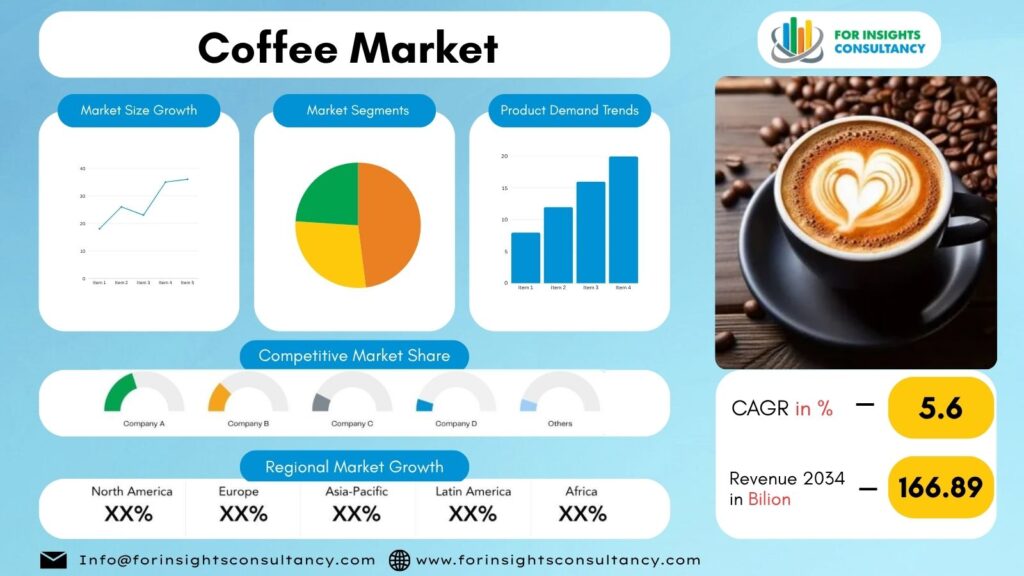
- Market Size (2026): USD 114.39 Billion
- Forecast (2034): USD 166.89 Billion
- CAGR (2026–2034): 5.6%
- Base Year: 2025
- Largest Segment: roasted coffee holds the largest product share (~51–53%)
- Leading Region: Europe (~37% Share)
Coffee Market Exclusive Summary
The Global Coffee Market had a market size of USD 114.39 Billion in 2026, forecast to grow to a market size of USD 166.89 Billion in 2034, with a Compound Annual Growth Rate (CAGR) of 5.6% from 2026 to 2034, with 2025 being the base year. Growth in the market is attributed to the growth in the consumption of coffee globally, growth in café culture, and increased demand for premium, specialty, and convenience-based coffee products. Roasted Coffee is the leading product type segment, making up 51–53% market share owing to its wide usage in households and foodservice segments.
Coffee Market Overview (2026)
In early 2026, Keurig Dr Pepper made a successful $18 billion takeover of JDE Peet’s, an acquisition announcement first made in August 2025 and expected to revolutionize the global coffee market competition arena. As the resulting entity, which is scheduled for launch in the second half of 2026 under the brand name of “Global Coffee Co.”, will have a global manufacturing network consisting of more than 40 factories and over 130 brands such as Keurig, Jacobs, L’OR, and Peet’s, Global Coffee Co. will become the world’s second largest coffee company after Nestlé and the first-ever pure-play global coffee firm.
This is not a stand-alone trend, but part of the premiumization movement that is changing the way people approach coffee. As certifications such as direct trade become more common, single origin coffee, and other specialty products, companies are scrambling to find the perfect balance between large-scale production capabilities and quick innovation of next-gen coffee products like cold brew concentrates and functional high-protein RTDs for health-focused younger consumers.
This report provides an overview of the Coffee Market by various product types (Roasted, Instant, RTD), by distribution channels (B2B, B2C, Off-Trade), and by region (Europe, North America, Asia Pacific) featuring some of the prominent players in this market: Nestlé, Starbucks, Keurig Dr Pepper/JDE Peet’s, and Luckin Coffee.
Below are the main parts of this report highlighting the size, trends, and drivers of the market until 2034.
Coffee Market Dynamics 2026
Growth Driver
Specialty Coffee Consumption Hits Record Highs
As per NCA’s Spring 2026 National Coffee Data Trends Study — which is a nationally representative survey of 1,850 adults in the US carried out in January 2026 — 66% of Americans consumed coffee within the last 24 hours, higher than any other drink, even bottled water or tap water. Of particular importance is the fact that 47% of American adults consumed specialty coffee within the last 24 hours, higher than traditional coffee consumption, which was only at 42%. This trend started back in 2024 and has remained unchanged since then. According to Bill Murray, president and CEO of NCA, “Americans always go for coffee because of taste, comfort, energy, health benefits, and many others.”
Younger Consumers Are the Clearest Growth Engine
In the NCA/SCA partnership report, the popularity of specialty coffee is seen as being disproportionately attributed to younger consumers, with 69% of adults aged 25-39 having consumed specialty coffee in the past week, which is higher than 60% for adults aged 40-59 and 46% for those older than 60 years. Among this age group, the share of past-week consumption of espresso-based beverages increased from 40% in 2022 to 45% in 2026, led by lattes (21%, compared to 18% in 2023) and espresso (20%, up from 16%). Yannis Apostolopoulos, SCA’s CEO, pointed out that “when close to half of all American adults are drinking specialty coffee on a daily basis and doing so primarily through the younger demographic, it is clear that coffee matters.”
Cold and RTD Formats Are Growing Fastest
The consumption of cold brew increased by 31% year over year within the past-week specialist coffee consumers. Cold brew, along with other non-espresso cold coffee drinks such as frozen blended and nitro, is gradually taking share from traditional hot drinks. This trend has been associated with the impact of Gen Z and the fourth wave coffee movement which favors customizations over traditional brewing methods.
Trends
EU Deforestation Regulation (EUDR) Enters Application
As per the official guidance of the Green Forum of the European Commission, the EUDR mandates that from December 30, 2026, all coffee products introduced into the EU market be proven to be free from deforestation through their geographic location tracing to the exact plot of land from which the beans have been sourced. In a communication dated May 4, 2026, the Commission issued a simplification review and delegated act to include soluble coffee (instant coffee) under the ambit of the EUDR regulation. This was because of what officials termed as “a gap in the coffee” supply chain which made it possible for processed coffee derivatives to escape regulation.
Record Production Meets Record-Thin Inventory
According to the “Coffee: World Markets and Trade” report issued by the USDA in July 2026, coffee production is projected to hit record levels of 178.8 million 60kg bags in 2025/26, mainly due to Brazil’s positive Arabica biennium cycle, while global consumption will also hit a record high of 173.9 million bags. Even though these figures suggest an ample supply of coffee in the market, the world’s ending stocks are expected to continue declining in the ICO’s Coffee Market Report of June 2026, for the fifth consecutive year to 20.1 million bags – the lowest level in years.
Format Diversification Is Outpacing Traditional Brewing
According to the 2026 National Coffee Data Trends Report by NCA/SCA, there has been an increase of 31% in the consumption of cold brew in the past week among specialty coffee consumers, while the consumption of espresso beverages has gone up from 40% (in 2022) to 45% (in 2026). This report clearly associates this trend with “fourth wave” coffee culture where format and customization become the key determinants of purchasing decisions.
Coffee Market Top Companies Covered In this Report are
- Grady’s Cold Brew LLC
- PepsiCo Inc.
- Tata Coffee Limited
- Kraft Foods Group Inc.
- Royal Cup Inc.
- Ueshima Coffee Co. Ltd.
- Red Thread Coffee Co.
- Christopher Bean Coffee
- Nestle SA
- Slingshot Coffee Co.
- Synergy Flavors Inc
Coffee Market company news 2026
Nestlé S.A.
Nestlé’s coffee business — its largest globally, spanning Nescafé, Nespresso, and Starbucks — continued strong organic growth in 2026 (3-4% projected), even as the company navigated a leadership scandal and 16,000 job cuts. Under the Global Coffee Alliance with Starbucks (running since 2018), Nestlé launched Starbucks Coffee Craft concentrate in April 2026, debuting in Japan, Korea, and the UK before rolling out to Europe and Asia in 2027. Nestlé’s 2026 trend forecasting also drove new launches like Coffee mate Cold Foam and NESCAFÉ Espresso Concentrate, capitalizing on “flavor tourism” demand for global coffee styles.
PepsiCo Inc.
Through the North American Coffee Partnership (its longstanding joint venture with Starbucks), PepsiCo helped launch RTD Starbucks Coffee & Protein in March 2026 — blending Starbucks coffee with 22g of complete protein, 5g of prebiotic fiber, and just 2g of sugar. The launch was extended in May 2026 with a limited-edition weighted vest and Strava fitness challenge tie-in, directly targeting the functional-nutrition and morning-routine trend among younger consumers.
Tata Coffee Limited (Tata Consumer Products)
Tata Consumer Products reported coffee revenue growth of 24% in Q1 FY26 and 20% in Q4 FY26, with new launches including Tata Coffee cold coffee premixes. The company also collaborated with CSIR-NIIST (February 2026) to advance Coffee Crema Technology, and its U.S. brand Eight O’Clock Coffee continued gaining market share at more than double the category growth rate. Tata Starbucks (the India joint venture) posted its third consecutive quarter of positive same-store sales growth, expanding to 502 stores across 80 cities.
Coffee Market Segments
Segment by Product Type
- Roasted Coffee — largest segment (~51–53% share), favored for widespread use across households and foodservice channels
- Instant Coffee — strong contributor, particularly in value-driven and emerging markets
- Ready-to-Drink (RTD) Coffee — fastest-growing segment, driven by convenience and cold coffee demand among younger consumers
Segment by Bean Type
- Arabica — premium segment, valued for flavor complexity and specialty coffee positioning
- Robusta — cost-efficient segment, widely used in instant coffee and blends
Segment by Category
- Conventional — dominant segment (~84% share), reflecting mainstream mass-market consumption
- Organic — smaller but fastest-growing category, aligned with clean-label and sustainability trends
Segment by Application
- Household/Retail Consumption
- Foodservice (cafés, restaurants, QSRs)
- Bakery Shops & Restaurants — fast-growing niche within foodservice
Segment by Distribution Channel
- B2B / Off-Trade (retail, grocery, supermarkets)
- B2C / On-Trade (cafés, restaurants, foodservice) — fastest-growing channel, driven by specialty coffee culture and out-of-home consumption
largest segment share
Why Roasted Coffee Leads the Coffee Market
Roasted coffee — whole bean and ground coffee that hasn’t been processed into instant or ready-to-drink form — commands roughly half the global coffee market, and this lead reflects deep structural advantages rather than simple habit.
- It’s the foundational format everything else is built from.
- Café culture and foodservice depend on it almost exclusively.
- Premiumization reinforces the format rather than replacing it.
- At-home brewing culture provides a durable demand floor.
Coffee Market Regional Insights
North America
Stages in Coffee Trade War
In North America, the coffee trade witnessed the most important period in the form of trade disruption between 2025 and 2026. In April 2025, the Trump administration declared tariffs on Brazilian imports. The Brazilian products were subject to a 50% tariff charge as of August 6, 2025, even after the remarks made by Commerce Secretary Howard Lutnick that some goods not produced in the country (such as coffee which does not grow in the United States) will be exempted from the tariff charges. However, on November 20, 2025, the administration exempted 238 tariff classifications under 11 categories of food and agriculture products, including green coffee beans, lowering the tariff on Brazilian coffee from 50% to 40%.
Europe
Europe, Far and Away the Largest Coffee Market in the World
Based on data published on June 25, 2026 by the European Coffee Federation (ECF), produced by London consultancy Europe Economics at World of Coffee Brussels, Europe continues to be the largest coffee market in the world consuming about 28% of global coffee. The ECF has over 750 members representing some 35% of world coffee trade, which is what gives this statistic unique importance compared to regular market estimations. The EU27 alone consumes close to a quarter (24%) of the world’s coffee supply, importing 2.9 million tonnes (48.3 million bags) of raw and roasted coffee from non-EU countries in 2025, valued at €18.7 billion.
The Disproportionate Influence of Germany as Europe’s Coffee Entrance Gate
More than one-third (34%) of coffee imported into the EU in 2025 was handled by Germany – 1.01 million tonnes – with the main entrance being Hamburg port. However, the most important detail to note based on ECF report is that not all of it was consumed in Germany: Hamburg and Bremen/Bremerhaven were mainly responsible for transit and re-exports of coffee further into EU member states.
Asia-Pacific
Vietnam: The Region’s Production Powerhouse
According to the USDA Foreign Agricultural Service May 2026 Coffee Annual report, the total output of coffee produced in Marketing Year 2026/27 will be estimated at 32.5 million bags (green bean equivalent), where Robusta accounts for 31.4 million bags and Arabica for 1.1 million bags – compared to 31.7 million bags of MY 2025/26. In this case, Vietnam becomes the second largest producer of coffee in the world, following Brazil and being the key producer of Robusta. According to the statistics by Vietnam Ministry of Agriculture and Environment, the country earned $3.6 billion on exports of coffee within the first 4 months of 2026, which accounted for the biggest agricultural export product of Vietnam by value. Germany, Italy, and Spain remained the largest markets of Vietnam’s exports.
China: Growth in Domestic Demand Overwhelming Store Economics
As it was shown in Luckin Coffee’s Q2 2026 SEC-filing (Form 6-K), the company has achieved explosive scale: quarterly net revenues reached RMB15.9 billion (up by 28.5% yoy). The store network exceeded 36,310 units, whereas average monthly transacting customers increased to a record 112.7 million (+22.9% yoy).
Rest of World
Brazil: Record Crop Changing the Supply Situation
According to the June 2026 Coffee Annual from the USDA Foreign Agricultural Service, production of green coffee beans in Brazil is expected to increase by 14.1% to reach 71.9 million 60-kilo bags in Marketing Year 2026/27, the largest harvest after five years of under-delivering, due to good weather conditions during the blooming period and the peak of Brazil’s biannual crop cycle. It should be noted that government agencies of Brazil are more optimistic regarding the outlooks for the country’s agricultural sector; according to CONAB (Brazilian National Supply Agency), 66.7 million bags will be produced, while according to IBGE (national institute of statistics), 65.1 million bags will be produced – both agencies employ a different methodology, and usually make lower estimates than USDA. Exports of Brazilian coffee in MY 2026/27 are expected to soar by 29.6% to 49.07 million bags, although, according to the report, exporters are rather careful about entering into any commitments amid low stocks and potential El Niño threat in the next season (MY 2027/28).
Growth Story of Ethiopia: Structural in Nature
According to the global production outlook for 2026 issued by USDA in July (through industry trade reports based on government data), the 2026/27 production of Ethiopia would be around 12.1 million bags, of which exports would account for 7.1 million bags — an increase of about 200,000 bags. The above trend in production has been fueled by recent investments made in the renewal of around 50% of the coffee production regions in Ethiopia with high yielding variety of crops.
Frequently asked questions with answers
How big is the global Coffee market?
Coffee Market is projected to grow from USD 114.39 Billion in 2026 to USD 166.89 Billion by 2034, at a CAGR of 5.6%.
Who are the key players in the Coffee industry?
Leading companies include Nestlé S.A., Starbucks Corporation, PepsiCo Inc., Keurig Dr Pepper/JDE Peet’s, Tata Coffee Limited, Luckin Coffee Inc., Kraft Heinz (Maxwell House), and Royal Cup Inc.
Which region dominates Coffee?
Europe leads the global Coffee Market with approximately 37% share.
Which segment holds the largest share in the Coffee Market?
Roasted Coffee holds the largest product segment share (~51–53%), while the Off-Trade/B2B distribution channel and Conventional (non-organic) category also lead their respective segments.
Why should buy this Coffee Market Report?
- Make confident investment and market-entry decisions
- Understand exactly where the growth is happening
- Benchmark against the competitive landscape
- Navigate regulatory complexity with clarity
- Identify the best regional entry point for your strategy
- Save months of independent research
- Support internal business cases and stakeholder buy-in
If you’re conducting a deeper analysis, let me know:
Are you focusing on a specific sector?
Do you need data on specific regional markets or key players?
Any Requirement Contact Us: https://www.forinsightsconsultancy.com/contact-us
Related Market Reports
Mushroom Coffee Market —Size, Growth & Future Outlook 2034
Ready-to-Drink Market — Size, Share, Trends & Growth Forecast 2026-2034
Coffee Brewing Technology Market — By Type, Application, Forecast to 2034
Enzyme Coffee Market — Size, Trends, Forecast to 2034
Cappuccino Market — Size, Share, Current Trends, Forecast to 2034
Select PDF License
Single User: $3499
Multiple Users: $4499
Corporate Users: $5499