

EV Connectors Market Outlook 2034: Market Size, Demand Analysis & Strategic Insights
Jun-2026 Formats | PDF | Category: Automotive | Delivery: 24 to 72 Hours
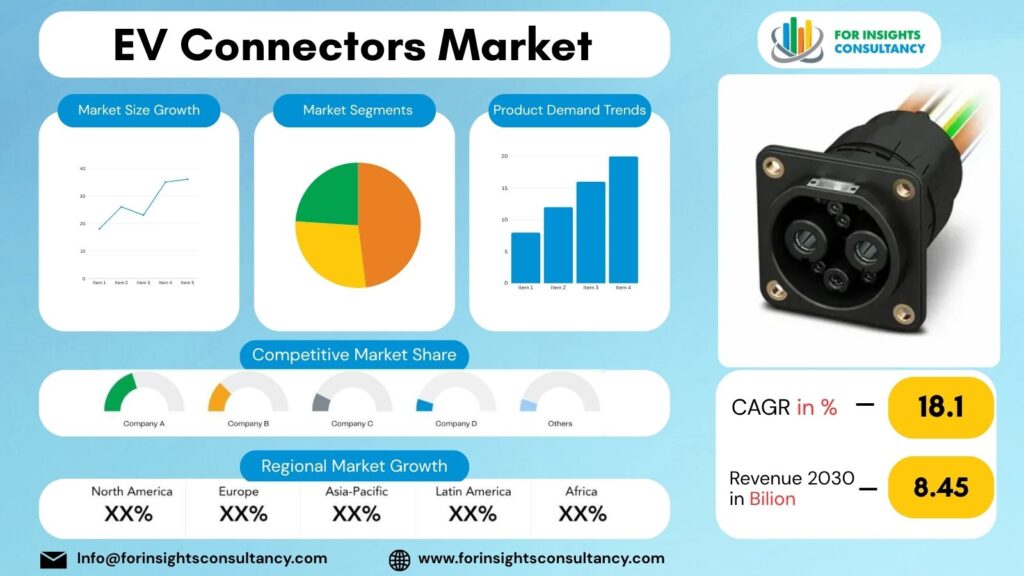
EV Connectors Market Size & Forecast
- Market Size (2026): USD 70 Billion
- Forecast (2034): USD 45 Billion
- CAGR (2026–2034): 1%
- Base Year: 2025
- Key Segments: By Connector Type: Type 1, Type 2, CCS (Combined Charging System), CHAdeMO, GB/T, Tesla Connector.By Charging Type: AC Charging, DC Fast Charging.By Vehicle Type: Battery Electric Vehicles (BEVs), Plug-in Hybrid Electric Vehicles (PHEVs).By End User: Residential Charging, Commercial Charging Stations, Fleet Operators.
- Top Regions: North America: Driven by expanding fast-charging infrastructure and EV adoption incentives.Europe: Led by stringent emission regulations and widespread CCS charging standard adoption.Asia-Pacific: Fastest-growing region due to large-scale EV production and government electrification initiatives.Rest of the World: Growth supported by emerging EV infrastructure investments in Latin America, the Middle East, and Africa.
EV Connectors Market Executive Summary
The EV Connectors Market globally is growing steadily and annually because of use of Electric Vehicles (EVs) at fast pace, growth of charging infrastructure and Governments worldwide supporting making transportation industries to drive towards electric vehicles. With countries aggressively shifting towards low emissions vehicles, type and range of EV charging connectors used is expected to increase significantly. The key will be to ensure safe, efficient and portable transfer of power across standard formats.
The market expansion has also been driven by the rising demand of ultra-fast charging systems and the investment in public and private charging infrastructures. The rising market share of the BEVs and PHEVs and the investment in ultra fast chargers, are pushing the requirements of a connector system to manage higher power, durabilities and safety concerns.
Furthermore, new trends like premiumisation, sustainability, or digital transformation are impacting the competition. In the case of premium OEMs, the deployment of high-power charging technology (supporting optimized charging speeds and utilization rates) is increasing. Sustainability drivers could result in a demand for energy-efficient charging components and recyclable connector materials. Digital transformation trends lead to smart charging feature availability, remote monitoring, and interconnectivity between vehicle, charger, and energy management system.
Other innovations in charging standards, connectors, thermal regulation, and high-voltage charging methods, are also expected to push market growth. R&D in those fields is centered on creating smart, lightweight, and efficient connector solutions tailored to the needs of future passenger cars, commercial fleet, and transit systems.
Players continue to search for new approaches by investing in new product development, strategic alliances, and expanding operations to solidify their market share. Alliances between vehicle makers, providers of charging infrastructure, and connector makers are enabling the build of interoperable charging networks that enhance travel convenience and charging availability.
With proliferation of electric vehicles and charging stations across the globe, the EV Connectors Market is expected to grow significantly during the forecast period. The market shall play an integral part in the EV infrastructure and provides the platform for the growth of cleaner, smarter and connected vehicle transportation networks around the world.
EV Connectors Market Overview (2026)
The EV Connectors Market refers to the connectors, plugs, sockets and interface systems utilized to create electrical connection points for electric vehicles to recharge at. Electric vehicle connectors allow power to be transferred to and from electric vehicles in a safe and efficient manner. Types of electric vehicle chargers and their charging connectors include: Type 1, Type 2, CCS (Combined Charging System), CHAdeMO, GB/T and other proprietary charging systems. Electric vehicle charging connectors are used across a variety of applications including, but not limited to; electric passenger vehicles, electric commercial vehicles, public charging stations, at-home charging and fleet charging.
In the last decade, the industry has undergone a rapid evolution propelled by the fast migrating world automotive industry, which is moving so fast toward vehicles electrification. The everchanging internal combustion engine vehicles for battery-powered vehicles transition has increased at levels never seen before the worldwide necessity of electric vehicle charging infrastructure together with the introduction of new, higher-powered standardized charging technologies.
Increasing customer consciousness to sustain the environment, fuel cost and electric vehicle utilization benefits will shape markets in the domestic and international front. Simultaneously, the evolution of the high voltage charge ecosystems where Ultra-fast charging, smart electric vehicle charging grid (ECG), and bi directional charging also being adopted. The connector designs are still progressing for higher power capability, thermal efficiency, resiliency and support to next-gen EVs.
Market structure is also influenced by regulatory changes. Governments in North America, Europe, Asia-Pacific, and other regions are setting tight emission standards, incentives and policies to promote adoption of EVs and infrastructure development, accelerating the process of transportation electrification. As a result, the market is witnessing investments into public charging infrastructure and implementation of standardized connector technologies at various levels for the seamless operating of charging stations and vehicle brands.
The market is also forecasted to benefit from the proliferation of fast-charging corridors, smart city projects, renewable energy adoption, and enhanced investments in the electric commercial vehicle fleet segment. As charging infrastructure gets bigger and Electric Vehicles become more widely adopted all around the world, the EV Connectors Market will likely continue to constitute an integral part of the developing electric mobility ecosystem.
EV Connectors Market Dynamics 2026
Growth Driver
Rising Demand for Electric Vehicles and Charging Infrastructure
Another key factor spurring the evolution of the EV Connectors Market is the increasing worldwide availability and adoption of Electric Vehicles (EVs). Regulations pertaining to emissions are becoming stricter in all countries, incentives for EV purchases are becoming more generous, and investments on greater charging infrastructure are progressively increasing to hasten the electrification of the entire transportation sector. As EVs sales increase, so does the market for high-capacity, reliable charging connectors.
Increasing availability of public charging stations, workplaces and home charging installations is generating huge demand for standardized connector solutions. As such, fast-charging stations require high-performance connectors that can provide high voltage and high current electric power transfer in a safe, reliable and efficient manner. The rise of this infrastructure ecosystem is boosting innovation in connector technology and helping foster long-term market development.
Growth in Fast-Charging and High-Power Charging Technologies
The development of fast-charging has accelerated the growth of the EV Connectors Market, as customers now demands short charging times and easy-easy access, leading electric chargers providers and car manufactures to implement ultra-fast chargers with increasing power.
As electric vehicles continue to grow in popularity, connector systems are improving to allow for high voltage architecture, increased thermal management, and optimized durability for a higher number of charging cycles. The expansion of state-of-the-art DC fast-charging stations along highways, in cities, and at business facilities will drive increased necessity for high powered connector designs.
Although the increase in charging power to a General Specification is important, there are other benefits of faster chargers. The availability of high power charging technologies enhance the overall usability of EVs, shrinking range anxiety and allowing for the increased adoption of electric vehicles. As the number of next generation EVs continues to grow and venture into mainstream automotive markets a need is being driven to develop even faster and more efficient charging trends, with manufacturers making the investment in plug innovation, interoperability standards and intelligent charging technologies. This segment will continue to be a major growth driver over the forecast period.
Key Trends
Premiumization Driving Demand for High-Performance Charging Solutions
Premiumisation is fast catching up as a trend in the EV Connectors Market as electric vehicle manufacturers now try to offer consumers a greater charging experience, greater reliability and faster charging capabilities. Premium EV brands are now offering first-class connector technology that supports ultra-fast charging, better thermal management, improved durability and enhanced user interaction.
Premium buyers of electric vehicles demand for comfortable, fast, reliable and efficient charging infrastructure to avoid long waiting time or idle time for their automobiles. This translates to the need for premium connector materials, ergonomic designs, intelligent locking systems and safety features. It‘s expected that, premium charging station infrastructure and connector system will continue to account for a larger share of the penetration of luxury electric vehicles globally.
Sustainability Influencing Connector Design and Material Selection
Charge stations and manufacturers of connector have been pointed out to be a major focus area in EV world. Almost every company is of trying to reuse materials and design eco friendly way to the production of their charging stations.
Manufacturers are moving towards designing splitter/charger components which are lighter and smaller, and thus use fewer raw materials but can still meet performance and durability requirements. The application of recyclable plastics, green manufacturing processes and energy efficient production techniques is also becoming more popular as industry players try to meet global sustainability initiatives. The increasing availability of renewable energy powered charging networks is strengthening demand for environmentally friendly charging components along the value chain.
Technological Innovation Accelerating Charging Efficiency
Technological innovation is among the most prominent trend, which have the potential to bring a tremendous change in the EV Connectors Market. The innovation in high power charging systems, smart charging innovations and connector standardization is changing the EVs charging paradigm. Next generation connectors are being engineered to accommodate higher voltage architecture‘s, ultra fast charging and bidirectional features, such as vehicle-to-grid (V2G).
Smart connector technologies that integrate communication protocols also allow for monitoring, energy use, authentication and predictive maintenance. Advances in thermal management systems are enabling connectors to safely deliver, store and distribute increased power and charge vehicles at faster rates. Universal charging standards are also in development to maximise vehicle infrastructure interoperability globally.
Therefore, as the charging infrastructure progresses, advances in connector technology will be critical to facilitate higher power charging, efficiencies, safety and the proliferation of electric mobility systems worldwide.
EV Connectors Market Top Companies Covered In this Report are
· TE Connectivity
· Phoenix Contact
· Amphenol Corporation
· Yazaki Corporation
· Leoni AG
· ABB Ltd.
· Siemens AG
· Tesla, Inc.
· ChargePoint Holdings, Inc.
· EVgo Inc.
· Lectron
· Huber+Suhner
· ITT Inc.
· Molex LLC
· Schneider Electric
EV Connectors Market company news 2025 and 2026
TE Connectivity Expands EV Charging Connector Business
In February 2026, TE Connectivity acquired major EV charging inlet assets from Phoenix Contact E-Mobility. The transaction strengthens TE Connectivity’s position in vehicle-side charging connectors and expands its ability to serve global automotive OEMs as EV adoption accelerates.
Rapid Expansion of NACS Connector Deployment
EVgo announced plans to significantly expand deployment of North American Charging Standard (NACS) connectors across its charging network. Following successful pilot installations in 2025, the company plans to deploy more than 500 NACS connectors and expand NACS charging availability across more than 25 U.S. states by the end of 2026.
EV Connectors Market Segments
- Electric Vehicle Connector Market Voltage Type Outlook
- AC Charging
- DC Charging
Electric Vehicle Connector Market Charging Speed Type Outlook
- Slow
- Fast
- Rapid
EV Connectors Market Regional Insights
North America – Charging Standard Consolidation Creating New Market Dynamics
North America is undergoing this distinct change where the industry is converging around the NACS; resulting in evolving trends in connector demand among automakers and charging network operators. Automakers are designing vehicles charging systems around the new standard and charging network providers are modifying existing infrastructure to accommodate multiple vehicle platforms. North America is also experiencing robust growth in high-power DC fast-charging corridors, which will drive demand for next-generation connector technologies to support ultra-fast charging and 400V+ architectures.
Europe – Interoperability and Ultra-Fast Charging Deployment Driving Innovation
Europe continues to be one of the most developed worldwide markets for EV charging, with connector demand likely to be driven further by the proliferation of cross-border charging networks. A notable regional trend is the increasing focus on interoperability, which will enable continuity of charge regardless of country, charging operator or make of vehicle. The build-out of ultra-fast charging corridors along key motorways will boost demand for high speed CCS connectors with innovative thermal management. V2G programs are also fostering the need for sophisticated intelligent connectors able to facilitate bi-directional power flow.
Asia-Pacific – Growth Driver: Massive EV Manufacturing Ecosystem
Asia-Pacific is the fastest growing region in the EV Connectors Market driven by the strong number of automotive and battery manufacturing among this region. China, Japan, South Korea and India are investing heavily in EV supply chain, charging infrastructure and smart mobility initiatives. The key growth driver for this market is the rapid growth in the home grown EV manufacturing, which is responsible for rising demand for charging connectors across residential, commercial and public charging station applications.
Rest of the World – Emerging Trends in Fleet Electrification and Smart Charging
EV Connectors Market in the Middle East, Latin America and Africa is slowly catching up due to increasing investment by governments and private players in charging networks. Additionally, increasing electrification of commercial fleet, such as public transit, logistics vehicles, last-mile applications is an emerging trend. These requirements demand for a rugged connector system that can withstand multiple charging cycles and higher energy flow. Smart charging technology with renewable energy integration is also steadily gaining acceptance creating a demand for next-generation connectors that improve energy efficiency and grid management.
Analyst Insights
According to market analysts at For Insights Consultancy the EV Connectors Market is moving from a product-oriented market to an essential enabler of the global electric mobility infrastructure. As electric vehicles are adopted at a rapidly increasing rate across the world, connector technology is emerging as a key factor in the efficiency, interoperability, safety and user convenience of the charging network. The market is no longer being shaped by EV sales alone, but also by the fast-growing number of charging sites, charger standards and high-power charging engines.
In the future, high-voltage, ultra-fast charging connector solutions are set to dominate the market up-trend thanks to the growing rate of 800V vehicle architectures implantation, battery technology progress, as well as customers’ critical requirements for quick charge. As new electro-mobility technologies demand faster energy supply, the industry is moving swiftly toward ultra-fast charger/connectors development.
Another key driver of the industry‘s future, say analysts, is charging standard harmonization. As charging interfaces become more standardized in the world‘s biggest automotive markets, it will enhance consumer convenience by increasing infrastructure compatibility. Meanwhile, the connectors’ manufacturers are working on multi-standard compatibility solutions for car-makers to incorporate into future vehicle designs.
A significant trend is the rise of smart charging incorporated in the connector system. Connectivity functions, dynamic status feedback, anticipation maintenance, and intelligent charge control are evolving connectors from load hardware to intelligent members of the connected charging network. This is expected to increase charging consistency, reduce down time, and facilitate advanced smart grid functionalities.
Analysts also point out that commercial fleet electrification will be a significant growth driver for connectors manufacturers. As fleets for logistics, transit, and corporate applications move to electric vehicles, the demand for robust chargers and rugged connector systems that can meet the needs of high-frequency charging and high-use trucking will expand, opening new opportunities.
Asia-Pacific is likely to continue as the “biggest growth contributor,” with its robust electric vehicle manufacturing industry and substantial scale of charging network rollout. North America and Europe, on the other hand, are set to spearhead innovation through substantial investment in fast charging facilities, intelligent charging solutions, and future generations of connectors.
In the future, the EV Connectors Market will evolve as a highly intelligent, interconnected and future-ready charging architecture. It is predicted that the EV Connectors Market will see innovations such as liquid cooled connectors, bidirectional chargers, vehicle-to-grid integration and ultra-fast charging emerge in the upcoming decade.
In summary, the consensus among analysts is that the companies able to provide trustworthy, standardized, and high tech connector solutions will be those best placed to exploit the fast pace of the worldwide electric mobility and charging station boom forecasted for the period.
EV Connectors Market Research Methodology
The EV Connectors Market Report by For Insights Consultancy is compiled using a comprehensive multi-tiered research approach which aims to gather the most authentic market intelligence, reliable forecasts and actionable business insights. It employs detailed primary research, exhaustive secondary research and high-end data validation methods to analyze the trends, competitive environment, trends and technological advancements within the global EV charging part.
Primary Research
Primary research is a key part of the research and directly engages with players in the electric vehicle (EV) value chain to extract information. EV manufacturers, charging infrastructure providers, connector manufacturers, technology developers, component suppliers, industry consultants, distributors and car company bigwigs are interviewed.
Anyhow these conversations involve key people who have direct interaction with this markets as far as charging standards, connector technology, deployment of infrastructure planning, investment scenario, supply chain developments, regulatory influences, and on new market opportunities. Primary research also confirms these assumptions and future directions affecting the demand of EV connector solution across globe.
Secondary Research
Secondary research involves the methodical examination and interpretation of data from authoritative business and industry sources to develop the basis of a detailed market structure. Data is sourced from company annual reports, investor presentations, regulatory publications, government databases, industry groups, technical and white papers, trade journals, industry reports and market intelligence sources.
Other research investigates trends in adoption of electric vehicles, investment patterns in charging infrastructure, evolution of connector standards, policy programs, sustainability schemes and technology development within the industry. This process enables the formulation of an intricate picture of market trends and projections.
Data Validation and Market Modeling
All primary and secondary research data is subject to a comprehensive multi-step validation process in order to verify the quality, consistency, accuracy and reliability of the input data. Data triangulation techniques are used to offset potential bias of and cross-verify primary data and secondary data from other sources.
Sophisticated market modeling and forecasting tools are employed to determine market size, growth values, sales, revenue, segment performance, geographical demand trends and future investment opportunities. Qualitative and quantitative analysis are done to assess the influence of factors such as EV utilization, investme t in charging network, fast-charging technology installation, connection point standardization, policy evolution towards market growth.
EV Connectors Market – Data Sources
Government Publications
The report uses information from cybersecurity bodies, telecommunications departments, digital infrastructure bodies and regulatory bodies to assess trends in cloud security, digitalization in companies and changes in policy on cybersecurity.
Industry Databases
Market intelligence is collected from sources such as cybersecurity database, cloud networking platforms, source of research of enterprise IT and tech analytics providers to analyze market size, adoption rates, competitive landscape and innovation trends.
Company Financial Reports
Revenue trends, strategic investments, technology evolution, product expansion are monitored by analyzing annual reports, SEC filings, investor presentations, press releases and financial statements of the top SASE vendors, cloud security vendors and networking companies.
Trade Journals
This report will use references of cybersecurity journals, cloud computing magazines, enterprise networking publications, white papers and technical research articles to study the trends over the AI-based security improvements, Zero Trust adoption and SASE architecture change from around the world.
Proprietary Research (For Insights Consultancy):
Broader validation and learning are then produced by way of internal databases, experienced interviews and specialist analysis by For Insights Consultancy, providing accurate, trustworthy, current market intelligence to meet client needs.
Customization: We Can Provide Following Things
1) On Market More Company Profiles (Competitors)
2) Data About Particular Country Or Region
3) We Will Incorporate The Same With No Additional Cost (Post Conducting Feasibility).
Any Requirement Contact Us: https://www.forinsightsconsultancy.com/contact-us
Related Market Reports
Examines emerging alternatives and complementary technologies to conventional connector-based charging.
Vehicle-to-Grid (V2G) Public Charger Market
Focuses on bidirectional charging solutions and smart connector innovations.
Table of Contents
For TOC Contact us: https://forinsightsconsultancy.com/contact-us/