

21 September-2026 Formats | PDF | Category: Information Technology | Delivery: 24 to 72 Hours
Online Poker Market Overview 2026
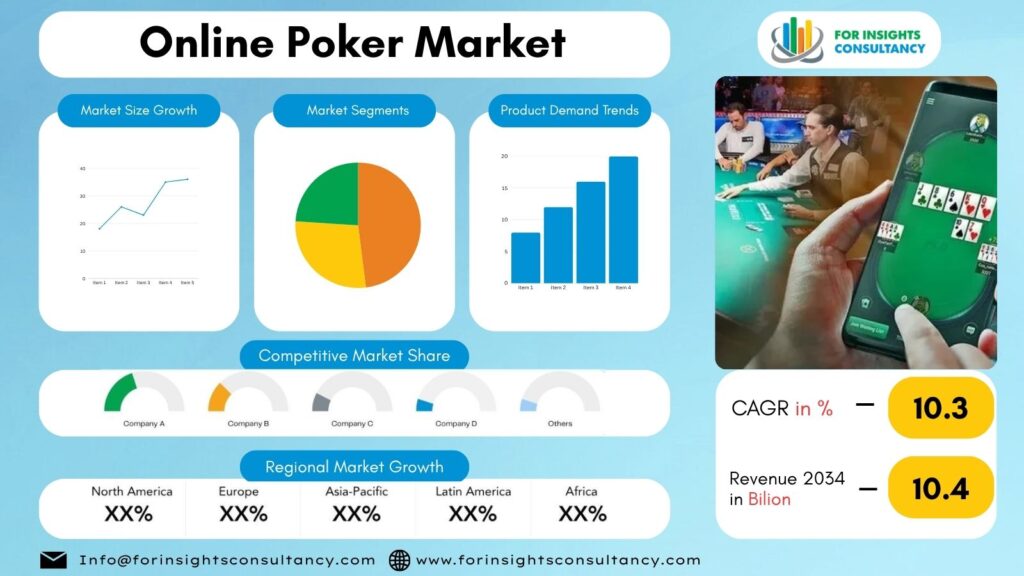
The legality of online poker revolves around the location from where it is played; it is legal and regulated in many states in the United States, such as Nevada, New Jersey, Michigan, Pennsylvania, and Delaware, among many other European and Latin American countries, while in other regions, it is either illegal or uncertain. This is precisely the reason why the legality of online poker is one of the major factors driving market growth today. The value of the total market depends largely on how wide its scope is, but based on a triangulated estimation, the market is expected to be valued at about $4.75 billion in 2026 and rise up to $10.4 billion in 2034 – values which do not take into account social and casual poker apps, which are included in market valuation by other companies to give very high values. PokerStars has been the leading online poker site in terms of traffic for many years, followed by GGPoker and partypoker, among other sites such as Americas Cardroom and BetOnline.
The following have been contributing to growth consistently: the development of legal and regulated markets especially in the U.S. and Latin America, increasing acceptance of cryptocurrencies as the mode of depositing and withdrawing money, and the evolution of mobile applications, which is attracting casual gamers that would not have used the desktop interface previously. It is estimated that over 100 million individuals have participated in online poker at least once, with over 30 million qualifying as monthly active users, and this is mostly happening via mobile interfaces.
Online Poker Market Size & Forecast
Metric | FIC Value |
Base Year | 2025 |
Market Size (2025, base) | ~$4.3 Billion |
Market Size (2026) | ~$4.75 billion |
Forecast (2034) | ~$10.4 billion |
CAGR (2026–2034) | ~ 10.3% |
Largest Segment | Cash Games (by Game Type) — For Insights Consultancy Estimate: ~55% share, ahead of Multi-Table Tournaments (MTTs) and Sit & Go formats |
Leading Region (2026) | Europe — For Insights Consultancy Estimate: 35–38% share. |
Request a Free Sample Copy: https://www.forinsightsconsultancy.com/reports/request-sample-online-poker-market/
Online Poker Market Growth Driver 2026
Making improvements to mobile-first platforms — As mobile apps continue to become more refined, more and more casual and younger players are using them to play poker who would never have used a traditional desktop poker client before.
Integrating with other iGaming offerings — More online poker rooms are being integrated into the same app along with sports books and online casinos, bringing traffic into the poker games from sports betting and casino gaming players.
Penetration of smartphones and internet in developing countries — More players in the Latin American and Asian regions are now accessing the internet via their smartphones.
Developing platforms through use of AI technology — Investments are being made by companies in anti-collusion detection and personalized gameplay through the use of artificial intelligence technology.
Growing live stream and content-based poker community — The growing number of poker content viewers on platforms like Twitch and YouTube continues to bring more players to online platforms.
Trends 2026
Platform Domination by Mobile-First Platforms
The app-based/mobile format continues to dominate over the web-based one and remains steady at 46–68% among the surveyed sources in terms of the adaptation of the platform type to mobile learning.
AI-Based Feedback and Movement Corrections
More and more platforms start applying AI-based tools for feedback and correcting movements made by the users, thus reducing the difference in experience between online and in-person lessons.
Gamified Learning Modules
More and more platforms apply gamification principles such as tracking of user progress, badges, and modules based on challenges to improve users’ engagement and reduce subscription cancellations.
Subscription Formats Overtaking Single Course Purchases
Subscription formats continue dominating single course purchases, which is beneficial both for the platforms (as far as it allows them to have more stable income streams) and for users (who get unlimited access to updated collections of materials).
Wearable Device Integrations
More and more providers include heart rate monitoring and other fitness functions provided by wearable devices into their dance instruction apps.
Restraints and Challenges 2026
Fragmented and non-uniform regulations – The legal status remains highly divergent between states and nations, requiring platforms to deal with a complicated licensing framework rather than one global legal environment, limiting growth opportunities and increasing compliance costs.
Segregation of player pools (“ring-fencing”) – Several jurisdictions where gambling platforms operate legally demand that player liquidity be confined to state/national borders, leading to segregation of player pools and limiting the possibility of offering popular and large tables for games.
Increasing cost of customer acquisition – Competition among established platforms (PokerStars, GGPoker, partypoker) and new players is raising marketing costs for acquiring customers.
Unresolved issues of trust and fairness – Despite use of certified RNG and auditing services for platforms working under licenses, doubts regarding manipulation of game results persist due to the use of bots and other methods to manipulate games.
Constraints in payment processing — Although there has been significant growth in cryptocurrency use, even now, most traditional banks and payment processors impose constraints on gambling transactions and treat them suspiciously, making it difficult for the players to transfer money via these methods.
Problems with bots/AI play — With improvements in AI tools, the platforms have found it increasingly hard to recognize bot or AI-assisted gameplay.
Top Companies Covered
- PokerStars (Flutter Entertainment)
- GGPoker
- partypoker (Entain)
- Ignition Casino
- Americas Cardroom
- BetOnline
- Zynga Inc. (Zynga Poker — social/casual segment)
- Playtika Ltd. (social/casual segment)
- Tencent (via WePoker and other Asian poker platform investments)
- Baazi Games (India)
- Pocket52 (India)
- BLITZ POKER (India)
- Quadrific Media Pvt Ltd (India)
- Arkadium (casual/social card gaming)
Online Poker Market Company news 2026
GGPoker (the clear market leader story of 2026)
GGPoker has been the top-ranked online poker site worldwide for four straight years leading into 2026. The company has come to control an estimated 36% of global visible cash game seats, followed by PokerStars’ 25% and WPT Global’s 15%, with the top three accounting for 76% of visible cash game liquidity – the highest figure since at least a decade in the industry. Major highlights of 2026 include: doubling of the GGMasters Freezeout buy-in from $500,000 to $1 million (challenging PokerStars’ Sunday Million); fully integrating its World Series of Poker (WSOP) brand, purchased by parent company NSUS in 2024; hosting WSOP Online on GGPoker for 45 days worth of over $350 million in tournament prize pools; maintaining the “Poker Operator of the Year” award for the EGR Awards for the second straight year; and exploring potential entry into the US market. Among ambassador additions and departures are Bertrand “ElkY” Grospellier out and Michael Mizrachi in.
Americas Cardroom (ACR)
Launched AI-powered “Skip-It” multi-table tournaments in March 2026 — described as an industry first, signaling real product innovation rather than just marketing activity from a mid-tier operator.
Online Poker Market Segments
By game type, Texas Hold’em is the leader on the market with market share exceeding 70%, thanks to its easy rules and massive promotion through big tournaments broadcast on television and streaming channels. Omaha and 7-Card Stud occupy less significant positions on the market, followed by other variations such as 5-Card Draw and Follow the Queen.
By platform, mobile apps have taken about 70% of the market, due to the presence of payment gateways within applications, push notifications, and the increased user-friendliness of playing in apps. Desktop clients still remain popular among professional players who prefer large screens and multi-tabling, and at this stage, the availability of cross-platform support becomes a necessity for them.
By end-users, there are two main groups: recreational users who play poker for fun and socialization, and serious/professional users who consider playing poker to be a source of their earnings and prefer to use platforms with large liquidity, low rake and good payout system. Preferences in formats also reflect this distinction: multi-table tournaments are the most engaging format for casual and semi-serious players, while cash games and fast fold formats become popular among experienced players seeking faster, higher-volume play.
Online Poker Market Regional Insights
Europe
Market Share (2026): ~35–38%
Major Players: PokerStars, GGPoker, partypoker, 888poker
Trends: This remains the continent where online poker is most mature and most regulated, with the majority of licenses going via Malta and Gibraltar. In 2026 what’s notable about this market is that it is becoming more and more a focus for live events – both 888poker and partypoker have separately increased the reach of their tours to include Spain and the UK this year. Also potentially a big shake-up on the horizon is PokerStars’ parent company, which has begun integrating its other gaming companies – Betfair, Paddy Power, Sky Poker – into one network, which may significantly affect PokerStars’ traffic if it goes ahead as planned.
North America
Market Share (2026): ~28–30%
Top Companies: GGPoker (apparently considering a US launch), Americas Cardroom, BetOnline, PokerStars (regulated jurisdictions: New Jersey, Michigan, Pennsylvania, Delaware, Nevada)
Trends in Consumption: Fifteen years following the “Black Friday” crackdown that has changed the face of legal online play in America, the online poker industry in the US continues to be pieced together state-by-state rather than being a single market. Smaller companies are differentiating themselves through product innovation and not through just marketing – for instance, the launch of the Americas Cardroom’s “Skip-It” tournaments assisted with AI in early 2026. Meanwhile, the Fertittta family’s takeover of Caesars Entertainment in the current year raises some eyebrows considering the many ties between Caesars and the WSOP brand and their control over online poker in the US.
Asia-Pacific
Market Share (2026): ~18-20%
Leading Companies: GGPoker, Tencent platforms, regional brands
Consumer Trends: It’s no secret that a large portion of the four years that GGPoker has been on the throne among global markets can be attributed to the power of its user base in the Asian markets. The company has not sought growth in all markets, but chose a more selective region-by-region strategy for 2025 and 2026. Among live poker tournaments, there is a great success in Australia, where the Aussie Millions managed to attract an astounding 2,144 entries.
Middle East — Smallest, Early-Stage Region
Market Share (2026): ~4-5%
Leading Brands: None significant; market entry is largely informal or offshore in nature
Trends Among Consumers: This is definitely the hardest region worldwide to have regulated online poker gain ground. Where online poker occurs, it is through offshore operators, not local ones, and that’s not likely to change soon due to the legality issues surrounding it in some of the larger countries in the region.
Latin America
Market Share (2026): ~8–9%
Main Products: GGPoker, PokerStars, up-and-coming local companies
Customer Trends: It’s no surprise that this area always pops up as one of the fastest-growing regions in the world when it comes to online poker – not because it’s a well-established market that has found its second breath of life, but because the regulation is just now beginning to open up here. Add to this the increase in smartphone usage and crypto payment familiarity, and suddenly the barriers that used to stand in the way of newcomers fade into the background.
Frequently Asked Questions
Is mobile or desktop currently the dominant platform for generating Gross Gaming Revenue (GGR)?
Mobile is the dominant platform by volume and share (~70% of the online poker market), but desktop still tends to generate disproportionately higher GGR per player, since high-stakes and professional players — who drive the bulk of rake and revenue — largely play multi-tabled sessions on desktop rather than mobile.
How big is Online Poker market?
Online Poker market revenue, prized at $4.75 billion in 2026, is projected to rise to $10.4 billion by 2034, registering a CAGR of 10.3%
Who are the top 5 poker players?
Based on CardPlayer’s 2026 Player of the Year (POY) World Leaderboard, the top 5 by points are: Danny Tang, Punnat Punsri, Quan Zhou, Mehdi Chaoui, and Kelvin Kerber.
Is there a real ceiling on how big GGPoker’s lead can get, or could it approach the kind of dominance a single sportsbook has in some markets?
Probably not — poker needs a mix of skill levels at the table to stay fun, so if GGPoker gets too dominant, the games get tougher and recreational players start looking elsewhere, which naturally caps how far ahead it can pull.
Which region leads Online Poker market?
Europe leads the Online Poker market with roughly ~35–38% Share, while Asia-Pacific is the fastest-growing region.
What’s the actual difference between buying into a “poker market” report versus an “iGaming market” report if I only care about poker?
A “poker market” report isolates just poker’s numbers, while an “iGaming” report often lumps poker in with casino and sports betting revenue — so if you only care about poker, the iGaming version can quietly bury or inflate what you actually want to know.
What’s driving growth in the online poker market?
Key driving factors are legalization in the regulated market, use of cryptocurrency payments, enhancement of mobile-friendly platforms, and further integration with the larger casino and sportsbook applications.
What’s Included in This Report — Online Poker Market
- Market Size & Forecast — Base year (2025) valuation, current market sizing, and forecasts through 2034, including year-by-year revenue projections and CAGR analysis, with clear scope definitions to distinguish narrow real-money poker figures from broader iGaming-inclusive estimates
- Market Segmentation Analysis — Detailed breakdown by game type (Texas Hold’em, Omaha, 7-Card Stud, Short Deck), format (cash games, MTTs, Sit & Go, fast-fold variants), platform type (web, mobile, live-dealer), business model (real-money, social/casual, crypto-native), and end-user category (gambling enthusiasts, dabblers, social exuberants)
- Regional & Country-Level Analysis — Market sizing and growth trends across North America, Europe, Asia-Pacific, Latin America, and Middle East & Africa, including standalone coverage of India’s distinct domestic-platform-led market structure
- Competitive Landscape — Company profiles and market positioning of major operators including GGPoker, PokerStars, partypoker, 888poker, Americas Cardroom, and BetOnline, plus directly-sourced cash game liquidity share data (GGPoker ~36%, PokerStars ~25%, WPT Global ~15%)
- Market Dynamics — In-depth analysis of growth drivers, restraints, opportunities, and challenges, including regulatory fragmentation, ring-fencing effects on player liquidity, and crypto payment adoption trends
- Regulatory Impact Analysis — Coverage of state-by-state and country-by-country legalization status, licensing frameworks, and how classification as a “game of skill” versus gambling affects market entry in key jurisdictions like India
- Emerging Trends & Innovation — Insights into AI-powered tournament formats, anti-collusion detection technology, crypto-native platforms, and convergence between poker rooms and broader sportsbook/casino apps
- End-Use & Player Behavior Analysis — Demand patterns across recreational players, semi-professional grinders, and high-stakes professionals, including mobile-first usage trends
- Recent Developments & M&A Activity — Coverage of platform partnerships, brand integrations (e.g., WSOP brand consolidation under GGPoker’s parent company), and notable ownership shifts affecting the competitive landscape
- SWOT & Porter’s Five Forces Analysis — Strategic frameworks assessing competitive intensity, regulatory barriers to entry, and platform/player bargaining dynamics
- Custom Research Options — Availability of tailored analysis for specific countries, regulatory environments, or competitive benchmarking needs (available on request)
Who Should Buy This Report?
iGaming operators & platform owners — Companies evaluating market entry, expansion into new states/countries, or competitive benchmarking against dominant players like GGPoker and PokerStars
Investors & M&A advisors — PE/VC firms and dealmakers assessing acquisition targets, platform valuations, or investment opportunities amid ongoing consolidation among mid-tier operators
Regulatory & compliance teams — Legal and policy professionals tracking state-by-state and country-by-country legalization status, licensing requirements, and jurisdictional classification of poker as skill-based gaming versus gambling
Affiliate marketers & iGaming media — Businesses in the poker affiliate/review space needing data-backed market context to support content strategy and partnership negotiations with operators
Payment & fintech providers — Companies offering crypto payment rails, e-wallets, or banking solutions evaluating demand for gambling-friendly payment infrastructure
Buy This Report Now — https://www.forinsightsconsultancy.com/buy-now-online-poker-market/ (Access In-Depth Analysis, Forecasts & Company Profiles)
Related Market Reports of Information Technology
Online Gambling & Betting Market Size, Share & Forecast 2034
Indonesia Esports Market Size, Share & Growth Forecast 2034
Request TOC: https://www.forinsightsconsultancy.com/contact-us/
Select PDF License
Single User: $3499
Multiple Users: $4499
Corporate Users: $5499