
Tractor Market Report: Market Size, Innovation & Future Opportunities
Jun-2026 Formats | PDF | Category: Automotive | Delivery: 24 to 72 Hours
Tractor Market Size & Forecast
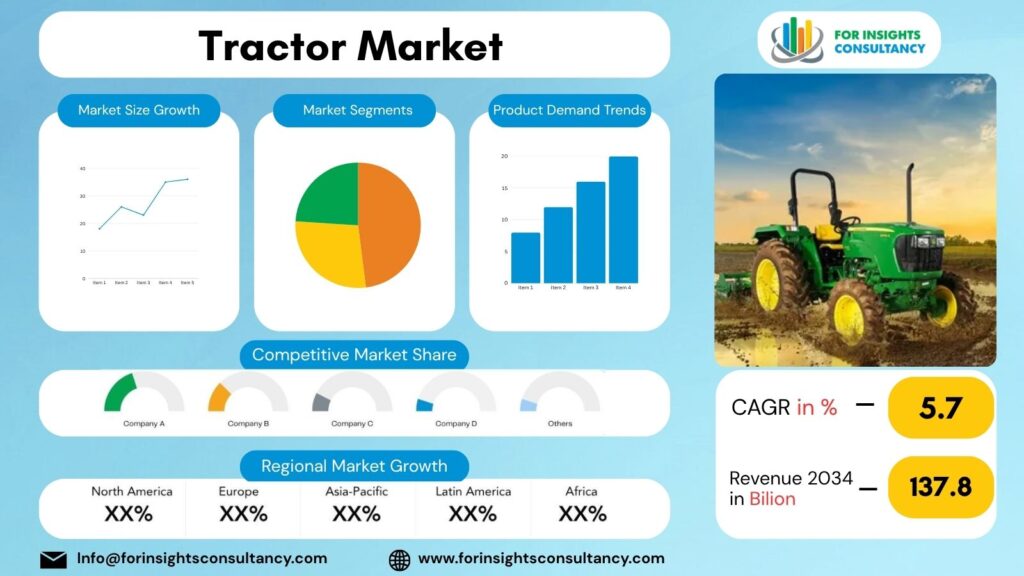
- Market Size (2026): USD 78.4 Billion
- Forecast (2034): USD 137.8 Billion
- CAGR (2026–2034): 5.7%
- Base Year: 2025
- Key Segments: By Engine Power (Below 40 HP, 40–100 HP, Above 100 HP), By Drive Type (2WD, 4WD), By Application (Agriculture, Construction, Landscaping), By Fuel Type (Diesel, Electric, Hybrid).
- Top Regions: North America, Europe, Asia-Pacific, Latin America, Middle East & Africa, with Asia-Pacific leading the market due to large agricultural economies, increasing farm mechanization, government subsidies, and strong tractor demand in countries such as India and China.
Tractor Market Executive Summary
The world Tractor Market is witnessing moderate growth due to mechanization of agriculture, rise in food demand, escalation in labor shortage of farms and growing government support measures in favor of advanced agricultural machinery. With the overall farm productivity being increased and cost per unit area being reduced for farmers, the tractors have become both inevitable and a necessity to run large commercial farms and small scale agricultural units.
The increasing demand for advanced precision farming tools and intelligent farm machinery is leading to a growth in the sector. The latest generation tractors with guidance systems, telematics, automated systems, along with precision farm data analysis are positively helping precision farming procedures to make farming more efficient and productive with high yields. The rising popularity of precision farming practices has, therefore, been encouraging global investments in modern tractor systems.
Moreover, new trends like premiumisation, sustainability or digitalisation are also affecting the nature of competition. The market for premium, high performance tractors tends to be growing as there is an increasing market of customer demand for models with improved fuel efficiency, optimization of comfort through automation and communication solutions. Modern digital solutions are also transforming traditional product into intelligent, integrated platforms capable of support modern farm management systems.
With growing emphasis on sustainable practices within the agricultural sector, new innovations in the industry are continuously emerging. Consumers with environmentally conscious farming practices are demanding more efficient equipment which burns less fuel, emits fewer greenhouse gases and supports more sustainable farming. Electric tractors, hybrid powertrain technologies and alternative fuel types are being developed to meet this demand.
Government-sponsored schemes, modernization programs, schemes for soft financing are giving a big fillip for growth especially in the developing countries One can expect this trend to take bold strides in the time to come. Asian-Pacific, Latin-American and African countries have been innovating and promoting mechanization as effective means to food security and meeting the growing food demands leading to higher adoption of tractors.
All market participants are looking to broaden their market presence through product innovation, strategic alliances, digital integration and geographic expansion. Manufacturers that are up front in the market are working on leveraging strengths in autonomous driving, AI, remote monitoring and connected farm ecosystems for revenue growth and product differentiation.
The Tractor Market, being closely associated with the global developments in agricultural productivity in terms of efficiency, sustainability, and higher levels of technological adoption, is bound to grow steady during the forecast period. The continuous spiraling of advancements in agricultural mechanization, adoption of precision farming practices, and global digital revolution will continue to fuel the growth of tractor market worldwide.
Tractor Market Overview (2026)
Agricultural Tractor Market refers to a range of vehicles from a broad category of tractors and implements designed primarily to provide mechanized assistance to the farmer in all aspects of agriculture and land management. These includes a variety of farm tractors based on power output, drive, type of fuel and application. Agricultural tractor acts as a major application of implementing mechanization for effective and efficient performance of all agricultural works.
During last decade, the agriculture has been dramatically changed by more and more advanced technologies such as agricultural mechanization, precision agriculture and digital agricultura. Old time tractor for pulling and hauling purpose are now replaced by a number of high-intensive vehicles with various features. With GPS navigation, telematics, auto-steering, remote diagnosics and data analysises, they can help farmers increase their productivity and reduce input costs.
Rising concern about food security, sustainable agriculture and farm productivity over the period has altered the overall structure of the market. With increasing pressure on farmers to optimize farm production at the same time reducing the use of inputs in the agricultural processes, there has been an increase in the utilization of new generation tractors for precision farming, conservation agriculture, and optimisations of resource use.
The Tractor Market is also being revolutionized by new technology. Manufacturers are now adopting artificial intelligence (AI), the Internet of Things (IoT), hardware machines learning, as well as the concept of autonomous and driverless tractors. Tractor smart technology allows farmers to analyze data from the fields, monitor and help to improve equipment operation, improve fuel efficiency, and works in support of automated agriculture. Electric and hybrid tractors are also becoming hot topics in the industry.
Market growth is also significantly affected by policy and regulatory changes. Most countries have elaborate agricultural modernization initiatives, equipment subsidy programmes and rural development policies to promote farm mechanization. In parallel, higher emission standards and environmental concerns are pushing tractor manufacturers to design and develop cleaner and fuel-efficient equipment technology.
Meanwhile, rising investments in precision agriculture technologies, smart farm infrastructure and digital farm management are also contributing to the growth of the industry. The market for precision farming is mostly driven by the developing economies, where farm mechanization level is still low and such economies are also invest heavily to improve agricultural productivity. Apart from this, the developed world markets are also making heavy investments to develop advanced, high-horsepower and autonomous tractors.
The technology advancement in agriculture will further impact the Tractor Market and it is anticipated to stay as an integral part of the world‘s farming structure. Advances in automation, connectivity, sustainability, and precision farming will offer many career opportunities for Tractor manufacturers and technology providers, as well as for associated agricultural bodies.
Tractor Market Dynamics 2026
Growth Driver
Rising Demand for Agricultural Mechanization and Farm Productivity
Introduction- The tractor market is driven by the rising demand for farm mechanization to enhance the farm productivity and efficiency. The increasing food demand on the world is encouraging farmers to shift to more sophisticated farm mechanization owing to decreasing arable land and rising availability of labor force in rural areas. A tractor is used for preparing soil, planting, cultivating, harvesting and transporting activities on farms.
The increased mechanization of agricultural operations is of great importance in emerging markets where governments are vigorously encouraging farm mechanization through subsidy programs, credit schemes and development programs for agriculture. In response to these incentives, small and medium scale farmers are increasingly buying tractors for higher crop productivity, machinery and labor cost reduction, and high profitability. As farms are becoming more commercialized and productivity oriented, the global demand for tractors of different power sectors is expanding.
Growth in Precision Agriculture and Smart Farming Technologies
The growth in precision agriculture is another key driver for this market. As farms are consistently driven towards higher efficiency, new technologies and data analysis methods are employed to increase productivity and reduce costs. This has created a need for more advanced machinery that is able to use computers, GPS tracking and other digital systems effectively to analyze and make use of all available information. Advanced tractors, fitted with GPS guidance, telematics, sensors and/ or artificial intelligence capabilities are now in high demand.
These technologies allow farmers to carry out precise field operations, decrease the consumption of fuel, limit material waste and increase productivity. Smart tractors are capable of gathering and processing on-line data, performing variable application rates, tracking of machines health and communicating with farm software. Ultimately, the financial performance for a farm is expected to significantly improved.
Market growth is also driven by the increasing adoption of connected farm systems. Farmers in different areas are searching for intelligent tractors that are capable of integrating and communicating with other equipment as well as digital platforms and their own machinery. Developed regions are the main demand drivers in this respect, as investments in sustainable and labor-saving farming solutions are more viable there.
Buy too, the development of semi- or even fully-autonomous tractors means new companies entering the industry. These state-of-the-art vehicles have the ability to execute multiple repetitive operations without depending on human input.
The increasing trend of mechanization in the agricultural industry and expansion of precision farming equipment is forecast to be a continued growth stimulant for the Tractor Market ensuring long-term development and innovations of the industry worldwide.
Key Trends
Premiumization Through High-Performance and Smart Tractors
Premiumization trend is ongoing in Tractor Market, in which farmers are more inclined to use quality and high-end machinery to increase productivity and optimize the efficiency. Modern day‘s tractor comes with a bundle of advanced features including auto-steering based on GPS, telematics services, touch screen controls, air-cooled cabs, precision farming equipment, remote diagnostics and so on. Large commercial farms and corporate/agribusiness farms are demanding for high-horsepower tractors with increased intelligence, efficiency and comfort. Premiumization of equipment category has inspired manufacturers to develop new premium product mix which could maximize farm‘s profitability.
Sustainability Driving the Adoption of Eco-Friendly Agricultural Machinery
Sustainability currently ranks high among the world‘s main concerns and has a remarkable influence on developments in the tractor industry. Farmers’ and farm organizations’ demand for machines capable of lower fuel consumption, fewer emissions of greenhouse gases and environmentally acceptable farming methods is at the root of increased investments in more efficient engines, hybrid, electric and alternative fuel powered tractors. The expansion of conservation tillage and precision management practices is leading to a rising use of machinery able to make the best use of resources and minimize soil degradation and negative impacts to the environment without sacrificing farm output.
Technological Innovation Reshaping Modern Farming Operations
Though all the above trends are significant, one of them is more than any other influencing the Tractor Market. This is technology innovation. Adoption of digital technologies such as AI, IoT, cloud computing, machine learning and future sensor technology is turning tractors into smart farms. Telematics enables farmers to systematically gather real time machine operational data, gasoline consumption data, analyze the machine functioning and offer advice on predictive maintenance and other opportunities.
Manufacturers are also providing telematics platforms for remote monitoring/telemetry and fleet management so that farm managers can utilize data to make educated decisions and increase efficiency of their equipment which will become necessary in a rapidly expanding industry.
Tractor Market Top Companies Covered In this Report are
- John Deere
- CNH Industrial (Case IH & New Holland)
- AGCO Corporation
- Mahindra & Mahindra Ltd.
- Kubota Corporation
- Escorts Kubota Limited
- SDF Group (SAME Deutz-Fahr)
- CLAAS KGaA mbH
- Yanmar Holdings Co., Ltd.
- Massey Ferguson
- Fendt
- Sonalika Tractors
- TAFE – Tractors and Farm Equipment Limited
- Lovol Heavy Industry Group
- Argo Tractors S.p.A.
Tractor Market company news 2025 and 2026
Autonomous Tractor Development Accelerates
Leading manufacturers are increasing investments in autonomous and semi-autonomous tractor technologies. Advanced GPS guidance, machine vision systems, artificial intelligence, and precision steering capabilities are enabling tractors to perform field operations with minimal human intervention, helping farmers address labor shortages and improve productivity.
Growth of Precision Agriculture Integration
Tractor manufacturers are expanding integration with precision farming ecosystems, including drones, satellite imaging, telematics platforms, and farm management software. These connected solutions enable real-time monitoring, field mapping, variable-rate application, and data-driven decision-making, improving operational efficiency and crop yields.
Tractor Market Segments
By Drive Type
- Four-Wheel Drive (4WD)
- Two-Wheel Drive (2WD)
- Autonomous / Electric
By Application
- Agriculture
- Construction & Mining
- Landscaping & Grounds
- Forestry
Tractor Market Regional Insights
North America – Insight
North America is a highly developed tractor market with a major emphasis on large commercial farming and adoption of precision agriculture techniques. US and Canada are leading the shift towards automation and connected technologies and the current trends include adoption of telematic and GPS-controlled tractors, and data enabled farm management. Strong inclination toward forward-looking farm automation to cut labor and man-hours is fast becoming the company’s differentiating factor and North America is expected to lead the sales of autonomous tractors globally.
Europe – Insight
Europe‘s demand for tractor is influenced by strict norms for environmental pollution, sustainability trends, and adoption of high precision farming. Countries like UK, Germany, and Italy have observed rising demand for fuel efficient, low-emission, integrated assisted tractors. Also European nations have seen rapid adoption of electric/ alternative fuel tractor due to incentives from government for sustainable agriculture. Usage of precision farming equipment has risen among farmers for adhering to environment norms increased productivity and resource optimization.
Asia-Pacific – Growth Driver
Asia-Pacific region is the biggest and fastest growing tractor market in the world. This growth is driven by increasing agriculture mechanization, high food demand, government support to improve farm modernizaion in the region. India, China, Japan, and Australia are the major consumers of tractor in the region because of the prevalence of large farms, rural mechanisation programmes, and farm subsidy policies that stimulate farm mechanization & modernization. Large agriculture work force, booming population and increasing adoption of modern farming practices is helping Asia-Pacific image as significant countries for tractor manufactures in the future. Shortage of labor in agriculture field is expected further to rise demand of compact & mid-range tractor in the years to come.
Rest of World – Emerging Trends
Rest of the world, its comprises regions such as Latin America, Middle East and Africa is experiencing an upward trend in the adoption of tractors, driven by the efforts of governments who are looking at boosting food productivity levels and ensuring security. Key trends in this region is rise in financial backing to buy farm machinery, rising number of dealer networks across rural area, increasing need for affordable and efficient tractors to match with local farming conditions, and growing and adoption of precision farming techniques. Digital farming solutions and machinery sharing techniques is also catching up among various developing nations.
Analyst Insights
For Insights Consultancy‘s agricultural analyst points out that more and more the Tractor Market is no longer just about farm machinery, and it has evolved to become a serious part of the smart agriculture ecosystem as a whole. Farm mechanization and labor efficiency are no doubt still among the major factors that drive the Tractor market, but revolution brought on by precision farming, automation, modern digital connectivity and sustainability are now defining the growth in the market.
The analysts also found that an important trend is the increased integration of digitally-intensive accessories and systems that tractor operators or farm managers are using. Such systems include GPS guidance, autonomous/driver-less operations, telematic-oriented service and self-monitoring features, advanced AI and onboard sensors (IOT Internet of Things), integrated cloud-based farm management systems etc. From farmers’ perspective, tractors are transforming from simple field work-horse into an integrated module providing extensive data for daily farm planning and management.
Tractor Market Research Methodology
The report on Tractor Market is prepared through meticulous research methodology which involves the use of secondary sources of information, extensive primary interviews and in-depth validation process by the industry experts. The report offers extensive analysis and comprehensive insights into the global tractor market along with the growth trends and market forecasts.
Primary Research
Primary research for this report involved in-depth discussion with industry personnel, tractor manufacturers, agricultural equipment suppliers, distributors and dealers, farm operators, agricultural consultants, technology providers, and other key participants in the value chain. Their responses shed light on the current source of demand, purchasing trends, product improvements and emerging technologies, price trends, developments in the supply chain, and potential for growth.
Secondary Research
Secondary research also involves a comprehensive survey of relevant industry publications, company annual reports, investor presentations, government reports, databases and other sources such as trade association reports, regulatory reports, academic studies, market intelligence and machinery related journals. This research is used for determining market trends, competitor analysis, industry developments, technological innovations and past industry performance.. They also confirm the data collected through primary interviews.
Data Validation and Market Modeling
All data collected are validated through a considered multi-stage approach to provide a consistent and accurate information source. Research findings are validated through data triangulation, referencing other adopted primary research, secondary research and proprietary tools and models. Market size, market share, market growth, segment performance, regional demand dynamics and future revenue potential are forecast through quantitative and qualitative models and statistical software.
Tractor Market – Data Sources
Government Publications
The report uses information from cybersecurity bodies, telecommunications departments, digital infrastructure bodies and regulatory bodies to assess trends in cloud security, digitalization in companies and changes in policy on cybersecurity.
Industry Databases
Market intelligence is collected from sources such as cybersecurity database, cloud networking platforms, source of research of enterprise IT and tech analytics providers to analyze market size, adoption rates, competitive landscape and innovation trends.
Company Financial Reports
Revenue trends, strategic investments, technology evolution, product expansion are monitored by analyzing annual reports, SEC filings, investor presentations, press releases and financial statements of the top SASE vendors, cloud security vendors and networking companies. Methodology This Tractor Market report is backed by strong research methodology involving primary research, secondary analysis and sophisticated market modeling to derive precise, dependable and usable industry insights.
Trade Journals
This report will use references of cybersecurity journals, cloud computing magazines, enterprise networking publications, white papers and technical research articles to study the trends over the AI-based security improvements, Zero Trust adoption and SASE architecture change from around the world.
Proprietary Research (For Insights Consultancy):
Broader validation and learning are then produced by way of internal databases, experienced interviews and specialist analysis by For Insights Consultancy, providing accurate, trustworthy, current market intelligence to meet client needs.
Customization: We Can Provide Following Things
1) On Market More Company Profiles (Competitors)
2) Data About Particular Country Or Region
3) We Will Incorporate The Same With No Additional Cost (Post Conducting Feasibility).
Any Requirement Contact Us: https://www.forinsightsconsultancy.com/contact-us
Related Market Reports
Drone Agriculture Solutions Market
Source: https://www.forinsightsconsultancy.com/reports/drone-agriculture-solutions-market
Smart Agriculture Market
Source: https://www.forinsightsconsultancy.com/reports/smart-agriculture-market
Table of Contents
For TOC Contact us: https://forinsightsconsultancy.com/contact-us/