

Wind Turbine Blade Recycling Market Size, Trends Analysis Research Report By Material Type (Thermoset Composites, Thermoplastic Composites), by Process (Mechanical Recycling, Thermal Recycling, Chemical Recycling), by Application, by End User, and By Region Global Market Analysis And Forecast, 2025-2034
Nov-2025 Formats | PDF | Category: Energy & Power | Delivery: 24 to 72 Hours
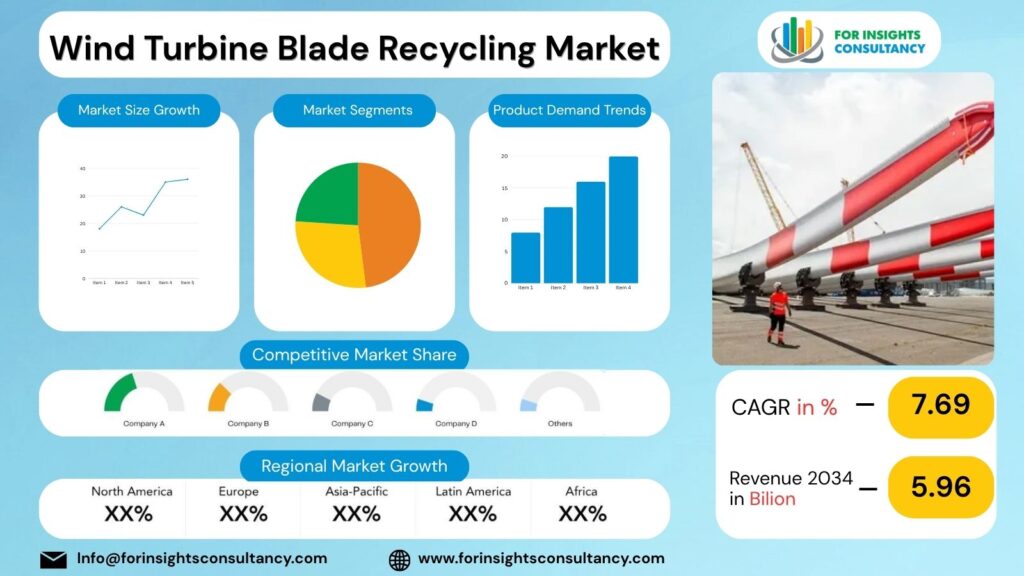
Wind Turbine Blade Recycling Market Size & Forecast 2026 to 2034
Discover
the Wind Turbine Blade Recycling market poised to grow from US$ 3.8 Billion in
2025 to US$ 5.96 Bilion by 2034 at a CAGR of 4.58%. Explore key trends, growth
drivers, and opportunities shaping the renewable recycling industry.
Overview of the Wind Turbine
Blade Recycling Market and Expected Growth (2026)
The Wind
Turbine Blade Recycling market is starting to boom as the demand for renewable
energy sources and the need for sustainable solutions in the wind energy
industry grow. As more and more wind turbines reach the end of their useful
life, the need for recycling solutions for turbine blades, which are made of
difficult-to-recycle composite materials, is becoming more urgent. It is
estimated that the market for wind turbine blade recycling will reach USD 3.8
billion in 2025 and grow to USD 5.96 billion by 2034, representing a Compound
Annual Growth Rate (CAGR) of 4.58%. This market growth is a response to the
need for more sustainable recycling solutions, new recycling regulations, and
the advent of new recycling technologies.
The
strongest drivers of this market are the rapidly growing installation of wind
turbines, the increased awareness and concern for blade waste, and the
government-sponsored incentive programs aimed at establishing a circular
economy. Firms are concentrating their efforts on the development of mechanical
recycling, processes that are thermal in nature, and the recycling of materials
to recover useful composites, thereby diverting materials from the landfill.
As part
of industry evolution, stakeholders put investments towards R&D to build up
the effectiveness of recycling methods and look into what else can be done with
recycled materials to be used in construction, automotive and infrastructure.
These efforts not only help with the carbon footprint, but also the revenue,
making the recycling of wind turbine blades an important part of the renewable
industry ecosystem.
Due to
unsustainable recycled materials and aging wind infrastructure, wind energy
penetration, Europe, North America, and Asia-Pacific are expected in the next 3
years to have the highest demand for innovative recycling. Due to government
sustainability mandates, and the oldest wind infrastructure, Europe, North
America, and Asia Pacific are expected to have the highest demand for
innovative recycling in the next 3 years.
Market Dynamics 2026
Growth Drivers
Worldwide Wind Energy
Installations –
As wind turbines are being installed at an increasing rate globally, there is a
growing supply of end-of-life turbine blades that need recycling.
Renewed Environmental
Regulations and Policies – The tightening of the circular economy and waste management
regulations is driving the composite wind blade recycling.
Trends
Advancements in
Recycling Technology – The use of more mechanical grinding, pyrolysis, and
chemical recycling methods are improving material recovery and cost efficiency.
Transition to Circular
Economy Principles – Actors
within the wind energy market are initiating the recycling of turbine blades at
end of life as construction materials, automotive
parts, and other industrial uses.
Focus on Sustainability
and ESG Compliance – The
recycling of materials by corporations and utilities is now part of the efforts
to accomplish ESG objectives.
Opportunities
Development of
Applications for Recycled Composites – The renewed materials from turbine blades can
be used for construction, automotive, furniture, and industrial parts, thereby
creating new business opportunities.
Designing Blades for
Recyclability – Manufacturers
can take advantage of the emerging demand for modular and fully recyclable
blades, which makes end-of-life management simpler and diminishes the
ecological footprint.
Challenges
Difficulty of Recycling Composite
Materials – The
wind turbine blades are made of fiber-reinforced composites that are tough to
disassemble and recycle, which increases operational costs and decreases
recycling effectiveness.
Increased Costs of Recycling – The investments required to
recycle composites through mechanical, thermal, or chemical methods involve
significant costs in technology, workforce, and energy, which may inhibit small
and medium enterprises from entering the recycling market.
Wind Turbine Blade Recycling Market Top Companies Covered In This Report:
Evaluate
The Strategic Positioning And Innovation Pipelines Of Leading Market Companies-From
Multinational Enterprises To Disruptive Regional Firms. Understand How Key
Players Are Innovating, Expanding, And Capturing Value, And Use Competitive
Benchmarks To Plan Your Next Move.
- Global
Fiberglass Solutions
- Veolia
Environmental Services
- SUEZ
- BladeBUG
- RESINEXX
- GE
Renewable Energy
- Vestas
Wind Systems
- Siemens
Gamesa Renewable Energy
- EDF
Renewables
- Enel
Green Power
Wind Turbine Blade Recycling Market Company News 2025 and 2026
Siemens Gamesa Renewable Energy
Siemens
Gamesa Renewable Energy continues to lead innovation in recyclable blade
technology, launching the RecyclableBlade—a wind turbine blade designed to be
recycled at end‑of‑life. Agreements are in
place to install these blades in major offshore projects with partners like RWE
and EDF Renewables as part of broader sustainability efforts in wind energy
production.
At the
Sofia Offshore Wind Farm in the UK, RWE successfully completed the installation
of 150 recyclable blades manufactured by Siemens Gamesa, marking a milestone
for large‑scale
deployment of recyclable blade technology and advancing circular economy
practices in offshore wind development.
Vestas Wind Systems
Vestas
Wind Systems is actively working on scaling up chemical and mechanical
recycling processes for wind turbine blades through industry collaborations.
Recent sustainability reporting highlights progress in breaking down epoxy
resin blades and expanding value chains for recycled materials.
Key Segments
Segmentation
By Material Type
- Thermoset
Composites
- Thermoplastic
Composites
Segmentation
By Process
- Mechanical
Recycling
- Thermal
Recycling
- Chemical
Recycling
Segmentation
By Application
- Cement
Co-processing
- Composites
Reuse
- Energy
Recovery
- Other
Applications
Segmentation
by End User
- Wind
Energy
- Construction
- Automotive
- Aerospace
Global Geographic Coverage:
The
Report Provides In-Depth Qualitative And Quantitative Data On The Wind Turbine
Blade Recycling Market For All Of The Regions And Countries Listed Below:
North America
United States – Market Leader: The U.S. leads
in North America due to its numerous wind turbine installations and increasing
demand for end-of-life blade recycling.
Support and Innovations from the
DOE: The
U.S. Department of Energy sponsors research on the mechanical, thermal, and
chemical recycling of composite blades.
Infrastructure Development: Recycling pilot facilities and
blade processing partnerships are being built in Texas, Iowa, and Oklahoma.
Canada – Focus on Sustainability:
Ontario and Alberta undertake research and promote recycling and the circular
economy to manage the end of life blades.
Mexico – Market in Development:
Environmental impact and recycling technologies are crossing borders for future
collaborations and projects.
Regulatory Considerations: North America’s environmental
regulations and landfill policies drive the incorporation of recycling
technology and the development of disposal alternatives.
Commercial Potential: Increased investments in
recycling from the private sector and partnerships of turbine manufacturers,
recyclers, and research institutes.
Europe
Northern Europe – Innovation Leader: Countries
such as Denmark, Sweden, and Germany are forefronteers in developing and
testing blade recycling in conjunction with new technologies in wind energy.
Western Europe – Strong Policy Framework:
Countries such as France, The Netherlands, and Belgium have robust policies on
waste management and the circular economy which incentivize recycling and
discourage landfilling as a disposal method.
Southern Europe – Emerging Europe: Countries
such as Spain, Italy, and Portugal are increasing their wind energy capacity
and are starting to consider recycling as a means of disposal as older turbines
reach end of life.
Central and Eastern Europe – Developing Countries such as
Poland, the Czech Republic, and Hungary are starting to increase their wind
energy capacity and are starting to consider the sustainable management of
end-of-life wind turbines, including blade recycling.
Influence of the European Green
Deal: The
European Union’s policies on sustainability and the circular economy have
incentivized the improvement of recycling across member states.
Expansion of Recycling
Facilities: The
creation of new specialized recycling consortia is emerging to facilitate the
processing of end-of-life composite blades and to maintain recycling supply
channels for industrial materials.
Innovation Gap: The collaboration between governments,
wind associations, and research institutes is fostering the advancement of
blade recycling technologies and the establishment of best practices.
Asia Pacific
East Asia – Technological Innovation &
Pilot Studies: China, Japan, and South Korea are concentrating on research and
pilot studies related to wind blade recycling to further sustainability
initiatives and combat landfill waste.
South Asia – Rising Wind Energy &
Recycling Demand: The growing wind energy sector in India and the surrounding
countries creates a nascent Vertical Recycling demand as turbine fleets age and
require recycling.
Southeast Asia – New Emerging Activities:
Thailand, Vietnam, and Indonesia are starting to invest in composite recycling
technologies due to new regional renewable energy commitments.
Oceania – Focus on Innovation &
Sustainability: Australia and New Zealand are starting to include recycling in
the windfarm lifecycle and sustainability frameworks, underlining the
importance of a circular economy for renewable energy.
Policy & Government Backing: A patchwork of regional
governments is beginning to address the imperative of recycling and the
management of waste, regulated in part, for responsible management of waste and
recycling of renewable resources.
Middle East and Africa
Gulf Cooperation Council (GCC) – Increased Focus on
Sustainability: As legislation in the region begins introducing sustainability
goals, countries such as Saudi Arabia, the United Arab Emirates, and Qatar, are
building renewable energy facilities, and as they are planning for lifecycle
management, they are becoming aware of the necessity of wind turbine blade
recycling.
North Africa – Increasing Policy Awareness:
Egypt, Morocco, and Tunisia are embarking on the construction of wind energy
projects as they begin to develop an understanding of the need to recycle end
of life blades, and while formal recycling systems are still in the process of
being constructed, the formal recycling infrastructure is still in the process
of construction.
Sub-Saharan Africa – Developing Awareness: In the
region, countries such as South Africa and Kenya are initiating efforts to be
aware of the need for recycling wind blades as part of an integrated approach
to renewable energy development and environmental management.
Opportunities for Regional
Cooperation:
Emerging collaborative partnerships among governments, renewable energy
developers, and environmental organizations are addressing the problem of
composite waste and the need for recycling in addition to the technology for
re-compositing waste.
Frequently Asking Questions
What is
the Wind Turbine Blade Recycling market size and growth forecast?
Wind
Turbine Blade Recycling Market is predicted to grow from USD 3.8 Billion in
2025 to approximately USD 5.96 Billion by 2034. the industry is estimated to
expand at a CAGR of 4.58%.
Who are
the key players in the Wind Turbine Blade Recycling market?
The Wind
Turbine Blade Recycling Market Includes Major Companies SUEZ, BladeBUG,
RESINEXX, Global Fiberglass Solutions, GE Renewable Energy, Vestas Wind
Systems, Siemens Gamesa Renewable Energy, EDF Renewables, Enel Green Power,
Veolia Environmental Services, Others.
What are
the current and future trends for Wind Turbine Blade Recycling market?
Current
trend: Increasing demand for sustainable practices driving growth in the Wind
Turbine Blade Recycling market. Future trend: Advancements in technology
leading to more efficient and cost-effective recycling methods for wind turbine
blades.
What are
the challenges facing the Wind Turbine Blade Recycling market?
The main
challenge facing the Wind Turbine Blade Recycling market is the lack of
efficient and cost-effective recycling technologies for composite materials.
Which
regions dominate the Wind Turbine Blade Recycling market?
Europe
and North America dominate the Wind Turbine Blade Recycling market due to
established recycling infrastructure and government regulations promoting
sustainable practices.
Key insights provided by the report that could help you take critical strategic decisions?
· Regional
reports analyse product/service consumption and market factors in each region.
· Reports
highlight possibilities and dangers for suppliers in the Wind Turbine Blade
Recycling Market business globally.
· The
report identifies regions and sectors with the highest growth potential.
· It
provides a competitive market ranking of major companies, as well as
information on new product launches, partnerships, business expansions, and
acquisitions.
· The
report includes a comprehensive corporate profile with company overviews,
insights, product benchmarks, and SWOT analysis for key market participants.
Customization: We can provide following things
1) On request more company profiles (competitors)
2) Data about particular country or region
3) We will incorporate the same with no additional cost
(Post conducting feasibility).
Any Requirement Contact us: https://www.forinsightsconsultancy.com/contact-us/
Table of Contents
For TOC Contact us: https://forinsightsconsultancy.com/contact-us/