
Detergent Market Size, Trends Analysis Research Report by Product Type (Powder Detergents, Liquid Detergents, Pods/Tablets , Bar Detergents), by Application (Laundry Care, Dishwashing, Household Cleaning,Industrial & Institutional (I&I)), and by Category, by Distribution Channel, and by Region Global Market Analysis and Forecast, 2025-2034
Sep-2025 Formats | PDF | Category: Chemical | Delivery: 24 to 72 Hours
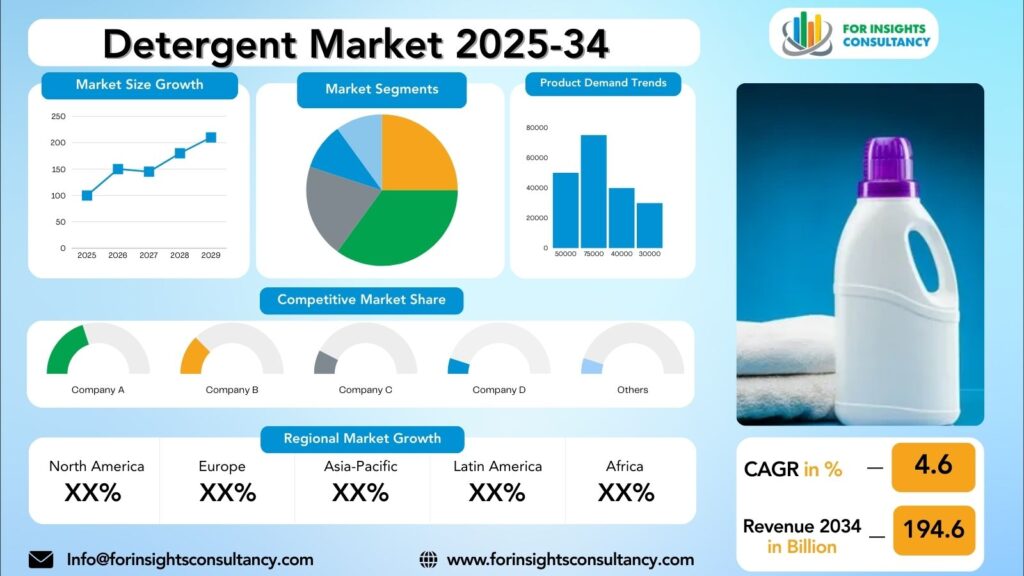
Detergent Market is forecast to increase from USD 144.8 Billion in 2025 to USD 194.6 Billion by 2034, at a CAGR of 4.6%.
Detergent Market: A Comprehensive Overviewand Future Developments
The detergent market has experienced significant growth and innovation over the years, with manufacturers introducing a variety of products to meet consumer needs, including eco-friendly and high-efficiency formulas. The market is highly competitive, with major players like Procter & Gamble, Unilever, and Henkel investing heavily in research and development to stay ahead of the curve. Additionally, smaller, niche brands are entering the market, focusing on specific consumer segments like natural or luxury detergents.
Future developments and trends in the detergent market include the rise of smart detergents equipped with sensors and technology that optimize washing cycles and conserve water and energy. Additionally, the popularity of online sales channels for detergent products is increasing, providing consumers with greater access to a wide range of products from the comfort of their homes. This shift towards online shopping is expected to drive further growth in the detergent market.
Detergent Market Dynamics
Growth Drivers
The detergent market has seen significant growth in recent years due to various factors. Consumers are becoming more environmentally conscious, leading to a shift towards eco-friendly and sustainable detergents. Technological advancements have revolutionized the detergent industry, leading to more effective and efficient products. The rise in urbanization has increased the demand for convenient and easy-to-use cleaning products, such as liquid detergents and pods.
As disposable income levels rise, consumers are more willing to spend on premium and high-end detergent products, often featuring features like fragrance boosters, fabric softeners, and color protection technology. The shift towards online retail has also impacted the detergent market, with more consumers turning to e-commerce platforms for purchasing cleaning products.
In conclusion, the detergent market is experiencing steady growth driven by changing consumer preferences, technological advancements, urbanization, increasing disposable income, and the rise of online retail. To meet the demands of a dynamic and competitive market landscape, detergent manufacturers must stay ahead of these trends and adapt to the changing landscape of the industry.
Restraints
The detergent market is a vital consumer goods industry that constantly evolves to meet the needs and demands of consumers. However, it faces several restraints that can impact its growth and profitability. These include pricing pressures, environmental regulations, raw material cost fluctuations, intense competition, changing consumer preferences, and changing consumer preferences.
Pricing pressures involve companies engaging in price wars to attract consumers, which can lead to lower profit margins and reduced revenue. To combat this, companies must focus on innovation, cost efficiency, and market differentiation to justify premium pricing and maintain profitability.
Environmental regulations are another significant restraint in the detergent market. As consumers become more aware of the impact of chemicals in detergents on the environment, there is a growing demand for eco-friendly and biodegradable products. Companies must invest in research and development and adhere to stringent environmental regulations to maintain market share and credibility.
Raw material cost fluctuations are another challenge in the detergent market. Companies must closely monitor commodity prices, engage in strategic sourcing, and establish long-term partnerships with suppliers to mitigate the impact of these fluctuations. Failure to effectively manage raw material costs can lead to reduced profitability and competitiveness in the market.
Intense competition is another challenge in the detergent market. Established brands like Procter & Gamble, Unilever, and Henkel dominate, making it challenging for newer entrants to carve out a niche. To thrive, companies must differentiate their products, leverage digital marketing strategies, and build a strong brand image.
Opportunities
The detergent market is a rapidly evolving industry that presents numerous opportunities for businesses and consumers. Key opportunities include sustainable product offerings, innovative formulations, and digital marketing strategies. Consumers are increasingly seeking eco-friendly products, which can be achieved by using biodegradable ingredients, reducing water usage, and using recyclable packaging.
Innovation is crucial in the detergent market, as consumers seek products with superior cleaning performance and convenience. Companies can invest in research and development to create new and improved detergent formulations, such as effective stains removal or time-saving laundry pods. Digital marketing strategies, such as social media advertising, influencer partnerships, and search engine optimization, can help businesses reach a wider audience and drive sales.
Expansion into emerging markets presents a valuable opportunity for companies to tap into new customer bases. By conducting thorough market research, understanding local preferences, and adapting their products to meet specific needs, businesses can successfully enter new regions with high growth potential.
Collaborations and partnerships can unlock new opportunities and drive growth. By teaming up with suppliers, retailers, or other brands in complementary industries, companies can access new markets, share resources, and leverage each other’s expertise. This can lead to innovative product offerings, expanded distribution networks, and increased brand visibility, benefiting all parties involved.
In conclusion, the detergent market offers a wealth of opportunities for businesses looking to innovate, expand, and connect with consumers in meaningful ways. By staying ahead of trends, embracing sustainability, leveraging digital marketing, exploring new markets, and forming strategic partnerships, companies can thrive in this competitive industry and achieve long-term success.
Challenges
The detergent market faces several challenges, including adapting to changing consumer preferences, competition from new entrants, supply chain disruptions, and regulatory compliance. Companies must adapt their offerings to meet eco-friendly and natural trends, requiring extensive research and development. New entrants constantly disrupt the industry with innovative products, making it difficult for established companies to maintain market share. Building brand loyalty and offering unique value propositions can help differentiate companies from the competition.
Supply chain disruptions, such as raw material shortages and transportation delays, require strong communication and contingency planning to minimize negative impacts on operations. Regulatory compliance is crucial for companies to meet all standards on chemicals and packaging, requiring ongoing attention to detail and compliance monitoring.
To succeed in the detergent market, companies must be proactive in addressing these challenges. Investing in research and development, building strong brand loyalty, maintaining a robust supply chain, and staying compliant with regulations can position companies for long-term success. Staying informed of industry trends and consumer preferences allows companies to stay ahead of the competition and offer innovative products that meet consumer needs.
In conclusion, companies that can adapt and innovate in the detergent market are well-positioned for success. By focusing on consumer preferences, building brand loyalty, maintaining a strong supply chain, and staying compliant with regulations, companies can overcome obstacles and thrive in this competitive industry.
Detergent Market Top Companies Covered In This Report:
Evaluate The Strategic Positioning And Innovation Pipelines Of Leading Market Companies-From Multinational Enterprises To Disruptive Regional Firms. Understand How Key Players Are Innovating, Expanding, And Capturing Value, And Use Competitive Benchmarks To Plan Your Next Move.
- P&G (Procter & Gamble)
- Christeyns NV
- Ecolab
- Unilever
- Kersia Group
- Virox Technologies Inc.
- DeLava
- Neogen Corporation
- Theseo Group
- Huntsman Corporation LLC
- Solvay
- Evonik Industries AG
- BASF SE
- Kao Corporation
- Clariant AG
- Croda International Plc
- Tata Chemicals Ltd.
- Stepan Company
- Oxiteno
- Galaxy Surfactants Ltd.
- Lion Specialty Chemicals Co., Ltd.
- Henkel AG & Co. KGaA
- A K ChemTech Co. Ltd
- LANXESS
- Diversey, Inc.
- CID LINES N.V.
- Holchem Group Ltd.
Detergent Market News
P&G (Procter & Gamble)
P&G is focusing on two key areas: supply chain transformation and product innovation. In mid-2025, the company announced a major overhaul of its global supply chain, leveraging AI and digital technologies to improve efficiency, reduce costs, and enhance resilience against disruptions.
In early 2025, it introduced new fragrance lines for its laundry brands and launched new and improved formulas for popular products like Cascade dish soap and Dawn liquid dish soap. The company is also using an AI-powered recommendation system on its e-commerce platform in India to help consumers choose the best detergent for their needs.
Unilever
Unilever’s major focus is on sustainability and convenience. The company’s biggest home care innovation in 2024 was “Wonder Wash,” a liquid detergent designed specifically for short-cycle washing machines, which taps into the consumer trend of faster laundry routines. By early 2025, the product was on track to be available in 20 markets.
Unilever is also actively piloting refill and reuse models in emerging markets like Indonesia and Bangladesh to reduce plastic waste. These initiatives offer consumers a more sustainable and often more affordable way to purchase detergents.
Henkel AG & Co. KGaA
Henkel is pushing the boundaries of technology with its “Smartwash” system, unveiled at CES 2025. This AI-driven, cartridge-based dosing system can be integrated into washing machines and dishwashers to automatically dispense the precise amount of detergent needed for each load. The company aims to partner with appliance manufacturers to bring this technology to market, positioning itself as a leader in smart home care.
Segmented View of the Industry:
The Equipment segment holds the largest market share due to the high cost of terminals, antennas, and modems. However, the Connectivity Services segment is expected to show the highest growth rate.
The Detergent Market Is Mapped Through A Multidimensional Lens-Tracking Shifts Across Product Type, Applications, And Geographic Regions. This Segmented Approach Enables Businesses To Localize Their Growth Plans And Align Offerings With The Most Profitable Demand Centers.
Segmentation by Product Type
- Powder Detergents
- Liquid Detergents
- Pods/Tablets
- Bar Detergents
Segmentation by Application
- Laundry Care
- Dishwashing
- Household Cleaning
- Industrial & Institutional (I&I)
Segmentation by Category
- Conventional/Synthetic
- Organic/Natural
Segmentation by Distribution Channel
- Supermarkets/Hypermarkets
- Online Retail
- Convenience Stores
Global Geographic Coverage:
Based on recent market analysis, North America is the largest and most mature market for Very Small Aperture Terminals (VSAT). Its leading position is driven by significant investments in defense and government sectors and a well-established telecommunications infrastructure.
The Report Provides In-Depth Qualitative and Quantitative Data On the Detergent Market For All Of The Regions And Countries Listed Below:
North America
The US detergent market is dominated by domestic and international brands like Procter & Gamble, Church & Dwight, and Colgate-Palmolive, with high demand for laundry detergents, dishwashing detergents, and household cleaning products. Consumers in the US value convenience, efficacy, and sustainability in choosing detergent products.
Canada’s detergent market is characterized by a mix of local and international brands, with a shift towards eco-friendly and natural products driven by growing environmental awareness. Leading brands in Canada include Tide, Persil, and Seventh Generation. Mexico’s growing detergent market is driven by urbanization, rising disposable incomes, and changing consumer lifestyles. Domestic brands like Foca and Roma dominate the market, offering affordable and effective solutions. Multinational companies like Unilever and Henkel are expanding their presence in Mexico to capitalize on the growing demand for detergent products.
Europe
The UK detergent market is a leading player in the industry, driven by factors such as hygiene awareness, busy lifestyles, and a focus on sustainable and eco-friendly products. Major players include Procter & Gamble, Unilever, and Henkel. Germany is another key player in the European detergent market, known for its high-quality and innovative products, and its strong focus on sustainability. The market is highly competitive, with local and international brands vying for market share. Consumers in Germany are also looking for products that are gentle on sensitive skin, leading to a rise in demand for hypoallergenic detergents. France is a significant market for detergents, with a diverse range of products catering to various consumer preferences. The French market is characterized by growing demand for organic and natural detergents, as consumers become more conscious of the impact of chemicals on their health and the environment. Major players in the French detergent market include L’Oréal, Colgate-Palmolive, and Procter & Gamble. By understanding the specific trends and preferences of consumers in each country, companies can tailor their products and marketing strategies to succeed in this vibrant market.
Asia Pacific
The Asia Pacific region’s detergent market is diverse and dynamic, with each country exhibiting unique consumer preferences and trends. China, known for its massive population and rapid urbanization, is one of the largest markets for laundry detergents due to growing awareness about hygiene and cleanliness. Key players in the market are constantly innovating to cater to the evolving needs of Chinese consumers. Japan, known for its stringent quality standards, is characterized by high demand for eco-friendly and sensitive skin-friendly detergents, with a strong emphasis on sustainability. India, with its vast consumer base and growing middle-class population, is a major player in the market, with both domestic and international brands vying for market share. South Korea, with its technologically advanced market, is influenced by the trend of premiumization, with consumers willing to pay a premium for specialized detergent products. Australia’s detergent market is characterized by a preference for environmentally friendly and sustainable products, with a surge in demand for biodegradable and plant-based detergents. Concentrated detergents are also gaining popularity due to their convenience and reduced packaging waste.
Middle East and Africa
Saudi Arabia, the United Arab Emirates, and Nigeria are major markets for detergents in the Middle East. Saudi Arabia, with a growing population and disposable income, is a major player in the market, with key players including Procter & Gamble, Unilever, and Henkel. The UAE, with its booming hospitality industry and high standard of living, is also a significant market for detergents. The demand for premium and eco-friendly cleaning products is on the rise, with local brands like Dabur and Cleantech making a mark. Nigeria, with its large population and growing awareness about hygiene, is a key market for detergents, dominated by local brands like WAW and Morning Fresh. South Africa, with its mature detergent market, is characterized by a wide range of products catering to different population segments. The demand for eco-friendly and natural cleaning solutions is also on the rise, with global brands like Ariel and Omo having a strong presence.
Reasons to Buy:
- The Research Would Help Top Administration/Policymakers/Professionals/Product Advancements/Sales Managers And Stakeholders In This Market In The Following Ways.
- The Report Provides Detergent Market Revenues At The Worldwide, Regional, And Country Levels With A Complete Analysis To 2034 Permitting Companies To Analyze Their Market Share And Analyze Projections, And Find New Markets To Aim For.
- To Understand The Most Affecting Driving And Restraining Forces In The Market And Their Impact On The Global Market.
- Major Changes And Assessment In Market Dynamics And Developments.
- The Objective Of The Detergent Market Report Is To Identify New Business Opportunities Using Quantitative Market Forecasts.
- Formulate Sales And Marketing Strategies By Gaining An Understanding Of Competitors, Their Positioning, And Strengths & Weaknesses.
Faq – What Global Leaders Are Asking
What Is The Growth Prospect For The Detergent Market By 2034?
Detergent Market Is Expected To Achieve A Stable Growth Rate With A Compound Annual Growth Rate (Cagr) Of About 4.6% From 2025 Through 2034.
What Is Driving The Growth Of The Detergent Market?
The growth of the detergent market is driven by rising urbanization, increasing household disposable incomes, and the growing penetration of washing machines in developing regions. Additionally, a heightened focus on hygiene and sustainability is leading to greater demand for specialized, high-quality, and eco-friendly products.
Who Are The Key Players In The Detergent Market, And What Are Their Market Shares?
The Detergent Market Includes Major Companies Like P&G (Procter & Gamble), Christeyns NV, Ecolab, Unilever, Kersia Group, Virox Technologies Inc., DeLava, Neogen Corporation, Theseo Group, Huntsman Corporation LLC, Solvay, Evonik Industries AG, BASF SE, Kao Corporation, Clariant AG, Croda International Plc, Tata Chemicals Ltd., Stepan Company, Oxiteno, Galaxy Surfactants Ltd., Lion Specialty Chemicals Co., Ltd., Henkel AG & Co. KGaA, A K ChemTech Co. Ltd, LANXESS, Diversey, Inc., CID LINES N.V., Holchem Group Ltd., Others.
Specific Market Share Data Is Not Publicly Available and Is Typically Provided In Detailed, Proprietary Market Research Reports.
Which Regions Are Leading the Detergent Market Growth?
Asia-Pacific region is the largest market for detergents, while North America is currently the fastest-growing. This is due to rising disposable incomes, increasing urbanization, and greater washing machine penetration in Asia-Pacific.
Customization: We Can Provide Following Things
1) On Market More Company Profiles (Competitors)
2) Data About Particular Country Or Region
3) We Will Incorporate The Same With No Additional Cost (Post Conducting Feasibility).
Any Requirement Contact Us: Https://Www.Forinsightsconsultancy.Com/Contact-Us/
Table of Contents
For TOC Contact us: https://forinsightsconsultancy.com/contact-us/