

Semiconductor Manufacturing Equipment Market Size and Share
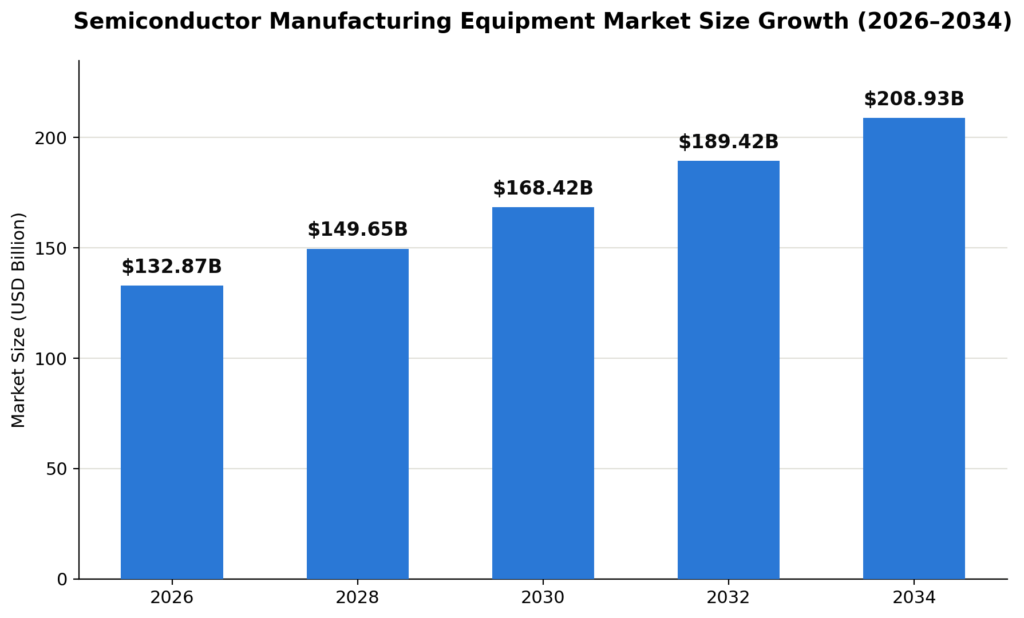
- Market Size (2026): USD 132.87 Billion
- Forecast (2034): USD 208.93 Billion
- CAGR (2026–2034): 8.6%
- Base Year: 2025
- Largest Segment: Front-End Equipment is the largest segment (~70–74% share in 2026)
- Leading Region: Asia Pacific (~67% Share)
Semiconductor Manufacturing Equipment Market Executive Summary
The Semiconductor Manufacturing Equipment market worldwide was valued at USD 132.87 Billion in 2026 (base year: 2025) and is projected to reach USD 208.93 Billion by 2034, growing at a CAGR of more than 8.6%. It’s being driven by demand for advanced semiconductors, AI accelerators and high-performance computers. Front-End equipment make up a large share of about 70-74% of the overall segment in manufacturing equipment, indicating the strong focus and investment in technologies used in wafer fabrication, such as EUV lithography, deposition, etching and others. Asia Pacific holds about 67% market share of semiconductor manufacturing equipment with strong presence of players participated in the market research such as Taiwan, China and South Korea.
Semiconductor Manufacturing Equipment Market Overview (2026)
Semiconductor manufacturing equipment refers to the machinery and systems that are used in the fabrication of integrated circuits (ICs) and semiconductor devices . This includes both front-end processes such as wafer fabrication, lithography, etching, deposition and ion implantation, as well as back-end processes such as assembly, packaging and testing. With this equipment, chipmakers can create increasingly smaller, more powerful semiconductors for consumer electronics, automotive, telecommunications, industrial automation, and AI/data centre applications. Major equipment categories are lithography systems, etch and deposition systems, wafer inspection systems, and packaging/test equipment.
The future of the market will possibly be influenced by ongoing geographical diversification of fab capacity as economies like the US, Japan, and India seek to decrease their dependence on concentrated Asia Pacific manufacturing hubs; however, the Asia Pacific region is predicted to maintain its dominance during the entire forecast period due to its current infrastructure and knowledge in the field. Equipment manufacturers are expected to invest massively in EUV and high-NA EUV lithography systems in order to facilitate the production of next generation process nodes as well as increasing R&D in AI-based defect detection and yield optimization solutions that minimize manufacturing losses and increase fab efficiency. In addition, the back-end/advanced packaging sector is predicted to grow at a faster rate than the front-end equipment one due to the spread of chiplet-based technology; this indicates that the industry is undergoing a transformation from pure miniaturization to a new type of integration.
How does Government Investment Impact the Semiconductor Manufacturing Industry?
Government investment in the fabrication equipment sector is occurring due to the number of fabrication plants currently being built and planned to be built in the coming years. The number of plants under construction is indicative of the investment being made in the fabrication equipment sector. Increasing government investment encourages both remaining and new stakeholders to introduce innovative production technologies. These government investments in fabrication plants directly correlate to the investments being made by Wafer Manufacturing Equipment (WFE) and Advanced Packaging Equipment (APE) fabrication plants.
Market Dynamics 2026
Growth Drivers
Growth Need for Sophisticated Semiconductors.
The continuing adoption of artificial intelligence, high-performance computing and smart consumer electronics is saturating the chipmakers fabrication capacity, which increases the demand from manufacturing equipment.
Growth of global semiconductor manufacturing plants.
New wafer fabrication plants are being developed at a rapid pace in major semiconductor-producing regions which have created a sustained demand for lithography, deposition, etching, and inspection systems.
Move to high development processes.
The move to smaller nanometer technologies requires more sophisticated and accurate equipment which forces continuous upgrades and replacements within a fabrication facility.
Surge of Electric Cars and Automotive Electronics.
Advanced driver-assistance systems (ADAS), along with other in-vehicle electrochemical large batteries, connected vehicles and electric powertrains, have gained significant traction in recent years.
Trends
EUV and High-NA EUV Lithography Uptake
Leading foundries are ramping up investment in extreme ultraviolet (EUV) and next-generation high-NA EUV systems to enable sub-3nm and future process nodes, with ASML remaining the dominant supplier of this critical technology.
Acceleration of AI & HPC Requirements
Artificial intelligence and high performance computing (HPC) are key drivers for the latest process nodes, as well as for advanced packaging.
Rapid Growth in Advanced Packaging & Chiplet Integration
The shift from monolithic chip design to chiplet-based architectures is driving strong demand for back-end equipment supporting 3D stacking, heterogeneous integration, and advanced packaging techniques like CoWoS and hybrid bonding.
AI-Driven Demand Reshaping Equipment Investment
The explosive growth of AI accelerators, GPUs, and data center infrastructure is redirecting capital expenditure toward equipment capable of producing high-performance logic and HBM (high-bandwidth memory) chips.
Geographic Diversification of Fab Capacity
Government incentive programs – the US CHIPS Act, EU Chips Act, Japan’s semiconductor subsidies, and India’s Semiconductor Mission – are driving new fab construction outside traditional Asia Pacific hubs, gradually reshaping equipment demand geography.
Rising Investment in Silicon Carbide (SiC) & Gallium Nitride (GaN) Equipment
Growing adoption of electric vehicles, renewable energy systems, and industrial power electronics is fueling demand for specialized equipment to manufacture wide-bandgap power semiconductors.
Increasing Adoption of AI-Powered Yield Management & Defect Detection
Fabs are integrating machine learning-based inspection and metrology systems to improve yield rates, reduce waste, and detect nanoscale defects earlier in the production process.
Growing Focus on 300mm Wafer Capacity Expansion
300mm wafers continue to dominate new fab investments due to superior production efficiency and lower cost per chip, particularly for advanced logic and memory manufacturing.
Supply Chain Localization & De-risking Strategies
Chipmakers and equipment suppliers are diversifying supply chains for critical materials and components to reduce geopolitical risk exposure, particularly around rare earth elements and specialty chemicals.
Strategic M&A and Capacity Expansion by Equipment Makers
Leading players (Applied Materials, ASML, Lam Research, Tokyo Electron, KLA) are expanding manufacturing capacity and pursuing partnerships to meet surging fab orders while managing supply chain bottlenecks.
Top Companies Covered In This Report
- Applied Materials Inc.
- Lam Research Corporation
- KLA Corporation
- ASML
- Tokyo Electron Limited
- Advantest Corporation
- SCREEN Semiconductor Solutions Co., Ltd.
- Cohu, Inc.
- ACM Research Inc.
- Nordson Corporation
- Tokyo Seimitsu Co., Ltd.
- EV Group (EVG)
- Modutek Corporation
- Dainippon Screen Group
- Ferrotec Holdings Corporation
Semiconductor Manufacturing Equipment Industry Company News
Applied Materials Inc.
News (2025-2026): Reported strong momentum entering 2026, expecting over 20% growth in semiconductor equipment driven by AI computing, advanced logic, and high-bandwidth memory demand. Expanded focus on advanced packaging and hybrid bonding technologies supporting next-generation chip architectures.
Industry impact:
Applied Materials’ investments reinforce the shift toward AI-optimized fabrication and advanced packaging, accelerating capital spending cycles while also emphasizing regulatory risk management across global supply chains.
Lam Research Corporation
News (2025–2026):
Achieved important customer wins for advanced etch systems supporting 3D DRAM and next-generation memory production. Benefited from rising demand for DDR5 and high-bandwidth memory manufacturing transitions.
Industry impact:
Lam Research strengthens the etch equipment segment, enabling memory scaling and reinforcing the growing equipment intensity per wafer as chip architectures become more complex.
Tokyo Electron Limited
2026 Focus:
Expanded involvement in advanced packaging and wafer processing technologies alongside global equipment peers.
Industry impact:
Tokyo Electron’s expansion supports the industry’s transition from traditional scaling toward heterogeneous integration and packaging innovation.
Cohu, Inc.
Company News (2025–2026):
Focused on semiconductor test handling and automation solutions aligned with automotive and industrial chip reliability requirements.
Industry Impact
Growing automotive semiconductor standards are expanding long-term demand for reliability testing and automated inspection systems.
Detailed Segmentation and Classification of the report (Market Size and Forecast – 2034, Y-o-Y growth rate, and CAGR):
Segment by Product Type
- Logic Devices
- Memory Devices
- Analog Devices
- Optoelectronics
- Sensors
- Others
Segment by Application
- Foundry & Logic Manufacturing
- DRAM Manufacturing
- NAND Manufacturing
- Analog & Mixed Signal Devices
- Discrete Devices
- Optoelectronics
Segment by Dimension (Integration Technology):
- 2D ICs
- 5D ICs
- 3D ICs
Segment by End User
- Semiconductor Foundry
- Integrated Device Manufacturers (IDMs)
- Outsourced Semiconductor Assembly & Test (OSAT) Providers
- Research Institutes & Pilot Lines
Segment by Manufacturing Facility Size
- Large-Scale Manufacturing Facilities
- Medium-Scale Manufacturing Facilities
- Small-Scale Manufacturing Facilities
Segment by Supply Chain Process
- Wafer Fabrication
- Assembly & Packaging
- Testing & Inspection
Regional Deep-dive Analysis:
The report provides in-depth qualitative and quantitative data on the Semiconductor Manufacturing Equipment Market for all of the regions and countries listed below:
North America
North America keeps pivotal importance in semiconductor manufacturing especially in the years to come because of many developing technology, government funding, and fabrication plants. Manufacturing plants in this area have a well developed and established ecosystem to make semiconductors including varied and developed manufacturing directed research and development, a workforce, and technology in high-end processing.
Utilization of the U.S. Fab Expansion
In the U.S. construction of various logic and memory manipulation plants are taking place in the states Arizona, Texas and New York, these plants are meant to implement the most modern manufacturing.
Incentives by the Government. Stimuli programs made by the CHIPS Act in the U.S. support the production of domestic chips which in turn creates the need of construction of wafer fabrication and testing plants.
Focus on Advanced Other Back End Packaging. Due to the recent high backing demand for equipment, the use of the 2.5D and 3D packaging has increased in chips related to artificial intelligence, high performance computing, and automotive.
Innovation and Research and Development. The presence of well and great institutions of the developing semiconductor and the research centers increases the demand for the latest developed semiconductor tools such as lithography, deposition, and metrology.
Supply Chain Resilience. In North America, priority becomes regionally supported and diversified sources for equipment to retake services to support the equipment globally.
Canada
With the development of sensors, quantum computing chips, and niche analog devices, small scale equipment demand becomes great.
With the Research and Pilot Lines. Once the production of tester and inspection equipment becomes established, Canadian universities and research centers will have the opportunity to construct pilot production lines, thus advancing the production of these devices greatly.
Government Assistance: Fiscal policies assisting innovation in semiconductor manufacturing increase initial adoption of cutting-edge fabrication tools.
Mexico
Assembly & Packaging Center: Mexico continues to position itself as an expanding site for outsourced assembly and packaging (OSAT), increasing demand for back-end and testing tools.
Workforce Cost Benefits: Manufacturing labor that is less expensive promotes the establishment of mid-scale assembly and wafer testing facilities.
Transnational Cooperation: Robust relations with the U.S. simplify the transport of equipment and service integration.
Europe
In 2026, Europe will remain strategically important in the semiconductor manufacturing equipment market. The region specializes in research and development for advanced semiconductors, specialty chips, and fab modernization. European self-sufficiency is improving as the EU has been rolling multiple programs, including a semiconductor directive and incentives for domestic chips.
Germany
Germany allocates more than 5 billion euros. It will go to semiconductor foundries that manufacture logic chips and HPC.
Germany, the automobile’s core, will be a major beneficiary. That is, more demand for automotive semiconductor manufacturing equipment. For example, it may likely be for electric vehicles. Also, more demand for advanced packaging and wafer testing equipment.
A good number of research institutions and corporate R&D centres accelerate the adoption of next-generation lithography, etch and deposition tools.
France
Specialty Semiconductors focuses on analog, mixed-signal devices, and sensors for industrial and auto applications.
France is financing the production of pilot lines with government grants that create demand for small- to mid-scale fabrication and testing equipment.
Funding Programs: They encourage the deployment of efficient and precision equipment in regional fabs.
Netherland.
Having many lithography equipment suppliers, they are encouraging EUV adoption across European fabs.
Cutting-Edge Node Investment: Dutch fabs play a central role in the production of leading-edge logic chips, increasing demand for critical metrology, inspection and deposition tools.
Industry and university partnerships drive process innovation and adoption of advanced packaging.
Italy and Eastern Europe.
Italy, with Eastern European countries like Poland and Hungary, is rapidly becoming a location for OSAT and wafer-level packaging assembly and packaging functions.
Demands for Mid-Scale Equipment; Capacities in these areas focus on assembly testing and inspection equipment rather than advanced node front-end systems.
Competitive labor costs will drive growth of mid-cap semiconductor manufacturing by keeping quality at moderate levels.
Asia-Pacific
In the Asia-Pacific (APAC) regions, the demand from semiconductor manufacturing equipment is expected to rise, APAC is expected to dominate due to the government investments and incentives to wafer fabrication on a larger scale. The APAC semiconductor ecosystem has a large production volume and also has strong and rapid supply chains and the adoption for AI, Automotive, and consumer electronics end use applications.
The China region is seeing the largest rapid construction of fab that are large scale and incorporate logic, memory and specialty chips. The construction of such fabs is creating greater demands for construction of lithography, deposition, etch and testing systems. China has policies, subsidies and also encourages self sustaining semiconductor programs as part of their strategy for self sustaining infrastructure for advanced tools to be integrated.
The construction of advanced packaging systems will support and increase the need for back end equipment in the support of 2.5D and 3D chiplet as well as high bandwidth memory chip packaging. As the supply chain is localizing the importing of high tech equipment from international sources will also be reduced.
Taiwan is dominating the logic and memory production. The country has advanced node logic and memory chips and is the leader in the use of EUV lithography, deposition, etch and metrology systems. High levels of Capital are required for continuous technological changes, expansions and upgrades of TSMC advanced node Fabs as they require long term investment in equipment to ensure top production levels. The country has a strong engineering and research workforce that is to a greater extent able to integrate AI assisted automation in fabrication.
South Korea Memory Dominance
The demand for South Korea’s memory info tech sequencing goods is on the rise due to the location of South Korea’s Memory Dominance global leaders for DRAM and NAND memory technologies and the continued memory scaling technologies that South Korea provides.
Technology Modernization
As a result of the increasing need for South Korea to modernize its technologies with next-generation logic and DRAM nodes, South Korea is a global leader in the modernization of packaging and wafer fabrication tools.
Back-End Innovation
The new packaging systems that have been developed for High Performance Computing (HPC) and Artificial Intelligence (AI) accelerators are rapidly expanding the market for testing and assembly equipment.
Japan
Specialty and Mature-Node Focus
The growing demand for production equipment for analog, discrete, and sensor devices is fostering equipment growth on the middle and small scale for Japan and the Asia Pacific region.
Equipment Manufacturing Leadership
Japanese fabrication, cleaning, and etching, and wafer deposition tool manufacturers are global leaders in the supply of those tools for the semiconductor industry.
Pilot Lines and Research Initiatives
The work of the R&D departments of the universities and companies is vital to the production of advanced specialized semiconductors and the prototyping of those semiconductors with specialized equipment at the small scale.
Southeast Asia (Singapore, Malaysia, Thailand)
OSAT and Back-End Manufacturing Hub
Countries such as Malaysia and Singapore have become the main back-end assembly, testing, and packaging hubs in the region.
Mid-Scale Equipment Growth
The development of mid-scale equipment for wafer testing, bonding, and inspection systems is on the rise, particularly for automotive, IoT, and consumer electronics chips.
Skilled Workforce and Logistics
The efficient logistics and skilled labor in the countries also provides a competitive advantage in the back-end semiconductor processes.
Frequently Asked Questions with Answers
What is the Semiconductor Manufacturing Equipment Market current size?
Semiconductor Manufacturing Equipment Market is projected to reach a value of USD 132.87 Billion in 2026 and is anticipated to grow to approximately USD 208.93 billion by 2034.
Who are the key players in the Semiconductor Manufacturing Equipment market?
The Semiconductor Manufacturing Equipment Market Includes Major Companies Applied Materials Inc., Lam Research Corporation, KLA Corporation, ASML, Tokyo Electron Limited, Advantest Corporation, SCREEN Semiconductor Solutions Co., Ltd., Cohu, Inc., ACM Research Inc.
What are the current and future trends for Semiconductor Manufacturing Equipment market?
The Semiconductor Manufacturing Equipment market is trending toward AI-driven chip production, advanced node miniaturization, heterogeneous and advanced packaging technologies, smart factory automation, and geographically diversified semiconductor manufacturing investments.
Which regions dominate the Semiconductor Manufacturing Equipment market?
Asia Pacific leads decisively across virtually all sources, with ~67% market share in 2026, supported by the concentration of leading foundries, memory manufacturers, and OSAT facilities.
Customization: We can provide following things
1) On request more company profiles (competitors)
2) Data about particular country or region
3) We will incorporate the same with no additional cost (Post conducting feasibility).
Any Requirement Contact us: https://www.forinsightsconsultancy.com/contact-us/
Related Reports
Semiconductor Foundry Market Trends
Outsourced Semiconductor Assembly and Test (OSAT) Market Size
Semiconductor Production Equipment (SPE) Market Share