

Biofertilizers Market Growth Analysis Research Report By Type: Nitrogen-Fixing Biofertilizers, Phosphate-Solubilizing Biofertilizers, Potash-Mobilizing Biofertilizers, Micronutrient Biofertilizers, Others, By Microorganism: Rhizobium, Azotobacter, Azospirillum, Blue-Green Algae (Cyanobacteria), Mycorrhiza, Bacillus, Pseudomonas, By Application: Seed Treatment, Soil Treatment, Foliar Spray - and Global Forecast to 2034
Mar-2026 Formats | PDF | Category: Agriculture | Delivery: 24 to 72 Hours
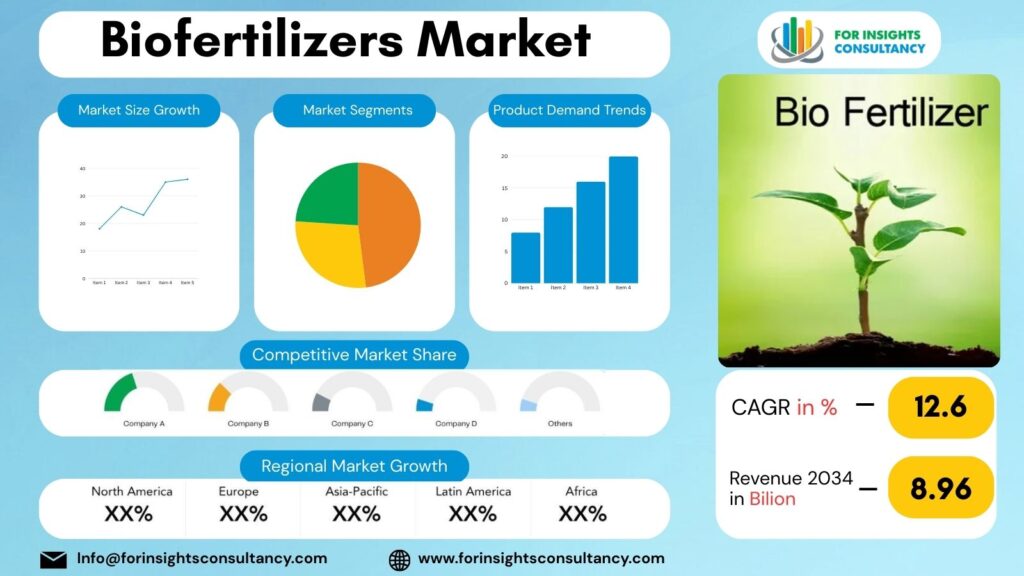
Global Biofertilizers Market expanding at 12.6% CAGR, rising from USD 2.86 Billion (2025) to USD 8.96 Billion by 2034, driven by eco-friendly farming and soil health solutions.
Overview of the Biofertilizers Market and Expected Growth (2026)
Soil regeneration and cutting back on agrochemical fertilizers and biofertilizers, made of useful microorganisms, are trending in the 2026 biofertilizers market and driving the ever-increasing adoption and diversification of biofertilizers in response to the environmental stresses of farming. Biofertilizers are ideal as they help to improve the productivity of crops and increase the sustainable farming practices. The farming community and agribusiness sector, along with support of policy makers, are accepting and incorporating biological crop nutritional inputs as values to soil health and enhanced the biological structure and activity of soils.
The world is becoming increasingly aware of the problem of soil degradation and the importance of restoring the biological activity of soils. The degradation is largely a result of farming that uses synthetic fertilizers. Biofertilizers are becoming accepted as supportive supplements instead of being the sole nutrient source to help increase the bioactivity of distressed soils and improve the productivity of crops. Biofertilizers are being recognized as supplements that improve the overall effectiveness and lowers the necessity of agrochemical fertilizers.
Increased investment in sustainable agriculture due to government programs is another important driver of growth. Countries are providing first-time subsidies to farmers as a way to encourage more sustainable farming practices. Eco-friendly practices are taught to farmers through educational programs. These practices increase farmers’ use of biological inputs for crop growth. The initiatives, aimed at educating farmers, complement sustainability and climate goals for decreasing GHGs and increasing carbon sequestration in soil.
Sustained market growth for 2026 is being driven by government support of technological developments. In microbial strain and fermentation technologies, as well as in improvement and reliability of field performance for increased shelf-life of products, sustained improvement is being realized. The formulation of modern biofertilizers has made carrying, applying, and transporting biofertilizers simpler and is eliminating barriers to their adoption. Furthermore, modern biofertilizers have and are being further developed to be used in combination with precision farming technology.
Within the Asia-Pacific region, due to the presence of large economies based in agriculture, adoption is extending in Asia-Pacific and increasing for Organic Farming. In Europe and North America, as agriculture practices that support these regulations of the Environment are used, they are providing a sustaining and renewable form of agriculture. Farming in developing regions is interested in cost-effective practices for sustaining declines in fertility.
Innovations, supportive regulations, and a rise in consumer demand for sustainably produced food will drive the biofertilizers market toward biofertilizers being more broadly used in agriculture in 2026. Moreover, the combination of bio-fertilizers with other technologies such as biotechnology and digital agriculture will establish bio-fertilizers as a key focus area for crop nutrition as environmental stewardship approaches.
Market Dynamics 2026
Growth Drivers
Expansion of Sustainable Agriculture Methods
Farmers are engaging with biological crop inputs as a means of eliminating the use of synthetic fertilizers while also aligning with environment sustainability objectives, as the inputs also improve the growing system. Environmentally sustainable practices are also coupled with the objectives of maintaining the growing system’s soil quality.
Increased Concern with Soil Health
The soil degradation that has accompanied the use of chemical fertilizers has led a number of regions to adopt microbial-based solutions to replenish the nutrient cycle and enhance the microbial ecosystem of the soil.
Increased Organic and Residue-Free Farming
The growing demand for food without chemical residues has stimulated the Organic farming. Biofertilizers use in a more sustainable nutrient management and compliance with certification guidelines.
Increased Government Policy Support
Increased use of biological fertilizers has been facilitated by government policies, subsidized training and awareness programs, and supportive assessments of biological fertilizers as part of more environmentally friendly, climate-smart, and low-input sustainable agriculture practices.
Restraints
Limited awareness and technical understanding of farmers
In numerous agricultural areas, there is a lack of understanding regarding the appropriate methods of application, storage, and time frames relating to the performance of biofertilizers, and as a result, adoption is much lower than that of conventional fertilizers.
Short shelf life and storage issues
Due to the fact that biofertilizers are living microorganisms, they are sensitive to temperature, humidity, and light, creating a number of logistical issues in regard to the transport and storage of biofertilizers, especially in areas lacking a cold chain system, which hampers the transport and storage of biofertilizers.
Variable performance in the field
Microbial products are dependent on soil conditions, climate, crop types, and compatible microbes in the field which can lead to inconsistent results compared to chemically based fertilizers which will result in a more predictable outcome.
Delayed Nutrient release
Biofertilizers may provide nutrients more slowly and less attractively than immediately available chemical fertilizers during critical growth periods of crops, biofertilizers are less active during most of the life cycle of the plant as they provide nutrients through the activity of biological processes that take time to become active.
Opportunities
Biofertilizers and the Future of Agriculture
The global emphasis on soil health and responsible farming practices creates opportunities for microbial solutions that improve soil ecosystems and mitigate chemical dependencies.
Restoration of Battered Ecosystems and Global Demand for Organic Produce
The increasing organic farming methodology adoption globally accelerates the need for compliant biofertilizers that sustain certification and residue-free farming practices.
Climate-Conscious Agriculture
Incorporating biological alternatives to synthetic fertilizers to mitigate greenhouse gas emissions is being encouraged for low-emission farming practices
Advanced Technologies for Enhanced Nutrient Use Efficiency
Developing agricultural economies stand to gain commercially from biofertilizers’ capacity to increase the uptake of nutrients and fixation of nitrogen resulting in the farming community less reliant on chemical fertilizers.
Challenges
Variability in Product Quality by Geography
Biofertilizers are based on living microorganisms. Because of the variability in microbial viability, concentration, and production standards, performance of the products can be inconsistent leading to decreased farmer confidence and decreased adoption.
Storage and Shelf Life Issues
Microbial strains are temperature, humidity, and light sensitive making them more difficult to store and transport, especially in areas without cold-chain transport.
Underperformance in Various Soil Conditions
Biofertilizers can be less effective depending on soil pH, moisture, and climate, and interaction with native microorganisms which can lead to inconsistent performance across farms and regions.
Compared to Chemical Fertilizers, Biofertilizers have Delayed Nutrient Release
Biofertilizers provide delayed nutrient availability to the soil as microbial activity needs to be established. This can be discouraging to farmers more interested in immediate yield increases.
Top Companies Covered In This Report
(Major global and regional players shaping the industry)
- BASF SE
- Novozymes A/S
- UPL Limited
- Korean Biofertilizer Company
- Stanes & Company Ltd.
- TATA Chemicals Ltd.
- Valagro S.p.A.
- Associates of Cape Cod Inc.
- AgriLife
- Agri Biotech Pvt Ltd
- Symborg S.L.
- Isagro S.p.A.
- Enconta Biofertilizers LLC
- I.D. Parry Limited
Biofertilizers Industry Company News
BASF SE
2025: BASF expanded its agricultural biologicals portfolio by launching new microbial biofertilizer solutions focused on enhancing nitrogen fixation and phosphorus solubilization in major crop systems.
2026: The company announced partnerships with regional distributors in Asia and Latin America to improve last‑mile delivery and farmer training programs for bio‑input adoption.
UPL Limited
2025: UPL launched an integrated suite of bio‑nutrient products complementing traditional inputs, emphasizing synergistic effects with reduced chemical fertilizer usage.
2026: The company strengthened its rural outreach by establishing mobile demonstration farms showcasing biofertilizer performance in diverse agroecological zones.
- Stanes & Company Ltd.
2025: T. Stanes expanded its biofertilizer production capacity in South India to meet rising farmer demand for organic and sustainable inputs.
2026: The firm collaborated with agricultural universities to conduct training workshops on best practices for microbial product application and soil health monitoring.
Detailed Segmentation and Classification of the report (Market Size and Forecast – 2034, Y-o-Y growth rate, and CAGR):
By Type
- Nitrogen-Fixing Biofertilizers
- Phosphate-Solubilizing Biofertilizers
- Potash-Mobilizing Biofertilizers
- Micronutrient Biofertilizers
By Microorganism
- Rhizobium
- Azotobacter
- Azospirillum
- Cyanobacteria (Blue-Green Algae)
- Mycorrhiza
- Phosphate-Solubilizing Microorganisms (PSM)
By Crop Type
- Cereals & Grains
- Pulses & Oilseeds
- Fruits & Vegetables
- Plantation Crops
- Turf & Ornamentals
By Form
- Liquid Biofertilizers
- Carrier-Based (Solid) Biofertilizers
By Application
- Seed Treatment
- Soil Treatment
- Foliar Application
By End User
- Farmers
- Commercial Agriculture Producers
- Greenhouses & Nurseries
- Research & Agricultural Institutions
Regional Deep-dive Analysis:
The report provides in-depth qualitative and quantitative data on the Biofertilizers Market for all of the regions and countries listed below:
North America
In 2026, North America is forecasted to be one of the most technologically advanced and commercially developed biofertilizer markets owing to developed farming practices, a strong awareness of sustainable agriculture, and a growing regulatory focus on the protection of the environment. Biofertilizers are now increasingly regarded by farmers as means to overcome the problems of nutrient runoff, climate change, and the increase of organic matter. Biofertilizers are now increasingly regarded by farmers as means to overcome the problems of nutrient runoff, climate change, and the increase of organic matter. North America is firmly establishing itself as a market of progressive farming practices and operationally sustainable agriculture.
Due to its large-scale commercial farming operations, the United States serves as a leader in the regional adoption of biological crop input systems in precision agriculture. Adoption is expanding to commercial farming operations where microbial products are being used to stimulate nitrogen fixation, increase phosphorous availability, and enhance the efficiency of fertilizer applications. A collaborative approach by agricultural technology providers, universities, and agronomic advisors creates a basis for on-farm validation of biological products, and along with education and confidence, fosters adoption. Furthermore, the sustainability promises made by food processors and retailers are encouraging farmers to practice responsible and sustainable nutrient management within the agricultural supply chains.
Canada has positioned itself as a key player in the growth of the regenerative commerce market due to soil carbon management and regenerative farming practices. Farmers in Canada’s prairie regions are utilizing biofertilizers to increase soil microbial activity and to fortify crops under stressful climate conditions. In Canada, northern prairie region farmers use biofertilizers to comply with governmental mitigation programs that support the reduction of emissions and the conservation of soil. The country has a robust research network, and northern climates are developing cold-tolerant microbial strains.
Adoption of biofertilizers in Mexico is driven by the agricultural sector’s focus on the reduction of synthetic fertilizers and the improvement of soil fertility in overexploited soil regions. The use of biofertilizers has grown in export-driven, horticultural and fruit farming. Here, the market has placed sustainability certifications and residue-free farming as paramount. Training and agricultural extention services have been paramount in the education of farmers on the use of integrated nutrient management and biofertilizers.
Europe
Sustainable agriculture is becoming the focus of farming practices across the whole European region. As the use of harmful agricultural chemicals is phased out and practices that assist soil life and soil regeneration start to encourage the use of bio-fertilizers that assist the soil’s microbial life and the soil’s ability to capture and utilize nutrients. The gradual adoption of this method by European farmers gives evidence of their willingness to comply with Europe’s commitment to maintaining high levels of agricultural productivity and soil health while minimizing the use of chemicals.
There is also a large demand for sustainable farming practices that assist the soil’s microbial systems in the European region. Due to the developed sectors of organic farming and sustainable food growing in Germany, France, and the Netherlands, a demand for microbial soil fertilization to be integrated into precision farming systems is justified. The long-term productivity of the soil and the ecological health of the soil that has served humanity for decades is being demanded. The soil needs to restore the microbial life that has been depleted by centuries of farming practices.
The adoption of biofertilizers in Denmark, Sweden, and other Northern European states is a direct effect of the region’s implementation of favorable environmental policies and the development of a strong cooperative research network between bioengineering, agriculture, and environmental sciences. Farmers are seeking microbial solutions for better nitrogen utilization and lower nutrient loss by leaching to waterways, as this is the major environmental problem in the region. Additionally, sustainable livestock farming systems are indirectly increasing the demand for biofertilizer due to integrated nutrient recycling and initiatives of circular farming.
The Southern European region comprises mainly of southern European states, specifically Spain, Italy, and Portugal. Here, the adoption of biofertilizers is driven by climate (i.e. water scarcity, soil erosion, and loss of soil organic matter) related issues. Biofertilizers are becoming more common in the horticultural, vineyard, and other high-value specialty crop sectors as soil and crop quality, as well as the health and resilience of plants, are becoming more important due to climatic variability (droughts and floods) and unexpected rainfall/floods.
Central and Eastern Europe, particularly, are expected to have a significant demand for biofertilizers by the year 2026. In these regions, the modernization of agriculture, particularly alignment with European standards of sustainability, is influencing the adoption of biological inputs in combination with integrated nutrient management. These regions have low awareness, but with development of network distribution, it’s expected that biofertilizers will become a common tool in farming in the near future.
Asia-Pacific
The Asia-Pacific biofertilizers market will experience strong growth owing to the impacts of population growth and food demand on the region’s agricultural productivity and soil sustainability. Governments and agricultural communities are encouraged to adopt nutrient-efficient agricultural inputs. Along with policy change, the use of biofertilizers is becoming more common in response to soil degradation awareness among farmers. Several agricultural universities are conducting outreach programs to educate and demonstrate the use of microbial solutions to improve soil health and nutrient availability.Active soil is vital to improve soil health and nutrient availability.
Owing to recent policy strategies that include sustainable farming and biofertilizer use, both India and China are set to develop and grow regionally and globally. China, through the use of technology in agriculture, has seen the growth of microbial biofertilizers in integrated nutrient management systems. In India, through the use of cooperatives and local production units, biofertilizers are used in the crop nutrition program for cereals, pulses, and vegetables. Both countries are seeing the growth of the private sector, focusing on climate-resilient and soil-specific microbial strains.
The countries of Southeast Asia, the Philippines, Thailand, Vietnam, and Indonesia, are changing their agricultural approach toward more sustainable practices and receiving accreditations like the ‘Agricultural Export Certification of the European Union’. In the plantation, vegetable, and fruit farming inland, the utilization of biological soil enhancers has also shown promising results in increasing soil productivity. Agriculture-developed nations Japan, Australia, and South Korea are adopting precision agriculture methods. In the agricultural sector, digitalized farm monitoring, advanced irrigation systems, and biofertilizers are used to reduce environmental pollutants, thus, maximizing nutrient use efficiency.
Middle East and Africa
The regional biofertilizer market in the Middle East and Africa is predicted to grow in the next 4 years due to the biofertilizers’ alignment with the new farming practices expected to develop in the area over the forecast period. Factors like limited, arable land and water, and soil nutrient depletion are driving farmers and policymakers to investigate biological soil amendment alternatives.
Biofertilizers are being recognized as the sustainable solution to enhance soil health and nutrient uptake. Particularly where soil productivity is diminished due to over chemical fertilization. Increased focus on soil health as a restorative approach to problem soils is being supported by governments and agrarian development initiatives, signaling soil restoration to be a solution in the errors of antiquated formulas.
There is focus on agrarian development in the Middle Eastern regions of the Middle East and Africa due to controlled-environment farming and a desire to develop regional food self-sufficiency. Countries like the UAE and KSA that are implementing and investing in advanced farming practices like biofertilizers supported desert agriculture are experiencing improved nutrient retention and decreased synthetic farming practices. Increased use of microbial formulas is expected in the developed horticultural sector, particularly in high-value fruits and vegetables with advanced irrigation practices. As a national priority, stakeholders of the agriculture sector in the Middle East are seeking biological inputs to achieve optimal water use efficiency and embrace regenerative agriculture practices.
Long-term growth potential for markets in agricultural development is best for the African continent because of the market’s large untrained agricultural labor supply and the developing emphasis on sustainable cropping systems in the region.
Countries like Kenya, Ethiopia, Nigeria, and South Africa have Agricultural Training and Technology Transfer Partnership Programs that focus on management of soil and subsoil resources, and the role of local agritech partners is pivotal for improved soil health management. Given that smallholder farmers constitute the majority of the Agricultural Sector in most developing countries, farmers’ adoption of bio-fertilizers is increasing because of the low cost and improved soil health. Staple food and horticultural crops cultivated with bio-fertilizers experience increased nutrient use efficiency and, therefore, improved productivity and profitability of the farmers as well.
Frequently Asked Questions with Answers
What is the Biofertilizers market size and growth forecast?
Biofertilizers Market is projected to reach a value of USD 2.86 Billion in 2025 and is anticipated to grow to approximately USD 8.96 Billion by 2034. This expansion reflects a compound annual growth rate (CAGR) of 12.6% during the forecast period from 2026 to 2034.
Who are the key players in the Biofertilizers market?
The Biofertilizers Market Includes Major Companies BASF SE, Novozymes A/S, UPL Limited, Korean Biofertilizer Company, T. Stanes & Company Ltd., TATA Chemicals Ltd., Valagro S.p.A., Associates of Cape Cod Inc., AgriLife, Agri Biotech Pvt Ltd, Symborg S.L., Isagro S.p.A., Enconta Biofertilizers LLC, E.I.D. Parry Limited, Others.
What are the current and future trends for Biofertilizers market?
The biofertilizer’s market current and future growth are influenced by the increasing adoption of sustainable and regenerative farming, its combined use with precision farming technologies, and the advancements in microbial and multi-strain biofertilizers.
Which regions dominate the Biofertilizers market?
The Asia-Pacific region, followed by North America and Europe, boasts the greatest share of the biofertilizers market owing to high levels of agricultural activity, the growing incorporation of organic farming, and robust sustainability initiatives.
Key insights provided by the report that could help you take critical strategic decisions?
- Regional reports analyse product/service consumption and market factors in each region.
- Reports highlight possibilities and dangers for suppliers in the Biofertilizers Market business globally.
- The report identifies regions and sectors with the highest growth potential.
- It provides a competitive market ranking of major companies, as well as information on new product launches, partnerships, business expansions, and acquisitions.
- The report includes a comprehensive corporate profile with company overviews, insights, product benchmarks, and SWOT analysis for key market participants.
Customization: We can provide following things
1) On request more company profiles (competitors)
2) Data about particular country or region
3) We will incorporate the same with no additional cost (Post conducting feasibility).
Any Requirement Contact us: https://www.forinsightsconsultancy.com/contact-us/
Table of Contents
For TOC Contact us: https://forinsightsconsultancy.com/contact-us/