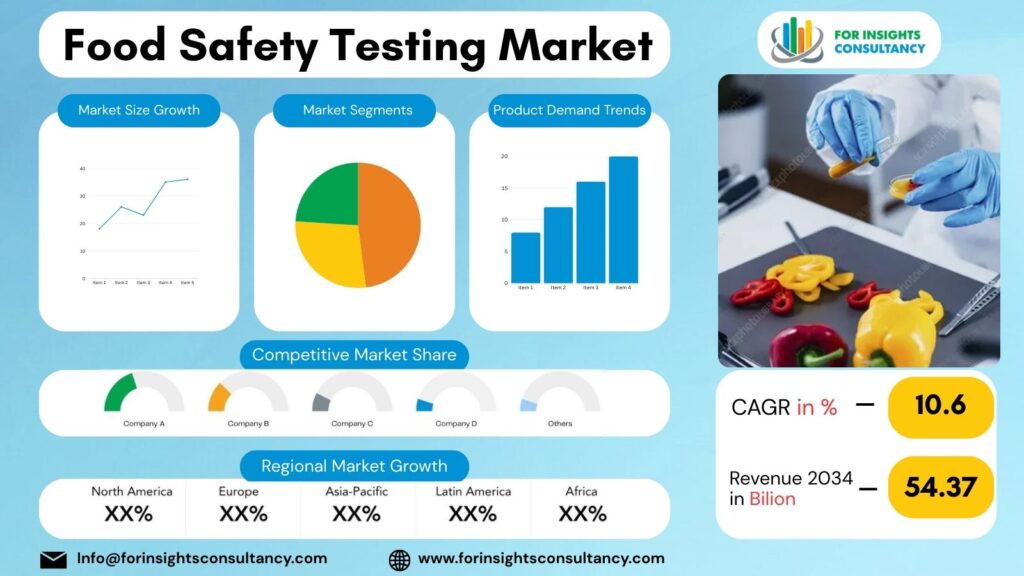
The Global Food Safety Testing Market is estimated to be valued at USD 27.89 Billion in 2025 and is expected to reach USD 54.37 by 2034, growing at a compound annual growth rate (CAGR) of 10.6% from 2026 to 2034.
Food Safety Testing Market: Overview and Growth in the Upcoming Year
global Food Safety Testing Market in 2026? It’s leaning toward steady growth, honestly. Governments are tightening the screws—enforcing more, consumers are paying more attention, and global supply chains have never been more tangled. By 2026, the market size is pegged at about USD 28–30 billion, basically mid-to-high single-digit growth from what we’ve seen before. And yeah, authorities worldwide keep raising the bar on compliance, which means manufacturers and suppliers gotta ramp up their testing game.
Growth in 2026 is driven mainly by the rising incidence of foodborne illnesses, the expansion of processed and packaged foods, and the globalization of food trade. Food companies are increasingly investing in advanced diagnostic technologies—rapid PCR-based testing, immunoassays, and chromatography—to get faster and more accurate detection of pathogens, allergens, toxins, and pesticide residues. Additionally, stricter labeling requirements and export regulations are pushing companies to tighten quality control measures.
Regionally, North America is still the dominant market in 2026, you could say—it’s all about strict regulatory frameworks and a well-oiled lab infrastructure, the kind that just gets things done. Europe? It’s not far behind, with solid compliance standards keeping everything in check. Then there’s Asia-Pacific, the speedster of the bunch: fastest-growing region, driven by expanding food processing industries, more urbanization, and a wave of government moves to boost food safety in emerging economies like China and India.
Looking ahead, 2026 isn’t just another year—it’s a transition year where digitalization and automation in food testing labs get more front-and-center. AI, blockchain-based traceability systems, and portable rapid testing kits are expected to up the game and improve market efficiency. All in all, the Food Safety Testing Market in 2026 shows a strong growth trajectory, positioning the industry for sustained expansion through the rest of the decade.
Top Companies Covered In This Report
- Eurofins Scientific SE
- Intertek Group plc
- Bureau Veritas SA
- ALS Limited
- TÜV SÜD AG
- AsureQuality Limited
- Bio-Rad Laboratories Inc.
- Thermo Fisher Scientific Inc.
- Microbac Laboratories Inc.
- Symbio Laboratories
- DNV GL
- NSF International
- Idexx Laboratories Inc.
- Neogen Corporation
- Agilent Technologies Inc.
- Shimadzu Corporation
- PerkinElmer Inc.
- Merieux NutriSciences Corporation
- The SOCOTEC Group
- Romer Labs Division Holding GmbH
- Charm Sciences Inc.
- Hygiena LLC
- R-Biopharm AG
- MilliporeSigma
- 3M Company
- QIAGEN N.V.
- SGS
Food Safety Testing Industry News
Eurofins posted solid Q1 2025 revenue growth (~6.9%) led by food/feed testing demand, reflecting resilient performance despite healthcare reimbursement challenges in some markets.
In January 2026, Eurofins reported it achieved its financial objectives for 2025 with ~24% EPS growth, driven by organic growth, disciplined cost control, and strategic acquisitions. Notably, food and feed testing registered strong growth in North America and APAC while new labs and signature systems supported digital ordering and data delivery. A new Brisbane laboratory is anticipated to open by Q1 2026.
In 2025, Intertek continued investment in food testing and safety services, with its Half Year Results showing increased demand for food safety testing and hygiene audits across factory supply chains.
Detailed Segmentation and Classification of the report (Market Size and Forecast – 2034, Y-o-Y growth rate, and CAGR):
Segment By Test Type
- Pathogen Testing
- GMO Testing
- Allergen Testing
- Chemical and Toxin Testing
- Pesticide Residue Testing
- Heavy Metal Testing
- Others
Segment by Technology
- PCR-Based Testing
- Immunoassay-Based Testing
- Chromatography and Spectrometry
- Rapid Testing Kits
- Next-Generation Sequencing (NGS)
- Others
Segment by Food Type
- Meat and Poultry
- Dairy Products
- Processed Foods
- Fruits and Vegetables
- Cereals and Grains
- Seafood
- Beverages
- Others
Segment by Target Tested
- Salmonella
- coli
- Listeria
- Campylobacter
- Norovirus
- Mycotoxins
- Allergens
- Others
Segment by Service Type
- In-House Testing
- Third-Party Laboratory Testing
Regional Deep-dive Analysis:
The report provides in-depth qualitative and quantitative data on the Food Safety Testing Market for all of the regions and countries listed below:
North America
In 2026, North America is still the big boss of the global food safety testing market—the region leads by a long shot, driven by tight regulatory frameworks, slick laboratory infrastructure, and high consumer safety expectations. Estimates do vary, sure, but most industry reports say the market will grow modestly from its 2025 level, a sign of sustained demand for food safety and quality assurance services.
The U.S. and Canada still have some of the strictest food safety rules on the planet, with agencies like the FDA, USDA, and CFIA (Canadian Food Inspection Agency) enforcing testing standards that cover microbiological, chemical, and allergen hazards. FSMA—the Food Safety Modernization Act—keeps creating ongoing demand for routine and preventive food testing across all major food types.
North American consumers and retailers are quick to react to recalls and contamination alerts, so producers and processors are pushed to expand testing proactively to dodge brand risk and costly recalls. And yes, reports keep highlighting recalls tied to pathogens (Salmonella and E. coli) and undeclared allergens.
Tech innovation—especially PCR-based assays, rapid testing kits, and next-generation sequencing—continues to be a strong growth engine. North America still holds a leading share of the PCR-based food safety assay market, a reflection of investments in fast, accurate detection methods that modern compliance protocols depend on.
Europe
By 2026, the Europe Food Safety Testing Market is projected to be valued at around USD 8.41 billion, up from 2025 levels as the region keeps expanding its analytical and compliance testing services. It’s a healthy growth trajectory, powered by more widespread use of advanced testing, tougher regulatory enforcement, and consumers demanding higher food quality and safety.
Europe’s stringent safety frameworks—led by the European Food Safety Authority (EFSA) and the General Food Law (EC 178/2002)—mean there’s real, ongoing monitoring of microbiological and chemical hazards across the food supply chain. This regulatory pressure pushes food producers and processors to test more often for pesticide residues, toxins, allergens, and pathogens.
European consumers are squarely concerned with food transparency, traceability, and authenticity. Surveys show a strong demand for origin and safety data, which nudges labeling and testing beyond bare minimum compliance. The rising popularity of organic and pesticide-free foods also fuels testing for chemical residues and contaminants.
On the tech side, you’ve got PCR, chromatography, spectrometry, immunoassays, and biosensors — all of which speed up detection and boost accuracy. European labs are rolling out high-throughput platforms to handle complex contaminant matrices quickly, and that’s a key driver behind the region’s increased capacity in 2026.
Asia-Pacific
In 2026, the Asia-Pacific food safety testing market is the fastest-growing regional slice of the global scene, riding the momentum from the past few years. Forecasts say APAC will clock a higher cumulative growth rate than many other regions, with a CAGR around 8–9% or more through the late 2020s, powered by rising food production, bigger consumer awareness, and tougher regulatory enforcement across big players like China, India, Japan, South Korea, and Southeast Asia.
China
China remains the largest Asia-Pacific market, with a big push to expand food testing infrastructure to cover both what people eat at home and what gets exported. Growth here is underpinned by strict regulatory standards and a growing use of advanced testing tech—PCR, chromatography, immunoassays, and rapid kits.
India
India’s market is quickly turning into a high-growth hotspot, driven by rising awareness of foodborne illnesses, government moves to strengthen food safety labs, and more investment in accredited testing services. Reforms under the Food Safety and Standards Authority of India (FSSAI) continue to build lab capacity nationwide, boosting national food safety surveillance.
Japan and South Korea
These markets are moving forward thanks to heavy tech adoption and strong industrial food sectors. Japan stays focused on high-precision testing and meeting export standards, while South Korea’s regulatory improvements and quality assurance systems help keep growth steadier.
Middle East and Africa
In 2026, the Middle East and Africa food safety testing market is projected to be worth approximately USD 1.10 billion, continuing a moderate growth trajectory from prior years. The market is forecast to grow at a ~5.2% CAGR between 2026 and 2031, driven by public health concerns, regulatory requirements, and expanding food supply chains in major countries such as Saudi Arabia, UAE, Egypt, and South Africa.
Governments in the Gulf Cooperation Council (GCC) and parts of North and Sub-Saharan Africa are implementing stricter food safety regulations, import controls, and quality standards requiring robust and accredited testing services. These include halal compliance verification and testing for contaminants to align with global safety protocols.
Rising incidences of foodborne disease outbreaks, particularly involving Salmonella and E. coli, are increasing the urgency for reliable food safety testing across the region. Public health agencies are investing in surveillance and laboratory capacity to support outbreak prevention and control.
Countries like Saudi Arabia, UAE, Egypt, and Nigeria are significant food importers and exporters. Ensuring quality and compliance with international markets raises demand for pathogen, residue, and chemical testing as part of import/export certification processes.
While the region has historically faced limited ISO 17025-accredited labs, public and private investments are helping expand advanced laboratory infrastructure. This includes adoption of PCR, immunoassays, and rapid testing technologies. Efforts supported by organizations such as FAO and IAEA aim to boost local testing capacity and standardization.
Frequently Asked Questions with Answers
What is the Food Safety Testing market size and growth forecast?
Food Safety Testing Market is projected to reach a value of USD 27.89 Billion in 2025 and is anticipated to grow to approximately USD 54.37 billion by 2034. This expansion reflects a compound annual growth rate (CAGR) of 10.6% during the forecast period from 2026 to 2034.
Who are the key players in the Food Safety Testing market?
The Food Safety Testing Market Includes Major Companies SGS SA, Eurofins Scientific SE, Intertek Group plc, Bureau Veritas SA, ALS Limited, TÜV SÜD AG, AsureQuality Limited, Bio-Rad Laboratories Inc., Thermo Fisher Scientific Inc., Microbac Laboratories Inc., Symbio Laboratories, DNV GL, NSF International, Idexx Laboratories Inc., Neogen Corporation, Others.
What are the current and future trends for Food Safety Testing market?
Key current and future trends in the food safety testing market include increasing adoption of rapid and advanced technologies (PCR, NGS, biosensors), stricter regulatory compliance, rising consumer demand for transparency, and growth in on-site and digital testing solutions.
Which regions dominate the Food Safety Testing market?
North America dominates the Food Safety Testing market.
Key insights provided by the report that could help you take critical strategic decisions?
- Regional reports analyse product/service consumption and market factors in each region.
- Reports highlight possibilities and dangers for suppliers in the Food Safety Testing Market business globally.
- The report identifies regions and sectors with the highest growth potential.
- It provides a competitive market ranking of major companies, as well as information on new product launches, partnerships, business expansions, and acquisitions.
- The report includes a comprehensive corporate profile with company overviews, insights, product benchmarks, and SWOT analysis for key market participants.
Customization: We can provide following things
1) On request more company profiles (competitors)
2) Data about particular country or region
3) We will incorporate the same with no additional cost (Post conducting feasibility).
Any Requirement Contact us: https://www.forinsightsconsultancy.com/contact-us/