

Power Factor Correction Market Growth Analysis Research Report By Type (Static, Automatic, Dynamic), By Application(Industrial, Commercial, Residential, Utilities), By Component - and Global Forecast to 2034
Mar-2026 Formats | PDF | Category: Energy & Power | Delivery: 24 to 72 Hours
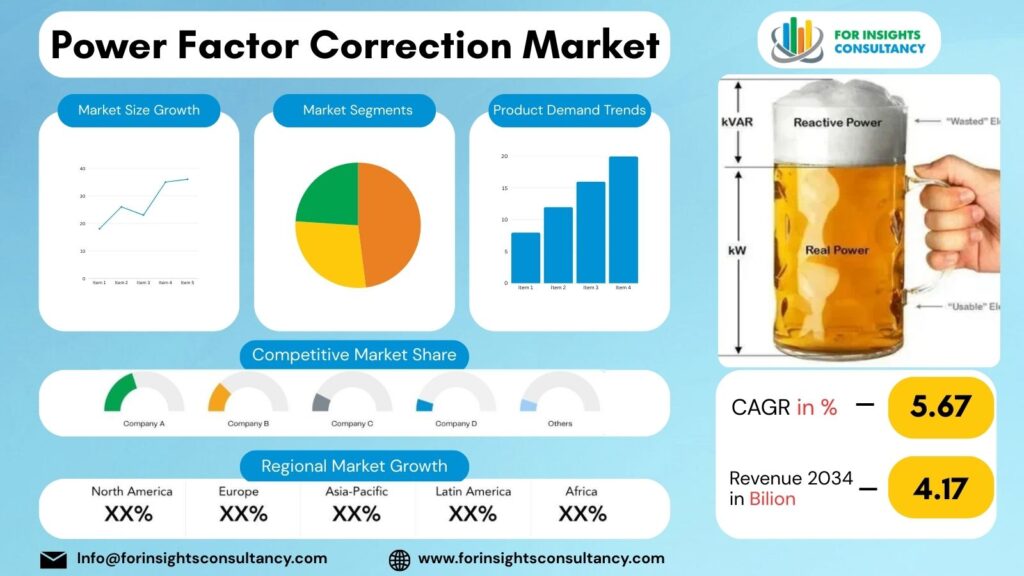
Power Factor Correction Market projected to reach USD 4.17 Billion by 2034, growing at 5.67% CAGR, fueled by industrial automation and energy-efficient solutions.
Overview of the Power Factor Correction Market and Expected Growth (2026)
For the next five years, the Power Factor Correction (PFC) market will expand as the industry, utility, and commercial sectors focus on energy savings, cost saving, and grid reliability. Power factor correction are methods to improve efficiency in power systems. Poor power factor increases losses, increases utility charges, and shorten lifespan of electrical equipment. This causes businesses and power Utility Operators to use correction methods like capacitors, reactors and scalable controllers to optimize energy usage.
Increasing use of electrical automation and modern industry in the manufacturing, oil & gas, power generation, mining and construction sectors is significantly contributing to the market. In modern industries, inductive loads from motors and heavy machinery result in low power factor, where power factor correction devices are the most practical solution. growing focus on sustainability, many businesses are implementing PFC solution. This ensures that they are compliant with energy efficiency mandates and environmental regulations while also controlling costs.
Market growth will increase steadily through 2026 due to supportive policies and frameworks for energy efficiency deployed by governments and grid operators. For instance, International Organizations and Standards bodies energy efficiency etiquettes guide industrial users to improve electrical performance and thus reduce system losses and decrease CO2 emissions. To help stabilize grid performance and decrease peak load stresses, Electric utilities are now implementing automated correction solutions to their transmission and distribution networks.
Advancements in technology will continue to support the growth of the market. Power factor correction systems are now incorporating more digital monitoring and automated control, and SCADA (supervisory control and data acquisition) system integration to allow for real-time correction and predictive maintenance. These systems benefit utilities and industry operators by enabling them to predict and address power quality problems before they result in costly outages or equipment failures.
Market Dynamics 2026
Growth Drivers
- The growing use of electric machinery and automation in industry means there is a higher demand for reactive power which Power Factor Correction (PFC) systems can compensate.
- Power Factor Correction (PFC) systems can compensate for the reactive power demand created by the increased industrial electrification and automation, as well as the increased use of heavy machinery, transformers and electric motors.
- Due to the rising costs of electricity and the push for energy saving, the adoption of PFC systems by businesses and utilities is a means to control operational costs, reduce weighted operating losses, and comply with imposed energy efficiency regulatory requirements.
- The energy efficiency design requirements and regulatory frameworks coupled with financial incentives to adopt energy-efficient electrical systems promote the adoption of Power Factor Correction (PFC) systems.
Restraints
Significant upfront investments – Sophisticated PFC systems that include automated control and digital monitoring systems involve large capital expenditures that may restrict their use, particularly for small and medium enterprises.
Integration challenges – Insertion of PFC devices into current electrical systems can demand comprehensive reworking of electronic circuitry and structures of reactive power compensation networks, particularly in retrofitted facilities.
Integration challenges – Insertion of PFC devices into current electrical systems can demand comprehensive reworking of electronic circuitry and structures of reactive power compensation networks, particularly in retrofitted facilities.
Operational and maintenance concerns – The performance of automated and dynamic PFC solutions is highly dependent on the frequent recalibrating, monitoring, and maintenance, which requires a higher-level skill, and is, therefore, a burden on the facilities.
Opportunities
Increased implementation of industrial automation and smart manufacturing – The construction of automated factories and the implementation of Industry 4.0 initiatives boost the demand for PFC systems which improve energy efficiency and lower operational costs.
Merger with renewable energy systems – Expanding solar, wind, and hybrid power plants provides new opportunities for PFC solutions to neutralize reactive power and improve the stability of voltage.
Increase in commercial and residential infrastructure – The development of high-rise buildings, shopping malls, and data centers increases the need for reliable power factor correction systems to reduce costs and comply with energy efficiency laws.
Improvement of PFC solutions – The value of smart controllers, IoT-based monitoring, predictive maintenance and digital dashboards increases for industrial and utility customers.
Challenges
Significant upfront investments – Automatic and dynamic PFCs have advanced functionalities that come at a cost. This limits the adoption of such systems by small and medium enterprises.
Limited qualified personnel – Installation, adjustment, and maintenance of PFC systems require highly skilled electrical engineers and technicians are scarce in some areas.
Difficult system integration – The modification of PFC systems into existing older electrical networks and industrial plants is often complicated and require a lot of time.
Diverse regulations – Different countries have different energy efficiency regulations, power quality regulations, and tariffs, which complicate the adoption of PFC systems in multinational industrial operations.
Top Companies Covered In This Report
(Major global and regional players shaping the industry)
- Schneider Electric SE
- ABB Ltd.
- Siemens AG
- Eaton Corporation plc
- General Electric (GE Grid Solutions)
- Hitachi Energy
- Toshiba Corporation
- Mitsubishi Electric Corporation
- Emerson Electric Co.
- Schweitzer Engineering Laboratories (SEL)
- S&C Electric Company
Power Factor Correction Industry Company News 2025 and 2026
Schneider Electric SE
2025: Schneider Electric announced major expansions in its energy management portfolio, emphasizing power quality solutions and digital grid performance enhancement technologies in industrial and utility sectors.
2026: The company introduced upgraded automation software and IoT‑enabled PFC controllers designed to integrate with eco‑friendly power systems and smart grids.
ABB Ltd.
2025: ABB strengthened its electrical systems division by launching advanced capacitor banks and reactive power compensation products optimized for renewable integration and industrial performance.
2026: ABB expanded partnerships with utilities in North America and Europe to deploy digital substation automation, including PFC systems that monitor and adjust power factor in real time.
Siemens AG
2025: Siemens announced its Smart Grid Portfolio 2.0, featuring improved PFC solutions that integrate with industrial automation systems to boost energy efficiency and reduce operational costs.
2026: Siemens highlighted its work with utility partners on next‑generation power quality platforms, supporting reactive power control across mixed renewable and conventional energy networks.
Eaton Corporation plc
2025: Eaton expanded its power quality team with new product lines focused on power factor correction and automation for commercial buildings and industrial facilities.
2026: The company unveiled enhanced PFC systems with predictive analytics to help reduce electricity bills and improve equipment lifespan for facility operators.
General Electric
2025: GE Grid Solutions continued strengthening its grid automation and reactive power management portfolio, integrating PFC modules into intelligent grid control systems.
2026: GE announced pilot projects with key utilities to test advanced PFC solutions that automatically balance load demands and reactive power in distributed networks.
Detailed Segmentation and Classification of the report (Market Size and Forecast – 2034, Y-o-Y growth rate, and CAGR):
By Type
- Static
- Automatic
- Dynamic
By Application
- Industrial
- Commercial
- Residential
- Utilities
By End-Use Industry
- Manufacturing
- Power Generation & Transmission
- Oil & Gas
- Mining & Metals
- Construction
- Other Industries
By Component
- Capacitors
- Reactors
- Controllers
- Others
Regional Deep-dive Analysis:
The report provides in-depth qualitative and quantitative data on the Power Factor Correction Market for all of the regions and countries listed below:
North America
Given the current levels of industrialization, acceleration of electrification, the improvement of energy standards efficiency, and rapid adoption of emerging technologies, it can be forecasted that, throughout the entire period of the study, North America will continue to be the leader throughout the North America PFC market, especially throughout the U.S.
The U.S. is the largest consumer of PFC solutions, as the government places a larger focus on the construction and optimization of electrical systems, as. On the commercial and industrial level, there is the implementation of PFC solutions (static, automatic, dynamic capacitor banks) so that energy efficiency can be improved and as a result, the overall quality of (reactive) power) can be improved. The government is also focusing on the improvement of energy efficiency and reliable energy PFC solutions.
Canada is also making advancements that benefit the power factor correction (PFC) market. the development of smart power factor correction systems that can be integrated into smart grids is happening, as is the development of PFC systems. These PFC systems are aimed at reducing the technical losses and improve the voltage and power stability of all regions, especially isolated areas. These PFC systems will enable the power factor correction (PFC) market to be improved, as will the research collaboration between universities and energy agencies.
While at a different stage in grid modernization, Mexico is also seeing increased adoption of PFCs as its industrial base expands, and commercial businesses seeks to lower their electricity costs. Mexican manufacturers are responding to the need to counteract the inefficiencies of reactive power by incorporating PFC solutions to systems in the manufacturing, automotive, and food processing sectors. Engineering partnerships with U.S. and Canadian energy experts have streamlined the transfer of technology and training in power quality, fostering regional practice integration.
Europe
In 2026, Europe’s power factor correction market will continue to grow as utilities, industries and commercial sectors continue endevour to improve energy efficiency and grid reliability with rising electrification and renewable integration. Europe’s energy performance policies and regulations that promote energy efficiency and decrease the electrical losses, improve power quality, and enhance the sustainability of energy systems.
Germany, France, the UK, and the Netherlands lead the way in Europe to implement power factor correction systems to address energy efficiency regulations and avoid reactive power cost penalties from utility tariffs. Demand is rising for automated and dynamic PFC systems, as these systems support upgrades to legacy systems and new systems that are designed with the ability to digitally manage energy, as well as provide real-time adjustments to reactive power compensation.
In 2026, Power factor correction solutions are going to be pivotal for balancing the grid as Power factor correction solutions line up adaptable and flexible solutions for all the new players in the grid including renewables, demand response etc. Older systems can be integrated into these new technologies including real-time energy management systems, which can include automated and dynamic systems for real-time control of reactive power. These highly adaptable tools for real-time reactive power management are pivotal for balancing the grid as the instantaneous demand of reactive as opposed to real power can be highly variable.
Germany, The UK, The Netherlands and France are the strongest early-adopters for Power Factor Correction Solutions in the European Power Factor Correction Solutions market. The European Union continues to issue progressive energy performance policies and regulatory frameworks to guide member states and aligned states further. Power factor correction solutions provide the means necessary to meet these more progressive energy performance policies and regulatory frameworks to achieve controlled electricity waste along with the other goals of increasing safety, security, etc.
Asia-Pacific
Due to rapid urbanization, industrial growth, and increased electricity requirements in the manufacturing and commercial sectors, the Asia-Pacific region will become one of the fastest growing markets for power factor correction solutions by 2026. Countries including China, India, Japan, South Korea, and Australia will have made major investments in new energy infrastructure, and will have ongoing requirements for power quality and reliability of the electricity grid. Most industrial enterprises in these economies will have high numbers of inductive loads like motors, compressors and heavy machinery, and will therefore have reactive power problems which will make PFC solutions necessary for energy savings and cost savings.
Middle East and Africa
Steady development in energy infrastructure and industrialization in the Middle East and Africa (MEA) region is predicted for the power factor correction market for the next 3 years (2023-2026). Everties in the region GCC (Gulf Cooperation Council) especially the countries of Saudi Arabia, United Arab Emirates (UAE), and Qatar, which is diversified from primary dependence on revenue from hydrocarbon sources toward sustainable economic development, are investing in the enhancement of the electrical grid and industrial development. Due to the increase in industrial, petrochemical, and construction load, power factor correction systems are being increasingly incorporated within industrial, commercial, and utility networks to improve energy efficiency, reduce utility imposed reactive power penalties, and improve overall power quality (POQ).
With the development of infrastructure within the GCC subregion such as smart cities and renewal of energy, there is a growing demand for more advanced power factor correction (PFC) technologies, particularly for construction and petrochemical loads. Real-time reactive power (RP) adjustment solutions are more favored especially in cities with high electricity demand and load shifting. These solutions are in support of the countries’ overall energy goals as improved voltage stability and reduction in energy loss are achieved.
Frequently Asked Questions with Answers
What is the Power Factor Correction market size and growth forecast?
Power Factor Correction Market is projected to reach a value of USD 2.78 Billion in 2025 and is anticipated to grow to approximately USD 4.17 Billion by 2034. This expansion reflects a compound annual growth rate (CAGR) of 5.67% during the forecast period from 2026 to 2034.
Who are the key players in the Power Factor Correction market?
The Power Factor Correction Market Includes Major Companies Schneider Electric SE, ABB Ltd., Siemens AG, Eaton Corporation plc, General Electric (GE Grid Solutions), Hitachi Energy, Toshiba Corporation, Mitsubishi Electric Corporation, Emerson Electric Co., Schweitzer Engineering Laboratories (SEL), S&C Electric Company, Others.
What are the current and future trends for Power Factor Correction market?
The Power Factor Correction market is trending toward increased adoption of automated and dynamic PFC systems, integration with smart grids, and renewable energy support, while future growth focuses on digitalization, energy efficiency, and real-time reactive power management.
Which regions dominate the Power Factor Correction market?
The Power Factor Correction market is dominated by North America and Europe, driven by advanced industrial infrastructure, stringent energy efficiency regulations, and widespread adoption of smart grid technologies.
Key insights provided by the report that could help you take critical strategic decisions?
- Regional reports analyse product/service consumption and market factors in each region.
- Reports highlight possibilities and dangers for suppliers in the Power Factor Correction Market business globally.
- The report identifies regions and sectors with the highest growth potential.
- It provides a competitive market ranking of major companies, as well as information on new product launches, partnerships, business expansions, and acquisitions.
- The report includes a comprehensive corporate profile with company overviews, insights, product benchmarks, and SWOT analysis for key market participants.
Customization: We can provide following things
1) On request more company profiles (competitors)
2) Data about particular country or region
3) We will incorporate the same with no additional cost (Post conducting feasibility).
Any Requirement Contact us: https://www.forinsightsconsultancy.com/contact-us/
Table of Contents
For TOC Contact us: https://forinsightsconsultancy.com/contact-us/