

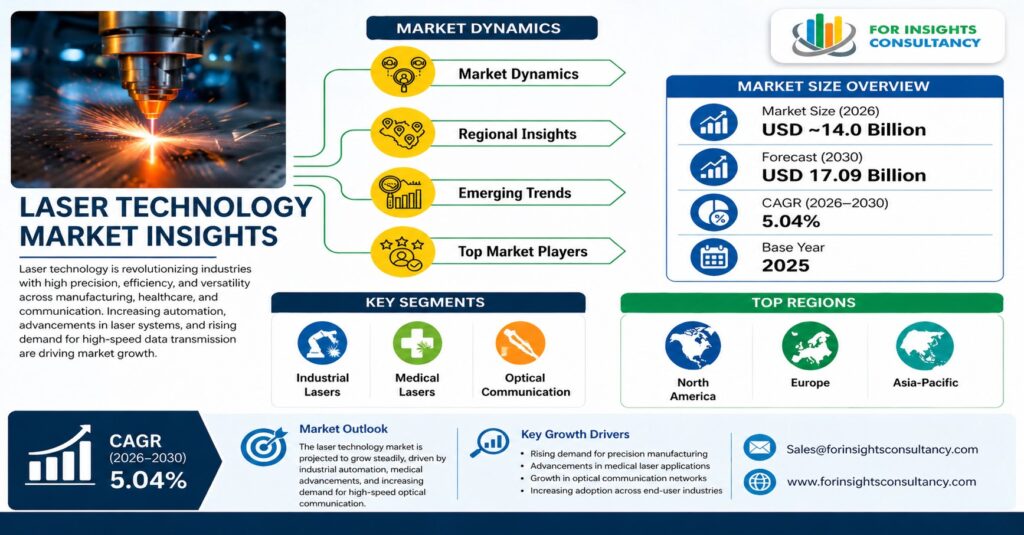
Laser Technology Market Insights
· Market Size (2026): USD ~14.0
Billion
· Forecast (2030): USD 17.09
Billion
· CAGR (2026–2030): 5.04%
· Base Year: 2025
· Key Segments: Industrial Lasers,
Medical Lasers, Optical Communication
· Top Regions: North America,
Europe, Asia-Pacific
Laser Technology Market Executive Summary
The global Laser Technology Market is showing a
positive trend and is moving up at a steady rate of growth owing to increasing
application of laser technology in precision manufacturing, medical sector,
high speed applications of optical communication systems and others. Increasing acceptance of laser based
applications in industries like automobile, aerospace, electronics and
healthcare is propelling market growth.
New trends in the market, including
sustainability-driven manufacturing, energy-efficient laser systems, and a
swift digital revolution, are defining new standards in competition. Continuous advancements in fiber
lasers and ultrafast lasers, and in the incorporation of AI into laser systems,
are improving operational capacity, precision, and cost-effectiveness.
Market players continue to focus on research and
development, product innovation and strategic partnerships in a bid to increase
market share. Growth in developing
countries and a rising demand for smart technologies have opened up new avenues,
promising long term development of the Laser Technology Market.
Laser Technology Market Overview (2026)
The Laser
Technology Market can be defined as the worldwide industry involved in the design,
manufacture and utilization of laser powered systems to: cut and weld, mark and medical use, and, optical communication. Laser technology
employs highly concentrated light energy to provide an enhanced productivity,
precision and speed.
The scope of the industry encompasses several industry like industrial manufactures, research, health, tele-communications, defense etc. Major part of the scope include industrial lasers used in automatised manufacturing like automotive, and electronic industry, medical lasers used in surgeries, aesthetic and other medical process and optical lasers for high speed data transmission as well as others like laser sources, laser system and software etc.
Laser
Technology Market is significant as it is critical to present day industrial
innovation and automation. As more and
more products require high-precision engineering, medical applications get less
invasive and digital networks improve speed, laser technology has become more
and more embedded in our daily lives.
The
market can be a support for such trends as intelligent manufacturing, digital
transformation and sustainable manufacturing, since it helps achieve efficient process,
less waste and higher product quality.
The laser technology market will play a key part in future global
industrial and health ecosystems.
Laser Technology Market Dynamics 2026
Growth Driver
Rising
Demand for Precision Manufacturing and Automation
Growing demand for high precision manufacturing
across industries including automotive, aerospace and electronics is one of the
major growth driver for Laser Technology Market. Laser system enables cutting,
welding and marking with reduced wastage of materials and at much higher
efficiency than traditional methods. With growing trend of global manufacturing
shifting toward automation and smart factories, demand for fiber laser and
ultrafast laser has increased substantially. Industry estimates suggest
automated laser systems can increase production efficiency by more than 20–30%.
Growth in
Optical Communication and Digital Infrastructure
Highe Gration Speed Internet, 5G and data center
expansion is greatly increasing applications and therefore strong in demand for
laser technology in optical communication, which uses lasers for high speed
data rate and transfer. Driven by the
large increase in global internet data consumption (cloud computing, streaming services,
touch screen & smartphone) and transmission bandwidth demand, more
investments are injected into the telecom infrastructure which will be a
positive in the laser market growth.
Restraints
High
Cost:
The high capital expenditure and operational expenses
associated with these advanced laser systems and components make them
prohibitively expensive for use in small and medium enterprises.
Regulatory
Challenges:
Strict safety standards and regulation requirements
are delays to product approval and add extra difficulties to the operating
process.
Supply
Chain Issues:
Reliance of number of critical parts from global
suppliers or sourcing from a single or few sources of supply may result in
disruption to the process, delay in the lead time and impact the overall
result.
Opportunities
Emerging
Markets:
A dramatic rise in industrialisation levels and growing
healthcare sector in regions like Latin America, Asia-Pacific will result in enormous market
potential for laser systems both in manufacturing as well as medical applications.
Innovation:
Improvements in fiber lasers, ultrafast lasers, and
AI-enabled solutions are creating new use cases, increasing efficiencies, and providing
high-precision capabilities to industries.
Digital
Channels:
Expansion of e-commerce,
internet marketing and online distribution networks is assisting
manufacturers to open new customer markets,
reduce cost of distribution and improve consumers experience.
Key Trends
Premiumization:
The craving for high end, high value added products, with
higher efficiency, improved accuracy and greater automation is also compelling
the industry to gravitate toward more sophisticated, high end laser products,
responding to a rising demand for sophisticated, high-end laser systems.
Sustainability:
Organizations across various industries are turning to
greener and more energy-efficient laser technologies to help cut down material waste,
decrease energy usage and promote sustainable manufacturing practices.
Digital
Transformation:
The integration of AI, IoT and intelligent software with
laser systems are providing solutions such as present status, early fault detection,
automated controls and user assistance for the laser system applications in
industrial and healthcare environments.
Laser Technology Market Top Companies Covered In this Report are
From large companies to small ones, many
companies are actively working in the laser technology market. These key
players include, Coherent, IPG
Photonics, Trumpf, Lumentum, Jenoptik, Novanta, Lumibird, Laser Star, Epilog Laser, Han’s Laser, MKS Instruments,
Gravotech,600 Group, Eurolasers Bystronic Lasers, Toptica Photonics Photonics
Industries, Foglight Technologies, Corning Incorporated, Access Lasers and others.
Laser Technology Market company News
Coherent Corp
In March 2025, Coherent Corp. launched the AIM FL
Series, a new line of fiber lasers with up to 3kW power, designed for precision
welding with high beam quality and stability.
IPG Photonics
In February 2024, IPG Photonics released the LightWELD XR, a
handheld laser welding and cleaning system that offers improved energy
efficiency and enhanced material handling.
Laser Technology Market Segments
Laser Technology Market by Type
- Solid-State
Lasers.
- Gas
Lasers.
- Liquid
Lasers.
- Semiconductor
Lasers
- Chemical
Lasers
- Metal-Vapour
Lasers
Laser Technology Market by Application
- Optical
Communication
- Laser
Processing
Laser Technology Market by Industry
- It
and Telecom
- Electronics
and Semiconductor
- Healthcare
- Manufacturing
- Automotive
·
Aerospace and Defense
Laser Technology Market Regional Insights
North
America – Insight
North America the largest market for high-end
lasers, driven by the early adaptation of automation and “Industry 4.0”
technology, along with a strong customer base in the aerospace, semiconductor
and medical device industries. The United States is a dominant single country,
where it expects the growth of demand to be used for ultra-fast and fiber
lasers application in precision manufacturing and surgical treatment.
Europe –
Insight
Europe Market is oriented around the mature
automotive market as well as other industrial sectors, with strong
manufacturing focus in Germany and France.
Market is characterized by high quality, high efficiency and energy
saving laser systems and a good potential for laser cutting and welding systems
for electric vehicle production and industrial automation.
Asia-Pacific
– Growth Driver
The most rapidly expanding region is Asia-Pacific;
due mainly to the rapid industrial growth occurring in China, India, Japan and
South Korea. Increased manufacturing of electronics,
a growing need for semiconductors and supporting government measures (such as
Make in India and China‘s industrial enhancements) are having a substantial
impact on laser industry growth.
Rest of
World – Emerging Trends
Countries in Latin America and the Middle East are
taking up laser technologies in healthcare and industrial markets at a slower
pace. However, more investments in
infrastructure, healthcare and energy projects are generating more
opportunities for these regions while and the demand for affordable and mobile
systems has increased.
Analyst Insights
Analysts therefore note that
increased need for high-end and high accuracy laser systems will be a
contributing factor in market growth, especially in high end applications like automation
and higher-end medical applications.
Increased trend of automation and smart manufacturing is leading to
increased adoption of fiber and ultrafast lasers.
Furthermore, growing digital infrastructure
(e.g. 5G, data centers) is fueling heavy demand for laser systems for optical
communication. Market analysts stress
that sustainability trends (e.g. Energy
efficient systems, less material waste) are transforming product innovations
and rivalry.
Laser Technology Market Research Methodology
Primary Research:
Insights obtained firsthand with
industry experts, manufacturers and distributors, end-users through interviews,
questionnaires to understand up-to minute trends, future demand and price forecasts.
Secondary Research:
Analysis of existing data from
company literature, industry publications, government databases, technical
journals, etc to determine market size, trends and competitive picture.
Data Validation:
Cross-referenced data with overlay,
using a number of sources and analytical models, third party validation, to ensure accuracy,
reliability and consistency of market findings.
Laser Technology Market – Data
Sources
Government Publications:
It could be gathered from
reports from authorities and government institutions: national statistical offices, trade departments,
authorities and bodies of regulation. Reports give information about industry production,
structures of manufacturing industry, export/import, and regulations which
influence introduction of laser technologies.
Industry Reports:
Market intelligence is
complemented by research conducted on reputable trade publications, such as
industry magazines, trading journals, and technology reports relating to laser
equipments, photonics and industrial automation. These can be used to evaluate
market size and growth trends, segmentation, and new developments.
Company Filings:
The information received are
from yearly published report, investor conférences and financial documentation
of the main laser companies of the sector. Those examples show revenue
performances, product ranges, R&D spends and market developments.
Proprietary Research (For Insights Consultancy):
Broader validation and learning
are then produced by way of internal databases, experienced interviews and
specialist analysis by For Insights Consultancy, providing accurate, trustworthy,
current market intelligence to meet client needs.
Frequently asked questions with answers
What is the market size of the Laser
Technology market?
Global Laser Technology Market
valued at ~USD 14.0 billion in 2026, projected to hit USD 17.09 billion by 2030
at 5.04% CAGR.
What are the key drivers of the Laser
Technology Market?
The major drivers are the increased
demand for precision manufacturing, the expanding use of glass in medical
surgeries, the growth of optical
communication, and developments in automation and intelligent systems.
What are the main types of laser
technologies?
Apart from this, there are a lot of
diverse types present such as fiber lasers, CO laser, solid state lasers and
semiconductor laser which is used for various purposes for industrial, medical
and communication sector.
What
are the major trends in the Laser Technology Market?
Major trends are adoption of
energy-efficient laser systems, use of AI and IoT, increased demand for high power lasers and
expansion of smart manufacturing.
Which
regions dominate the Laser Technology Market?
North America and Europe are already
developed due to their well-established industrial infrastructure. While
Asia-Pacific region is the fastest growing market with rapid level of
industrialization and production expansion.
What
challenges does the Laser Technology Market face?
Cost and regulatory challenges include,
and are not limited to, high capital equipment costs, stringent regulatory
requirements, and disruption in the supply chain for specialized components.
What
is the future outlook for the Laser Technology Market?
Market will experience steady recovery
driven by greater automation, expanding of digital infrastructure, ongoing
innovation in laser technology.
Customization: We Can Provide Following Things
1) On
Market More Company Profiles (Competitors)
2) Data
About Particular Country Or Region
3) We
Will Incorporate The Same With No Additional Cost (Post Conducting Feasibility).
Any
Requirement Contact Us: https://www.forinsightsconsultancy.com/contact-us
Related Market Reports
Laser
Technology Market Report
Covers market size, segmentation (solid-state, gas,
semiconductor lasers), applications, industry analysis, and forecast to 2030.
Laser
Processing Market Report
Includes insights on laser processing technologies, applications
in microelectronics, automotive, aerospace, and future growth trends.
Table of Content
- Introduction
- Market Definition
- Market Segmentation
- Research Timelines
- Assumptions and Limitations
- Research Methodology
- Data Mining
- Secondary Research
- Primary Research
- Subject-Matter Experts’ Advice
- Quality Checks
- Final Review
- Data Triangulation
- Bottom-Up Approach
- Top-Down Approach
- Research Flow
- Data Types
- Data Mining
- Executive Summary
- Market Overview
- Global Scientific Laser Technology Market Outlook
- Market Drivers
- Market Restraints
- Market Opportunities
- Impact of Covid-19 On Global Scientific Laser Technology Market
- Global Scientific Laser Technology Market Outlook
- Global Scientific Laser Technology Market by Type, (USD Million)
- Solid-state lasers.
- Gas lasers.
- Liquid lasers.
- Semiconductor lasers
- Chemical lasers
- Metal-vapour lasers
- Global Scientific Laser Technology Market by Application, (USD Million)
- Optical communication
- Laser processing
- Global Scientific Laser Technology Market by Industry, (USD Million)
- IT and Telecom
- Electronics and Semiconductor
- Healthcare
- Manufacturing
- Automotive
- Aerospace and Defense
- Global Scientific Laser Technology Market by Region, (USD Million)
- Introduction
- Asia-Pacific
- China
- India
- Japan
- South Korea
- Australia
- South-East Asia
- Rest of Asia-Pacific
- North America
- United States
- Canada
- Mexico
- Europe
- Germany
- United Kingdom
- France
- Italy
- Spain
- Russia
- Rest of Europe
- South America
- Brazil
- Argentina
- Colombia
- Rest of South America
- Middle East and Africa
- UAE
- Saudi Arabia
- South Africa
- Rest of Middle East and Africa
- Company Profiles
9.1. Coherent
9.2. IPG Photonics
9.3. Trumpf
9.4. Lumentum
9.5. Jenoptik
9.6. Novanta
9.7. Lumibird
9.8. Laser Star
9.9. Epilog Laser
9.10. Han’s Laser
9.11. MKS Instruments
9.12. Gravotech
9.13. 600 Group
9.14. Eurolasers Bystronic Lasers
9.15. Toptica Photonics Photonics Industries
9.16. Foglight Technologies
9.17. Corning Incorporated
9.18. Access Lasers
Tab Content
Tab Content
Select PDF License
Single User: $3499
Multiple Users: $4499
Corporate Users: $5499
Pages: 121 | Dec-2023 Formats | PDF | Category: Information and Technology | Delivery: 24 to 72 Hours