

Pages: 124 | Aug-2026 Formats | PDF | Category: Information Technology | Delivery: 24 to 72 Hour
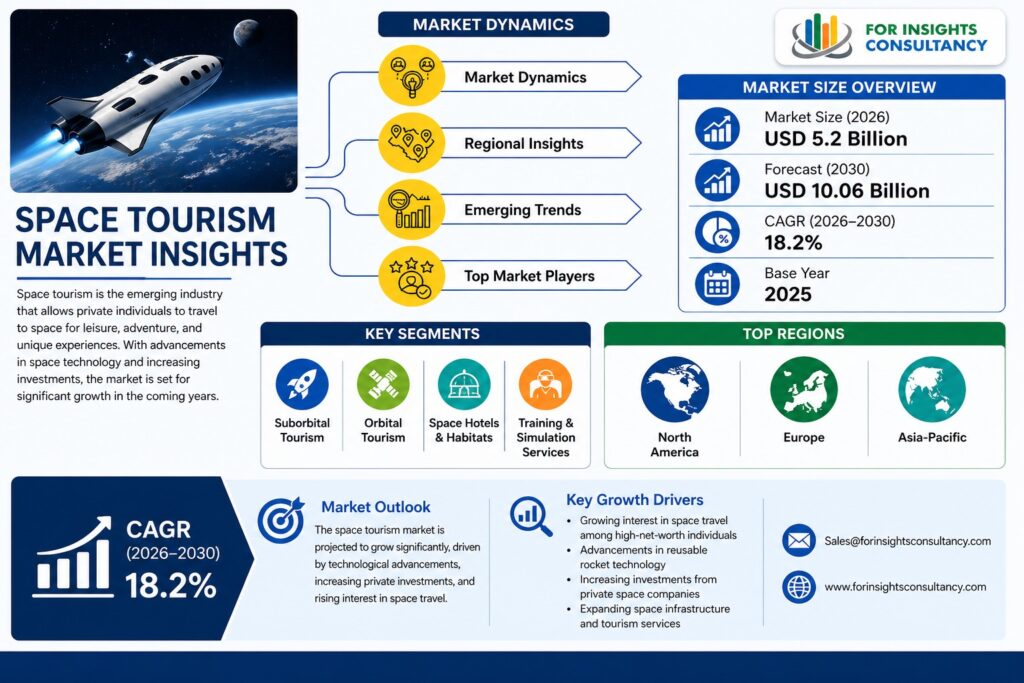
Space Tourism Market Insights
- Market Size (2026): USD 5.4 Billion
- Forecast (2034): USD 13.7 Billion
- CAGR (2026–2034): 24.6%
- Base Year: 2025
- Key Segments: Suborbital Tourism, Orbital Tourism, Space Hotels & Habitats, Training & Simulation Services
- Top Regions: North America, Europe, Asia-Pacific
Space Tourism Market Executive Summary
The worldwide Space Tourism Market has been growing at a rapid pace due to substantial investments from private space Agencies, space science experiment, technological developments like reusable rockets, and increasing investment from high-net-worth individuals. growing demand for short term orbital and suborbital space travel and development of commercial spaceflight programs are playing major role in boosting the market.
Furthermore, led by the establishment of several private space companies and public-private partnerships, the industry is witnessing dynamic changes. Space companies are investing in efficient spacecraft, safety systems, low-cost launch solutions so that space tourism becomes increasingly affordable and scalable.
Other developing trends including luxury space experiences (premiumisation), sustainability of space travel technology and digital revolution (AI based space training and observation simulation) are also reshaping competitive landscape. The combined utilization of next generation materials, automation and data analytics is not only improving efficiencies but also customer experiences.
Space Tourism Market Overview (2026)
Space Tourism Market refers to space travel services that are offered for private individuals for personal experiences, recreation, or research, other than required activities. The scope of this market can range from suborbital flights, to orbital missions, development of space hotels, and astronaut training services, using next generation space technologies and private space entrepreneurs.
The business has developed considerably in the last ten years led by innovation in the area of re-usable rockets, larger private sector involvement and decreasing costs of launching spacecraft. The changing role of private companies and change from government-funded space programs to private space exploration has made space tourism an emerging high growth industry rather than just an aspiration.
In terms of an industry scope, the Space Tourism Market covers all the following areas: Aerospace & defense, advanced manufacturing, space infrastructure, hospitality (space hotels), training & simulation. It also incorporates the latest pioneering innovations like AI-enabled flight systems, high performance materials and clean propulsion.
Increasing awareness by consumers among ultra-high-net worth individuals, faster technological development of spacecraft (safety and efficiency wise), and changing regulation are determining the overall market structure. Governments and space agencies are increasingly advocating commercialization, facilitated by policy frameworks.
The value of the Space Tourism Market is its ability to revolutionise worldwide travel, drive innovation in aerospace technology, and stimulate new income sources across the commercial space industry. As costs reduce and accessibility increases, it looks set to become a significant sector within space exploration, high-end tourism and advanced transport.
Space Tourism Market Dynamics 2026
Growth Driver
Rising Demand for Luxury & Experiential Travel (Key Factor)
The increasing consumer demand for ultra-premium and once-in a lifetime travel experiences is highly accelerating the Space Tourism Market. Leading to the growing number of High-net-worth Individuals (HNWIs) seeking unique experiences over luxury tourism.
Industry estimates indicate ticket prices in the USD 250,000 to USD 450,000 range for early space tourism flights, yet demand levels are growing and reveal willingness to pay and interest. If anything, the emerging focus on experience based consumption points to an increasing willingness to pay for “lasting” pleasures. This development “trickles down” as costs are brought closer to the reach of a broader consumer spectrum via availability of re-usable launch systems.
Growth in Commercial Spaceflight & Private Aerospace Industry (Industry Trend)
The Commercial spaceflight industry growth happening at a fast pace, is also boosting the development of the Space Tourism Market. The private sector is investing a lot in re-useable rockets, spacecraft and safety mechanisms, thus leading to a fewer flight costs and increased number of flights.
There is also an increasing level of government and private sector support, which could support infrastructure build up and simplify the legal framework. Spaceports, astronaut schools and space habitats are developing a space tourism ecosystem.
Restraints
High Cost:
Space tourism is extremely costly. A trip to space is likely to cost between hundreds of thousands and millions of dollars. This high price tag excludes the majority of potential customers, limiting space tourism exclusively to high-income earners.
Regulatory Challenges:
Stringent safety requirements, approvals for airspace utilization and the development of space law causes commercialization to be long and increase compliance costs for operators.
Supply Chain Issues:
Heavy reliance on advanced materials, specialty items and the limited ability of manufacturing may result in high costs, schedule delays and bottlenecks.
Opportunities
Emerging Markets:
Interest among high-net-worth customers in Asia-Pacific, the Middle East and elsewhere helps to broaden the size of potential customers and revenues for space tourism providers.
Innovation:
Improved reusable rockets, spacecraft design, and safety systems have already decreased the cost of traveling into space, are repeatedly making this more affordable and accelerating the long-term growth of the space travel market.
Digital Channels:
Utilising digital channels, virtual advertising campaigns and data-based marketing allows businesses to extend their reach to worldwide consumers, heighten the existing customer experience and simplify the booking and training procedures.
Key Trends
Premiumization:
The market is now developing into a luxury experience, with space travel packages to space, training and onboard services tailored to UHNW consumers.
Sustainability:
The increasing emphasis on green propulsion systems, reusable rockets and a lower carbon footprint is also influencing innovation, as firms come under pressure to check the environmental impact of space exploration.
Digital Transformation:
Cutting-edge innovations including virtual booking engines, AI-based training programs, and simulation tools are improving customer service, operational management, and global expansion.
Space Tourism Market Top Companies Covered In this Report are
- Autodesk, Inc
- Hewlett Packard Corp.
- Materialise NV
- Dassault Systèmes
- ARC Centre of Excellence for Electromaterials Science (ACES)
- Norsk Titanium US Inc
- Aerojet Rocketdyne Holdings Inc.
- Engineering & Manufacturing Services Inc
- HeinekenNV
- Stratasys Ltd
- ExOne Corporation
- Organovo Holdings, Inc.
- 3D Systems Inc
Space Tourism Market company News
Blue Origin
The company is also making advancements in other areas, such as
its Blue Ring spacecraft platform, which provides in-space logistics and
delivery services, and its plans to launch the MK1 Lunar Lander as a
“pathfinder” mission in 2025
spaceX
SpaceX’s successful launches for NASA’s commercial crew program and private missions like Inspiration4 have positioned it as a dominant force in providing reliable and accessible space tourism experiences. The company’s development of the fully reusable Starship system aims to make space travel more routine.
Space Tourism Market Segments
By Type
- Sub-Orbital Space Tourism
- Orbital Space Tourism
- Lunar Tourism
- Interplanetary Tourism
- Space Hotel Tourism
By End User
- Government
- Commercial
- Others
By HNW Communities
- 20M to 40M
- 40M to 60M
- More than above Ranges
By Sales Channel
- Launch Provider
- Third Party Partnership
- OTAs
Space Tourism Market Regional Insights
North America – Insight
North America has dominated the Space Tourism Market. This is because after Japan, North America was the first region to make inroads into commercial private spaceflight, and home to most of the companies operating this business, such as SpaceX, Blue Origin and Virgin Galactic. North America has an advantage due to their existing launch facilities, more relaxation in regulations and copious flow of private investments.
One of the critical factors where NA is clearly in lead is the advancement of reuse-enabled launch systems that bring considerable cost down and enhances the scalability of space tourism. Moreover, support from the US Government like NASA has sped up the commercialization and innovative studies in the space domain which helps the NA to create a space eco-system in terms of commercial space ports and astronaut training centers, making the space tourism space a worldwide monopoly.
Europe – Insight
The Europeans are now key players with just a strong interest in state of the art engineering, sustainability and regulation. For instance, the European Space Agency sponsors the commercialization of space from Europe.
Set as eco-efficient propulsion, environmental responsibility, along with safety rights and standards, the region promotes leading the way in space travel and advanced planetary exploration technology. German, France and UK is funded by spaceport construction and research-led aerospace innovation, especially in suborbital flight systems, space research tourism. Europe ‘s advantage is precision manufacturing of aerospace-graded components.
Asia-Pacific – Growth Driver
Asia-Pacific is the fastest growing region in the Space Tourism Market and is expected to exhibit very high growth during the forecast period. This is due to high government support as well as the growing pace of industrialization. Countries like China, India and Japan for instance are investing heavily in space programs and commercial space activities.
An also-missing key driver of growth is the build-up of indigenous space programs in ISRO and CNSA and around them the non-exploration related commercial and tourism based missions. Furthermore, the increasing population of high-net-worth individuals and technological capabilities is creaming both demand and supply.
Rest of World – Emerging Trends
While space tourism business models are most developed for the US and Europe, regions such as the Middle East, Latin America, and in parts of Africa are experiencing early adoption experimentation. For instance, the UAE through the Mohamed bin Rashid Space Centre is leveraging space through space research, astronaut programs, and future tourism development.
New trends are spaceport construction, foreign investments and partnership in luxury niche markets. Countries are using their geographical location and policies to prepare themselves to become future launch hubs and investment magnets. Although in initial stage, accelerating foreign investments and partnership with international space ventures will help to increase penetration gradually.
Analyst Insights
Analysts also note that the rising demand for ultra-luxury experience-centric travel will dramatically impact the growth of the Space Tourism Market. Affluent consumers are designing travel plans around once in a lifetime exclusive experience, with space travel emerging as the next segment in luxury tourism.
Technology wise, the developments being driven by start-ups such as SpaceX, Blue Origin and Virgin Galactic are quickly improving launch efficiency, safety systems and cost profiles. Analysts suggest this reusable rocket technology could cut a large part of launch costs in the next 10 years.
Furthermore, the broader commercial space ecosystem of spaceports, astronaut training facilities and orbital infrastructure is believed to facilitate longer-term market scalability. Studies point out that the price of tickets, currently around USD 250,000 and exceeding USD 450,000, will probably fall in the event of higher competition and number of flights.
A further important realization concerns the progress of regulation and public-private sector collaboration (such as NASA and the European Space Agency) that allows a more controlled and safeguard commercialization process.
Space Tourism Market Research Methodology
Primary Research:
Real-time data is gathered from interviews with industry entrepreneurs; space tourism stakeholders; aerospace engineers; aerospace players, e.g. NASA, SpaceX, and Virgin Galactic.
Secondary Research:
The market analysis data is gathered from the government space agencies such as NASA, European Space Agency. Industry reports, company filings and aerospace journals. The following points can be indicated from the references that there would be demand for spacecraft in various applications and the various technologies being developed can be identified.
Data Validation:
All data collected is validated, compared, and confirmed from many sources, models, and Analytic experts. Triangulating between data, models, and experts confirms data and validates market forecasts, analysis, and predictions (EEAT).
Space Tourism Market – Data Sources
Government Publications:
Sources of information are space and regulatory bodies, for instance NASA, ESA, ISRO. These institutions give fact-based reports about launch operations, information related to space missions and different fund programmes along with regulatory institutions behind commercial space travel.
Industry Reports & Technical Journals:
Reference to information provided from aerospace industry publications, the space economy of report, and the peer-reviewed journal articles covering the technology for reusable rocket, commercialization of space flight, and tourism infrastructure development are presented.
Company Filings & Financial Reports:
The evaluation draws on a variety of sources publicly available annual reports, investor presentations and financial disclosures from leading players namely SpaceX, Blue Origin and Virgin Galactic. These enable an understanding of revenue evolution, R&D expenditure, commercialization plans and product development streams.
Proprietary Research (For Insights Consultancy):
Broader validation and learning are then produced by way of internal databases, experienced interviews and specialist analysis by For Insights Consultancy, providing accurate, trustworthy, current market intelligence to meet client needs.
Frequently asked questions with answers
What is the difference between sub-orbital and orbital space travel?
Suborbital flights briefly reach space’s edge on a parabolic arc before falling back, whereas orbital flights achieve 17,500+ mph velocity to continuously circle Earth.
How long does a commercial space flight last?
Suborbital commercial spaceflights last roughly 10 to 90 minutes, whereas orbital tourist missions range from 3 to 14+ days.
Do you need intense astronaut training to go on a space flight?
No. Suborbital tourist flights only require 2 to 3 days of basic safety orientation, though orbital trips require several months.
What companies currently offer recreational space travel?
SpaceX (charter missions) and Axiom Space (ISS trips) actively fly orbital tourists, while Virgin Galactic and Blue Origin offer suborbital flights.
Who is the core target demographic for sub-orbital versus orbital experiences?
Suborbital trips target High-Net-Worth Individuals (HNWIs) seeking thrill and prestige, whereas orbital missions target Ultra-HNWIs, sovereign astronauts, and private researchers.
How can luxury travel providers effectively position and brand space experiences?
Position them as ultra-exclusive, transformative human milestones, emphasizing bespoke preparation, private astronaut status, and once-in-a-lifetime access over raw technology.
What psychological barriers (such as perceived risk and safety concerns) affect consumer purchase intent?
Fear of catastrophic vehicle failure, physiological anxiety regarding extreme acceleration/zero-gravity, post-launch medical complications, and perceived social backlash for extreme luxury consumption.
If you’d like, let me know:
- Are you focusing on sub-orbital or orbital tourism models?
- Do you need deeper details on market sizing data or consumer demographics?
Any Requirement Contact Us: https://www.forinsightsconsultancy.com/contact-us
Related Market Reports
Covers market size, growth trends, competitive landscape, and future outlook of commercial space travel.
Commercial Spaceflight Market
Detailed analysis of reusable rockets, launch services, and private space exploration initiatives.
Satellite Manufacturing Market
Insights into satellite production, deployment trends, and increasing demand for communication infrastructure.
Aerospace & Defense Market
Comprehensive coverage of global aerospace innovation, defense technologies, and investment trends.
Advanced Materials Market
Focus on high-performance materials used in aerospace, including composites and thermal-resistant materials.
Semiconductor Market
Analysis of chip manufacturing growth supporting space technologies and advanced electronics.
Table of content
Chapter 1. Introduction
1.1. Research Objective
1.2. Scope of the Study
1.3. Definition
Chapter 2. Research Methodology
2.1. Research Approach
2.2. Data Sources
2.3. Assumptions & Limitations
Chapter 3. Executive Summary
3.1. Market Snapshot
Chapter 4. Market Variables and Scope
4.1. Introduction
4.2. Market Classification and Scope
4.3. Industry Value Chain Analysis
4.3.1. Raw Material Procurement Analysis
4.3.2. Sales and Distribution Channel Analysis
4.3.3. Downstream Buyer Analysis
Chapter 5. Market Dynamics Analysis and Trends
5.1. Market Dynamics
5.1.1. Market Drivers
5.1.2. Market Restraints
5.1.3. Market Opportunities
5.2. Porter’s Five Forces Analysis
5.2.1. Bargaining power of suppliers
5.2.2. Bargaining power of buyers
5.2.3. Threat of substitute
5.2.4. Threat of new entrants
5.2.5. Degree of competition
Chapter 6. Competitive Landscape
6.1.1. Company Market Share/Positioning Analysis
6.1.2. Key Strategies Adopted by Players
6.1.3. Vendor Landscape
6.1.3.1. List of Suppliers
6.1.3.2. List of Buyers
Chapter 7. Global Space Tourism Market, By Type
7.1. Space Tourism Market, by Type, 2023-2030
7.1.1. Orbital
7.1.1.1. Market Revenue and Forecast (2023-2030)
7.1.2. Sub orbital
7.1.2.1. Market Revenue and Forecast (2023-2030)
Chapter 8. Global Space Tourism Market, By Customer
8.1. Space Tourism Market, by Customer, 2023-2030
8.1.1. Government
8.1.1.1. Market Revenue and Forecast (2023-2030)
8.1.2. Commercial
8.1.2.1. Market Revenue and Forecast (2023-2030)
8.1.3. Others
8.1.3.1. Market Revenue and Forecast (2023-2030)
Chapter 9. Global Space Tourism Market, By Form
9.1. Space Tourism Market, by Form, 2023-2030
9.1.1. Innovators Early adopters
9.1.1.1. Market Revenue and Forecast (2023-2030)
9.1.2. Early majority
9.1.2.1. Market Revenue and Forecast (2023-2030)
9.1.3. Snacks
9.1.3.1. Market Revenue and Forecast (2023-2030)
9.1.4. Discrete
9.1.4.1. Market Revenue and Forecast (2023-2030)
9.1.5. Others
9.1.5.1. Market Revenue and Forecast (2023-2030)
Chapter 10. Global Space Tourism Market, By Product
10.1. Space Tourism Market, by Product, 2023-2030
10.1.1. High altitude jet fighter flights
10.1.1.1. Market Revenue and Forecast (2023-2030)
10.1.2. Atmospheric zero-gravity flights
10.1.2.1. Market Revenue and Forecast (2023-2030)
10.1.3. Aircraft replacement flights
10.1.3.1. Market Revenue and Forecast (2023-2030)
10.1.4. Others
10.1.4.1. Market Revenue and Forecast (2023-2030)
Chapter 11. Global Space Tourism Market, By Destination
11.1. Space Tourism Market, by Destination, 2023-2030
11.1.1. Mars
11.1.1.1. Market Revenue and Forecast (2023-2030)
11.1.2. Other Earth Destinations
11.1.2.1. Market Revenue and Forecast (2023-2030)
11.1.3. Earth Orbit
11.1.3.1. Market Revenue and Forecast (2023-2030)
11.1.4. Venus
11.1.4.1. Market Revenue and Forecast (2023-2030)
11.1.5. The Moon
11.1.5.1. Market Revenue and Forecast (2023-2030)
11.1.5. Ceres
11.1.6.1. Market Revenue and Forecast (2023-2030)
11.1.7. Others
11.1.7.1. Market Revenue and Forecast (2023-2030)
Chapter 12. Global Space Tourism Market, By Customers
12.1. Space Tourism Market, by Customers, 2023-2030
12.1.1. Civilians
12.1.1.1. Market Revenue and Forecast (2023-2030)
12.1.2. Enterprise
12.1.2.1. Market Revenue and Forecast (2023-2030)
12.1.3. Others
12.1.3.1. Market Revenue and Forecast (2023-2030)
Chapter 13. Global Space Tourism Market, By Service Provider
13.1. Space Tourism Market, by Service Provider, 2023-2030
13.1.1. The Government
13.1.1.1. Market Revenue and Forecast (2023-2030)
13.1.2. Commercial Institutions
13.1.2.1. Market Revenue and Forecast (2023-2030)
13.1.3. Others
13.1.3.1. Market Revenue and Forecast (2023-2030)
Chapter 14. Global Space Tourism Market, Regional Estimates and Trend Forecast
14.1. North America
14.1.1. Market Revenue and Forecast, by Type (2023-2030)
14.1.2. Market Revenue and Forecast, by Customer (2023-2030)
14.1.3. Market Revenue and Forecast, by Form (2023-2030)
14.1.4. Market Revenue and Forecast, by Product (2023-2030)
14.1.5. Market Revenue and Forecast, by Destination (2023-2030)
14.1.6. Market Revenue and Forecast, by Service Provider (2023-2030)
14.1.7. Market Revenue and Forecast, by Customers (2023-2030)
14.1.8. U.S.
14.1.8.1. Market Revenue and Forecast, by Type (2023-2030)
14.1.8.2. Market Revenue and Forecast, by Customer (2023-2030)
14.1.8.3. Market Revenue and Forecast, by Form (2023-2030)
14.1.8.4. Market Revenue and Forecast, by Product (2023-2030)
14.1.8.5. Market Revenue and Forecast, by Destination (2023-2030)
14.1.8.6. Market Revenue and Forecast, by Service Provider (2023-2030)
14.1.8.7. Market Revenue and Forecast, by Customers (2023-2030)
14.1.9. Rest of North America
14.1.9.1. Market Revenue and Forecast, by Type (2023-2030)
14.1.9.2. Market Revenue and Forecast, by Customer (2023-2030)
14.1.9.3. Market Revenue and Forecast, by Form (2023-2030)
14.1.9.4. Market Revenue and Forecast, by Product (2023-2030)
14.1.9.5. Market Revenue and Forecast, by Destination (2023-2030)
14.1.9.6. Market Revenue and Forecast, by Service Provider (2023-2030)
14.1.9.7. Market Revenue and Forecast, by Customers (2023-2030)
14.2. Europe
14.2.1. Market Revenue and Forecast, by Type (2023-2030)
14.2.2. Market Revenue and Forecast, by Customer (2023-2030)
14.2.3. Market Revenue and Forecast, by Form (2023-2030)
14.2.4. Market Revenue and Forecast, by Product (2023-2030)
14.2.5. Market Revenue and Forecast, by Destination (2023-2030)
14.2.6. Market Revenue and Forecast, by Service Provider (2023-2030)
14.2.7. Market Revenue and Forecast, by Customers (2023-2030)
14.2.8. UK
14.2.8.1. Market Revenue and Forecast, by Type (2023-2030)
14.2.8.2. Market Revenue and Forecast, by Customer (2023-2030)
14.2.8.3. Market Revenue and Forecast, by Form (2023-2030)
14.2.8.4. Market Revenue and Forecast, by Product (2023-2030)
14.2.8.5. Market Revenue and Forecast, by Destination (2023-2030)
14.2.8.6. Market Revenue and Forecast, by Service Provider (2023-2030)
14.2.8.7. Market Revenue and Forecast, by Customers (2023-2030)
14.2.9. Germany
14.2.9.1. Market Revenue and Forecast, by Type (2023-2030)
14.2.9.2. Market Revenue and Forecast, by Customer (2023-2030)
14.2.9.3. Market Revenue and Forecast, by Form (2023-2030)
14.2.9.4. Market Revenue and Forecast, by Product (2023-2030)
14.2.9.5. Market Revenue and Forecast, by Destination (2023-2030)
14.2.9.6. Market Revenue and Forecast, by Service Provider (2023-2030)
14.2.9.7. Market Revenue and Forecast, by Customers (2023-2030)
14.2.10. France
14.2.10.1. Market Revenue and Forecast, by Type (2023-2030)
14.2.10.2. Market Revenue and Forecast, by Customer (2023-2030)
14.2.10.3. Market Revenue and Forecast, by Form (2023-2030)
14.2.10.4. Market Revenue and Forecast, by Product (2023-2030)
14.2.10.5. Market Revenue and Forecast, by Destination (2023-2030)
14.2.10.6. Market Revenue and Forecast, by Service Provider (2023-2030)
14.2.10.7. Market Revenue and Forecast, by Customers (2023-2030)
14.2.11. Rest of Europe
14.2.11.1. Market Revenue and Forecast, by Type (2023-2030)
14.2.11.2. Market Revenue and Forecast, by Customer (2023-2030)
14.2.11.3. Market Revenue and Forecast, by Form (2023-2030)
14.2.11.4. Market Revenue and Forecast, by Product (2023-2030)
14.2.11.5. Market Revenue and Forecast, by Destination (2023-2030)
14.2.11.6. Market Revenue and Forecast, by Service Provider (2023-2030)
14.2.11.7. Market Revenue and Forecast, by Customers (2023-2030)
14.3. APAC
14.3.1. Market Revenue and Forecast, by Type (2023-2030)
14.3.2. Market Revenue and Forecast, by Customer (2023-2030)
14.3.3. Market Revenue and Forecast, by Form (2023-2030)
14.3.4. Market Revenue and Forecast, by Product (2023-2030)
14.3.5. Market Revenue and Forecast, by Destination (2023-2030)
14.3.6. Market Revenue and Forecast, by Service Provider (2023-2030)
14.3.7. Market Revenue and Forecast, by Customers (2023-2030)
14.3.8. India
14.3.8.1. Market Revenue and Forecast, by Type (2023-2030)
14.3.8.2. Market Revenue and Forecast, by Customer (2023-2030)
14.3.8.3. Market Revenue and Forecast, by Form (2023-2030)
14.3.8.4. Market Revenue and Forecast, by Product (2023-2030)
14.3.8.5. Market Revenue and Forecast, by Destination (2023-2030)
14.3.8.6. Market Revenue and Forecast, by Service Provider (2023-2030)
14.3.8.7. Market Revenue and Forecast, by Customers (2023-2030)
14.3.9. China
14.3.9.1. Market Revenue and Forecast, by Type (2023-2030)
14.3.9.2. Market Revenue and Forecast, by Customer (2023-2030)
14.3.9.3. Market Revenue and Forecast, by Form (2023-2030)
14.3.9.4. Market Revenue and Forecast, by Product (2023-2030)
14.3.9.5. Market Revenue and Forecast, by Destination (2023-2030)
14.3.9.6. Market Revenue and Forecast, by Service Provider (2023-2030)
14.3.9.7. Market Revenue and Forecast, by Customers (2023-2030)
14.3.10. Japan
14.3.10.1. Market Revenue and Forecast, by Type (2023-2030)
14.3.10.2. Market Revenue and Forecast, by Customer (2023-2030)
14.3.10.3. Market Revenue and Forecast, by Form (2023-2030)
14.3.10.4. Market Revenue and Forecast, by Product (2023-2030)
14.3.10.5. Market Revenue and Forecast, by Destination (2023-2030)
14.3.10.6. Market Revenue and Forecast, by Service Provider (2023-2030)
14.3.10.7. Market Revenue and Forecast, by Customers (2023-2030)
14.3.11. Rest of APAC
14.3.11.1. Market Revenue and Forecast, by Type (2023-2030)
14.3.11.2. Market Revenue and Forecast, by Customer (2023-2030)
14.3.11.3. Market Revenue and Forecast, by Form (2023-2030)
14.3.11.4. Market Revenue and Forecast, by Product (2023-2030)
14.3.11.5. Market Revenue and Forecast, by Destination (2023-2030)
14.3.11.6. Market Revenue and Forecast, by Service Provider (2023-2030)
14.3.11.7. Market Revenue and Forecast, by Customers (2023-2030)
14.4. MEA
14.4.1. Market Revenue and Forecast, by Type (2023-2030)
14.4.2. Market Revenue and Forecast, by Customer (2023-2030)
14.4.3. Market Revenue and Forecast, by Form (2023-2030)
14.4.4. Market Revenue and Forecast, by Product (2023-2030)
14.4.5. Market Revenue and Forecast, by Destination (2023-2030)
14.4.6. Market Revenue and Forecast, by Service Provider (2023-2030)
14.4.7. Market Revenue and Forecast, by Customers (2023-2030)
14.4.8. GCC
14.4.8.1. Market Revenue and Forecast, by Type (2023-2030)
14.4.8.2. Market Revenue and Forecast, by Customer (2023-2030)
14.4.8.3. Market Revenue and Forecast, by Form (2023-2030)
14.4.8.4. Market Revenue and Forecast, by Product (2023-2030)
14.4.8.5. Market Revenue and Forecast, by Destination (2023-2030)
14.4.8.6. Market Revenue and Forecast, by Service Provider (2023-2030)
14.4.8.7. Market Revenue and Forecast, by Customers (2023-2030)
14.4.9. North Africa
14.4.9.1. Market Revenue and Forecast, by Type (2023-2030)
14.4.9.2. Market Revenue and Forecast, by Customer (2023-2030)
14.4.9.3. Market Revenue and Forecast, by Form (2023-2030)
14.4.9.4. Market Revenue and Forecast, by Product (2023-2030)
14.4.9.5. Market Revenue and Forecast, by Destination (2023-2030)
14.4.9.6. Market Revenue and Forecast, by Service Provider (2023-2030)
14.4.9.7. Market Revenue and Forecast, by Customers (2023-2030)
14.4.10. South Africa
14.4.10.1. Market Revenue and Forecast, by Type (2023-2030)
14.4.10.2. Market Revenue and Forecast, by Customer (2023-2030)
14.4.10.3. Market Revenue and Forecast, by Form (2023-2030)
14.4.10.4. Market Revenue and Forecast, by Product (2023-2030)
14.4.10.5. Market Revenue and Forecast, by Destination (2023-2030)
14.4.10.6. Market Revenue and Forecast, by Service Provider (2023-2030)
14.4.10.7. Market Revenue and Forecast, by Customers (2023-2030)
14.4.11. Rest of MEA
14.4.11.1. Market Revenue and Forecast, by Type (2023-2030)
14.4.11.2. Market Revenue and Forecast, by Customer (2023-2030)
14.4.11.3. Market Revenue and Forecast, by Form (2023-2030)
14.4.11.4. Market Revenue and Forecast, by Product (2023-2030)
14.4.11.5. Market Revenue and Forecast, by Destination (2023-2030)
14.4.11.6. Market Revenue and Forecast, by Service Provider (2023-2030)
14.4.11.7. Market Revenue and Forecast, by Customers (2023-2030)
14.5. Latin America
14.5.1. Market Revenue and Forecast, by Type (2023-2030)
14.5.2. Market Revenue and Forecast, by Customer (2023-2030)
14.5.3. Market Revenue and Forecast, by Form (2023-2030)
14.5.4. Market Revenue and Forecast, by Product (2023-2030)
14.5.5. Market Revenue and Forecast, by Destination (2023-2030)
14.5.6. Market Revenue and Forecast, by Service Provider (2023-2030)
14.5.7. Market Revenue and Forecast, by Customers (2023-2030)
14.5.8. Brazil
14.5.8.1. Market Revenue and Forecast, by Type (2023-2030)
14.5.8.2. Market Revenue and Forecast, by Customer (2023-2030)
14.5.8.3. Market Revenue and Forecast, by Form (2023-2030)
14.5.8.4. Market Revenue and Forecast, by Product (2023-2030)
14.5.8.5. Market Revenue and Forecast, by Destination (2023-2030)
14.5.8.6. Market Revenue and Forecast, by Service Provider (2023-2030)
14.5.8.7. Market Revenue and Forecast, by Customers (2023-2030)
14.5.9. Rest of LATAM
14.5.9.1. Market Revenue and Forecast, by Type (2023-2030)
14.5.9.2. Market Revenue and Forecast, by Customer (2023-2030)
14.5.9.3. Market Revenue and Forecast, by Form (2023-2030)
14.5.9.4. Market Revenue and Forecast, by Product (2023-2030)
14.5.9.5. Market Revenue and Forecast, by Destination (2023-2030)
14.5.9.6. Market Revenue and Forecast, by Service Provider (2023-2030)
14.5.9.7. Market Revenue and Forecast, by Customers (2023-2030)
Chapter 15. Company Profiles
15.1. Airbus Group SE
15.1.1. Company Overview
15.1.2. Product Offerings
15.1.3. Financial Performance
15.1.4. Recent Initiatives
15.2. Boeing Company
15.2.1. Company Overview
15.2.2. Product Offerings
15.2.3. Financial Performance
15.2.4. Recent Initiatives
15.3. Excalibur Almaz, Limited (Isle of Man)
15.3.1. Company Overview
15.3.2. Product Offerings
15.3.3. Financial Performance
15.3.4. Recent Initiatives
15.4. Space Adventures, Inc
15.4.1. Company Overview
15.4.2. Product Offerings
15.4.3. Financial Performance
15.4.4. Recent Initiatives
15.5. Space Island Group
15.5.1. Company Overview
15.5.2. Product Offerings
15.5.3. Financial Performance
15.5.4. Recent Initiatives
15.6. Spacex
15.6.1. Company Overview
15.6.2. Product Offerings
15.6.3. Financial Performance
15.6.4. Recent Initiatives
15.7. Virgin Galactic, LLC
15.7.1. Company Overview
15.7.2. Product Offerings
15.7.3. Financial Performance
15.7.4. Recent Initiatives
15.8. Zero 2 Infinity S. L.
15.8.1. Company Overview
15.8.2. Product Offerings
15.8.3. Financial Performance
15.8.4. Recent Initiatives
Chapter 16. Research Methodology
16.1. Primary Research
16.2. Secondary Research
16.3. Assumptions
Chapter 17. Appendix
17.1. About Us
17.2. Glossary of Terms
Select PDF License
Single User: $3499
Multiple Users: $4499
Corporate Users: $5499