

Pages: 300 | Jun-2024 Formats | PDF | Category: Consumer Goods | Delivery: 24 to 72 Hours
Cosmetics Market Size & Forecast 2026 to 2034
Cosmetics
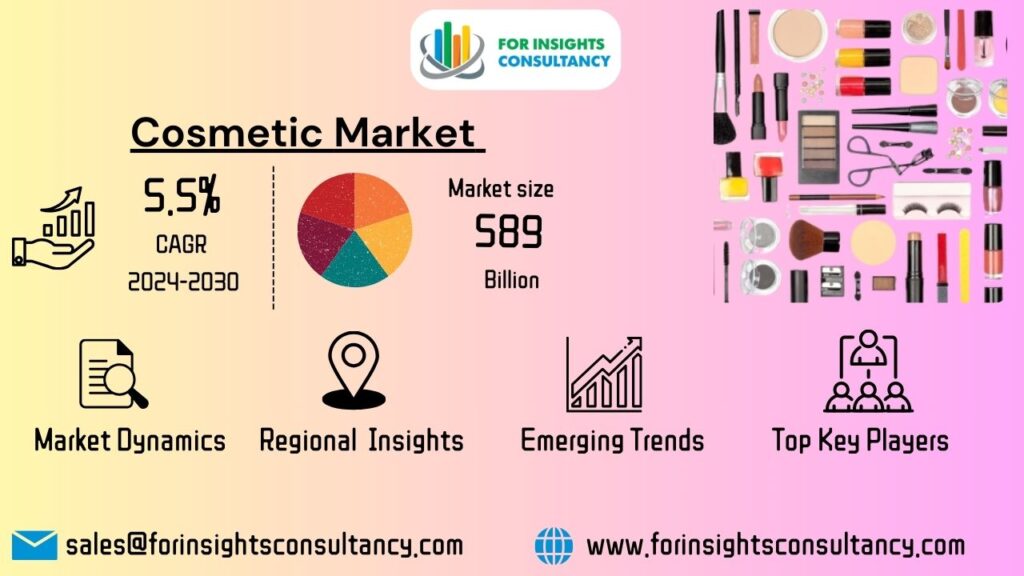
Market to grow from US$ 401Bilion in 2023 to US$ 589Bilion by 2034 at 5.5%
CAGR, driven by rising beauty demand, skincare innovation, and premium
products.
Overview of the Cosmetics
Market and Expected Growth (2026)
The rise
of both developed and emerging economies has fueled steady growth in demand for
cosmetics, skincare
product, personal care, and beauty products. The beauty industry has proven
to be innovative and adaptable, and offers products for varied audiences. In 2023,
the beauty industry has a value of $401 billion, and with changing beauty norms
and growing skincare awareness, projected annual growth of 5.5% will increase
the total industry value to $589 billion by 2034. The industry will experience
annual growth of 5.5% between these two years, and with just 3 years to reach
2026, these changes will occur quickly.
The
increase in demand for clean and transparent labeling and formulation has
occurs in conjunction with the demand for healthy, clean, and cruelty-free
products, and for the ethical and sustainable sourcing of ingredients. This has
in part caused an increase in the use of environmentally friendly and
completely bio-based raw materials in cosmetic formulations. In skincare,
personal care, and cosmetics, products especially active by dietary and/or
cosmetic means, cruelty-free, and/or eco-derm, are rapidly spreading to react
to the demand for the use of bio- and toxin-free active plant materials and
eco-derm products.
In the
cosmetics industry, technological evolution is providing innovation
opportunities for new strategies within the marketplace. The incorporation of
AI, AR, and machine learning are driving innovation in “virtual try-ons” and
recommending products for users. Digital marketing (especially Influencer
marketing) is having a huge impact on the consumer buying process for the
younger generation. The rise of e-commerce is making a direct impact on
cosmetics sales as brands are better able to sell to consumers that are located
all over the globe.
Because
of urbanization, a growing middle-class, and more disposable income – the
markets in the Asia-Pacific region are growing the fastest. The North American
and European markets are still developing, but with a more mature market. There
is a strong presence of brands and a greater demand for more expensive
products, and with this demand more innovation is required. There is a growing
importance of sustainability in the industry, along with a greater need for
digital engagement, and personalization. It is expected that in the cosmetics
industry there will be great expansion and diversification in product
categories by the year 2026.
Cosmetic Market Dynamics 2026
Cosmetic Market Trends
Increased Sales for Eco-Friendly and Clean
Beauty Products
There is
a growing selection of consumer packaged goods formulated with natural,
organic, and cruelty-free ingredients. Product transparency and responsible
sourcing of ingredients are becoming important to customers in most of the
world’s beauty markets.
Expanding Opportunities for
Customized Skin Care and Beauty Products
Using
digital and skin assessment technologies, beauty brands are creating customized
skin care products for different skin types, tones and conditions. Consumers
are responding well to personalized skin care regimens and to products that
focus on skin conditions.
Cosmetic Market Growth Drivers
Dermatological Research and
Innovation in Product Formulation
The
cosmetic industry is making a tangible commitment to combine cosmetic and
skincare products. Aimed at health-conscious consumers, the industry is
developing products enhanced with vitamins, antioxidants, and biotechnology
polymers.
The Rise of Skincare and
Anti-Aging Products
The
growing elderly demographic and the increasing concern for the health of the
skin are fuelling the demand for anti-aging creams and serums along with
protective moisturisers and sunscreens.
Cosmetic Market Opportunities
Integration of Technology in the
Beauty Industry
The
consumer shopping journey has changed with the introduction of virtual try-on
solutions, augmented reality makeup testing, and artificial intelligence (AI)
recommendations. These innovations offer beauty brands new solutions for
enhancing customer interaction and driving conversion rates.
Emerging Economies and
Opportunities
With
rapid urbanization, increased disposable incomes, and heightened awareness of
beauty products in developing markets, we are seeing an increased opportunity
for cosmetic companies to expand their operations in these regions.
Cosmetic Market Challenges
Increased
Complexity for Regulatory Compliance
Manufacturers of cosmetics need
to comply with laws governing the safety and labeling of cosmetics ingredients
across various regions. The varying regulations are costlier and more complex
for the business. An example of such regulations would be FDA guidelines in the
US and EU Cosmetics Regulation.
Increased
Costs of Raw Materials and New Production
Cosmetic business profitability
is affected by increases in cost for the raw ingredients, packaging, and labor.
Additionally, businesses have to deal with the pressure of maintaining
reasonable cost for the business while reducing the cost of ingredients while
maintaining quality and safety of the products.
Competitive Landscape of the
Cosmetic Market
Cosmetics
market is highly competitive, with a wide range of regional and global players
competing to gain market share. The industry is dominated by:
·
Avon Products
·
Kao Corporation
·
Oriflame Cosmetics S.A.
·
Revlon Inc.
·
Shiseido Company Limited
·
Skin Food
·
Estee Lauder
Cosmetics Market Company News
Estee Lauder
In October 2024, Estée Lauder
announced it would withdraw its 2025 annual sales and profit forecast, and
nearly halved its dividend, citing weak demand in China and Asia travel retail.
In January 2025, the company
confirmed that under its new CEO (effective 1 Jan 2025) it is reviewing its
portfolio of beauty brands and may sell some of them in an effort to improve
performance.
L’Oréal S.A
In June 2025, L’Oréal announced
the acquisition of a majority stake in British skincare brand Medik8 (valued
~€1 billion) to bolster its science-backed premium skincare footprint.
Procter & Gamble
For fiscal year 2025, P&G
reported net sales of US $20.9 billion in Q4 (up ~2% vs. prior year), while its
Beauty segment (skincare/hair etc.) saw organic growth of ~1% in that quarter.
In January 2025, P&G said its
Beauty segment organic sales were up ~2% year-on-year, but volume was down;
pricing and mix contributed to the growth.
Cosmetic Market Segment
Analysis
The
cosmetics market is divided into several categories that cater to the different
needs and preferences of consumers.
Skincare: These products are such as
moisturizers and cleansers which are aimed at maintaining healthy skin and even
improving it. With the increasing concerns of aging skin, skin sensitivity, and
pollution, skincare products have become a trend for the last few years.
Makeup: In makeup are included such
products as foundation, lipsticks, mascaras, eyeshadows, and blushes. Consumers
do makeup to make themselves look more attractive, to discover and present
their creative side, and to be trendy. This has led to an enormous market with
a vast range of products.
Haircare: The haircare products include
shampoos and conditioners, styling products, and hair treatments. They are the
solutions to hair issues such as the hair being damaged, frizzy, or dry. The
demand for haircare products depends on hair texture, hairstyling preferences,
and hair health condition.
Fragrances: The main sources of fragrances
are perfumes, colognes, and body sprays. These products are attractiveness to
those consumers who want to display their scent preferences. Besides that, they
deliver a sensory experience. Fragrance fads change with the seasons and
culture.
Men’s
Grooming: This
segment comprises products such as shaving creams and aftershaves that are used
for men’s grooming. Also, facial cleansers, grooming tools, and other grooming
accessories are included here. The segment has been growing due to the rising
awareness of men’s personal grooming and their inclination towards the
specialized products.
Natural
& Organic: This
sector embraces products made entirely from natural ingredients and those that
do not contain synthetic chemicals. The need for such products is a result of
the consumers’ choice to live sustainably and make healthy lifestyle decisions.
Brands
can target and capitalize on specific consumer preferences by targeting each
segment of the cosmetics market.
By
Category
·
Skin
& sun care products
·
Hair care
products
·
Deodorants
& fragrances
·
Makeup
& color cosmetics
By Gender
·
Men
·
Women
·
Unisex
By
Distribution Channel
·
Hypermarkets/Supermarkets
·
Specialty
Stores
·
Pharmacies
·
Online
Sales Channels
·
Other
Cosmetic Market Regional
Outlook
The
cosmetics market is dynamic in different regions. It reflects the unique
consumer preferences and influences of socio-economic factors.
North America
Cosmetics
Market in North America – 2026 Prediction
United States
The U.S.
has the biggest market in North America. Consumers spend a significant amount
of money on skincare, makeup, and anti-aging products. Market growth is fuelled
by strong e-commerce, digital marketing, and a preference for organic and
natural beauty products.
Canada
The
growing interest in premium skin and natural beauty products is contributing to
the expansion of the market. The awareness of the market for sustainable
packaging and cruelty-free products has stimulated the interest of both local
and international companies.
Mexico
Due to
urbanization, higher disposable income, and an increasing demand for
middle-class consumers, the Mexican cosmetics market is experiencing growth. There
is a demand for both skincare and color cosmetics, particularly among younger
consumers.
Europe
External Europe (Germany, France,
UK, Italy, Spain)
Anti-aging,
premium, and natural skin care products are in high demand in Western Europe
due to high levels of consumer awareness and purchasing power. France and
Germany are major centers of cosmetic product innovation and luxury beauty
brand creation.
Nordic Europe (Sweden, Denmark,
Norway, Finland)
Consumers
are influenced by the sustainability movement, and are focused on ethically
sourced skincare products and improved multifunctional solutions in growing
numbers. These trends are impacting the demand for organic, cruelty-free, and
sustainable skin care products.
South Europe (Portugal, Greece,
Italy, Spain)
Mass skin
care, color cosmetics, and skin protection are popular among both local and
international consumers, and the market is steadily growing. Increased
disposable incomes, urbanization, and the growth of tourism-driven retail in
Southern Europe are driving demand.
Eastern Europe (Poland, Czech
Republic, Hungary, Russia)
Eastern
Europe is an emerging market where awareness of beauty is growing, the middle
class is growing in urban areas, and economies are growing. These factors are
driving the rapid adoption of international cosmetic brands and premium
skincare products.
Asia-Pacific
Northeast Asia (China, Japan,
South Korea, Taiwan)
Northeast
Asia dominates all other areas in terms of size and growth for the cosmetics
industry, and this is driven by skincare advancements, the K-beauty phenomenon,
and anti-aging + multifunctional product tech. Innovations in these areas,
along with the rise of consumer awareness regarding these products, coalesce.
E-commerce and social media platforms play a critical role in shaping consumer
preferences.
Southeast Asia (Indonesia,
Thailand, Vietnam, Malaysia, Philippines)
Rapid
growth is expected in this market due to increasing urbanization, higher
disposable incomes, and a younger population that is increasingly conscious
about beauty. In this area, the most in demand products consist of skincare
products, sun protection products, and products made with natural ingredients.
South Asia (India, Sri Lanka,
Bangladesh, Pakistan)
With a
growing middle class and increased digital accessibility, there is increased
awareness and acceptance of cosmetic products, resulting in South Asia
presenting a growing market opportunity, especially for organic, halal, and
premium cosmetics.
Oceania (Australia, New Zealand)
Oceania’s
cosmetics market is growing, with high consumer demand for natural, clean, and
sustainable beauty products. Strong retail and e-commerce channels support the
growth of premium skincare and sun protection products.
Middle East and Africa
Gulf Cooperation Council (GCC) Countries
(Saudi Arabia, UAE, Qatar, Kuwait, Bahrain, Oman)
Due to
high disposable income, growing urban populations, and demand for affordable
premium skincare, luxury fragrances, and color cosmetics, the GCC countries
have the largest cosmetics market in the Middle East. Influencer marketing and
e-commerce are accelerating adoption of products.
North Africa (Egypt, Morocco,
Algeria, Tunisia)
North
Africa’s market for cosmetics is growing because of increased beauty awareness
and female workforce participation, and demand for halal and natural cosmetics.
Skincare and haircare products are the most popular.
Sub-Saharan Africa (Nigeria,
South Africa, Kenya, Ghana)
Sub-Saharan
Africa’s market is emerging, supported by urbanization, the formation of a middle-income
bracket, and internet connectivity. affordable skincare and haircare products
and color cosmetics have a strong demand. International and regional brands are
entering the market.
Frequently Asked Questions
How much
is the cosmetics market size?
Cosmetic
Market is expected to grow rapidly at a 5.5% CAGR consequently, it will grow
from its existing size of from $ 401 Billion in 2023 to $ 589 Billion by 2030.
Who are
the major players operating in the cosmetics market?
The major
market player includes Avon Products Inc., Kao Corporation, L’Oreal S.A.,
Oriflame Cosmetics S.A., Revlon, Inc., Shiseido Company Limited, Skin Food Co.,
Ltd., The Estee Lauder Companies Inc., The Procter & Gamble Company and
Unilever Plc..
Which are
the driving factors of the cosmetics market?
The surge
in demand for organic cosmetics products and the rapid growth in consumers
disposable income are the growth driving factors of the cosmetics market.
Which
segment is expected to hold the largest share in the cosmetics market?
The skin
and sun care products held the largest revenue share in the cosmetics market.
Key insights provided by the
report that could help you take critical strategic decisions?
· Regional
reports analyse product/service consumption and market factors in each region.
· Reports
highlight possibilities and dangers for suppliers in the Cosmetics Market
business globally.
· The
report identifies regions and sectors with the highest growth potential.
· It
provides a competitive market ranking of major companies, as well as
information on new product launches, partnerships, business expansions, and
acquisitions.
· The
report includes a comprehensive corporate profile with company overviews,
insights, product benchmarks, and SWOT analysis for key market participants.
Customization: We can
provide following things
1) On request more company profiles (competitors)
2) Data about particular country or region
3) We will incorporate the same with no additional cost
(Post conducting feasibility).
Any
Requirement Contact us: https://www.forinsightsconsultancy.com/contact-us/
Table of Contents
Chapter 1. Introduction
1.1. Research Objective
1.2. Scope of the Study
1.3. Definition
Chapter 2. Research Methodology
2.1. Research Approach
2.2. Data Sources
2.3. Assumptions & Limitations
Chapter 3. Executive Summary
3.1. Market Snapshot
Chapter 4. Market Variables and Scope
4.1. Introduction
4.2. Market Classification and Scope
4.3. Industry Value Chain Analysis
4.3.1. Raw Material Procurement Analysis
4.3.2. Sales and Distribution Channel Analysis
4.3.3. Downstream Buyer Analysis
Chapter 5. Market Dynamics Analysis and Trends
5.1. Market Dynamics
5.1.1. Market Drivers
5.1.2. Market Restraints
5.1.3. Market Opportunities
5.2. Porter’s Five Forces Analysis
5.2.1. Bargaining power of suppliers
5.2.2. Bargaining power of buyers
5.2.3. Threat of substitute
5.2.4. Threat of new entrants
5.2.5. Degree of competition
Chapter 6. Competitive Landscape
6.1.1. Company Market Share/Positioning Analysis
6.1.2. Key Strategies Adopted by Players
6.1.3. Vendor Landscape
6.1.3.1. List of Suppliers
6.1.3.2. List of Buyers
Chapter 7. Global Cosmetics Market, By Category
7.1. Cosmetics Market, by Category Type, 2023-2030
7.1.1. Skin & sun care products
7.1.1.1. Market Revenue and Forecast (2018-2030)
7.1.2. Hair care products
7.1.2.1. Market Revenue and Forecast (2018-2030)
7.1.3. Deodorants & fragrances
7.1.3.1. Market Revenue and Forecast (2018-2030)
7.1.4. Makeup & color cosmetics
7.1.4.1. Market Revenue and Forecast (2018-2030)
Chapter 8. Global Cosmetics Market, By Gender
8.1. Cosmetics Market, by Gender, 2023-2030
8.1.1. Men
8.1.1.1. Market Revenue and Forecast (2018-2030)
8.1.2. Women
8.1.2.1. Market Revenue and Forecast (2018-2030)
8.1.3. Unisex
8.1.3.1. Market Revenue and Forecast (2018-2030)
Chapter 9. Global Cosmetics Market, By Distribution Channel
9.1. Cosmetics Market, by Distribution Channel, 2023-2030
9.1.1. Hypermarkets/Supermarkets
9.1.1.1. Market Revenue and Forecast (2018-2030)
9.1.2. Specialty Stores
9.1.2.1. Market Revenue and Forecast (2018-2030)
9.1.3. Pharmacies
9.1.3.1. Market Revenue and Forecast (2018-2030)
9.1.4. Online sales channels
9.1.4.1. Market Revenue and Forecast (2018-2030)
9.1.5. Others
9.1.5.1. Market Revenue and Forecast (2018-2030)
Chapter 10. Global Cosmetics Market, Regional Estimates and Trend Forecast
10.1. North America
10.1.1. Market Revenue and Forecast, by Category (2018-2030)
10.1.2. Market Revenue and Forecast, by Gender (2018-2030)
10.1.3. Market Revenue and Forecast, by Distribution Channel (2018-2030)
10.1.4. U.S.
10.1.4.1. Market Revenue and Forecast, by Category (2018-2030)
10.1.4.2. Market Revenue and Forecast, by Gender (2018-2030)
10.1.4.3. Market Revenue and Forecast, by Distribution Channel (2018-2030)
10.1.5. Rest of North America
10.1.5.1. Market Revenue and Forecast, by Category (2018-2030)
10.1.5.2. Market Revenue and Forecast, by Gender (2018-2030)
10.1.5.3. Market Revenue and Forecast, by Distribution Channel (2018-2030)
10.2. Europe
10.2.1. Market Revenue and Forecast, by Category (2018-2030)
10.2.2. Market Revenue and Forecast, by Gender (2018-2030)
10.2.3. Market Revenue and Forecast, by Distribution Channel (2018-2030)
10.2.4. UK
10.2.4.1. Market Revenue and Forecast, by Category (2018-2030)
10.2.4.2. Market Revenue and Forecast, by Gender (2018-2030)
10.2.4.3. Market Revenue and Forecast, by Distribution Channel (2018-2030)
10.2.5. Germany
10.2.5.1. Market Revenue and Forecast, by Category (2018-2030)
10.2.5.2. Market Revenue and Forecast, by Gender (2018-2030)
10.2.5.3. Market Revenue and Forecast, by Distribution Channel (2018-2030)
10.2.6. France
10.2.6.1. Market Revenue and Forecast, by Category (2018-2030)
10.2.6.2. Market Revenue and Forecast, by Gender (2018-2030)
10.2.6.3. Market Revenue and Forecast, by Distribution Channel (2018-2030)
10.2.7. Rest of Europe
10.2.7.1. Market Revenue and Forecast, by Category (2018-2030)
10.2.7.2. Market Revenue and Forecast, by Gender (2018-2030)
10.2.7.3. Market Revenue and Forecast, by Distribution Channel (2018-2030)
10.3. APAC
10.3.1. Market Revenue and Forecast, by Category (2018-2030)
10.3.2. Market Revenue and Forecast, by Gender (2018-2030)
10.3.3. Market Revenue and Forecast, by Distribution Channel (2018-2030)
10.3.4. India
10.3.4.1. Market Revenue and Forecast, by Category (2018-2030)
10.3.4.2. Market Revenue and Forecast, by Gender (2018-2030)
10.3.4.3. Market Revenue and Forecast, by Distribution Channel (2018-2030)
10.3.5. China
10.3.5.1. Market Revenue and Forecast, by Category (2018-2030)
10.3.5.2. Market Revenue and Forecast, by Gender (2018-2030)
10.3.5.3. Market Revenue and Forecast, by Distribution Channel (2018-2030)
10.3.6. Japan
10.3.6.1. Market Revenue and Forecast, by Category (2018-2030)
10.3.6.2. Market Revenue and Forecast, by Gender (2018-2030)
10.3.6.3. Market Revenue and Forecast, by Distribution Channel (2018-2030)
10.3.7. Rest of APAC
10.3.7.1. Market Revenue and Forecast, by Category (2018-2030)
10.3.7.2. Market Revenue and Forecast, by Gender (2018-2030)
10.3.7.3. Market Revenue and Forecast, by Distribution Channel (2018-2030)
10.4. MEA
10.4.1. Market Revenue and Forecast, by Category (2018-2030)
10.4.2. Market Revenue and Forecast, by Gender (2018-2030)
10.4.3. Market Revenue and Forecast, by Distribution Channel (2018-2030)
10.4.4. GCC
10.4.4.1. Market Revenue and Forecast, by Category (2018-2030)
10.4.4.2. Market Revenue and Forecast, by Gender (2018-2030)
10.4.4.3. Market Revenue and Forecast, by Distribution Channel (2018-2030)
10.4.5. North Africa
10.4.5.1. Market Revenue and Forecast, by Category (2018-2030)
10.4.5.2. Market Revenue and Forecast, by Gender (2018-2030)
10.4.5.3. Market Revenue and Forecast, by Distribution Channel (2018-2030)
10.4.6. South Africa
10.4.6.1. Market Revenue and Forecast, by Category (2018-2030)
10.4.6.2. Market Revenue and Forecast, by Gender (2018-2030)
10.4.6.3. Market Revenue and Forecast, by Distribution Channel (2018-2030)
10.4.7. Rest of MEA
10.4.7.1. Market Revenue and Forecast, by Category (2018-2030)
10.4.7.2. Market Revenue and Forecast, by Gender (2018-2030)
10.4.7.3. Market Revenue and Forecast, by Distribution Channel (2018-2030)
10.5. Latin America
10.5.1. Market Revenue and Forecast, by Category (2018-2030)
10.5.2. Market Revenue and Forecast, by Gender (2018-2030)
10.5.3. Market Revenue and Forecast, by Distribution Channel (2018-2030)
10.5.4. Brazil
10.5.4.1. Market Revenue and Forecast, by Category (2018-2030)
10.5.4.2. Market Revenue and Forecast, by Gender (2018-2030)
10.5.4.3. Market Revenue and Forecast, by Distribution Channel (2018-2030)
10.5.5. Rest of LATAM
10.5.5.1. Market Revenue and Forecast, by Category (2018-2030)
10.5.5.2. Market Revenue and Forecast, by Gender (2018-2030)
10.5.5.3. Market Revenue and Forecast, by Distribution Channel (2018-2030)
Chapter 11. Company Profiles
11.1. Avon Products Inc.
11.1.1. Company Overview
11.1.2. Product Offerings
11.1.3. Financial Performance
11.1.4. Recent Initiatives
11.2. Kao Corporation
11.2.1. Company Overview
11.2.2. Product Offerings
11.2.3. Financial Performance
11.2.4. Recent Initiatives
11.3. L’Oreal S.A.
11.3.1. Company Overview
11.3.2. Product Offerings
11.3.3. Financial Performance
11.3.4. Recent Initiatives
11.4. Oriflame Cosmetics S.A.
11.4.1. Company Overview
11.4.2. Product Offerings
11.4.3. Financial Performance
11.4.4. Recent Initiatives
11.5. Revlon, Inc.
11.5.1. Company Overview
11.5.2. Product Offerings
11.5.3. Financial Performance
11.5.4. Recent Initiatives
11.6. Shiseido Company Limited
11.6.1. Company Overview
11.6.2. Product Offerings
11.6.3. Financial Performance
11.6.4. Recent Initiatives
11.7. Skin Food Co., Ltd.
11.7.1. Company Overview
11.7.2. Product Offerings
11.7.3. Financial Performance
11.7.4. Recent Initiatives
11.8. The Estee Lauder Companies Inc.
11.8.1. Company Overview
11.8.2. Product Offerings
11.8.3. Financial Performance
11.8.4. Recent Initiatives
11.9. The Procter & Gamble Company
11.9.1. Company Overview
11.9.2. Product Offerings
11.9.3. Financial Performance
11.9.4. Recent Initiatives
11.10. Unilever Plc.
11.10.1. Company Overview
11.10.2. Product Offerings
11.10.3. Financial Performance
11.10.4. Recent Initiatives
Chapter 12. Research Methodology
12.1. Primary Research
12.2. Secondary Research
12.3. Assumptions
Chapter 13. Appendix
13.1. About Us
13.2. Glossary of Terms
Select PDF License
Single User: $3499
Multiple Users: $4499
Corporate Users: $5499