
Green Energy Market Growth Analysis Research Report By Energy Source: Solar Energy, Wind Energy, Hydropower, Biomass Energy, Geothermal Energy , (By Technology: Photovoltaic (PV) Systems, Concentrated Solar Power (CSP), Onshore Wind Turbines, Offshore Wind Turbines, Bioenergy Conversion Technologies )- and Global Forecast to 2034
Mar-2026 Formats | PDF | Category: Energy & Power | Delivery: 24 to 72 Hours
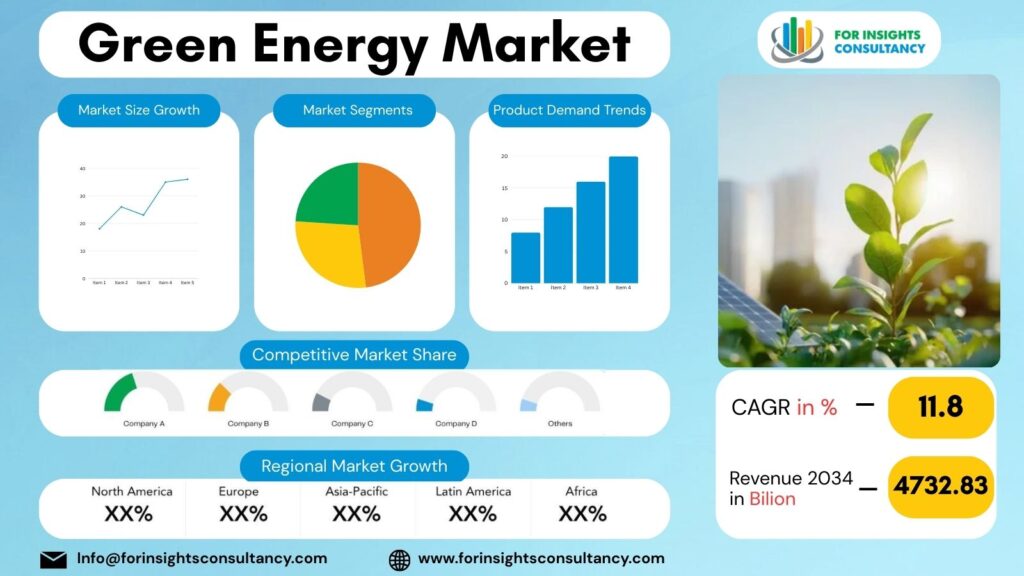
Green Energy Market Size & Forecast 2026 to 2034: Industry to grow from USD 1482.38 Billion (2025) to USD 4732.83 Billion (2034) with 11.8% CAGR. driven by increasing investments in renewable energy, policies for decarbonization, and growing use of solar and wind energy.
Overview of the Green Energy Market and Expected Growth (2026)
The Green Energy Market, also called the renewable energy market, is one of the fastest-growing sectors of the global energy market. It encompasses energy produced from renewable sources, which include solar, wind, hydropower, biomass, and geothermal systems. The market is expected to continue to grow substantially in 2026, as governments, businesses, and individuals look for cleaner alternatives to fossil fuels due to the effects of climate change, energy security, and the need for sustainability.
The transition to green energy is driven in part by the rapid growth of renewable energy capacity. In the last few years, the largest share of global new electricity generation came from renewable sources, especially solar and wind, which lead the increases thanks to lowering costs and improved operational efficiencies. In 2024, for example, approximately 585 gigawatts of renewable energy capacity was added, representing more than 90% of global new power capacity.
Government policies and technology improvements have also shaped the market. Large-scale investment in renewable energy infrastructure is the result of policies like renewable energy subsidies, tax credits, and decarbonization targets. Green energy has become more economical than fossil fuel-based power generation as solar photovoltaic and wind turbine costs have decreased greatly.
As corporate sustainability pledges and international climate deals evolve, there is greater need for clean energy alternatives. With governments looking to extend renewable portfolios for their carbon-reduction targets, companies are more frequently buying renewable electricity via long-term power purchase agreements (PPAs). This makes rapid global scaling of renewable energy capacity innovation in energy storage, smart grids, and hybrid energy systems (solar, wind, and battery).
Market Dynamics 2026
Growth Drivers
Growing global need for electricity
The need for electricity is growing due to population growth, industrial development, and the proliferation of digital technologies. This has compelled countries to incorporate renewable energy sources for a sustained energy supply.
Decreasing prices of renewable technologies
The ongoing advancement of manufacturing technologies and the innovation of new technologies have significantly decreased the prices of solar photovoltaic panels and wind turbines and have also made it possible to compete with fossil fuels.
Restraints
Significant upfront cost for infrastructure
Due to the need for installation, grid connection, and storage systems, the first cost hurdle to be overcome for the construction of solar farms, wind parks, and hydropower plants is often a great deterrent to the development of renewables, especially in the early phases of development in a given area.
Renewable energy sources are dependent on the weather
The generation of solar energy and wind energy is heavily dependent on the weather, resulting in a generation of energy that is not constant, and a lack of storage systems can unbalance the grid.
Opportunities
Progress in energy storage technologies
Improvements in battery storage and systems for energy storage at grid scale are facilitating the integration of renewable energy in electricity grids and opening new prospects for investment.
Electrification of transport
The worldwide transition to electric vehicles is driving the consumption of renewable electricity and, consequently, business prospects for renewable energy generators and providers of charging infrastructure.
Challenges
Challenges with grid integration
Incorporating substantial amounts of renewable electricity into current power grids is particularly difficult for areas where transmission systems were first built for centralized fossil-fuel generation.
Supply chain dependence for vital minerals
The renewable energy systems rely on critical minerals like lithium, cobalt, and rare earth elements. Supply chain disturbances for these minerals will affect the timelines and costs of manufacturing for the projects.
Top Companies Covered In This Report
(Major global and regional players shaping the industry)
- NextEra Energy
- Iberdrola
- Vestas Wind Systems
- JinkoSolar
- GE Vernova
- Canadian Solar
- Ørsted
- Enel Green Power
- Adani Green Energy
- Brookfield Renewable Partners
Green Energy Industry Company News 2025 and 2026
NextEra Energy
In 2025, the company expanded its renewable and battery storage pipeline, adding several gigawatts of new solar, wind, and storage projects to its backlog to support increasing electricity demand from technology and data-center companies.
Iberdrola
In 2026, the company announced it will stop global production of the paraquat herbicide by June 2026, citing strong competition from generic products and strategic portfolio shifts.
Vestas Wind Systems
In 2025–2026, Vestas continued expanding its global wind turbine installations and service agreements as countries accelerate offshore and onshore wind projects to meet renewable energy targets.
GE Vernova
GE Vernova expanded its renewable energy portfolio, focusing on advanced wind turbine technology and grid solutions aimed at improving renewable energy integration and power system reliability.
Detailed Segmentation and Classification of the report (Market Size and Forecast – 2034, Y-o-Y growth rate, and CAGR):
By Energy Source
- Solar Energy
- Wind Energy
- Hydropower
- Biomass Energy
- Geothermal Energy
- Other Renewable Sources
By Technology
- Photovoltaic (PV) Systems
- Concentrated Solar Power (CSP)
- Onshore Wind Turbines
- Offshore Wind Turbines
- Bioenergy Conversion Technologies
By Application
- Electricity Generation
- Heating and Cooling
- Transportation
- Industrial Energy Use
By End User
- Residential
- Commercial
- Industrial
- Utilities
Regional Deep-dive Analysis:
The report provides in-depth qualitative and quantitative data on the Green Energy Market for all of the regions and countries listed below:
North America
In the North American renewable energy market, the strong government incentives, technological innovation, and increasing investments in North American renewable energy projects are leading capacity in North America >570GW in 2025 and continues to grow in the following years (North America Energy Outlook 2026).
USA:
USA in the leading position in North America due to the massive investments in energy storage systems and the construction of wind and solar power plants. The massive investments in solar and wind energy face certainty in the market to grow, due to the combination of fgovernmental subsidies and massive procurements of renewable energy by large corporations.
Canada:
Due to the existence of substantial resources of hydropower, which serve to the majority of the generation of the electricity in the country, ana supports Mich the growth of the energy sector which takes hydropower as the essential resource. In addition, the growth of wind and solar energy in the country is expanding the diversification of the country in the renewable energy resources.
Mexico:
Due to the existence of favorable geographical resources for solar, wind, and geothermal energy and the growing investments receivable in the sustainable electric energy generation, Mexico is likely to be a growing economy in the renewable energy generation.
Europe
Market analysts project that the Europe green energy market will reach 106 billion euros by 2026. Europe will still be one of the industry-leading regions due to solid political frameworks and funding for the wind, solar, and hydro projects. Europe has also implemented strong climate policies and decarbonization targets.
Western Europe:
Germany, France, and the United Kingdom, with their tremendous policy frameworks, spearhead the market due to their high offshore solar and wind renewables energy capacity.
Northern Europe:
Denmark, Sweden, and Finland have adopted renewable energy technologies and set sophisticated and generous energy policies. Therefore, they have the highest renewable energy technology share.
Southern Europe:
Spain, Italy, and Portugal have also increased their solar, wind energy, and renewables policies due to solar/wind favorable climate policies.
Eastern Europe:
Poland, Romania, and Hungary are also increasing their funding/renewable policies to boost energy diversification and reduce fossil dependency.
Asia-Pacific
The Asia-Pacific region green energy market is projected to hit major milestones by 2026. This region will be one of the fastest-growing markets of renewable energy due to increasing electricity demand, large investments in solar and wind projects and government policies that support the market. Asia-Pacific is expected to lead the world in solar and wind energy and by 2024 is expected to have 1.18TW of solar energy and 0.67TW of wind energy. These high amounts of energy produced will be a result of the rapidly growing clean energy infrastructure.
China:
For the Asia-Pacific region, China leads the market with its ability to build large-scale solar, wind, and hydroelectric power plants. China also leads the world in solar photovoltaic capacity. They have about 887 GW of this energy source.
India:
India is developing its ability to produce renewable energy rapidly. Large investments in the construction of solar parks, wind farms, and hybrid renewable projects is a way India will develop its ability to produce large amounts of clean electricity. This is in support of the developing world’s energy transition goals.
Japan & South Korea:
Japan and South Korea have developed large investments in offshore wind and solar energy and also in systems that are based on hydrogen. These two countries develop advanced technologies that allow for better power grids and also improved storage of energy.
Southeast Asia:
Vietnam, Thailand, the Philippines, and Indonesia are becoming renewable energy hubs, thanks to good natural resource potential and rising levels of investment in solar and wind facilities. There is anticipated strong growth in the region’s renewable capacity anticipated by 2030.
Australia & New Zealand:
These markets focus on large-scale solar farms, wind energy, and the development of energy storage as a means to promote their national decarbonization strategies and energy exports.
Middle East and Africa
In 2026, with the Middle East and Africa (MEA) green energy market expanding, governments are aiming to cut down the use of fossil fuels by diversifying the energy sources they use. The whole region is developing large-scale projects for solar, wind and green hydrogen, and with ever-increasing demand for electricity, along with abundant solar radiation, it is no surprise. In 2025, the Middle East and North Africa region had 43.7 GW of renewable energy capacity, with the largest share of installations in solar power.
Middle East:
Middle eastern countries are expanding their solar and wind energy projects at an unprecedented pace. Countries like Saudi Arabia, United Arab Emirates and Israel are investing in battery storage systems to support energy diversification along with utility-scale solar park construction to achieve long-term sustainability.
North Africa:
North African countries like Egypt, Morocco and Algeria are constructing large solar and wind projects to provide electricity to their countries and support the planned clean energy exports to Europe.
Sub-Saharan Africa:
In Sub-Saharan Africa, countries like South Africa, Kenya and Nigeria are investing more in solar mini-grids, wind power, and hydropower to ensure electricity access and to fall off the dependency wheel of diesel-based power generation.
Southern Africa:
South Africa is the leader in the sub-region in installing renewables as a result of its national renewable procurement programs which stimulate private investments in the construction of solar and wind farms.
Frequently Asked Questions with Answers
What is the Green Energy market size and growth forecast?
Green Energy Market is probable to reach a value of USD 1482.38 Billion in 2025 and is anticipated to grow to almost USD 4732.83 Billion by 2034. This expansion reflects a compound annual growth rate (CAGR) of 11.8% during the forecast period from 2026 to 2034.
Who are the key players in the Green Energy market?
The Green Energy Market Includes Major Companies NextEra Energy, Iberdrola, Vestas Wind Systems, JinkoSolar, GE Vernova, Canadian Solar, Ørsted, Enel Green Power, Adani Green Energy, Brookfield Renewable Partners, Others.
What are the current and future trends for Green Energy market?
Increasing adoption of solar and wind power, expansion of energy storage technologies, growth of green hydrogen, and strong government policies supporting global decarbonization are key trends shaping the green energy market.
Which regions dominate the Green Energy market?
Asia-Pacific dominates the green energy market, driven by large renewable installations and strong investments in solar and wind power in countries like China and India.
Key insights provided by the report that could help you take critical strategic decisions?
- Regional reports analyse product/service consumption and market factors in each region.
- Reports highlight possibilities and dangers for suppliers in the Green Energy Market business globally.
- The report identifies regions and sectors with the highest growth potential.
- It provides a competitive market ranking of major companies, as well as information on new product launches, partnerships, business expansions, and acquisitions.
- The report includes a comprehensive corporate profile with company overviews, insights, product benchmarks, and SWOT analysis for key market participants.
Customization: We can provide following things
1) On request more company profiles (competitors)
2) Data about particular country or region
3) We will incorporate the same with no additional cost (Post conducting feasibility).
Any Requirement Contact us: https://www.forinsightsconsultancy.com/contact-us/
Table of Contents
For TOC Contact us: https://forinsightsconsultancy.com/contact-us/