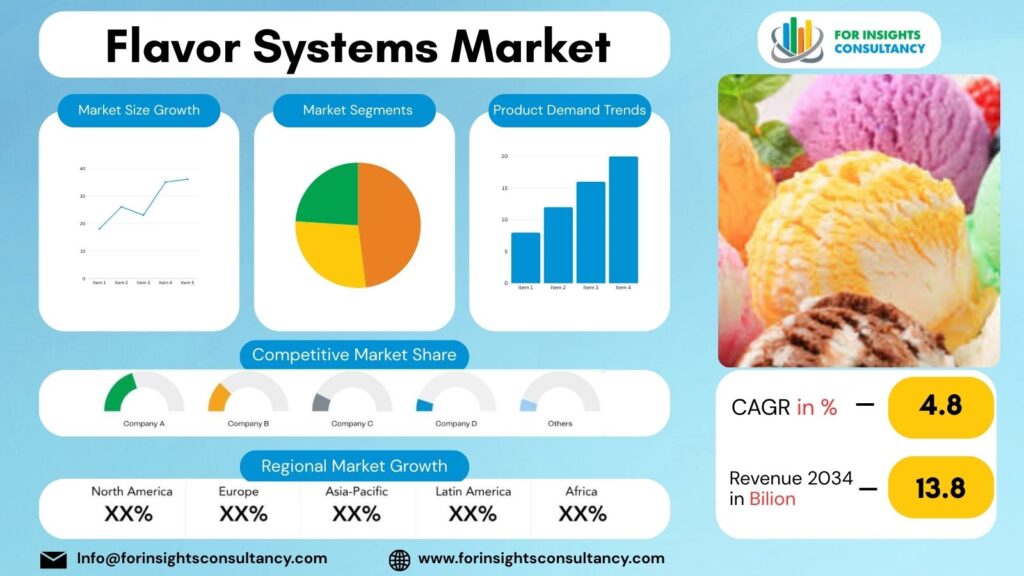
The Global Flavor Systems Market is estimated to be valued at USD 7.23 Billion in 2025 and is expected to reach USD 13.8 Billion by 2034, growing at a compound annual growth rate (CAGR) of 4.8% from 2026 to 2034.
Flavor Systems Market: Overview and Growth in the Upcoming Year
The Flavor Systems Market is expected to witness steady expansion in 2026, driven by evolving consumer preferences, product innovation, and the increasing demand for differentiated taste experiences. Flavor systems, which combine multiple ingredients to create consistent and enhanced taste profiles, are becoming essential in modern food and beverage formulation.
In 2026, the market is projected to grow at a moderate pace as food manufacturers focus on product customization and premiumization. Companies are investing in advanced flavor blending techniques to ensure stability, longer shelf life, and improved sensory performance. The growing demand for convenience foods, ready-to-drink beverages, dairy alternatives, and plant-based products is significantly contributing to market momentum.
Clean-label trends continue to shape the industry landscape. Consumers are increasingly preferring natural and plant-derived flavors over synthetic alternatives. This shift is encouraging manufacturers to reformulate products with transparent ingredient lists while maintaining taste consistency and cost efficiency.
Overall, the Flavor Systems Market in 2026 reflects a balanced mix of innovation, health consciousness, and global expansion. As consumer tastes evolve and demand for high-quality, consistent flavors rises, the market is positioned for sustainable growth in the upcoming year.
Market Dynamics
Growth Drivers
- Natural & organic food products’ demand is increasing.
- Enlargement of functional and fortified foods.
- A rise in consumption of processed and packaged foods.
- Technologies for flavour encapsulation and delivery.
- The middle-class in developing economies is enlarging and is more urbanised than ever before.
Industry Trends
In 2026, innovation remains central to market growth. Flavor houses are focusing on:
- Customized solutions tailored to regional taste preferences
- Sugar and salt reduction technologies without compromising flavor
- Sustainable sourcing of raw materials
- Development of plant-based and allergen-free flavor systems
Digital tools and AI-based formulation technologies are also transforming product development, enabling faster innovation cycles and more accurate flavor replication.
Restraints
Fluctuating Raw Material Prices
Natural flavor ingredients such as essential oils, botanical extracts, and fruit concentrates are highly dependent on agricultural output. Climate change, crop failures, and supply chain disruptions can increase production costs.
Stringent Regulatory Frameworks
Governments across regions are tightening food safety and labeling regulations. Compliance with varying international standards increases operational complexity and costs for manufacturers.
Clean-Label Reformulation Challenges
While demand for natural flavors is rising, replacing synthetic ingredients without affecting taste stability, shelf life, or cost efficiency remains technically challenging.
High R&D and Innovation Costs
Developing advanced flavor systems, including encapsulation and controlled-release technologies, requires significant research investment, which may impact small and mid-sized companies.
Intense Market Competition
The presence of established global players and regional manufacturers leads to pricing pressure and reduced profit margins.
Supply Chain Disruptions
Geopolitical tensions, logistics delays, and transportation costs continue to affect raw material sourcing and timely product delivery.
Challenges
Structure Reorganizes.
Achieving a taste consistency while reducing sugar, salt and artificial ingredients is technically very challenging. It continues to be a challenge to attain clean-label with the flavor intensity.
Increasing Customer Demand.
Consumers want more personalized, functional and healthy products. Developing products that appeal to various regional tastes and scale has become a challenge.
Inconsistency of rules across regions.
Each country has its own rules for flavor ingredients, labeling, and safety approval. The differences in regulations slow down the global launch of any product.
Sustainable Pressures.
Demand for the responsible sourcing of raw materials is likely to rise. Making your products sustainably affects your operations costs.
Top Companies Covered In This Report
- Charles H. Baldwin and Sons (U.S)
- A. Weber and Co. (U.S)
- Atlantic Holdfast Seaweed Co(U.S)
- Aquarev Industries (U.S)
- Eurovanille (France)
- Amadeus Trading Co. (U.S)
- Apex Flavors Inc. (U.S)
- Lochhead Manufacturing Company (U.S)
- MacTaggarts Brand (U.S)
- McCormick and Company Inc (U.S)
- Mikoya Kasho Co. Ltd. (Japan)
- Rodelle Inc. (U.S)
- SAMBIRANO AROMATIC (Switzerland)
- Seamore Holding BV (Netherlands)
- Celtic Sea Spice Company Ltd (U.S)
- Frito-Lay North America Inc. (U.S)
Flavor Systems Industry News
McCormick & Company Inc (U.S.)
In August 2025, McCormick announced it agreed to acquire an additional 25% ownership in McCormick de Mexico, raising its stake to 75% and strengthening its regional flavor and condiment footprint, particularly in Latin America; the deal is expected to close in early 2026.
2025 earnings highlighted strong growth in its customized flavor systems segment, with B2B solutions gaining traction as food manufacturers seek tailored taste profiles even amid macro cost pressures.
E.A. Weber and Co. (U.S.)
In 2025, the company published a Top 40 flavor trends bulletin for bakery applications, showing its continued focus on evolving taste preferences (e.g., premium and nut/coffee-inspired notes), though there were no major corporate deals reported publicly.
Detailed Segmentation and Classification of the report (Market Size and Forecast – 2034, Y-o-Y growth rate, and CAGR):
Segment By Type
- Natural Flavors
- Artificial Flavors
- Nature-Identical Flavors
Segment by Form
Segment by Application
- Beverages
- Dairy Products
- Bakery & Confectionery
- Savory & Snacks
- Meat & Poultry
- Pharmaceuticals
Segment by Origin
Regional Deep-dive Analysis:
The report provides in-depth qualitative and quantitative data on the Flavor Systems Market for all of the regions and countries listed below:
North America
North America is one of the leading regional markets for flavour system Driven by a strong food and beverage industry and high levels of innovation in the market, the region has been capturing a staggering share of the global flavour market for some time. In 2025, the region held approximately 30–35% of the market for flavor systems worldwide, which is expected to rise from 2026.
The regional market is by far the most dominant in the United States owing to the highest food manufacturing plants and innovation hubs in the country. Furthermore, it owes its major share to the largest per-capita consumption of all flavored products. The packaged food industries in Canada and Mexico are also increasing, along with the demand for premium and natural flavoring systems.
In 2026, North America will remain the leading innovator and adopter of flavor systems. Demand for natural clean-label products, together with investment in flavor technologies and strong beverage and food processing industries, will help the region sustain dominant growth as part of the global flavour systems ecosystem.
Europe
Europe will still be one of the largest regional markets for flavor systems by 2026. The demand is being supported by the region’s robust food processing industry, strict quality and safety regulations, and a growing emphasis on natural and clean-label products. Europe is estimated to account for nearly a quarter to a quarter of the whole flavour systems market.
The market for flavor systems which is a European flavor systems market is likely to grow at a stable rate in 2026. The growth is due to the increase in consumer preference for natural and sustainable flavors solutions. Moreover, ongoing innovations in flavor delivery technologies will also accelerate the growth.
Germany is leading the region owing to its strong food processing set-up and high adoption rate of premium flavor technology.
France has always maintained strong demand due to its culinary culture experienced with gourmet and artisanal flavours.
The markets of Spain and Italy are equally important, with a focus on value and growth in organic and wellness products.
Almindt-3 has been present in Europe for a long time.
Flavored drinks and functional beverages to support growth of beverages.
Uninterrupted demand for premium taste profiles in dairy & bakery.
Savory and Snacks expanding ready-to-eat and convenient food categories.
All these segments together enhance regional demand for customized flavor solutions.
Asia-Pacific
The Asia-Pacific flavor systems market is one of the fastest-growing regional markets globally. One of the key reasons for market growth is rapid urbanization along with rising disposable incomes. Moreover, the rapidly expanding food and beverage industry is also boosting market demand. The broader ASEAN region of countries is estimated to account for nearly a third share of overall global consumption of flavour systems. China, India, Japan and other South-East Asian countries also contribute to overall demand.
China continues to dominate Asia-Pacific market with a substantial share of regional demand, along with strong use of traditional flavours and innovative flavour systems.
India’s booming food processing industry and the rising demand for packaged foods will fuel strong growth in the near future.
Japan and South Korea show steady demand backed by a premium food culture and a focus on high-quality flavor solutions.
Middle East and Africa
In 2026, the Middle East and Africa (MEA) flavor systems market continues to develop as a steadily expanding region, driven by increasing demand for advanced taste solutions across the food and beverage industry. The region represents a meaningful share of global flavor systems consumption, with GCC countries such as the United Arab Emirates and Saudi Arabia playing a leading role in regional growth.
The MEA flavor systems market was valued at approximately USD 450 million in 2025 and is projected to grow further in 2026. Growth is supported by rising adoption of flavor systems in beverages, dairy products, bakery items, and snack applications, alongside expanding food processing activities.
United Arab Emirates: A key regional contributor, supported by strong trade networks, food innovation hubs, and a well-developed import-export ecosystem.
Saudi Arabia: Demonstrates solid domestic demand, driven by food industry diversification initiatives and increasing local manufacturing capacity.
South Africa and Egypt: Important African markets with expanding beverage consumption and growth in packaged and processed food segments.
Nigeria: An emerging market showing potential growth as urbanization and changing demographics increase demand for affordable flavored food and beverage products.
Frequently Asked Questions with Answers
What is the Flavor Systems market size and growth forecast?
Flavor Systems Market is projected to reach a value of USD 7.23 Billion in 2025 and is anticipated to grow to approximately USD 13.8 billion by 2034. This expansion reflects a compound annual growth rate (CAGR) of 4.8% during the forecast period from 2026 to 2034.
Who are the key players in the Flavor Systems market?
The Flavor Systems Market Includes Major Companies E.A. Weber and Co. (U.S), Eurovanille (France), Lochhead Manufacturing Company (U.S), MacTaggarts Brand (U.S), McCormick and Company Inc (U.S), Mikoya Kasho Co. Ltd. (Japan), Rodelle Inc. (U.S), SAMBIRANO AROMATIC (Switzerland), Amadeus Trading Co. (U.S), Apex Flavors Inc. (U.S), Charles H. Baldwin and Sons (U.S), Seamore Holding BV (Netherlands), Celtic Sea Spice Company Ltd (U.S), Frito-Lay North America, Inc. (U.S), Atlantic Holdfast Seaweed Co(U.S), Aquarev Industries (U.S), Others.
What are the current and future trends for Flavor Systems market?
The Flavor Systems market is currently driven by demand for natural and clean-label ingredients, product customization, and sugar reduction solutions, and is expected to grow further with advancements in flavor delivery technologies, plant-based innovations, and expanding applications across global food and beverage sectors.
Which regions dominate the Flavor Systems market?
North America dominates the Flavor Systems market, supported by its advanced food processing industry, strong innovation capabilities, and high demand for natural and customized flavor solutions.
Key insights provided by the report that could help you take critical strategic decisions?
- Regional reports analyse product/service consumption and market factors in each region.
- Reports highlight possibilities and dangers for suppliers in the Flavor Systems Market business globally.
- The report identifies regions and sectors with the highest growth potential.
- It provides a competitive market ranking of major companies, as well as information on new product launches, partnerships, business expansions, and acquisitions.
- The report includes a comprehensive corporate profile with company overviews, insights, product benchmarks, and SWOT analysis for key market participants.
Customization: We can provide following things
1) On request more company profiles (competitors)
2) Data about particular country or region
3) We will incorporate the same with no additional cost (Post conducting feasibility).
Any Requirement Contact us: https://www.forinsightsconsultancy.com/contact-us/