

Aroma Ingredients Market Growth Analysis Research Report By Type (Natural Aroma Ingredients, Synthetic Aroma Ingredients), By Product (Essential Oils, Aroma Oils, Aroma Chemicals, Terpenes, Musk Chemicals, Benzenoids, Others), By Source (Botanical/Plant-Based, Animal-Based, Chemical/Synthetic), by Application - and Global Forecast to 2034
Feb-2026 Formats | PDF | Category: Food Beverages | Delivery: 24 to 72 Hours
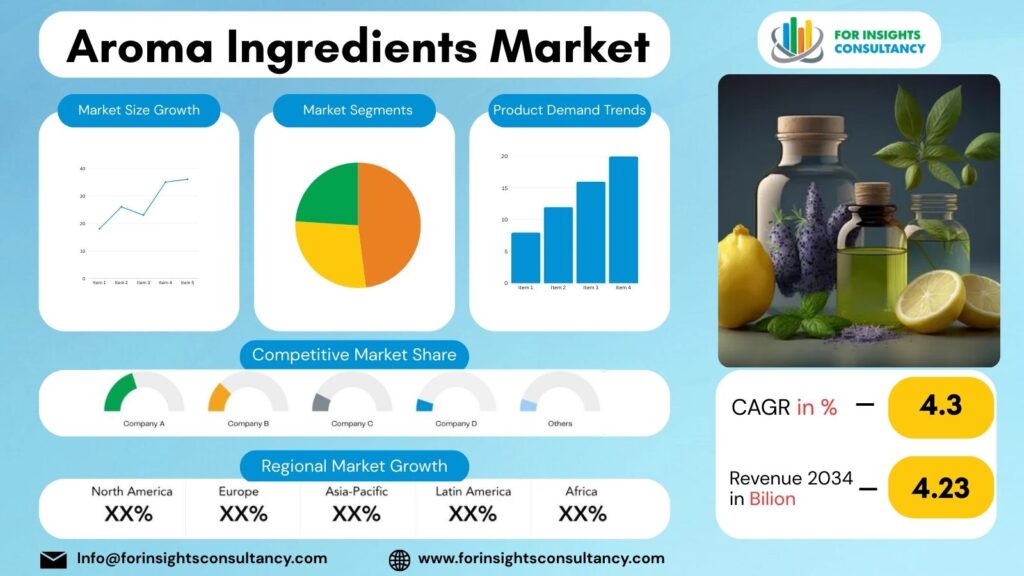
The Global Aroma Ingredients Market is projected to be valued at USD 2.97 Billion in 2025 and is expected to reach USD 4.23 Billion by 2034, growing at a compound annual growth rate (CAGR) of 4.3% from 2026 to 2034.
Aroma Ingredients Market: Overview and Growth in the Upcoming Year
The global Aroma Ingredients Market is expected to maintain steady growth momentum in 2026, supported by expanding applications across personal care, fine fragrances, homecare products, and food & beverage formulations. Aroma ingredients, which include natural extracts, essential oils, and synthetic aroma chemicals, play a vital role in enhancing product appeal by improving scent performance, consumer experience, and brand differentiation.
Industry analysis indicates that the market will continue progressing at a moderate but stable growth rate in 2026, driven by increasing global consumption of cosmetics, hygiene products, and premium fragrance solutions. As consumer purchasing behavior increasingly emphasizes sensory experience and emotional connection, fragrance composition has become a strategic component in product innovation rather than simply an additive feature.
A key factor shaping market development in 2026 is the growing preference for sustainable and responsibly sourced ingredients. Manufacturers are investing in bio-based aroma compounds, green chemistry processes, and advanced extraction technologies to meet evolving regulatory standards and consumer expectations for transparency. Natural aroma ingredients derived from botanical sources are gaining traction, while synthetic ingredients remain essential for consistency, scalability, and cost efficiency.
From an industry perspective, technological advancements are improving formulation capabilities. Encapsulation technologies, biotechnology-based molecule development, and AI-assisted fragrance design are enabling longer-lasting scents and improved stability across diverse applications. These innovations are helping manufacturers respond to demand for customized fragrances used in skincare, premium detergents, ambient scenting, and wellness-focused products.
North America and Europe continue to lead in product innovation, sustainability initiatives, and premium fragrance adoption. The combination of emerging market consumption and developed market innovation creates a balanced global growth environment.
Looking ahead, the aroma ingredients industry in 2026 is positioned for innovation-led expansion, supported by clean-label trends, wellness integration, and evolving consumer lifestyle preferences. Continuous investment in sustainable sourcing, research and development, and fragrance personalization is expected to strengthen market competitiveness and ensure long-term industry resilience.
Market Dynamics
Growth Drivers
Rising Demand for Personal Care and Hygiene Products
Increasing global consumption of personal care and hygiene products continues to be a primary growth driver. Products such as shampoos, skincare formulations, deodorants, soaps, and cosmetics rely heavily on aroma ingredients to enhance user experience and brand identity. Growing awareness of personal grooming and hygiene, particularly in emerging economies, is strengthening demand for fragrance solutions integrated into everyday consumer products.
Shift Toward Premium and Experience-Driven Products
Consumers are increasingly valuing sensory appeal alongside product functionality. Fragrance has become an important factor influencing purchasing decisions, encouraging manufacturers to develop distinctive scent profiles and premium formulations. This transition toward experience-focused products is expanding the role of aroma ingredients beyond traditional perfumery into homecare and lifestyle categories.
Increasing Preference for Natural and Sustainable Ingredients
Sustainability considerations are shaping product development strategies in 2026. Brands are adopting plant-based and responsibly sourced aroma ingredients to align with clean-label trends and environmental expectations. Advances in green chemistry and sustainable extraction methods are improving scalability while maintaining ingredient quality, supporting wider commercial adoption.
Technological Advancements in Fragrance Development
Innovation in biotechnology, encapsulation techniques, and digital formulation tools is enhancing fragrance performance and stability. These technologies allow longer-lasting scents, controlled release mechanisms, and customized aroma profiles, enabling manufacturers to meet evolving consumer expectations across cosmetics, household care, and wellness applications.
Industry Trends
Growing Adoption of Natural and Bio-Based Ingredients
One of the most prominent industry trends is the increasing use of natural and plant-derived aroma ingredients. Consumers are showing stronger preference for products formulated with botanical extracts and renewable raw materials. Manufacturers are expanding sourcing partnerships and investing in sustainable cultivation and extraction processes to ensure supply stability while meeting environmental standards.
Integration of Sustainability Across the Value Chain
Sustainability is moving beyond ingredient sourcing to include packaging, production efficiency, and carbon footprint reduction. Companies are adopting green chemistry practices, biodegradable fragrance compounds, and responsible sourcing certifications. Transparency in ingredient origin and production methods is becoming an important factor in brand positioning and regulatory compliance.
Technological Innovation in Fragrance Creation
Advancements in biotechnology and digital formulation tools are transforming how aroma ingredients are developed. AI-assisted fragrance modeling, precision fermentation, and encapsulation technologies are enabling improved scent longevity, controlled release, and formulation consistency. These innovations help manufacturers create differentiated products while optimizing development timelines.
Expansion of Functional and Wellness-Focused Fragrances
Fragrance applications are expanding into wellness and lifestyle categories. Aroma ingredients are increasingly incorporated into aromatherapy products, stress-relief solutions, home ambiance systems, and mood-enhancing consumer goods. This trend reflects growing consumer awareness of the connection between scent, emotional well-being, and daily routines.
Restraints
Volatility in Raw Material Supply and Pricing
Many aroma ingredients, particularly natural essential oils and botanical extracts, depend on agricultural outputs that are sensitive to climate conditions, seasonal variations, and geopolitical disruptions. Fluctuations in crop yields and supply chain constraints can lead to inconsistent availability and pricing instability, creating challenges for manufacturers seeking cost predictability.
Stringent Regulatory and Compliance Requirements
The aroma ingredients industry operates under strict safety and labeling regulations across multiple regions. Compliance with evolving standards related to ingredient safety, allergen disclosure, and environmental impact requires continuous testing, documentation, and reformulation efforts. These regulatory obligations can increase operational costs and extend product development timelines, particularly for smaller manufacturers.
High Production Costs for Natural Ingredients
Although demand for natural and plant-based aroma ingredients is rising, production costs remain relatively high compared to synthetic alternatives. Extraction processes, sustainable sourcing practices, and certification requirements contribute to higher pricing structures, which may limit adoption in price-sensitive markets or mass-market product categories.
Supply Chain Complexity and Sustainability Pressures
Global sourcing networks for aroma raw materials often involve multiple intermediaries, increasing logistical complexity and exposure to transportation disruptions. At the same time, companies face growing pressure to demonstrate ethical sourcing and environmental responsibility, requiring additional investments in traceability systems and supplier audits.
Challenges
Balancing Natural Demand with Commercial Scalability
While consumer interest in natural and plant-based aroma ingredients continues to rise, scaling production remains a significant challenge. Natural raw materials often require extensive cultivation, harvesting, and extraction processes, which can limit supply consistency. Maintaining quality standards while meeting large-scale industrial demand requires substantial investment in sourcing and production infrastructure.
Increasing Regulatory Complexity Across Regions
Manufacturers must comply with diverse regulatory frameworks governing ingredient safety, labeling transparency, and environmental impact. Regulations vary significantly between regions, requiring reformulation and additional testing to ensure compliance. Keeping pace with changing standards increases operational complexity and may delay product launches.
Maintaining Cost Efficiency Amid Market Competition
The aroma ingredients industry operates within a competitive pricing environment, particularly in high-volume applications such as detergents and household care products. Companies must balance innovation, sustainability investments, and product performance improvements while maintaining cost competitiveness, which can place pressure on profit margins.
Supply Chain Vulnerability and Raw Material Dependence
Many aroma ingredients rely on geographically concentrated agricultural resources. Climate variability, transportation disruptions, and geopolitical uncertainties can affect availability and lead to procurement risks. Ensuring stable supply chains while maintaining ethical sourcing standards remains a continuing industry challenge.
Top Companies Covered In This Report
- Givaudan (Switzerland)
- Firmenich SA / DSM-Firmenich (Switzerland)
- International Flavors & Fragrances Inc. (IFF) (U.S.)
- Symrise AG (Germany)
- Takasago International Corporation (Japan)
- MANE SA (France)
- Robertet Group (France)
- Sensient Technologies Corporation (U.S.)
- Hasegawa Co., Ltd. (Japan)
- Bell Flavors & Fragrances (U.S.)
Aroma Ingredients Industry News
Givaudan (Switzerland)
In 2025 financial results, Givaudan reported 5.1% sales growth, reaching about CHF 7.5 billion, supported mainly by strong performance in fragrance and beauty divisions. The company continued progress toward net-zero 2030 sustainability goals, with a large share of natural ingredients responsibly sourced.
Industry impact: Reinforces sustainability and premium fragrance innovation trends in aroma ingredients.
Firmenich SA / DSM-Firmenich
In 2025, DSM-Firmenich launched its “Flavor of the Year 2026 – Frosted Star Anise,” highlighting consumer demand for calming and wellness-oriented scent and flavor profiles.
Industry impact: Growth of wellness-inspired aroma ingredients and experiential fragrance design.
MANE SA (France)
MANE is recognized among major fragrance ingredient producers expanding customized scent solutions and natural extracts portfolios.
Industry impact: Growth in bespoke and natural aroma formulations.
Detailed Segmentation and Classification of the report (Market Size and Forecast – 2034, Y-o-Y growth rate, and CAGR):
Segment By Type
- Natural Aroma Ingredients
- Synthetic Aroma Ingredients
Segment by Product
- Essential Oils
- Aroma Oils
- Aroma Chemicals
- Terpenes & Musk Chemicals
- Benzenoids & Others
Segment by Source
- Botanical / Plant-Based
- Animal-Based
- Chemical / Synthetic
Segment by Application
- Fine Fragrances & Perfumes
- Personal Care & Cosmetics
- Homecare / Household Products
- Soaps & Detergents
- Food & Beverages
- Aromatherapy & Others
Segment by End User
- Food & Beverage Industry
- Cosmetics Industry
- Personal Care Industry
- Household Care Industry
- Pharmaceutical Industry
Regional Deep-dive Analysis:
The report provides in-depth qualitative and quantitative data on the Aroma Ingredients Market for all of the regions and countries listed below:
North America
North America remains a mature and innovation-focused market for aroma ingredients in 2026. Strong demand from the cosmetics, personal care, and household product industries supports consistent ingredient consumption across the United States and Canada. Manufacturers in the region emphasize sustainable sourcing, advanced fragrance formulation technologies, and premium scent development. High consumer awareness regarding product quality and ingredient transparency continues to shape formulation strategies, encouraging investments in bio-based and responsibly sourced aroma compounds.
Europe
Europe maintains a prominent position in the global aroma ingredients industry, driven by established fragrance houses and strict regulatory standards governing ingredient safety and sustainability. Countries such as France, Germany, and Switzerland serve as major innovation hubs for fine fragrances and natural extracts. In 2026, the regional market benefits from growing demand for clean-label products and environmentally responsible manufacturing practices. European consumers’ preference for premium and artisanal fragrances further supports value-driven market growth.
Asia-Pacific
Asia-Pacific represents the fastest-growing regional market in 2026, fueled by rapid urbanization, rising disposable incomes, and expanding middle-class populations. Increasing consumption of personal care products, packaged foods, and homecare solutions across countries such as China, India, Japan, and South Korea is accelerating demand for aroma ingredients. Local manufacturing expansion and international brand penetration are strengthening regional supply chains, positioning Asia-Pacific as a key growth engine for the global market.
Middle East and Africa
The Middle East & Africa region is emerging as a promising market driven by increasing urbanization and strong cultural preference for fragrances and scented products. Rising demand for perfumes, air care solutions, and luxury personal care products supports gradual market expansion. Gulf Cooperation Council (GCC) countries, in particular, demonstrate strong adoption of premium fragrance ingredients, creating opportunities for international suppliers.
Dominant vs Fastest-Growing Region (2026)
Dominant Region:
North America and Europe collectively dominate the aroma ingredients market due to established fragrance manufacturers, technological expertise, and high-value product consumption.
Fastest-Growing Region:
Asia-Pacific is projected to record the fastest growth rate in 2026, supported by expanding middle-class populations, increasing beauty and personal care spending, and rapid industrial development.
Frequently Asked Questions with Answers
What is the Aroma Ingredients market size and growth forecast?
Aroma Ingredients Market is projected to reach a value of USD 2.97 Billion in 2025 and is anticipated to grow to approximately USD 4.23 billion by 2034. This expansion reflects a compound annual growth rate (CAGR) of 4.3% during the forecast period from 2026 to 2034.
Who are the key players in the Aroma Ingredients market?
The Aroma Ingredients Market Includes Major Companies Givaudan (Switzerland), Firmenich SA / DSM-Firmenich (Switzerland), International Flavors & Fragrances Inc. (IFF) (U.S.), Symrise AG (Germany), Takasago International Corporation (Japan), MANE SA (France), Robertet Group (France), Sensient Technologies Corporation (U.S.), T. Hasegawa Co., Ltd. (Japan), Bell Flavors & Fragrances (U.S.), Others.
What are the current and future trends for Aroma Ingredients market?
The Aroma Ingredients market is driven by rising demand for natural and sustainable ingredients, premium and personalized fragrances, wellness-focused applications, and technological innovations such as biotechnology and AI-assisted fragrance development.
Which regions dominate the Aroma Ingredients market?
Europe dominate the Aroma Ingredients market.
Key insights provided by the report that could help you take critical strategic decisions?
- Regional reports analyse product/service consumption and market factors in each region.
- Reports highlight possibilities and dangers for suppliers in the Aroma Ingredients Market business globally.
- The report identifies regions and sectors with the highest growth potential.
- It provides a competitive market ranking of major companies, as well as information on new product launches, partnerships, business expansions, and acquisitions.
- The report includes a comprehensive corporate profile with company overviews, insights, product benchmarks, and SWOT analysis for key market participants.
Customization: We can provide following things
1) On request more company profiles (competitors)
2) Data about particular country or region
3) We will incorporate the same with no additional cost (Post conducting feasibility).
Any Requirement Contact us: https://www.forinsightsconsultancy.com/contact-us/
Table of Contents
For TOC Contact us: https://forinsightsconsultancy.com/contact-us/