

Electric Supercharger Market Growth Analysis Research Report By Type: Electric Turbocharger, Electric Centrifugal Supercharger, Electric Roots Supercharger, Electric Twin-Screw Supercharger, Vehicle Type: Passenger Cars, Light Commercial Vehicles (LCV), Heavy Commercial Vehicles (HCV), Sports & Performance Vehicles, Electric Vehicles (EVs), Hybrid Vehicles, by Technology - and Global Forecast to 2034
Feb-2026 Formats | PDF | Category: Automotive| Delivery: 24 to 72 Hours
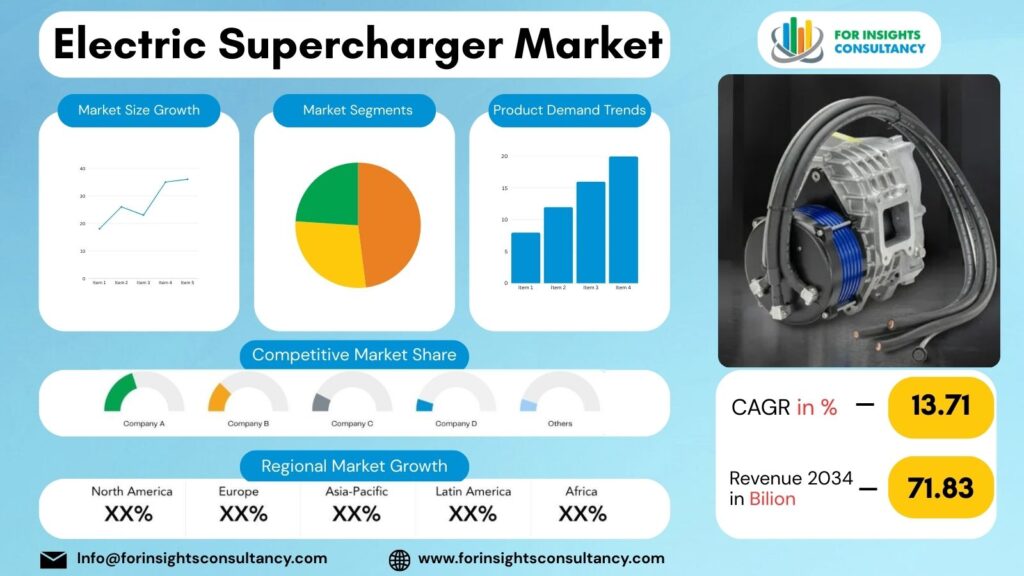
The Global Electric Supercharger Market is projected to be valued at USD 22.49 Billion in 2025 and is expected to reach USD 71.83 Billion by 2034, growing at a compound annual growth rate (CAGR) of 13.71% from 2026 to 2034.
Electric Supercharger Market: Overview and Growth in the Upcoming Year
The year 2026 marks a tipping point for expansion in the Electric Supercharger Market due to the shift to electrification being pursued by the automotive sector, stringent emission standards and demand for high-performance and energy-efficient vehicles. Electric superchargers are utilized by a number of car manufacturers. This is an electrically powered supercharger that uses compressors to deliver instant boost pressure, which improves acceleration and lowers engine lag and fuel consumption.
In 2026, the market is positioned to straddle engine downsizing and vehicle electrification. To enhance power output without growing the size of the engine, carmakers have begun including electric superchargers in hybrid and next-gen combustion platforms. The shift has been driven by global regulation for lower driving emissions whilst retaining driving characteristics, particularly in the premium passenger car and sporty offerings.
Long-term forecasts signal strong growth in the worldwide electric supercharger market at double-digit growth rates through the upcoming decade. Industry momentum reflects the anticipated fast adoption of applications for hybrids and electrified vehicles.
Market Dynamics
Growth Drivers
Quick uptake of hybrid and 48V vehicle architectures.
The deployment of mild-hybrid and hybrid powertrains will arguably serve as one of 2026’s strongest growth catalysts. Electric superchargers can be easily integrated into 48-volt electrical systems that help add torque instantly while improving fuel consumption. Car makers are employing these systems to improve engine response, avoiding a complete platform re-design.
More demand to cut emissions.
As global emission standards become more stringent, manufacturers are increasingly adopting technology to reduce fuel consumption and carbon emissions. Downsizing the engine using electric superchargers helps smaller engines produce higher power, while also being environmental friendly. They are an attractive alternative to customary performance upgrades.
Expectation of Instant Speed and Better Driving Experience.
Consumers today want smooth and powerful performance even on fuel-efficient cars. Electric superchargers get rid of turbo lag and create a smoother driving experience by instantly compressing airflow. This efficient and optimal performance is accelerating adoption in the premium and mid-segment vehicles.
Move Towards Electrifying Performance Cars.
Large engines are not the only way to get performance. In 2026, more manufacturers are offering electrified performance solutions to improve acceleration without compromising energy efficiency through electric boosting technologies. Hybrid vehicles equipped with electric superchargers are now garnering consideration from buyers seeking sporty performance.
Development of Electric Motor and Power Electronics.
Ongoing advancements are making compact electric motors, power control units and thermal management systems smaller while reducing energy consumption. It is now easier to construct electric superchargers as technology has made them more reliable and cheaper.
OEMs Stay Focused on Transitional Technologies.
Although the full battery electric vehicles are growing in number, IC engines continue to matter in many markets. As automakers pivot towards electrification, they are investing in transitional engine technologies. Electric superchargers help in complying with regulations and stand out from competition.
Industry Trends
Integration with electrically powered drive systems.
The rising use of electric superchargers in mild-hybrid and hybrid vehicles is an influential trend driving the market. Car manufacturers are increasingly integrating electric boosting systems with electrified architectures to accelerate faster and consume less fuel. By utilizing this integration, manufacturers can boost engine output without raising emissions.
Switching from mechanical to electrical boosting
Mechanical superchargers are increasingly being replaced by electric superchargers. Electric systems utilize precise airflow control under independent engine speed to create smooth power delivery and more efficient energy use. The technological shift is the redefining how today’s cars achieve performance enhancement.
High-efficient engines are downsized.
In 2026, the industry continues to move towards engine downsizing. Electric superchargers let smaller engines develop greater powered output. This way manufacturers are capable of meeting regulatory efficiency targets while fulfilling consumers’ expectations of performance.
Growth Beyond Luxury Cars.
Electric supercharger technology is now making its way into mid-range passenger vehicles after starting with the high-end luxury and performance. Better cost efficiency and scalable component design enables wider adoption in various vehicle types.
Expansion of Air Management Systems Controlled by Software.
Vehicle intelligence is emerging as a key trend. More and more the electronic control unit and a software algorithm is used “predictively” to optimise airflow in the electric supercharger as per drive situation, load requirement and energy availability.
Greater Attention to Instantaneous Torque Supply.
Consumers increasingly want the kind of smooth and rapid acceleration associated with EVs. Electric superchargers enhance the driving quality and overall response of internal combustion as well as hybrid vehicles by replicating this instant torque response.
Restraints
Expensive Integration and System Costs.
Components like high-speed electric motors, power electronics, and sophisticated control systems characterize electric super chargers. The elements inflate overall vehicle production costs. As a result, it increases adoption lag in price-sensitive vehicle segments.
Greater shift to fully electric vehicles.
With the increasing market acceptance of battery electric vehicles (EVs), the long-term future of engine-boosting technologies looks bleak. Electric superchargers are mainly made for internal combustion (IC) and hybrid engines; hence, their application may become very limited with the rapid growth in EVs.
Incorporation of Advanced Powertrains.
Integrating electric superchargers needs a proper electrical architecture, thermal management systems, and engine calibration. The most important is engineering complexity, which can lengthen test times when carmakers move to new electrified platforms.
Concerns Over Energy Use and Battery Load
Even if electric superchargers make the engine more efficient, they also consume electrical energy. In some setups, sharing available energy between the propulsion system and auxiliary systems can be difficult. This is particularly true for hybrid vehicles with a small battery capacity.
Lack of Awareness Beyond Performance Areas.
While luxury car marques appreciate electric boosting technology, the broader market is still largely unaware of it. Fuel economy or electrification is prioritized by many consumers, along with fleet buyers. Hence, acceptance is slow.
Reliance on 48-Volt Electric Systems.
The best performance of electric superchargers is seen in 48V cars. While many manufacturers have embraced this electrical standard, others have yet to do so, limiting its immediate scalability across their global vehicle portfolios.
Challenges
Combustion Engine and Electrification Investments Balance.
At the same time, automakers are putting money into electric vehicles, hybrids, and efficiency upgrades for internal combustion engines. The division of investment focus creates uncertainty on how aggressively car manufacturers should scale electric supercharger deployment, slowing decisions on large-scale commercialization.
Making Affordable Vehicles Cost-Effective.
Electric superchargers provide better performance and efficient use of energy, however, it is a challenge to reduce the system costs to suit mid-range and economy vehicles. Manufacturers must scale production and standardize components before adoption can expand beyond premium segments.
Calibration Needs and Engineering Difficulties.
Integration between the engine management software, battery system, and air-flow control is paramount in electric superchargers. When calibration is done at optimal levels in various models, it creates complexity in development. Also, it requires numerous development cycles.
Temperature Control and Longevity Projections.
Electric compressors running in extreme conditions of temperature and pressure. The need for long-term durability coupled with compact system design poses engineering challenges, especially in vehicles operating in extreme climates or heavy-duty driving mode.
Market Position in Doubt.
The swift shift to full electric mobility causes strategic ambiguity. Certain manufacturers consider the electric supercharger to be transitional technology, which makes them more cautious in their long-term production planning and supplier investments than in the case of permanent electrification.
Maturity of Suppliers and Infrastructure.
Supply chain for electric boosting systems is still taking shape A lack of specialized manufacturing capacity and reliance on advanced electronic components can limit production scaling and lead times.
Top Companies Covered In This Report
- BorgWarner Inc
- MAHLE GmbH
- Ford Motor Company
- Robert Bosch GmbH
- Valeo
- Eaton Corporation
- Duryea Technologies
- Continental AG
- Aeristech Ltd
Electric Supercharger Industry Company News
BorgWarner Inc.
News (2026): BorgWarner secured a supply agreement with a major European automaker to provide variable turbine geometry (VTG) turbocharger technology for a hybrid electric vehicle platform, supporting future production programs.
Industry impact:
- Strengthens electrified boosting adoption in hybrid vehicles.
- Accelerates transition toward electrically assisted air-management systems.
- Reinforces BorgWarner’s leadership in next-generation boosting solutions linked to electric supercharger evolution.
MAHLE GmbH
News (2025):
At CES 2025, MAHLE showcased advanced electrification and thermal-management technologies focused on efficiency and electric mobility integration.
Industry impact:
- Supports development of compact electric boosting and thermal systems.
- Enhances efficiency of electrified powertrains where electric superchargers operate.
- Signals strong supplier investment in electrified engine components.
Ford Motor Company
News (2025–2026):
Ford restructured electrification investments and adjusted battery joint-venture strategy amid changing EV demand dynamics.
Industry impact:
- Encourages focus on hybrid and transitional technologies.
- Creates opportunities for electric superchargers as efficiency upgrades in hybrid vehicles.
- Highlights balanced ICE-electrification strategy across automakers.
Robert Bosch GmbH
News (2025–2026):
Bosch reported continued revenue growth while expanding automotive electrification technologies and mobility solutions
Industry Impact:
- Increased investment in electrified components supports electric air-compression systems.
- Strengthens supply ecosystem for electronic control and power electronics used in e-boosters.
Detailed Segmentation and Classification of the report (Market Size and Forecast – 2034, Y-o-Y growth rate, and CAGR):
Segment By Type
- Electric Turbocharger
- Electric Centrifugal Supercharger
- Electric Roots Supercharger
- Electric Twin-Screw Supercharger
Segment by Vehicle Type
- Passenger Cars
- Light Commercial Vehicles (LCV)
- Heavy Commercial Vehicles (HCV)
- Sports & Performance Vehicles
- Electric Vehicles (EVs)
- Hybrid Vehicles
Segment by Component
- Electric Motor
- Power Electronics Controller
- Compressor Unit
- Battery Integration System
- Sensors & Control Units
Segment by Technology
- 12V System
- 48V Mild Hybrid System
- High-Voltage System
Segment by Fuel Type
- Gasoline
- Diesel
- Hybrid Powertrain
- Battery Electric Vehicles
Segment by Application
- Performance Enhancement
- Emission Reduction
- Fuel Efficiency Improvement
- Engine Downsizing Support
Regional Deep-dive Analysis:
The report provides in-depth qualitative and quantitative data on the Electric Supercharger Market for all of the regions and countries listed below:
North America
By 2026, North America is examined to be one of the most technologically advanced and innovation-driven regions in the electric supercharger market due to growing adoption for hybrid vehicles, and ability to performance-efficient powertrain solutions. The area is developing into a significant centre for electrification and performance technology.
According to this report, North America is likely to hold a significant share of the electric supercharger ecosystem globally, due to its automotive industry maturity as well as consumer demand for high-performance vehicles. One way is The United States has the highest regional demand owing to its advanced original equipment manufacturer research centres, supplier innovation and strong aftermarket ecosystem. Over the last few years, the region accounted for a noticeable share of global electric supercharger revenue owing to steady adoption in both OEM and retrofit applications.
United States
The highest contributor to regional demand.
Widespread use of hybrid vehicles and performance cars.
Significant investment in R&D and suppliers.
Canada
The electrification targets and incentives support a faster growth rate.
Facilities for cold-weather car optimizations and hybrid solutions.
North America’s electric supercharger industry is transitioning from performance-driven adoption to efficiency-centric integration from a professional perspective. Due to the hybrid mobility, bigger vehicular platform and advanced engineering capabilities, the region will experience consistent growth till 2026 and beyond.
Electric superchargers in North America increasingly compete not against full electrification but as a bridging technology for car companies to balance emissions compliance, consumer demand and powertrain evolution.
Europe
In 2026, Europe will be one of the technologically most advanced regions in the global electric supercharger market. This development is chiefly attributable to stringent emission laws, high automotive engineering standards, and rapid electrification of vehicle powertrains. In contrast to volume-driven sectors in other parts of the world, Europe’s growth is driven largely by regulation and innovation.
Electric superchargers are timely perceived as transition technology for hybrid and high-efficiency combustion engines as the region shifts towards full electrification.
The substantial production of premium vehicles in Europe has resulted in several manufacturers exceeding emission compliance requirements, a factor that is bolstering the adoption of supercharger in the continent.
Germany, a Leader in Innovation and Engineering.
Germany is the largest consumer of.Manufacture of luxury and performance vehicles.
Research and development ecosystems for advanced powertrains.
Implementation of electrified boosting systems at an early stage.
German carmakers are working on electric superchargers, especially for premium sedans and sporty SUVs – for regulatory and consumer reasons.
Transition Acceleration in France – Hybrid.
France displays a sustained growth pattern.
Subsidies for EVs by the government.
Limiting urban emissions.
Increased use of plug-in hybrids.
Automobile manufacturers are progressively equipping hybrid cars with electrically boosting technologies for better performance of smaller engines.
The United Kingdom Has the Quickest Growth Potential.
According to forecasts, the rate of growth of UK is going to be very strong.
Policies for electrification.
putting money in car designs
Shift to low-emission transport systems.
It is the expectation that the future will adopt motorcycles both for passengers and for the performance category.
Electrification Impact in Nordic Region.
Norway and, in general, the Nordic countries are showing very high electric vehicle (EV) adoption rates supported by incentives and infrastructure maturity. This is shaping the original equipment manufacturers (OEMs) strategies towards offering electrified performance solutions.
Even though full EVs occupy a prevalent position, hybrids still have certain efficiency technologies that they need to have on their platform.
Asia-Pacific
The Asia-Pacific electric supercharger market is the most dynamic and fastest-growing regional ecosystem, supported by large-scale automobile manufacturing, aggressive electrification policies, and rapid adoption of advanced powertrain technologies in 2026. The region has evolved from a vehicle manufacturing center to a technology innovation hub for electrical performance systems.
The leading regional share of the electric supercharger industry is by Asia-Pacific. The growth is on the back of strong vehicle output, penetration of hybrid vehicle, and tightening emission regulations across key economies.
Asia-Pacific remains in the lead due to structural advantages.
World’s largest automotive manufacturing hub.
Strategic adoption of mild-hybrid and fuel-efficient engines.
The government strongly encourages low-emission mobility.
Quick adoption of 48V electrical systems.
China – Leader In Technology And Volume
Regional acceptance monopolized due to China.
Incredible internal car production skills.
Robust electric vehicle and hybrid ecosystem.
Government climate policies.
Investments in Innovation by Local OEMs.
2026 Trends: Electrically assisted boosting technology when compared to mechanical boosting.
Japan is an Engineering innovation hub.
Japan assists with superior automotive engineering and the early adoption of other efficiencies.
Crucial Traits.
Concentrate on small hybrid vehicles.
Expert craftsmanship of components.
Performance-oriented passenger car integration.
Japanese car manufacturers focus on dependability and energy efficiency instead of performance enhancement.
Expansion of Electrified Platforms in Korea.
The significance of South Korea is growing due to.
Development of electric vehicle platforms.
The power of semiconductors and electronics.
Combining Smart Powertrain Control Units.
More EV super chargers are software defined vehicle compatible.
India, an accelerating market.
India’s future is gradually taking the shape of a demand hub.
Increase in the ownership of passenger vehicle.
Emissions Standards for Bharat.
The hybrid approach fosters the transition to electric.
Affordable component tracking.
At the moment, adoption is happening for premium and performance vehicles but is expected to open up by late decade.
Middle East and Africa
The electric supercharger market in the Middle East and Africa (MEA) is an emerging, yet strategic region in the global automotive electrification ecosystem by 2026. In the Middle East and Africa, growth is gradually being driven not only by emissions regulation, like in Asia-Pacific and Europe, but also along the lines of energy diversification, hybrids, and modernization of mobility.
Electric superchargers are gaining traction owing to a growing emphasis on technology that can aid in improving engine efficiency but has infrastructure limitations, which are also hampering full electric vehicle adoption across many MEA countries.
The region presently has a lower worldwide market share compared with developed regions but the adoption is witnessing a rise owing to the electrified vehicles making penetration into Gulf economies and selected African manufacturing hubs.
Innovation Centers in Gulf nations – Saudi Arabia and UAE.
The GCC countries are leading regional adoption of due to.
Economic diversification programs nationally.
Investments in intelligent transport systems.
Demand for high-end vehicles.
Eco-Friendly Transportation Programs.
At present, the UAE has the largest share of EV adoption in the region, while Saudi Arabia is tipped to see one of the fastest growth rates of electrification through to 2031. Morocco – Automobile Manufacturing Hub
Morocco is becoming an automotive production hub, attracting investment and increasing capacity for electrified vehicle assembly. The scale should be increased as well the localization rates through the recent new industrial investment to strengthen the supply chain in the region.
South Africa the Transition Market Leader for Africa.
One of Africa’s most sophisticated vehicle markets, South Africa is where automotive companies are launching hybrid and electric models as transition options.
The recent introduction of vehicles draws attention to the growing competition in hybrid mobility.
Egypt and Emerging African Economies – Government Talks on Schemes and Tax Changes are Likely to Boost Electrified Vehicles Adoption from 2026.
Egypt and other nations are putting money towards battery manufacturing for electric vehicles (EVs) while also giving financial incentives.
Progressively more, these initiatives expand the ecosystem for advanced efficiency technologies, e.g. electric superchargers.
Frequently Asked Questions with Answers
What is the Electric Supercharger market size and growth forecast?
Electric Supercharger Market is projected to reach a value of USD 22.49 Billion in 2025 and is anticipated to grow to approximately USD 71.83 billion by 2034. This expansion reflects a compound annual growth rate (CAGR) of 13.71% during the forecast period from 2026 to 2034.
Who are the key players in the Electric Supercharger market?
The Electric Supercharger Market Includes Major Companies BorgWarner Inc, MAHLE GmbH, Ford Motor Company, Robert Bosch GmbH, Valeo, Eaton Corporation, Duryea Technologies, Continental AG, Aeristech Ltd, Others.
What are the current and future trends for Electric Supercharger market?
Current and future trends in the Electric Supercharger market: Rapid adoption in hybrid and performance vehicles, driven by emission regulations, engine downsizing, lightweight smart boosting technologies, and continuous innovation toward compact, efficient, and electrically assisted powertrain systems.
Which regions dominate the Electric Supercharger market?
Asia-Pacific dominates the Electric Supercharger market, followed by Europe and North America, driven mainly by strong automotive manufacturing and rapid hybrid vehicle adoption.
Key insights provided by the report that could help you take critical strategic decisions?
- Regional reports analyse product/service consumption and market factors in each region.
- Reports highlight possibilities and dangers for suppliers in the Electric Supercharger Market business globally.
- The report identifies regions and sectors with the highest growth potential.
- It provides a competitive market ranking of major companies, as well as information on new product launches, partnerships, business expansions, and acquisitions.
- The report includes a comprehensive corporate profile with company overviews, insights, product benchmarks, and SWOT analysis for key market participants.
Customization: We can provide following things
1) On request more company profiles (competitors)
2) Data about particular country or region
3) We will incorporate the same with no additional cost (Post conducting feasibility).
Any Requirement Contact us: https://www.forinsightsconsultancy.com/contact-us/
Table of Contents
For TOC Contact us: https://forinsightsconsultancy.com/contact-us/