

Polyurethane Dispersions Market Research Report By Type (Solvent-Free Polyurethane Dispersions, Low-Solvent Polyurethane Dispersions), By Chemistry (Anionic Polyurethane Dispersions, Cationic Polyurethane Dispersions, Nonionic Polyurethane Dispersions, Self-Crosslinking Polyurethane Dispersions, Hybrid Polyurethane Dispersions), and Region – Global Forecast to 2034
Mar-2026 Formats | PDF | Category: Chemical & Materials | Delivery: 24 to 72 Hours
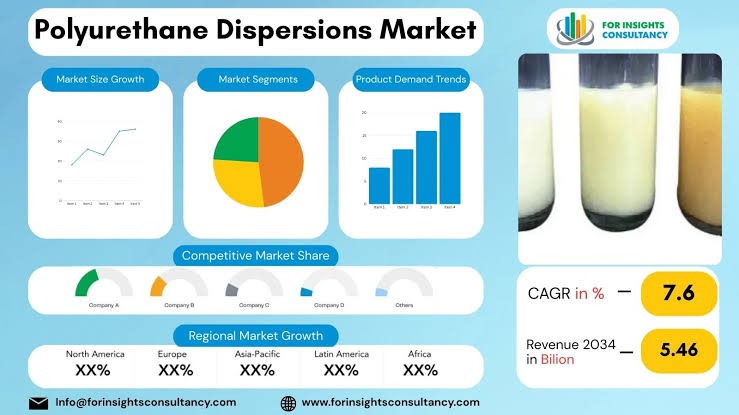
Polyurethane Dispersions Market Size & Forecast
Polyurethane Dispersions Market is expected to reach about $3.44 Billion in 2026, expanding from $3.2 Billion in 2025 to $5.46 Billion by 2034 at 7.6% CAGR. Discover market insights, demand drivers, and future outlook.
Overview of the Polyurethane Dispersions Market and Expected Growth (2026)
The Polyurethane Dispersions (PUD) Market is gaining serious momentum as several industries such as the coating, leather, textile and adhesive industry are moving increasingly towards environmentally friendly materials & water based polymer technology. PUDs are microparticles of polyurethane dispersed in water instead of being dissolved in an organic solvent.
These materials are highly flexible, highly abrasion resistant and highly adhesive and therefore used in many applications including industrial coatings, synthetic leather, textiles, automotive parts and packaging products. As the water rather than volatile solvents is employed as the medium, polyurethane dispersions generally have very low VOC levels and a very low scent.
Market demand for polyurethanes is on the rise as governments and industry put more focus on the rise of sustainable manufacturing coupled with higher emission standards. Water-borne polyurethane dispersions offer a significant replacement option to solvent-based resins for paint, adhesives and protective coatings, providing the trade-off of durability, chemical resistance and surface protection with reduced solvent emissions which has spurred increased use in the construction, automotive, furnishings and consumer goods markets.
Forecast for Global Market trends –the market value of the world polyurethane dispersions is expected to increase from an estimated $3.2 Billion in 2025 to an estimated $5.46 Billion in 2034, showing indication of a steady growth in the industry considering the increased pressures for sustainable technologies along with the growth in the global industry. Using this projection, the market for the year 2026 is predicted to be approximately $3.44 Billion, which is in part supported by the increased consumption for flexible-packaging, adhesives, and coating industries.
Polyurethane Dispersions Market Dynamics 2026
Growth Drivers
Rising Demand for Low-VOC and Eco-Friendly Coatings
The rise of enhanced environmental policies and sustainability initiatives prompted industries to move from solvent-borne coatings to water-borne polyurethane dispersions. Water-borne polyurethane dispersions are used to minimize the emission of volatile organic compounds (VOCs) providing relatively high performance, therefore, they are often preferred in the coating industry.
Growing Use in Automotive and Transportation Coatings
Polyurethane dispersions are increasingly being used by automotive manufacturers for interior and plastic parts and protective coatings because of their excellent durability and flexibility as well as scratch resistance. As vehicle manufacture and the use of lightweight materials increases, coating demand also rises.
Trends
Shift Toward Water-Based and Low-VOC Coating Technologies
To meet toughening environmental regulation and markets needs of sustainability, industries are replacing solvent-borne polymers by water borne polyurethane dispersions. They can significantly cut VOC emissions, and still have excellent adhesion, flexibility and chemical resistance.
Development of High-Performance and Cross-Linked Polymer Systems
New-generation cross-linking technologies are now being developed to improve water resistance, durability and chemical resistance of polyurethane dispersions. This is enabling water-borne coatings to perform at a level comparable (or better) than solvent-borne systems.
Integration of Hybrid Polymer Formulations
The modern tendencies of the system are hybrid systems of the type polyurethane+acrylic or any other polymer. Hybrid systems of this type allow increase of the drying speed, film strength, flexibility of the coating etc. and therefore may be used either for industrial coatings, furniture coatings or even for automobile finishing.
Opportunities
Expansion of Sustainable Coating Technologies
The increasing shift to greener coating solutions indicates a favorable market for polyurethane dispersions. Water-borne formulations with low VOC release will be more desirable to the construction, automotive, and furniture sectors due to stringent environmental regulations and sustainable enforcements.
Innovation in Bio-Based and High-Performance Polymer Formulations
In the future there will be an increase in the commercial demands for bio-based polyurethane dispersions and high technology hybrid systems as current R&D in the field of polymer chemistry enables their production.
Challenges
High Production and Raw Material Costs
Polyurethane dispersions are made using raw materials that are more complex and expensive, such as polyols, isocyanates and stabilizing additives. These raw materials tend to have variable prices, which will raise production costs and make them costlier than solvent based systems, limiting their market application to price-insensitive industries and emerging countries.
Performance Limitations in Extreme Conditions
Despite the excellent environmental benefits provided by PU dispersions some formulations do have a limited performance profile in very high and low temperatures, humid conditions or chemically aggressive scenarios. This can limit the application of PU dispersions in heavy industrial coatings and some outdoor coating and exposure situations.
Competitive Landscape of the Polyurethane Dispersions Market
Polyurethane Dispersions is a highly competitive market with a wide range of players, from small boutiques to large multinational corporations. The key players are:
- BASF SE
- Covestro AG
- Dow Chemical Company
- Mitsui Chemicals Inc.
- Lubrizol Corporation
- LANXESS AG
- Huntsman Corporation
- Wanhua Chemical Group
- Alberdingk Boley GmbH
- Allnex Group
- Perstorp Holding AB
- DIC Corporation
- Stahl Holdings B.V.
Polyurethane Dispersions Industry Top Companies News 2026 and 2025
BASF SE – Launch of Near-Zero SVOC Dispersion Technology (2026)
In January 2026, BASF introduced a new near-zero SVOC dispersion solution designed for interior coatings. The technology aims to improve indoor air quality and support healthier environments in homes, schools, and workplaces while maintaining high coating performance.
Lubrizol Corporation – New Sancure™ Polyurethane Dispersion for Wood Coatings (2025)
In 2025, Lubrizol launched Sancure™ 942 polyurethane dispersion, developed for residential and commercial wood floor finishes. The product improves protection, durability, and adaptability to different climate conditions in wood coatings.
Covestro AG – Expansion of Polyurethane Dispersion Production Capacity
Covestro expanded its polyurethane dispersion manufacturing capabilities through a new production facility in Shanghai, China, aimed at meeting the growing demand for environmentally friendly coatings and adhesives in the Asia-Pacific region.
Mitsui Chemicals Inc. – Development of High-Performance Polymer Materials
Mitsui Chemicals continues to develop advanced polyurethane dispersion systems for industrial coatings, adhesives, and specialty materials, supporting demand for durable and environmentally compliant polymer technologies.
Segment Covered in the report
By Type
- Solvent-Free Polyurethane Dispersions
- Low-Solvent Polyurethane Dispersions
By Chemistry
- Anionic Polyurethane Dispersions
- Cationic Polyurethane Dispersions
- Nonionic Polyurethane Dispersions
- Self-Crosslinking Polyurethane Dispersions
- Hybrid Polyurethane Dispersions
By Functionality
- One-Component (1K) Systems
- Two-Component (2K) Systems
By Application
- Paints & Coatings
- Adhesives & Sealants
- Leather Manufacturing & Finishing
- Textile Finishing
Polyurethane Dispersions Market Regional Outlook
North America
United States – Leading Market Share
The leading North American country in terms of the North American polyurethane dispersions market is the US. This is due to high consumption levels in areas such as automotive coatings, industrial coatings and Architectural applications. A trend among manufacturers is a move towards water-based low and zero-VOC dispersions to meet environmental standards and gain performance benefits.
Canada – Focus on Sustainable and Eco-Friendly Coatings
Water-born polyurethane dispersions are beginning to show up in construction, furniture and industrial coatings applications because of the urge for more environmentally friendly products for these uses by government authorities and limits on VOC emissions from applications.
Mexico – Expanding Industrial and Automotive Applications
As Mexico‘s car and industrial sectors grow, the consumption of polyurethane dispersions in adhesives, protective coatings and vehicle interiors is also on the rise, with manufacturers embracing water-based coating technologies to serve the needs of the domestic and export markets.
Growing Demand from Construction and Renovation Projects
The increased construction activity in North America both commercially and residentially is expected to increase demand for these PUDs in floor finishes, wood finishes and sealants. The demand will be sourced by the durable nature and chemical resistant PUDs.
Subregional Trends
Northeast U. S.: Booming market for industrial coatings combined with education and research furthering adoption of more advanced PUD technologies.
Midwest U. S.: Automotive production centers in this region significant drivers of PUD demand for interior for coatings and adhesives.
South U. S.: Booming construction and infrastructure projects boosting demand for coatings and sealants.
West U. S.: Emphasis on sustainable coatings driven by high-level regulation and eco-conscious building.
Asia Pacific
China – Dominant Market Leader
China accounts for the dominant share of the Asia-Pacific PUD market as the rapid industrialisation and urbanisation combined with a flourishing car, construction and coatings manufacturing industry. The use of water-based low-VOC polyurethane dispersions is expanding in this region.
Japan – Focus on High-Performance Coatings
The Japan market: focused on advanced industrial coatings, electronics and automotive uses. Japanese require high-performance and specialty polyurethanes dispersions to ensure high performance, chemical resistance and flexibility in demanding applications. India – Rapid Growth in Construction and Automotive Sectors
India‘s BOOMING construction industry and expanding auto-manufacturing sector are prime factors in rising PUD consumption for architectural coatings, floor finishes, adhesives, and vehicle interiors. Environmental awareness and sustainability drives are also boosting water-based technologies.
South Korea – Industrial and Electronics Applications
In South Korea, rapid developments in electrical and automotive sectors drive regional demand for these specialty polyurethane dispersions in coatings, adhesive and protective film applications. The region‘s manufacturers apply environmentally friendly formulations to comply with local environmental regulations.
ASEAN Countries – Emerging Markets
Increased demand for PUDs in countries such as Thailand, Malaysia and Vietnam is evident from the expansion of industrial parks, assembly plants for car manufacturing and the textile industry. Investment is expected to be directed towards sustainable coatings and adhesives in the South-East Asian subregion.
Subregional Trends
China & Japan: Strong industrial and automotive demand for coatings, high demand for specialty dispersions, electronics.
India: Expansion of the residential and commercial construction markets will support increased demand for architectural coatings and adhesives.
South Korea: The market for highperformance and protective coatings for electronics, automobile and construction machinery.
ASEAN: new found manufacturing centers leading to a rise in eco-friendly PUDs usage for textiles, automotive and industrial paints & coatings.
Europe
Germany – Largest Market in Europe
Germany is the dominant player in the European polyurethane dispersions market, led by the robust German automotive, industrial coatings and building industries. The use of water-based and low-VOC polyurethane dispersions has been encouraged by tight environment regulations and sustainability actions. France – Focus on Architectural and Industrial Coatings
Lack of demand for PUDs in France has meant a slide in sales for this region but recently though, there‘s an upsurge of demand in architectural paints, furniture finishes and industrial coatings. French regulations in favor of environmentally friendly products has sparked a demand in water born polyurethane fields. United Kingdom – Growing Use in Automotive and Industrial Applications
Automotive and manufacturing sectors in the UK are major markets for Polyurethane Dispersions. Consumers are demanding more and more water-based coatings for interior vehicles, protective coatings and adhesives to regulations relating to VOCs.
Italy – Expansion in Construction and Leather Industries
Italy makes good use of PU dispersions in textiles finishing, Leathers and construction coatings. The expansion of fashion, furniture and revamp projects pushes the demand of higher performance PUDs.
Spain – Adoption in Industrial and Furniture Coatings
Usage of polyurethane dispersions in industrial coatings, adhesives and furniture finishing is increasing in Spain, as water-borne versions are receiving attention in the respect of protection to the environment as well as to improve its performance.
Subregional Trends
Germany & France: Solid demand for automotive & industrial coatings: first ever generation of waterbased PUD.
UK: growing use in automotive interior applications & industrial adhesives.
Italy & Spain: heavily invested in textiles, leather and construction industries with the high demands of durability and environmental acceptability pushing forward the growth of organic coatings.
Eastern Europe: As emerging markets with industrialization, PUD consumption is slowly rising.
Middle East and Africa
United Arab Emirates (UAE) – Key Hub for Industrial Coatings
Middle East PUD market is led by UAE because of its rapidly increasing infrastructure, real estates and industrial developments. Water borne PUDs are emerging strongly in construction coatings, flooring application systems, and protective coating systems.
Saudi Arabia – Growth in Construction and Industrial Sectors
In the construction, oil & gas and manufacturing markets in Saudi Arabia, growing demand for coatings, adhesives and sealants, with easy application and durable performances, is increasing the demand for polyurethane dispersions in the country. Low-VOC and sustainable formulations are becoming increasingly desirable.
South Africa – Emerging Market in Industrial Applications
South Africa currently using PUDs for the coatings in automotive, industrial and furniture end-uses. South Africa is experiencing slow increase in water-based PUD use along with the increase in awareness for environment friendly products without compromising the durability of the coating.
Subregional Trends
GCC Countries (UAE, Saudi Arabia, Qatar): Extensive usage of construction paints and coatings, industrial adhesives, protective finishing.
North Africa (Egypt, Morocco, Algeria): Due to increased construction and infrastructure projects, the consumption of PUDs is on the rise.
Southern Africa (South Africa, Namibia): Steadily making inroads into industrial and decorative coatings markets
Frequently Asked Questions
What is the current size of the Polyurethane Dispersions market?
Polyurethane Dispersions Market is probable to grow from $3.2 Billion in 2025 to $5.46 Billion by 2034 at 7.6% CAGR, reaching about $3.44 Billion in 2026.
What are the key factors driving the growth of Polyurethane Dispersions market?
The growth of the Polyurethane Dispersions market is driven by rising demand for eco-friendly, low-VOC coatings and adhesives across automotive, construction, and industrial applications.
Who are the key players in the Polyurethane Dispersions market?
The key players in the Polyurethane Dispersions market are BASF SE, Covestro AG, Dow Chemical Company, Mitsui Chemicals Inc., Lubrizol Corporation, LANXESS AG, Huntsman Corporation, Wanhua Chemical Group, Alberdingk Boley GmbH, Allnex Group, Perstorp Holding AB, DIC Corporation, Stahl Holdings B.V.
What are the current trends in the Polyurethane Dispersions Market?
The current trend in the Polyurethane Dispersions market is the increasing adoption of sustainable, water‑based formulations and advanced high‑performance polymer technologies across coatings, adhesives, and textiles.
Which regions dominate the Polyurethane Dispersions Market?
North America, Europe, and Asia-Pacific dominate the Polyurethane Dispersions market due to strong industrial, automotive, and construction demand.
Key insights provided by the report that could help you take critical strategic decisions?
- Regional reports analyse product/service consumption and market factors in each region.
- Reports highlight possibilities and dangers for suppliers in the Kids’ Furniture Market business globally.
- The report identifies regions and sectors with the highest growth potential.
- It provides a competitive market ranking of major companies, as well as information on new product launches, partnerships, business expansions, and acquisitions.
- The report includes a comprehensive corporate profile with company overviews, insights, product benchmarks, and SWOT analysis for key market participants.
Customization: We can provide following things
1) On request more company profiles (competitors)
2) Data about particular country or region
3) We will incorporate the same with no additional cost (Post conducting feasibility).
Any Requirement Contact us: https://forinsightsconsultancy.com/contact-us/
Table of Contents
For TOC Contact us: https://forinsightsconsultancy.com/contact-us/