

Electric Power Substation Automation Market Growth Analysis Research Report By Component: Intelligent Electronic Devices (IEDs), SCADA Systems, Communication Networks, Protection Relays, Human Machine Interface (HMI), Automation Software, By Module Type: Hardware, Software, Services, Communication - and Global Forecast to 2034
Mar-2026 Formats | PDF | Category: Electronics & Semiconductor | Delivery: 24 to 72 Hours
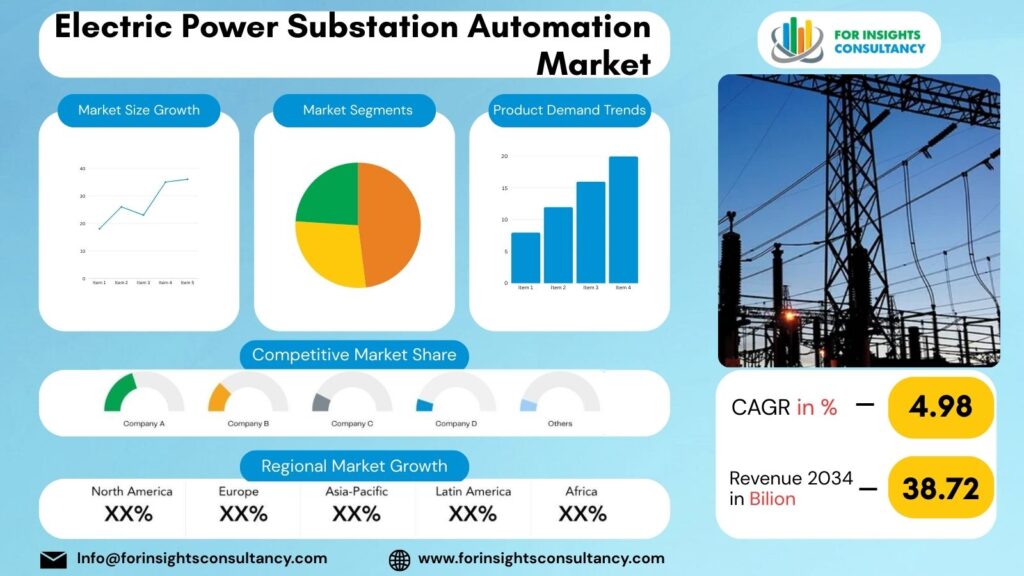
Electric Power Substation Automation Market to grow at 4.98% CAGR, increasing from USD 25.86 Billion in 2025 to USD 38.72 Billion by 2034, driven by grid modernization and smart energy demand.
Overview of the Electric Power Substation Automation Market and Expected Growth (2026)
As part of a global transformation in digital technology, the Electric Power Substation Automation Market is becoming more relevant as electricity networks operate smarter and more resiliently. Over the next 4 years, as monitoring and control technologies become more advanced and valuable, automation in monitoring and control technologies will become key components in substations, allowing utilities to manage grid operations with increasing amounts of precision, speed, and reliability.
Automation of substations uses digital protection relays, intelligent control systems, and advanced communication systems to maintain a constant awareness of the power flow and equipment being used. This means the operational parameters and state of the circuit being controlled can be accessed, and therefore, the operator can make informed responses without the need for the traditional manual inspection.
Utilities are modernizing the systems used for the transmission and distribution of electricity. This is particularly the case as electricity demand increases, the assets being used age, and the network becomes more complex. Automated substations provide operational transparency and are able to provide remote operational control. This is very important for large operational areas with a large geographical distribution of the power network.
The move to decentralized energy sources such as solar and wind and the increasing use of distributed energy also provide challenges for the efficient management of power inputs for substations. Automation technologies provide means to control and adapt to the varying loading of the grid and maintain stability.
Market Dynamics 2026
Growth Drivers
Developing Initiatives for Grid Modernization
Utilities globally are investing in new digital automation technology to replace old T&D systems in order to enhance grid reliability, operational efficiency, and outage management.
Increasing Renewable Energy Sources
The growing proportion of solar and wind energy modifies the requirements of substations. Automation for voltage control and load balancing becomes necessary as the energy inputs become more variable.
Expanding Smart Grid Deployment
Smart grid technologies that utilize automated substations for real-time control, remote management, and smart distribution of energy are becoming the focus of investments by the government and energy operators.
Increasing Electricity Demand Due to Urbanization and Electrification
The rapid development of cities and the resulting electric vehicle charging and industrial traffic are increasing the strain on power networks and resulting in greater demand for automated control systems.
Restraints
Daunting First Capital Outlay
The implementation of automated substations calls for a large initial outlay for new digital tools, communication systems, and integrated systems, which can slow down smaller utilities’ adoption.
Complicated Merging with Legacy Systems
Several current substations are run by outdated electromechanical systems, which makes the merging of new automation systems very challenging and time-consuming.
Threats to Cybersecurity and Data Security
As a result of the new automation systems, substations will be much more vulnerable to cyberattacks. Because of this, greater and continuous investment in new security systems and staff is needed.
Shortage of Qualified Personnel
The personnel for the construction and ongoing operation of automated substations must have knowledge in power engineering, cyber security and digital communication systems. This creates shortages of trained personnel in various areas.
Opportunities
Development of Smart Grid Technology
Smart grid technologies are creating new avenues for automated substations which provide real-time monitoring, control, and optimized management of energy distribution.
Integration of Renewable Energy
With more solar and wind generation plants being deployed, more advanced substation automation is needed to handle fluctuating generation and to provide consistent control of the grid.
Advancement of Digital Substation Programs
Utility companies are moving toward fully digital substations based on fiber optic communications and smart devices, creating new possibilities for automation.
Electrification of Transport
The increasing number of electric vehicles and electric mass transit systems raises the overall demand for electricity and pushes utilities to upgrade their substations to handle loads more efficiently.
Challenges
Managing Cybersecurity Threats in Connected Grids
As substations continue to digitize, defending operational technology (OT) systems against cyberattacks is a serious technical and regulatory challenge for utility companies.
Multi-Vendor Environment Integration Challenges
Utilities deploy devices from multiple vendors, which interoperability issues are exacerbated. These issues often require extensive testing and custom integration.
Substation Digitalization Highly Complex Technical Challenges
The transition from traditional substations to automated systems is complicated by the need for sophisticated communication systems, multiple software configurations, and extensive engineering redesigns.
Top Companies Covered In This Report
(Major global and regional players shaping the industry)
- ABB Ltd.
- Siemens AG
- Hitachi Energy
- Schneider Electric SE
- General Electric (GE Grid Solutions)
- Eaton Corporation plc
- Cisco Systems Inc.
- Honeywell International Inc.
- Toshiba Corporation
- Mitsubishi Electric Corporation
- Schweitzer Engineering Laboratories (SEL)
- Rockwell Automation Inc.
- Larsen & Toubro (L&T) Electrical & Automation
- Ingeteam S.A.
- NovaTech Automation
Electric Power Substation Automation Industry Company News 2025 and 2026
ABB Ltd.
November 2025: ABB announced a strategic focus on electrification and automation solutions to support expanding digital energy infrastructure and AI-driven power demand, alongside improved profitability targets tied to grid automation growth.
Schneider Electric SE
November 2025: The company secured $2.3 billion in U.S. data-center power infrastructure contracts, reinforcing demand for advanced substation and grid automation solutions.
Hitachi Energy
September 2025: Hitachi Energy was recognized as the global leader in grid automation products and services, highlighting strong adoption of digital substation technologies worldwide.
October 2025: The company acquired a minority stake in U.S.-based Shermco to expand grid services and modernization capabilities across North America.
Detailed Segmentation and Classification of the report (Market Size and Forecast – 2034, Y-o-Y growth rate, and CAGR):
By Component
- Intelligent Electronic Devices (IEDs)
- SCADA Systems
- Communication Networks
- Protection Relays
- Human Machine Interface (HMI)
- Automation Software
By Module Type
- Hardware
- Software
- Services
By Communication Technology
- Wired Communication
- Wireless Communication
By Installation Type
- New Substations
- Retrofit / Upgradation Projects
By Voltage Level
- Low Voltage
- Medium Voltage
- High Voltage
By End User
- Utilities (Transmission & Distribution)
- Industrial Sector
- Renewable Energy Plants
- Transportation Infrastructure
- Commercial & Institutional Facilities
Regional Deep-dive Analysis:
The report provides in-depth qualitative and quantitative data on the Electric Power Substation Automation Market for all of the regions and countries listed below:
North America
The region’s continuous shift to digitally managed electrical networks, which are intended to increase dependability, operational transparency, and energy efficiency, will influence the electric power substation automation environment in North America in 2026. In order to facilitate quicker system monitoring, automated fault isolation, and better coordination between transmission and distribution assets, power utilities are progressively integrating automation technology into substations. As utilities react to growing power demand and increasing grid complexity, modernizing electrical infrastructure has emerged as a strategic priority.
Utilities in the US are concentrating on replacing traditional substations with digital control systems that can facilitate remote operational management and real-time data interchange. In order to improve grid resilience, automation solutions are being used, especially in regions that are vulnerable to severe weather disruptions and varying energy loads. Utilities are being further encouraged to install intelligent substation platforms that enable adaptive power flow management and improved system stability by the growth of distributed energy resources and renewable power generation.
Geographic size and the requirement for effective long-distance transmission network management have an impact on adoption patterns in Canada. Automated substations improve maintenance planning and decrease operational downtime by enabling centralized equipment performance monitoring across distant locations. The incorporation of advanced automation technology in new and updated substations is also being supported by investments associated with low-carbon energy development and electrification programs.
Europe
As regional energy systems move toward low-carbon, digitally coordinated electricity networks in 2026, the European market for electric power substation automation is growing gradually. In order to enable flexible grid operations that can handle the fluctuation of renewable energy, cross-border power exchange, and changing consumption patterns, European utilities are progressively updating their substations. Automation technologies are being incorporated into interconnected national networks to boost grid stability, increase operational precision, and facilitate quicker reaction to power outages.
Automation deployment is being advanced by Western European nations including Germany, France, and the United Kingdom through extensive energy transition programs centered on energy efficiency and renewable integration. Substations are being outfitted with automated control systems and intelligence monitoring to help preserve voltage balance and transmission dependability as wind and solar capacity grows. In order to handle complicated power flows originating from decentralized generation sources, utilities are focusing on modern communication architectures and digital protection systems.
Automation adoption in Northern Europe, which includes nations like Sweden, Denmark, and Norway, is strongly correlated with grid interconnectivity and electricity systems that rely heavily on renewable energy. In spite of varying generation levels, reliable operation is made possible by automated substations that provide real-time coordination between hydropower, wind energy, and regional transmission networks.
In the meantime, grid modernization is receiving more funding in Southern and Eastern Europe as part of larger infrastructure development and energy security plans. To increase dependability and lower transmission losses, utilities in these areas are gradually replacing outdated substation equipment with digital automation platforms.
Asia-Pacific
China’s development in ultra-high voltage transmission networks and digitally controlled substations that allow for extended distance power transmission are critical to the development of the region. The power grid in China is capable of shifting power to and from urban centers and renewable power generation areas as a result of the development of automation technology. Additionally, the intelligent monitoring of the power grid can better utilize assets and result in the rapid identification and isolation of faults in the power grid.
With the rapid growth of electrification, the adoption of automation technology in India has been increasing as utilities adapt to the deployment of renewable energy and the growth of industrial electricity demand. The introduction of automated substations to improve grid reliability, reduce technical losses, and optimize remote supervision is especially true for regions where manual monitoring has previously restricted operational efficiency.
Japan, South Korea, and Australia are advanced economies that are prioritizing the enhancement of current substations incorporating digital protection features and communication-automated operational systems. In regard to the recent climate disruptions and the rise of renewables, these markets place focus on the reliability and resilience of their systems, as well as the efficient management of energy. With these automated systems in place, utilities may continue to effectively deliver energy quality control, despite the number of energy sources being decentralized.
Middle East and Africa
Middle Eastern nations like Saudi Arabia, the United Arab Emirates, and Qatar are making investments in cutting-edge power infrastructure in line with their own energy diversification plans. Large industrial zones and expanding urban growth are being supported by the integration of automation technologies into both newly built substations and renovation projects. In order to control peak electricity consumption and enhance response times during network disruptions, utilities are implementing automated protection systems and intelligence monitoring. Adoption of automated substations that can balance unpredictable generation output is being further encouraged by the growth of renewable energy installations, especially solar power projects.
In keeping with their own ambitions for energy diversification, Middle Eastern countries like Saudi Arabia, the United Arab Emirates, and Qatar are investing in state-of-the-art electricity infrastructure. Automation technologies are being used into both newly constructed substations and refurbishment projects to service large industrial zones and growing urban expansion. Utilities are putting automated protection systems and intelligence monitoring into place to manage peak electricity demand and improve response times during network interruptions. The expansion of renewable energy installations, particularly solar power projects, is encouraging the adoption of automated substations that can balance erratic generation output.
Investments in developing robust power infrastructure that can sustain population development and economic expansion are becoming more prevalent throughout the larger region. Automation solutions are helping utilities enhance grid stability, improve asset management procedures, and get networks ready for the integration of distributed and renewable energy sources in the future. By 2026, the Middle East and Africa market will show a slow but steady transition to smarter substations that integrate long-term infrastructure sustainability with operational efficiency.
Frequently Asked Questions with Answers
What is the Electric Power Substation Automation market size and growth forecast?
Electric Power Substation Automation Market is projected to reach a value of USD 25.86 Billion in 2025 and is anticipated to grow to approximately USD 38.72 Billion by 2034. This expansion reflects a compound annual growth rate (CAGR) of 4.98% during the forecast period from 2026 to 2034.
Who are the key players in the Electric Power Substation Automation market?
The Electric Power Substation Automation Market Includes Major Companies ABB Ltd., Siemens AG, Hitachi Energy, Schneider Electric SE, General Electric (GE Grid Solutions), Eaton Corporation plc, Cisco Systems Inc., Honeywell International Inc., Toshiba Corporation, Mitsubishi Electric Corporation, Schweitzer Engineering Laboratories (SEL), Rockwell Automation Inc., Larsen & Toubro (L&T) Electrical & Automation, Ingeteam S.A., NovaTech Automation, Others.
What are the current and future trends for Electric Power Substation Automation market?
The biofertilizer’s market current and future growth are influenced by the increasing adoption of sustainable and regenerative farming, its combined use with precision farming technologies, and the advancements in microbial and multi-strain Electric Power Substation Automation.
Which regions dominate the Electric Power Substation Automation market?
The Asia-Pacific region, followed by North America and Europe, boasts the greatest share of the Electric Power Substation Automation market owing to high levels of agricultural activity, the growing incorporation of organic farming, and robust sustainability initiatives.
Key insights provided by the report that could help you take critical strategic decisions?
- Regional reports analyse product/service consumption and market factors in each region.
- Reports highlight possibilities and dangers for suppliers in the Electric Power Substation Automation Market business globally.
- The report identifies regions and sectors with the highest growth potential.
- It provides a competitive market ranking of major companies, as well as information on new product launches, partnerships, business expansions, and acquisitions.
- The report includes a comprehensive corporate profile with company overviews, insights, product benchmarks, and SWOT analysis for key market participants.
Customization: We can provide following things
1) On request more company profiles (competitors)
2) Data about particular country or region
3) We will incorporate the same with no additional cost (Post conducting feasibility).
Any Requirement Contact us: https://www.forinsightsconsultancy.com/contact-us/
Table of Contents
For TOC Contact us: https://forinsightsconsultancy.com/contact-us/