
Molecular Breeding Market Growth Analysis Research Report By Marker Type(Simple Sequence Repeats (SSR), Single Nucleotide Polymorphism (SNP), Quantitative Trait Loci (QTL), Expressed Sequence Tags (EST), Others), By Trait Type(Yield Improvement, Disease Resistance, Stress Tolerance, Quality Enhancement, Herbicide Tolerance), By Application - and Global Forecast to 2034
Mar-2026 Formats | PDF | Category: Agriculture | Delivery: 24 to 72 Hours
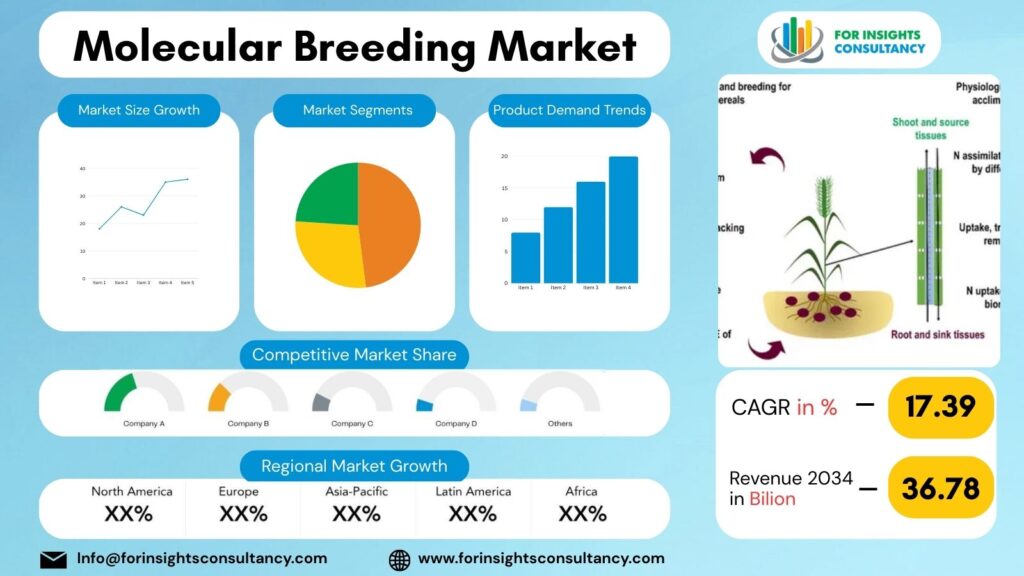
Molecular Breeding Market projected to expand at 17.39% CAGR, growing from USD 8.89 billion in 2025 to USD 36.78 billion by 2034, fueled by precision breeding technologies.
Overview of the Molecular Breeding Market and Expected Growth (2026)
Molecular breeding entails new methodologies in agricultural science integrating genetics, biotechnology, and computer science to enhance both crops and livestock. Instead of visual selection in breeding approaches over many generations, molecular breeding focuses on selecting an organism’s DNA to establish which traits to pursue from early in the organism’s life. This precision science minimizes the number of generations that are required, and increases confidence that desired traits will be expressed. The breeding market, which has undergone a transformation, has the potential to increase the length and the reliability of breeding cycles.
The molecular breeding market is anticipated to increase steadily by the year of 2026 due to the pressure of global agriculture to utilize an increasingly limited number of resources to create a greater volume of food. As the global population continues to increase and factors such as variability in climate and the productivity of soil continue to persist, governments and organizations involved in agriculture have begun to support the development of advanced breeding technologies that are designed to improve both the resilience and productivity of crops. This is due to the ability of molecular breeding to create different varieties of crops that can withstand drought, resist disease, and adapt to different environmental situations without excessive chemical inputs.
Technological advancements have been of central importance to the progress of the molecular breeding market. Recent advancements in various areas such as genome sequencing, and tools for bioinformatics, and systems that enable the quantatification of multiple traits (phenotyping) have made technical aspects of the market more accessible. Improved tools for analyzing large genetic data sets have been shown to shorten both the duration of a study and infcrease the the reliability of the data generated. As a result of these factors, nearly all international seed companies, regional breeding programs, and most public research institutions now have access to molecular breeding.
The growing emphasis on sustainable agriculture will also further contribute to growth in 2026. The demand for crop varieties that use less water, fertilizers, and pesticides is rising among both farmers and policymakers. With sustainability goals in molecular breeding, developers can focus on traits that promote environmental protection and climate mitigation and adaptation.
The innovation ecosystems on sustainable agriculture are also being fueled by the increasing public–private partnerships. Collaborative breakthroughs between agricultural universities, international research institutions, and biotechnology companies are improving the accessibility of genomic and other research tools, thereby fast-tracking the innovation process. Partnerships of this nature are enhancing the level of investments in developing agricultural economies where the improvement of productivity is essential for attaining food security.
Market Dynamics 2026
Growth Drivers
Global Population Growth and Food Demand
The world’s population continues to grow, putting additional stress on agricultural systems to generate more food on a limited amount of arable land. Molecular breeding, which improves crops more rapidly than traditional breeding by using harnessed genetic variations, will allow farmers to grow more food without having to expand their farmland.
Need for Climate Change Adaptation
The food demand and supply issues of unpredictable weather, drought, and heat, emerging diseases of plants, and stress from plants are catalysts of adoption of modern bribery tools. Molecular techniques will enable scientists to develop crops adapted to climate change.
Declining costs of Genomics and DNA Sequencing
The declining costs of sequencing and improving tools for genetic analyses are making Molecular breeding more accessible to research and seed development. More accessible precision trait mapping will significantly shorten the time to develop new crops.
Sustainable Agriculture
The agricultural value. chain is shifting towards the outcome of less use of chemicals and more efficient use of resources. Molecular breeding contributes to this through the provision of crops that are pest resistant by nature and use less nutrients than before.
Restraints
High Costs of Technology and Infrastructure
Advanced molecular breeding needs high-quality laboratories, sequencing technologies, bioinformatics tools, and trained people. When it comes to small breeding firms and public agricultural research institutions, the initial research and development (R&D) investment remains a major obstacle to adopting advanced molecular breeding.
Scarcity of Skills in the Developing World
In in many agricultural economies, trained personnel such as geneticists, molecular biologists, and data scientists remain in short supply. Without sufficient technical expertise, marker-assisted selection and genomic breeding programs can hardly get off the ground.
Biosafety and Regulatory Complexities
Genetic engineering regulations and policies differ in every country which leads to a lengthy and complex approval, compliance, and biosafety check process, regardless of country.
Data Overload and Molecular Breeding
Data generated during molecular breeding can be overwhelming to the point of requiring high-end computational systems, which many data scientists and analysts do not have. This results in a breeding pipeline that can be slow to analyze the data and make breeding decisions.
Opportunities
Developing Crop Varieties that Can Withstand Climate Change
More unpredictable climate patterns mean an increased potential for climate positive molecular breeding for developing drought, heat, and flood adaptive crops that help climate proof agricultural productivity.
Molecular breeding and Artificial Intelligence
The use of AI for genomic studies helps in understanding how positive traits can be better selected and predicting breeding outcomes, which helps in improving precision and reducing time in developing new crops.
Molecular breeding and precision agriculture
With the global spread of precision agriculture, the data-centric approach in agriculture can further be enhanced by molecular breeding to develop crops suited to the specifics of the soil, climatic, and nutrient conditions present.
Innovations in sustainable agriculture
The adoption of low-input agricultural systems by governments and international organizations will stimulate the demand for bio-efficient crops that require less fertilizer and pesticides.
Challenges
Considerable Expenses Related to Infrastructure for Genomics
Small public agricultural organizations and breeding companies invest heavily in advanced molecular breeding, as the bioinformatics systems, research systems, and sequencing infrastructures are very expensive.
Deficiency in Trained Genomics and Bioinformatics Personnel
A scarcity of skilled professionals in areas holding technology back in the developing agrarian economy, as the biosystems, genetic engineering, computational biologist, and molecular data skills are in need of the greatest.
Difficulties in Identification and Validation of Complex Traits
Identification of markers or proof for agronomic traits, including yield stability, stress tolerance, and other traits, is scientifically quite intricate and is very difficult.
Varied and Uncertain Regulatory Environments
Disparate regulations of the countries for commercialization of biotechnologies delays the commercialization of crops created by advanced genomic selection or breeding with gene-editing methods.
Top Companies Covered In This Report
(Major global and regional players shaping the industry)
- Bayer AG
- Corteva Agriscience
- Syngenta Group
- KWS SAAT SE
- Limagrain
- Vilmorin & Cie
- Rijk Zwaan
- Enza Zaden
- KeyGene N.V.
- Illumina, Inc.
- Thermo Fisher Scientific Inc.
- LGC Limited
- Eurofins Scientific
Molecular Breeding Industry Company News 2025 and 2026
Bayer AG
In 2025, Bayer strengthened its crop science innovation pipeline by expanding advanced breeding programs focused on improving genetic gain through modern genomics and molecular selection tools.
Corteva Agriscience
Corteva continued expanding climate-resilient crop development through biotechnology investments and acquisitions aimed at gene-edited and drought-tolerant crop traits.
Syngenta Group
During 2025–2026, Syngenta increased investment in next-generation seed innovation programs combining genomic analytics and precision breeding to support sustainable agriculture goals.
Thermo Fisher Scientific Inc.
In 2025–2026, Thermo Fisher expanded genomic sequencing and molecular analysis solutions used in agricultural biotechnology and plant breeding research.
Detailed Segmentation and Classification of the report (Market Size and Forecast – 2034, Y-o-Y growth rate, and CAGR):
By Marker Type
- Simple Sequence Repeats (SSR)
- Single Nucleotide Polymorphism (SNP)
- Quantitative Trait Loci (QTL)
- Expressed Sequence Tags (EST)
- Others
By Process
- Marker-Assisted Selection (MAS)
- Marker-Assisted Backcrossing (MABC)
- Genomic Selection
- QTL Mapping
- Marker-Assisted Recurrent Selection (MARS)
By Application
- Crop Improvement
- Livestock Breeding
- Plant Research
- Animal Genetic Research
By Trait Type
- Yield Improvement
- Disease Resistance
- Stress Tolerance
- Quality Enhancement
- Herbicide Tolerance
By End User
- Seed Companies
- Research Institutes & Universities
- Biotechnology Companies
- Agricultural Organizations
Regional Deep-dive Analysis:
The report provides in-depth qualitative and quantitative data on the Molecular Breeding Market for all of the regions and countries listed below:
North America
In 2026, the North American region is still one of the fastest regions for the adoption of molecular breeding technologies, as a result of strong public investment in research along and agricultural technology ecosystems, and university / public sector and seed company collaborations. The U.S. is the regional leader as a result of extensive genomics research directed at improving crop productivity, climate adaptation, and disease resistance through the use of marker assisted and genomic selection.
Innovation in breeding and deployment of the technologies at the farm level are the focus of the U.S. Department of Agriculture / National Institute of Food and Agriculture funded genomics and genetics research. Recent grants in research have have focused on quantitative genetics and phenotyping, as well as the use of data in breeding to aid the development of crops in a more sustainable and timely manner.
Canada has made advancements in collaborative research genomics and breeding programs for wheat, canola and pulse crops that adapt to new climates. Regional research networks for sharing genomic resources aid in the construction of integrated agriculture databases and breeding resources throughout the industry. Artificial intelligence, high-throughput sequencing and digital breeding tools are all helping to automate the breeding process and facilitate the identification of more traits and predictive selection models.
Mexico is the next up and coming participant in the region where international partnerships for agriculture and food security focusing on staple crops are helping to expand the research of molecular breeding. Collaborative research across borders leads to the exchange of germplasm and research on adaptability to help farmers mitigate drought and pest stresses in different agro ecological zones. All of this positions North America in the forefront of innovation for the expansion of the molecular breeding market.
Europe
As we look ahead to 2026, Europe’s strong molecular breeding market continues to benefit from a rich landscape of agricultural biotechnology, government support for sustainable agriculture, and strong collaborative networks. Germany, France, the Netherlands, and the United Kingdom spearhead adoption in Europe due to a combination of seed industry maturity, advanced genomics facilities, and a penchant for investment in precision breeding. Marker-assisted selection (MAS), genomic selection, and gene-editing technologies that improve yield, disease resistance, and stress tolerance of crops are all the rage in European research institutions and universities.
The European Union policies that advocate for sustainability and the lessening of chemical input use has created a champion for molecular breeding in the European market. Under Horizon Europe, genomic and digital phenotyping and high-throughput data assessment projects are being funded to shorten breeding cycles. These projects are consistent with Europe’s commitment to sustainable agricultural innovation and the development of climate-resilient, environmentally low impact, and biofortified crops.
The strength of Western European nations lies in their robust public–private collaboration. In Germany, for example, the focus of the plant genomics initiatives has been on enhancing disease resistance and other quality traits in cereals and vegetables, while genomic selection has driven France’s potato and maize improvement. In the West, private and public collaboration is advanced with the joint support of molecular breeding of biotech enterprises, agricultural cooperatives, and universities.
In the same vein, the Netherlands has committed significant resources to the vegetable and horticulture breeding sector and is using molecular markers and bioinformatics to customize traits for closed and open field production systems.
The southern European countries, notably Spain and Italy, have started to embrace molecular breeding for grapevines, olive tree species, and certain other specialized crops, using molecular techniques to enhance stress tolerance and overall crop quality. In Eastern Europe the situation is changing more slowly but is further supported by agricultural research institutes that collaborate with the European Union’s genomics research projects to modernize breeding systems and to address food security issues within the changing climate.
Asia-Pacific
In the next 3 years, new molecular breeding technologies in the Asia-Pacific region are projected at an accelerated scale, owing to rapid climate variability, an ever-growing population, and a subsequent demand for increased food production. With the application of molecular breeding technologies, China, India, Japan, and Australia are currently using breeding technologies such as genomics, and marker-assisted selection and predicted phenotyping to improve the yield of their staple food commodities which include rice, wheat, maize, and pulses. One of the key advantages of molecular breeding is that it allows identification of key traits such as disease resistance, drought tolerance, and nutrient use efficiency early in the breeding process which shortens the time frame for the development and commercial release of improved crop varieties.
In the Asia-Pacific, the adoption of molecular breeding depends to a great extent on the financial contributions of Government initiatives and the Public sector research funding. China has implemented genomics programs at the national level which are focused on ensuring crops are resilient and stable in terms of yield. In the food scarce and agriculturally degraded regions of India, the Government has integrated the molecular breeding initiatives, which focus on the development of climate-resilient rice, wheat, and horticultural crops, with initiatives in sustainable agriculture. Australia and Japan are using digital phenotyping and bioinformatics to improve the environmental sustainability of cereal and horticultural crop production.
Middle East and Africa
The Middle East and Africa (MEA) are set to experience increase in demand for molecular breeding technologies in the next 5 years due to the rise in challenges related to chronic food insecurity, the adverse impacts of climate change and the scarcity of water in the region. Particular focus is placed on Egypt, South Africa, Morocco, Kenya, and Nigeria – all of which are trying to develop Molecular Breeding (MB) technologies to develop crops that will tolerate water scarcity and be more resilient within the environment. These crops will include cereals, legumes, and horticulture, which all need some form of water to be able to carry out agricultural practices.
There has been the establishment of several funding schemes to support the genomic breeding technologies within the region. This has also been accompanied by MOUs for the support of staff training and the building of laboratories. These particular MOUs involve collaboration between the South African Agricultural Research Council and the Agricultural Research Center of Egypt to also carry out genomic and molecular breeding activities for the improvement of wheat, maize and some pulses. There also exists collaboration between the aforementioned South African Council and some of the International Agricultural Research Centers (ICARDA) for the exchange of some of the breeding materials (germplasm) and some molecules for the improvement of certain crops.
Frequently Asked Questions with Answers
What is the Molecular Breeding market size and growth forecast?
Molecular Breeding Market is projected to reach a value of USD 8.89 Billion in 2025 and is anticipated to grow to approximately USD 36.78 Billion by 2034. This expansion reflects a compound annual growth rate (CAGR) of 17.39% during the forecast period from 2026 to 2034.
Who are the key players in the Molecular Breeding market?
The Molecular Breeding Market Includes Major Companies Bayer AG, Corteva Agriscience, Syngenta Group, KWS SAAT SE, Limagrain, Vilmorin & Cie, Rijk Zwaan, Enza Zaden, KeyGene N.V., Illumina, Inc., Thermo Fisher Scientific Inc., LGC Limited, Eurofins Scientific, Others.
What are the current and future trends for Molecular Breeding market?
The Molecular Breeding market is trending toward rapid adoption of genomics, AI-assisted breeding, and high-throughput phenotyping to develop climate-resilient, high-yield, and nutrient-rich crops globally.
Which regions dominate the Molecular Breeding market?
North America and Europe dominate the Molecular Breeding market due to advanced research infrastructure, strong public-private collaborations, and high adoption of genomic technologies.
Key insights provided by the report that could help you take critical strategic decisions?
- Regional reports analyse product/service consumption and market factors in each region.
- Reports highlight possibilities and dangers for suppliers in the Molecular Breeding Market business globally.
- The report identifies regions and sectors with the highest growth potential.
- It provides a competitive market ranking of major companies, as well as information on new product launches, partnerships, business expansions, and acquisitions.
- The report includes a comprehensive corporate profile with company overviews, insights, product benchmarks, and SWOT analysis for key market participants.
Customization: We can provide following things
1) On request more company profiles (competitors)
2) Data about particular country or region
3) We will incorporate the same with no additional cost (Post conducting feasibility).
Any Requirement Contact us: https://www.forinsightsconsultancy.com/contact-us/
Table of Contents
For TOC Contact us: https://forinsightsconsultancy.com/contact-us/